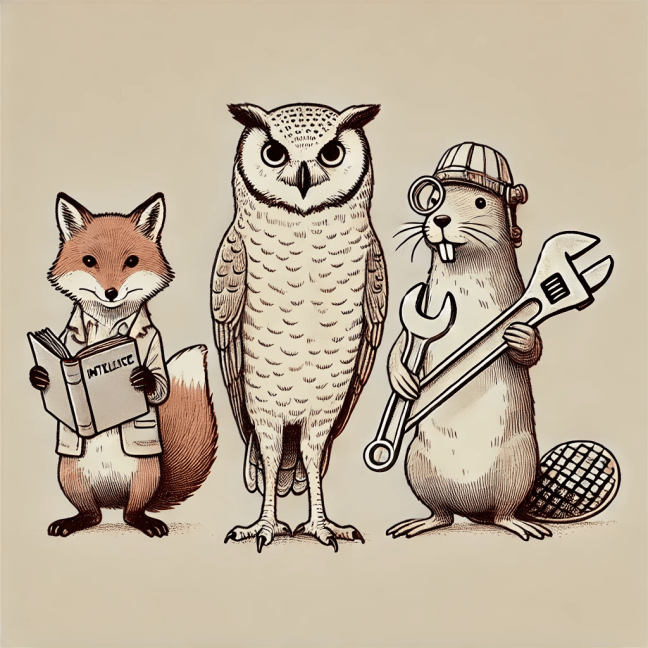
Starting with behavior that can be understood as intelligent, we can focus on tools. These were already present in the Homo lineage and are also shared with many other species on this planet. We can understand tools as macroscopic external elements of an animal’s body that are used to gain access to more resources, security, and reproductive success. More conceptually, tools can also be strategies to achieve the same objectives without the use of any specific external object, other than perhaps geography.
The use of tools can be both learned and innate and is abundant in the animal kingdom. Examples of tool use range from primates using stones and branches to crack nuts or open coconuts, to birds creating complex fishing utensils with their beaks and claws, especially in the family of Corvidae (ravens and crows) and psittacines (parrots). Dolphins, for instance, use the shore or each other to trap their prey.
But tool use can extend far beyond what we would usually consider “intelligence.” For example, creating nests and structures to attract females (as seen in bowerbirds), ants using sticks to build bridges or using fungus to ferment food, chickens eating rocks to aid digestion, hermit crabs using shells and plastic cups, caterpillars using leaves to make cocoons, foxes building dens, and beavers building dams. One could consider these behaviors as simply “innate” tool uses. However, there is ample literature arguing that the “social learning” of animals, whether innate or learned, is difficult to define and differentiate. Although instances of problem-solving behavior spreading have been observed, such as parrots opening trash bins in Australia.
Interestingly, the spontaneous use of tools—using environmental elements for one’s own benefit—is probably widespread in the animal world. Individuals of many species use tools in controlled lab environments, where they can solve complex puzzles using elements of the system. For example, pigs can play video games, rats solve mazes, and squirrels solve puzzles.
However, despite the shared use of tools among many animal species, we are fundamentally different. This shows that “intelligence,” in the case of humans, might be necessary but not sufficient to explain why we are the way we are. The key difference is culture. Many of the previous examples of animal innovation do not constitute culture. This is because the discoveries of one individual are often not explained or described to fellow individuals of the same species. In the case of puzzle-solving and tool-making, each individual must solve the problem themselves initially, which is an inefficient way of obtaining resources. Not all individuals of the same species show the same dexterity in solving the same puzzles, as we will see in more detail with the case of Mango the crow.
There are examples, though, of chimpanzees who learn from imitating fellow chimps or human instructors on how to open a complex box to obtain food or learn sign language. However, when imitation experiments have been conducted with both chimps and humans, it has been observed that humans tend to repeat every step of the process, even futile ones that do not contribute to obtaining the reward, this seems to be in the contest of our brains being wired for costly rituals, even at a young age. On the other hand, chimps, once they learn which steps are necessary, tend to avoid the unnecessary steps. This indicates that chimps are actually more efficient in problem-solving than humans, avoiding unnecessary steps. However, it also points to the fact that humans are better at copying than our closest relatives, to the point that, even understanding the mechanics of something, we keep extra steps for the sake of reproducibility. Although some dispute these conclusions.
Opening <- Previous Next -> Collaboration
Previous
Next
 humanitywants.org
3 thoughts on “Intelligence”