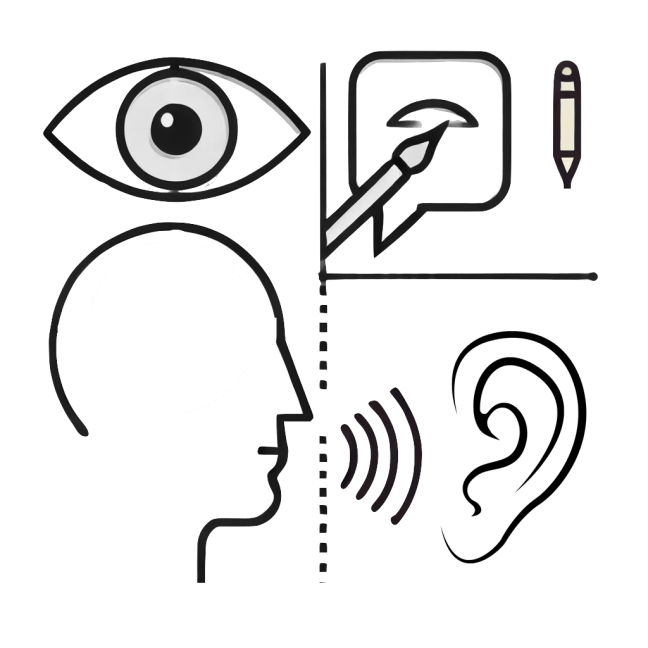
Let us briefly explore the main forms of communication that humans tend to use before examining global communication.
Visual/Symbolic Communication
One of the most basic and almost universal forms of communication is visual communication. At some point between 30,000 and 50,000 years ago, humans across the lands they occupied began extensively using pictorial representations to depict the world around them. Even if we cannot understand the language or all the characteristics of the cultures that lived during the Ice Age in the Altamira caves, when we look at the drawings there, we can easily identify what they were trying to represent—impressive buffaloes, as well as various other animals like horses and deer, along with dancing human figures.
It remains a mystery why figurative art in the Homo lineage became dominant worldwide at that time and not earlier. Anatomically modern humans—the term palaeontologists use to describe human remains that resemble us, i.e., Homo sapiens—have existed for approximately 200,000 to 300,000 years. This increase in the use of visual communication may be the result of a gradual accumulation of increasingly complex cultural traits that allowed for more sophisticated pictorial art. Alternatively, our perception may be biased due to a limited sample size and poor preservation of earlier examples of figurative painting. Regardless of the reason, figurative art now appears to be a universal human trait, present in almost all individuals from an early age.
Human infants can identify familiar objects such as a house, a horse, a person, or even smiling and sad faces from a very young age. Moreover, children begin creating geometric figures by the age of two and produce rough paintings of figures by the age of three. By the age of five, their drawings evolve into more standardised and symbolic images.
This symbolic representation in images also appears to be a universal mode of communication among humans. Simple pictorial forms can be used to identify common animals and objects found all over the world. However, some people in cultures unfamiliar with photography struggle to recognise an animal from a picture and require a specific body part to make the identification.
You may have relied on visual communication yourself when travelling to a foreign land where you could not speak the language. In such situations, you might have used gestures to figuratively describe an action or object or even resorted to crude drawings to communicate your needs. However, this form of cross-cultural visual communication has its limitations. I encountered these limitations when I wanted to cross a river in Papua but could not find a bridge. I asked the locals for directions, but despite my best efforts, they could not understand me. Using my hands and gestures, I tried to depict a river and a bridge over it. I then resorted to drawing it in the sand with a stick, using mimics and pointing towards the river, which was not far away. Finally, a combination of all these methods did the trick. I was swiftly guided to a path through the jungle that I would not have found on my own, even if I had searched for days. At the end of the path—after crossing several streams via wooden logs used as makeshift, slippery bridges—I reached the other side of a hanging bridge, with the river rushing 50 metres below me.
Acoustic Communication
Another form of communication that appears to be universal among humans—and likely many non-human animals—is auditory signalling. For example, a high-pitched, loud scream would generally startle you and make you wary of its source. Moreover, if the sound persists—such as the crying of an infant mammal—you might instinctively try to stop it by feeding, warming, or comforting the creature in any way possible. It is not difficult to imagine that we have an inbuilt genetic predisposition to associate certain sounds with specific actions or emotional reactions.
Another largely human—but possibly primate—auditory signal is laughter. All human cultures seem to associate enjoyment and fun with laughter and its characteristic sounds.
Additionally, the intensity and duration of sounds tend to convey universal messages. Loud sounds generally indicate aggression, whereas quieter ones suggest closeness and attentiveness. Similarly, short, abrupt sounds are used to grab attention, while long, howling sounds are often associated with connection and emotional expression.
Language <- Previous Next -> Curiosity and rarity, fromthe small to the global
Previous
Next
 humanitywants.org