
An amazing behaviour from non-human animals is way seems present giving to their carers. If you own a cat that roams freely outdoors, or know someone who does, you are likely familiar with the slightly unsettling “presents” they bring home. A variety of dead or half-dead creatures—perhaps a headless sparrow on the bed or a twitching cockroach on the pillow—serve as feline offerings. These gifts are likely given because the cat considers you part of its pack, reciprocating the security, shelter, and food you provide. Alternatively, they may be trying to teach you to hunt, much as wild cats do for their young. This is particularly evident among mother cats raising kittens. Similar behaviour can be observed in lions, where females bring back food for the pride’s alpha male, and mothers present cubs with small, disabled prey—sometimes even scorpions with their stingers removed—as part of the hunting learning process of the kitties. Interestingly, this behaviour is one of the few documented examples of “teaching” outside the human realm, a concept debated by researchers studying how learning takes place in humans and non-human animals.
Other animals also engage in gift-giving, though usually in the context of mating rituals. Some species of flies and spiders, for instance, present food or other items to potential partners. Returning to corvids, they have been observed offering gifts to human carers, often in the form of shiny objects. This is intriguing, considering that research suggests corvids are actually afraid of shiny objects. Despite this, the belief persists that magpies and crows are attracted to glistening objects. While corvids have been documented presenting “gifts” to other individuals in experimental settings, these events are rare and not actively pursued, leaving the true motivations behind this behaviour unclear.
Both corvids and non-human apes share remarkable cognitive abilities in problem-solving, tool-making, social interaction, and environmental manipulation. These parallels suggest that complex cognitive skills have evolved multiple times in distantly related species with vastly different brain structures. For example, corvids and parrots perform cognitively demanding tasks at levels comparable to primates, despite having much smaller brains. This suggests that brain connectivity, rather than sheer size, is key to developing advanced problem-solving skills. This apparent case of convergent evolution may indicate that similar social behaviours and strategies are necessary to tackle shared socio-ecological challenges. Yet, while these species follow different paths in tool-making and social learning, we have not yet identified non-human examples of the kind of collaboration seen in human societies.
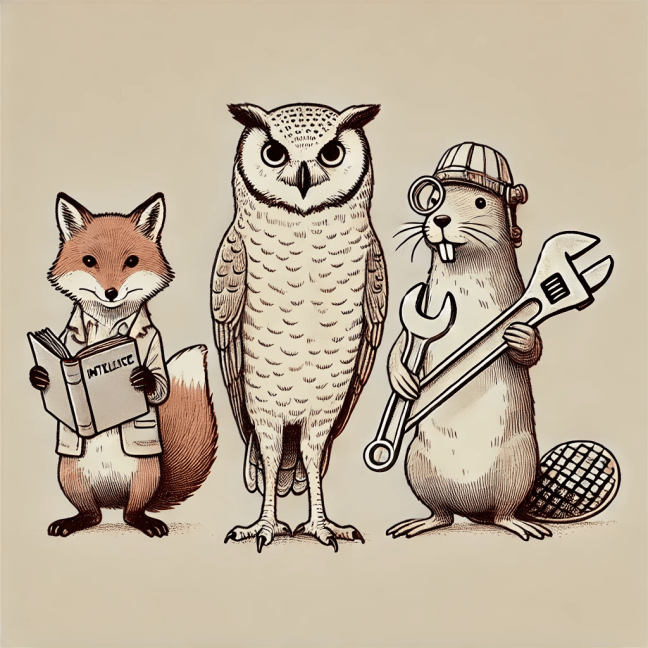
One potential comparison lies in large-scale infrastructure projects undertaken by collective animal efforts. Social insects provide the most striking examples, constructing elaborate nests, bridges, and even cultivating fungi. However, such projects appear to function at the colony level, with no evidence of inter-colony collaboration. An exception to this rigid structure exists among Argentine fire ants, which freely exchange individuals between related colonies, blurring the lines between distinct social groups. Beyond insects, some social animals also engage in large-scale collaborative construction. Beavers build extensive dams, and sociable weaver birds in southern Africa construct massive communal nests, accommodating hundreds of nesting pairs. These nests feature interior chambers that retain warmth at night and outer compartments that remain cool during the scorching daytime in the Kalahari. However, such complex communal infrastructure has not been observed in corvids, parrots, or non-human apes, though chimpanzees and orangutans do create nests and rudimentary shelters.
What all these collaborative species share is a sophisticated communication system, mutual benefits from group cooperation, a degree of specialisation, and the development of unique strategies tied to their social and environmental contexts.
Humans, however, have taken this a step further. We extend our networks beyond our immediate group through exchange and gift-giving, forming connections that span vast distances. In these exchanges, context is crucial—where the perceived “usefulness” of an object is shaped by the specific environment in which it is found.
Imagine a prehistoric landscape on the East African coast, where groups of foragers live between the Great Lakes and the sea. It is easy to see how these groups would not have access to the same resources. Coastal communities would have abundant seashells and seafood, while those inland would rely on savannah, jungle, or mountain resources, hunting different game and collecting unique plant species. Lakeside groups would have plentiful fish but limited access to large seashells, which would be abundant on the coast. This variation in resources stretches across just 600 kilometres—from Lake Victoria to the sea. No single forager group would regularly traverse such a distance, but a chain of six or seven groups, each moving within a 50-kilometre radius, could establish a web of exchanges over time. Such interactions lay the foundation for trade, gift-giving, and the vast cultural networks that would come to define human societies.
Tool Making <- Previous Next -> Signalling
Previous
Next
 humanitywants.org