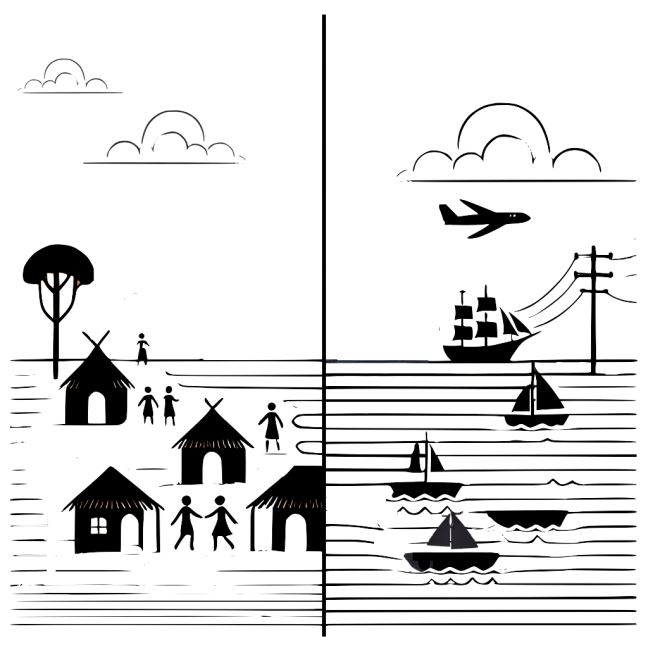
From the neighbours to the oceans

Olía a orines de mico. 'Así huelen todos los europeos, sobre todo en verano', nos dijo mi padre. 'Es el olor de la civilización'.
She smelled as money piss, that the smell of all Europeans, specially in summer" our father told us "that is the smell of civilization"
Gabriel García Márquez, Doce Cuentos Peregrinos


With the previous examples of failed connections, we can see the limits of the system presented earlier—just linking neighbours allows goods to flow only as far as they can be afforded.

The key point we will focus on now—and simplifying immensely complex human relations—is cost versus affordability: who is able to establish and maintain long-distance links that are worth the effort, over long periods of time?

To answer that, we will skip through 320,000 years of history, from the “first hints of exchange” to the onset of globalisation. I will place the beginning of our current globalisation trend at the breakdown of the ocean navigation barrier, accomplished by Western Europeans in the 15th and 16th centuries. In between these two time points—separated by more than 300,000 years—there is the accumulation of regional innovations, the constitution and entrenchment of increasingly diverse networks and hierarchies, which expanded and intensified the use of resources and energy. These “merely” 300,000 years have been widely studied elsewhere, and the reader may be familiar with the traditional “linear” narrative: from hunter-gatherers to agriculturalists, to city-states, to kingdoms, to empires, to nation-states. This image has been widely discredited, as the previous section shows, with many failures and non-linear trends. It has also been demonstrated repeatedly that no group is inherently more “advanced” than another. What people do exceptionally well is adapt to their environments—and the simpler the environment, the more efficient they tend to become. However, across these 300,000 years, there is an unmistakable increase in the scale of connectivity. This reflects episodes of creation and stabilisation of ever more distant networks, as seen in the previous section. These serendipitous mechanisms anchor larger-scale connections and reinforce otherwise fragile or unaffordable links.

So, if you will pardon me for glossing over 300,000 years of history, in the next section I will focus on the integration of all these networks into one worldwide system of connectivity—an unprecedented moment in human history—which leads us to the main question of these writings.

We all know the story of how European societies reached the shores of the Americas, changing the map of the world forever—quite literally, by creating modern mappae mundi and placing Europe at the centre. What you might be less familiar with is why that happened—why did Columbus sail west at that particular time?

Starting with cost versus affordability, we first needed something of high cost—in this case, we can focus on the spice trade. Specifically, the costliest spices were cloves and nutmeg (plus mace—the red aril of the nutmeg seed). Unlike silk, pepper, cinnamon, and ginger (other highly valued goods that travelled long distances), in the 15th century, nutmeg and cloves could only be found in two very small archipelagos the reader may be unfamiliar with. These are Tidore and Ternate for cloves, and the Banda Islands for nutmeg and mace. Today, they are part of Indonesia, in the Maluku Islands area. These spices were highly aromatic and highly valued in European markets, where they arrived in refined forms such as oleoresins, butter, essential oils, and powders. For Europeans, it was impossible to know the exact origin of these spices—some even thought they were of mineral origin. They did indeed come from faraway lands, often erroneously attributed to India, which was a genuine source of cinnamon and pepper. These species had a high cost relative to their volume and therefore represented a strong incentive to bridge the distance between Western Europe and India. In fact, these very spices were the reason Western Europeans—starting with Portugal and Castile—eventually bridged that 14,000-kilometre gap.

But why were these spices so costly, and why did people at the opposite end of the Eurasian continent want them so badly? Nutmeg and cloves had many uses. You may be familiar with their use in recipes—they did enhance the taste of food—but even today, with their lower price, ever-present in European cuisine, unlike other ingredients like tomatoes or potatoes, not present before the European expansion over the world. Another major use of these species was in perfumes. By the 15th century, European hygienic practices had changed significantly. In the 14th century, public baths were common throughout Europe, as it is quite typical for human beings across cultures to enjoy being clean and having clean people around them. However, the Black Death waves of the 14th century caused many bathhouses to close. Though some reopened, European aristocracy had, by then, begun adopting new fashions—such as undergarments and tight-fitting tailoring—which, in turn, created new ways to “trap the body’s evacuations in a layer above the skin”. At the same time, certain strands of the Catholic Church increasingly viewed bathing, nudity, and hygiene as contrary to chastity.

In the Iberian Peninsula, the Christian aristocracy—especially in the north—was gradually reclaiming land from Muslim rulers. Bathing and hygiene were (and still are) highly valued cultural practices in the Muslim world, and often also served as forms of social interaction. Therefore, part of the Christian Iberian aristocracy cemented its identity by rejecting cultural practices closely associated with their Muslim subjects, neighbours, and slaves. All of this led parts of European and Iberian elites to adopt habits that amplified body odour: less bathing, less washing, and tighter clothing. In warmer climates, this likely made body odours more intense. Consequently, rare, expensive, highly perfumed spices could help mask these natural human emissions—while also signalling wealth and status. This helps explain why the Iberian aristocracy, in particular, was motivated to fund direct expeditions to distant lands.

Ironically, Europeans not only brought diseases to the Americas, but also carried American diseases back to the continent. The most infamous of these was syphilis. Once syphilis began ravaging Europe, bathhouses once again closed—this time because baths were associated with libertine behaviour, and syphilis was primarily sexually transmitted. Additionally, beliefs grew that disease could be carried through water, and that open pores (caused by bathing) allowed sickness to enter the body. Within a few decades, bathing had largely disappeared from European daily life. Few households had running water, so opportunities to bathe were almost non-existent. Coupled with aristocratic customs and religious identity-making, this gave rise to figures like Louis XIV, who famously claimed to have bathed only twice in his life.

This cultural environment turned humble botanical species like nutmeg and cloves into commodities capable of financing multi-year expeditions—risky ventures where many ships and sailors might be lost. In the case of the Magellan expedition, only one of five ships completed the circumnavigation—without Magellan himself—but it returned so full of spices (including pepper) that it paid off the entire venture and paved the way for Spanish colonisation of the Philippines. From the association with perfume and the abandonment of bathing, we derive the enduring stereotype that Europeans don’t smell especially pleasant—particularly in summer. That this has anything to do with “civilisation” is now a running joke used by formerly colonised peoples to poke fun at their colonisers—whose domination was often justified on the basis of “cleanliness”.

Let’s now focus on the affordability of finding an alternative route to the spice lands—ultimately disrupting existing sea and overland trade networks by bypassing dozens of intermediaries. The process of making that circumvention possible was itself the result of 300,000 years of innovation, technological development, and skill acquisition. Crucially, as with the Austronesians and Vikings, it was the development of highly reliable navigational skills that enabled this. By the 15th century, Mediterranean and Atlantic ships were sturdy and autonomous enough, and the Iberian Peninsula had become a melting pot of maritime knowledge, making it affordable to attempt reaching India via new routes that bypassed the Levant.

Columbus believed his own (incorrect) computation of the Earth’s diameter—around a third smaller than it actually is—and convinced the Castilian crown to fund his westward voyage to reach “India”. His proposed route was reckless and misguided. But, as previously mentioned, there were hints that land existed across the Atlantic—not so far away. For instance, the Portuguese were aware of pau-brasil (or firewood) drifting from the west. Columbus, Castile, and luck all converged when they stumbled upon the Americas.

For the Portuguese, finding an alternative route to the spice islands was far less reckless. It took them over a century to circumnavigate Africa, learning gradually and establishing trading posts and outposts along the eastern African coast. Each expedition went a little further. By 1488, they reached the Cape of Storms (later the Cape of Good Hope), and in 1497, Vasco da Gama became the first European to reach India by sea—just five years after Columbus’s voyage.

At that point, for the first time in history, humans had the means to connect all the major landmasses in a way that was both affordable and repeatable. Just 20 years later (1519–1522), the first circumnavigation of the world was completed. For the first time, a human could potentially reach the shores of almost any land within a few years.

In the 15th century, the world changed dramatically due to the technologies and navigational expertise accumulated in the Western world over millennia—coupled with the high cost and demand for spices in Iberia. Within a few decades, the world transitioned from having vast disconnected landmasses to a planet where the first movers—Western Europeans—gained the upper hand. These few kingdoms, and later much of Europe, changed the existing order, wiping out tens of millions of people and cultures in the process, and subjugating nearly every major power on the planet.

That change forever transformed both ends of the lands reached by the Iberians. In the Americas, in less than half a century, a few thousand Europeans—mainly Castilians—overthrew two massive empires ruling tens of millions. In the East, in present-day Malaysia, the Portuguese seized Malacca in 1511 with just 18 ships—then the commercial hub of East Asia. It was the furthest territorial conquest in human history up to that time. To grasp its magnitude: imagine a fleet of advanced vehicles from Malaysia travelling 20,000 km to conquer Rotterdam—Europe’s major transport hub—and controlling it for centuries thereafter. This event had immense geopolitical implications, shifting the balance across Eurasia and reshaping global self-understanding until the present day.

Control of far-flung lands, trade routes, and global connectivity was taken over by small elites from a few North Atlantic coasts. These elites, supported by large home populations, had more resilience than earlier seafarers like the Vikings or Austronesians. Those earlier explorers made equally bold journeys and had the skills and knowledge—but little margin for failure and limited rewards. In contrast, the North Atlantic nations had the means, knowledge, and desire. They could afford the long-distance connection, and more importantly, its coercive and commercial control.

Pandemics, repression, and colonisation enabled long-term European settlement. As Eduardo Galeano famously wrote: “They came with the Bible and we had the land; we blinked, and now we have the Bible and they have the land.”

Previous

Next
Fragile communication

The basic structure described in the previous section allowed inland communities to have access, for example, to seashells, despite the fact they might never have seen the ocean themselves. However, one may ask: how is it that the people of Papua were still trading with stone axes in the 20th century? Even more so if the reader knows that Papua might be the oldest place on the planet where agriculture was developed, with some estimates suggesting that root vegetables were cultivated at least 10,000 years ago—slightly earlier than the domestication of grains in the Fertile Crescent.

That is actually a question Yali, an exceptional politician from Papua, asked Jared Diamond in 1972 when he was conducting fieldwork there to study ornithology, including birds such as the bowerbird. The actual question was: “Why do you white people have so much cargo and bring it to Papua, but we natives have so little of our own cargo?”—summarised as: “Why do your people have so many things compared to us?” For Yali, cargo was the generic term for all the items Westerners had brought to Papua since World War II. He was, in fact, asking about the technological gap between the Westerners travelling there and the local people.

Diamond spent 30 years developing an answer, culminating in his book Guns, Germs and Steel. In it, he presents two main theses:

First, geographically, some populations had more access to natural resources to begin with, such as plants and animals that were easy to domesticate. For instance, in Papua, the largest domesticable animal was the pig, while in Eurasia and Africa, cattle have symbolised wealth and power for generations. Papua also had no access to grain, while civilisations like the Mayas domesticated maize. Despite not having large animals, that was sufficient to develop a thriving and complex civilisation with many types of “cargo”. Additionally, domestic animals made human populations more exposed to germs, which they gradually adapted to. However, when these naturally engineered biological weapons encountered previously isolated populations, they wiped out 90 to 99% of the locals in less than a century. The pigs kept by Papuans may have spared them a similar fate to that of the Americas and the distant Pacific Islands.

The second thesis is that, due to geography, some areas of the world were better connected than others. Again, Diamond argued that it was relatively easy for trade networks to span Eurasia and Africa, with goods, ideas, domesticated foods, technologies, and ideologies spreading far in just a few generations. This was especially true for crops; species domesticated in one location often had suitable growing conditions across the climate zones from the Iberian Peninsula to Japan. This did not occur in other regions, such as the Americas, where many similar technologies had to be independently developed by both the Mesoamerican and Andean peoples. Their centres of domestication were only a few thousand kilometres apart. However, both groups had to independently domesticate crops like maize, cotton, and beans. Moreover, useful animals like the llama and crops like the potato, domesticated in the Andes, never reached the Mayas, while the writing system developed by the Mayas never made it to the Andes. According to Diamond, these gaps are due to difficult and diverse geographies. There is no easy land route connecting these American regions—dense tropical jungles, vast swamps, and rugged mountain ranges with dramatically different climates hinder the spread of domesticated species. Even today, in the 21st century, there is no road connecting these two areas. The Darién region, on the border between Panama and Colombia, remains impassable by vehicle, making it the only place on the continent without a road from north to south.

With these two main theses and strong reasoning, Diamond makes his case to answer Yali’s question. According to him, Papua did not have the species or connections that benefitted Europeans upon arrival. Europeans were simply lucky and thus came to dominate the known world. That left Papuans with a relatively limited set of food sources and restricted access to technologies developed elsewhere.

This view has been widely debated and does not fully account for the timing of major expansionist events. Still, the picture Diamond paints holds reasonably well until the 16th–17th centuries and the largest biological genocide in human history. Afterwards, the situation becomes more nuanced, as the connectivity of the world began to increase exponentially—but we will explore this in another chapter.

The limitation on access to technologies and information for the Papuans is related to our earlier examples of basic trading networks. These can only extend as far as humans can reliably reach each other at a more or less consistent pace. If mountains, oceans, and jungles must be traversed, the task may be too dangerous or uncertain to attempt. In such cases, communities at each end remain isolated. On the other hand, if obstacles are surmountable and there is a desire to connect, these networks can transform the well-being of participants. This is the case with the Eurasian and Indian Ocean trade networks. These spanned over 2,000 years, bringing silk, gunpowder, spices, and paper westward, and silver and wool eastward. Or take the so-called Columbian Exchange, where Europe plundered the immense wealth of the Americas, borrowed some botanical knowledge and cultural inspirations, and in turn colonised and Christianised native populations, erasing or warping their lands, traditions, institutions, and knowledge systems.

Returning to our earlier examples and thought experiments, these scenarios depicted only weakly connected communities. For instance, fragmented travel and exchange networks were the norm in the Papuan highlands. Although goods like axes or shells could travel freely, people could not. Residents of a group traditionally could not travel far beyond their territories or their closest trading partners. Unannounced or long-distance travel posed great risks—aggression, even death—making lone long-distance trade virtually non-existent. Commerce beyond immediate neighbours was carried out by intermediaries. Each of these intermediaries usually took a cut or incurred costs, inflating the final price of the item. This inflation could only go so far—only items of high value or buyers with considerable resources could justify the costs. This effectively limited how far an object could travel and placed natural boundaries on the kind of connection network described in the previous section. This is comparable today to drug or wildlife trafficking, where lightweight, high-value items traverse vast regulatory and law enforcement hurdles over thousands of kilometres.

Conversely, if exchange links are too weak or complex, they may collapse shortly after forming—before significant transfers of goods, ideas, or technologies can occur. This has happened countless times across different regions and eras. Think of a group of friends that never fully bonds, or a business that cannot reach its customers. Let’s consider some more striking historical examples. At least twice before Columbus, people from faraway regions reached the Americas, but failed to establish lasting presence or strong cultural exchange.

You might be thinking of one such example: the Vikings from Scandinavia in the 11th century. They arrived from sparsely populated Greenland, but their colonisation efforts in Vinland (modern-day North America) failed. Without delving too deeply into why, it’s clear they had the means to reach distant shores and found good land, but not much more. The distances were vast, the local resources were not especially valuable, the natives were not always welcoming—possibly becoming infected or hostile—and the Vikings had limited capacity for sustained support. Climate and political factors played a role, but ultimately the venture proved too costly for too little return.

The second example is even more epic and deserves wider recognition: the Polynesian crossing of the Pacific Ocean to reach the coast of South America. Sadly, we lack written records—like the Vinland Sagas—or significant archaeological evidence. But through genetic, linguistic, and species transfer evidence, we know that about 800 years ago, seafarers from the Polynesian islands reached South America. For context, that’s more than twice the distance Columbus travelled—and his crew believed land awaited. It’s also more than three times the longest Viking sea crossing to reach the Americas. The Polynesians had no clear reason to expect a continent ahead, yet they sailed into the unknown.

Imagine being in a boat no more than 30 metres long and about one metre wide, possibly connected to another boat as a catamaran. This platform allowed a few dozen people to bring animals, water, and supplies across the vast ocean. Some examples of these vessels—such as Druas in Fiji—could carry more than 200 people. Now imagine that your only known geography was a scattering of islands, and you did not know where or if more land existed. Countless such expeditions must have failed before one succeeded in making the 6,000 km journey—until finally, they found an enormous continent. Then they had to sail back, locating tiny home islands amid the ocean after weeks at sea. The adventure, mindset, skill, and ultimate success—after who knows how many failures—is one of the most remarkable, untold stories of human exploration.

This is not comparable with the Viking or Iberian voyages across the Atlantic. Those sailors knew something awaited beyond. The Vikings had seen driftwood from the west wash ashore in Greenland. Columbus, though mistaken in his estimation of the world’s size, expected land. The Portuguese, too, found driftwood in the newly colonised Cape Verde islands—Paubrasilia, or “firewood”, due to its red colour—which gave Brazil its name. All these peoples had reasons to expect land in the west.

We know Polynesians completed this journey because they brought coconuts and chickens with them—and brought back sweet potatoes, which later spread across the Pacific islands as a staple crop supporting larger populations. They also had children with local peoples, leaving genes still found today in Mesoamerican and Mapuche populations. There is even evidence of American ancestry in Polynesian populations.

This widespread gene flow shows that Polynesians not only crossed the ocean more than once but established contact across a broad swathe of the Pacific coast of the Americas. Unfortunately, the contact was not maintained over time, and no further instances of intermarriage are evident after 1300 CE. Furthermore, Polynesian navigational technology was not passed on to the local peoples. Native Americans would have greatly benefitted from such skills—especially considering the lack of transport links between North and South America even today.

We can speculate why the contact faded and the technology was not adopted—unlike sweet potatoes. In a simplified view, the connection was likely too distant and involved too few people to become meaningful. Perhaps the Marquesas Islands had only a few hundred inhabitants at the time, while the continent had millions and two sophisticated civilisations that saw little value in these distant seafarers. Whatever the case, the exchange was short-lived and limited.

More complex reasons could also explain the lack of adoption. For instance, Austronesian sailors from Makassar routinely travelled to the northeast coast of present-day Australia—around 3,000 km away—to harvest sea cucumbers for the Chinese market. This trade continued for centuries, ending only in the 20th century due to Australian colonial restrictions. Although contact endured, no lasting colonies were established, and the mixed communities that emerged never thrived. Some wives were exchanged, and a basic trade language developed, but local people only adopted simple technologies such as dugout canoes and shovel-nosed spears. More advanced knowledge may not have been shared—or perhaps locals weren’t interested.

Similar patterns emerged with Austronesian expansion to Madagascar and Taiwan. Though close to the mainland, these regions show little lasting influence on nearby East Africa or Southeast Asia. This suggests that Austronesians successfully expanded to uninhabited or sparsely populated areas (e.g. Pacific islands, Madagascar), but failed to make inroads in already densely populated regions like Asia, Africa, Papua, or the Americas.

In Australia’s case, the issue might have been resource scarcity. Northern Australia may not have offered enough to entice settlers. Local people may not have seen value in adopting agriculture or foreign technologies. Additionally, complex knowledge like seafaring is often guarded. Sailing is more than boat-building—it involves reading stars, winds, currents, and more. Mastery takes time, risk, and community effort. If local life was already sufficient, why go to the trouble?

Moreover, the fact that sea cucumber expeditions were male-dominated may have prevented the creation of Austronesian communities in Australia.

A good related example, but limited to technology and infrastructure, is the first transatlantic telegram cable. It was build in 1856 and it only worked poorly for 3 weeks until it completely failed. It took 15 years to build the successful 2nd cable. In this case a combination of affordability, technological improvement and willingness to communicate more instantly two continents made the 2nd attempt stuck. Now we have tens of thousands of underwater cables connecting all continents to transfer high speed data. But we could imagine many scenarios in which after the first failed transatlantic cable, the trend did not continue.

From the cases outlined here, we can see how many different scenarios could limit cultural and technological exchange, creating a nuanced and often unpredictable picture. Establishing sustained connections across natural and cultural boundaries is a long, fragile process—often with little success on the first attempt.

Previous

Next