Unstructured, draft outlines and chapters of a book trying to unveil what does that question mean, why we can ask it, who can act upon it, and possible answers
One sector that has reached most of the world’s people, and that also has a highly technical sector supporting it and fluent in one natural language, is informatics or Information technology (IT for short). If you are reading this text it is because of IT. It has been written down in a computer, sent to a publisher through the Internet where it has navigated different servers. Then again processed in another set of computers, and sent to your screen. This is still text, and it could have been done all like in pre-electronics time, but the difficulty of that would have been much bigger, as society is not familiar with the old ways, and the infrastructure is no longer in place to produce this kind of work in an accessible way.
Informatics is ubiquitous all around us, probably even your washing machine might have some pieces of code into it. Internally many electronic devices run using a specific language which is called “software”, a set of instructions written in a programming language which translates instructions that can be understood by humans to instructions that can be understood by the machine. That “language” is a set of instructions based on another natural language, English, the same one as aviation.
You can check this out quite easily, if you go to an internet browser based on open-sourced technology, such as Opera and Firefox, right-click on any web page and select the option “source code of the page”, or “origin of the page” or something along these lines. If you select that option you will see a long list of strange text. These are the instructions, the “programming language” will be a mixture of HTML and Java Script, and no matter where you are, virtually all of the keywords that you would see in that text will be “if”, “for”, “script”, “function”, “window”, “style”… All of them English vocabulary. Any computer in the world would use them and virtually all widely used programming languages are equally based on instructions that make use of English words such as “do”, “while” “end”… If one wants to program one would need at least a basic understanding of the natural language that is English.
This process of English coding itself into the infrastructure of IT happened for similar reasons to those of aviation. After World War II, a German scientist had already developed the first programming language, Plankalkül. But with the development of electronics moving to the US, and the Soviets not picking it up from this lonely German, the Plankalkül did not have much influence in the languages to come.
In the US in particular there was a heavy investment in all the IT sector by the US industrial might and wider university sector in UK and US. That effort set the backbone of all the programming languages to come. All of them were trying to make it easy for programmers to translate the instructions to the machine, and of course, for them English was the easiest language to use. Therefore, the syntax of the languages, by default, was in English. As with aviation, this was the first time that a prevailing technology was developed by only one linguistic group. The technology took global scale thanks to the level of connectivity developed since the years of the navigation breakthroughs. The English-speaking world piggybacked on the networks already established. With the redefining of world equilibria after WWII, English achieved almost total dominance in two key aspects of our current world, Aviation and IT.
To put this in context, there exist now about 8,500 different programming languages, all of them developed in the last 70 years, and virtually all of them with some amount of English in its structure. For comparison, that is more than the total of natural languages surviving on the planet today, about 7,000. These spoken languages took thousands of years to develop, and most of their diversity remains in only one island, Papua, where about 1,500 exist.
What is more interesting from this is why the Soviets, or the rest of the powers for that matter, were not able to muscle out alternative systems. As we have seen previously, the Europeans took over almost the complete surface of the planet. By the end of WWII the only territories that had some influence over the rest of the world were the US, the UK and the USSR. UK and US had English as their language, which translated to their technology. The USSR had Russian as its main language, so did they develop a programming language based in Russian and the Cyrillic alphabet?
The answer is that they did, but with few exceptions, did not continue the effort. By 1959, in Minsk, they developed a computer that used assembly language (strong correspondence between the instructions and the specific architecture of the computer), and later auto-programming systems translators — “Autocode Inzhener” and “Autocode Economist. It also incorporated translated languages such as ALGOL, ALGAMS and FORTRAN, which were developed in English logic. Meanwhile, in 1965 they developed a computer called MIR, not to be confused with the MIR space station. МИР (MIR) means both “world” and “peace” in Russian. The computer used AлМИР-65 (Almir-65) as coding language.
However, that incipient development did not come to foster further independent development. By 1966, when the Soviet Union could have had some influence in the wider world, the US and themselves stopped it. For example, when the Soviets signed a cooperation agreement with France to share IT research, the US punished France by blocking the purchasing of US mainframes, the supercomputers of the time. That might have been the pivotal moment for two independent computing systems. By 1968, the Council for Mutual Economic Assistance, an umbrella for Soviet-aligned communist and socialist countries –China already broke relations with the CCCP by that time– it was decided to abandon the Minsk line of computers, despite being on a par with its western counterparts, because it was decided that the software development was much more advanced on the other side of the Iron Curtain. Thus, the strategy shifted to develop a series of mainframe computers compatible with IBM’s System/360-370, as all the code could be more easily imported. The hardware was created by reverse engineering, but the software, the code, was based on IBM’s. From then on, the scientists and engineers were ordered more and more to copy semiconductor designs, playing always a catch-up dynamic which did not provide much room for fostering, and keeping, independent systems. By the 70s, the Soviet government ended most of the independent development, encouraging the pirating of US systems, and then by the mid-70s the US started exporting directly the computer hardware to the Soviet sphere.
And we all know what happened by the 80s… Through computing one can easily see the slow, and then fast, train of Soviet crash. With Perestroika, the Soviet bloc increasingly adopted foreign computers, but they were relatively more expensive. As the system was collapsing, the West pressured the Soviet government to grant exit visas to computer experts. By the fall of the CCCP at the end of 1991 the large state companies that manufactured computers for the Soviet military virtually ceased to exist.
With that rapid collapse, any real hopes for an alternative, non-English syntax system, mostly banished, with only a few strongholds. One is РЕФАЛ language that originated from the time that alternative system might have seemed possible (1966-68), and still is in use today, albeit also with English syntax. РЕФАЛ (Refal) is oriented toward symbolic computations, meaning that is good for mathematical and theoretical development, but also for writing sophisticated computer programs. These characteristics make it useful for some niche applications like text processing, language translation, artificial intelligence, but is not widely used and was not widely adapted for the Soviet mainframes. Another stronghold was Elbrus, a family of computers starting in 1972 and used in the space programme, nuclear weapons research, and defence. They initially used the Эль-76 (Elb-76) programming language, based on Russian syntax, but also used ALGOL, which is English-derived. Moreover, by 1978, Elbrus implemented a processor that executes instructions in an order depending on the availability of input data and execution units, independently of the actual order in the program, with register renaming and speculative execution that was years ahead of Western counterparts. Since Elbrus was linked to the military and space sectors, which were partially kept afloat in Russia by the West to keep a bit of the military and space capacity in place, that niche system had some options to persist.
For the rest, the Soviet system did not provide an alternative architecture to the Anglo one, not even in revolutionary terms, like the French with their Metric system, which persisted despite the first French Republic, and first French Empire burned to ashes in the Napoleonic flames. That universal role, in coding, has been left uncontested, so far, to English.
Let’s leave bureaus, sports, aid and law for a bit, and focus on one more scientifico-technical standard that emerged on the back of technological development at the beginning of the XXc.
The world had not finished with mathematics, music and signs as technical or symbolic languages. A much more passionate topic rolls on: road signage!
As with clocks (timekeeping), religion and administration (the calendar), accounting (mathematical signs), the printing press (punctuation), musical instruments (music sheets), geodesics and administration (the metric), statistics (significance and error conventions), the telegraph (the Morse code), the World Fairs (places for technonerds to meet), the railways (time zones), bicycles (standardised parts) and typewriting (QWERTY keyboards), the motorised vehicles that were taking over the planet at the beginning of the XXc were poised to push some convention upon us.
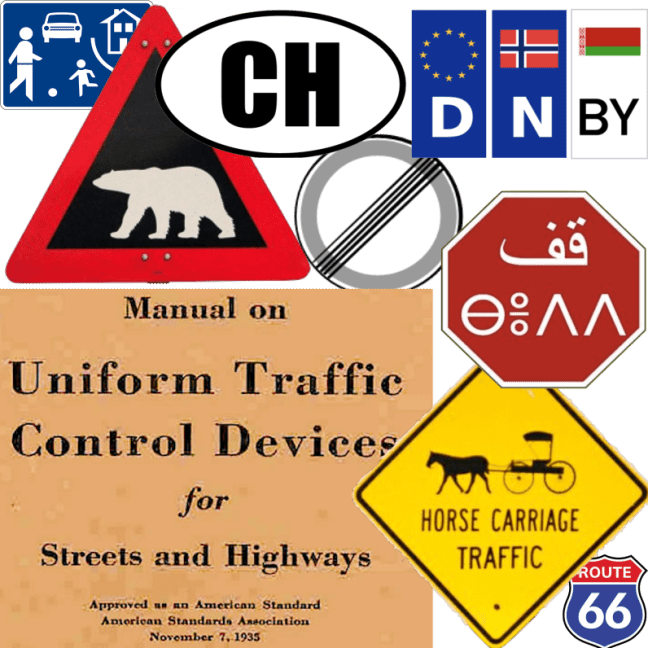
We might be familiar with the signs that emerge on the side of roads. They might be circular, squares, triangles, octagons, or sideways squares (diamonds), shields and house-like shapes (pentagons). Their colours would be red, white, blue, yellow, green, with the occasional brown, pink, or orange. There are also luminescent ones, with colours that change, usually from green to orange and to red. These signs have a combination of standardised pictures, messages and numbers to convey an almost global meaning. These signs are expected to be understood by the people who go about on the roads with their motor vehicles.
The signs and traffic lights did not exist before the clogging of the pre-existing roads with these fast vehicles, though bicycle clubs were the first ones to experiment with road signage, especially indicating slopes. The new road conditions called for easily identifiable signs to be read quickly by any driver, no matter their origin. So, with the fast, and numerous, vehicles the signs went up. Soon enough people in Europe were aware that the signs had to be shared across national borders, otherwise vehicles crossing from one country to another could be confused by different meanings. Speed of reaction was, and still is, crucial.
Following the international conventions that we have seen emerging from the end of the XIXc. on the back of technical inventions and imperial powers, they organised what probably is one of the most boring conferences in history. In 1909 the European vehicle associations met in Paris to decide on a small set of common traffic signs. They did a similar thing in 1931 and 1949 in Geneva to unify a larger set of signs on a European scale. By 1968 security triumphed over boredom, they met in Vienna and created the “Vienna Convention on Road Signs and Signals”, aiming to make traffic signalling universal for the whole planet.
They failed.
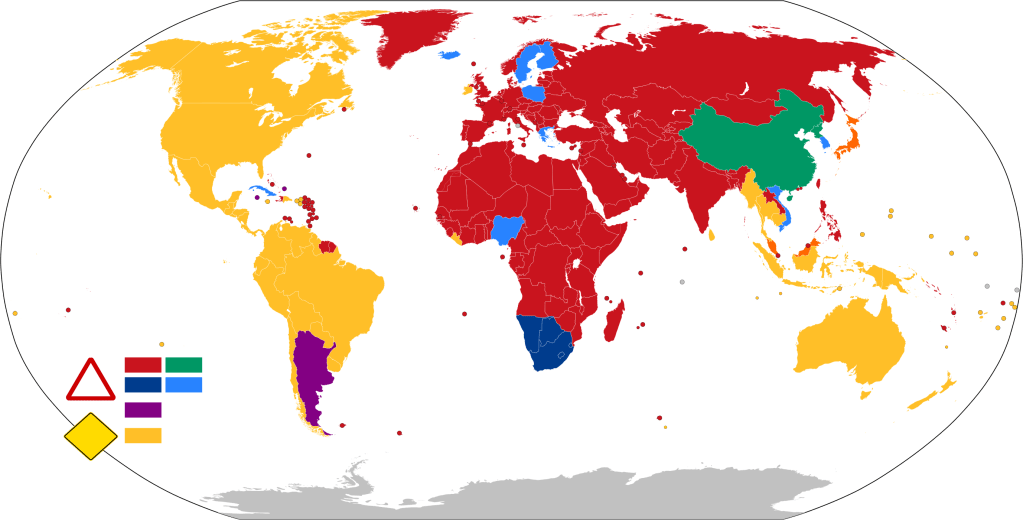
Map of “danger” sing shapes on by country. Red, blues, green denote triangles use ad warning or danger. Yellow and orange indicate diamonds use. Purple has both.
Currently, there are two main road sign standards on the planet, plus a lot of other stuff in between. One of them is the European one, which gave the world the “Vienna Convention”, adopted by 68 countries (roughly red on the map), and the North American one, boringly called the “Manual on Uniform Traffic Control Devices for Streets and Highways” (MUTCDSH), and used, with many variants, in the yellow countries on the map. But not all is well and standard in the US for the MUTCDSH, as some states engaged in Typefacewars, maybe the most bland wars in history. In southern Africa, ten countries use the also engaging name of the Southern African Development Community – Road Traffic Signs Manual (SADC-RTSM).
Road traffic sign from South Africa, as encoded in the Southern African Development Community – Road Traffic Signs Manual
But even in MUTCDSH- and SADC-RTSM-derived countries, The Convention forms the basis of much of the traffic signage, or is similar enough. If a non-Irish European drives through the US, most of the signs would be immediately familiar. The biggest differences between The Convention and Non-Convention countries are that speed limits and obligatory signs are rectangular, and yellow diamonds with black signs are used as warnings. Instead, The Convention uses round signs for speed limits and obligatory signs and an upward-pointing red and white triangle for warnings — also shared by SADC-RTSM, but one might find different animals. Even that difference between Convention and Non-Convention danger signs is not much, as an upward-pointing triangle is just the upper half of a diamond, therefore it is not much of a stretch of the imagination to understand the other.
We then took this little traffic diversion to show three ingredients that we will see from now on shaping many of the global questions of the planet. First, an agglomeration of big and middle-sized countries that are in close proximity to each other and need to share a convention for the benefit of them all find terms to agree with each other. Second, when new technology standards — especially related to communication — emerge and extend, the consolidation into commonly agreed rules tends to take shape relatively fast. Third, colonial powers force the conventions into colonised territories without the input of the societies under dominion.
Roads, moreover, are the paramount example of infrastructure. It is needed, inherited, maintained over generations and represents connectivity like nothing else. For much of the modern world, the combination of technology and infrastructure drives the need for a — virtually — universal language. Coordination forces create the political motivation for neighbouring, independent administrations to sit down at a table and try to agree on a common set of conventions. Once a standard achieves enough maturity through this process of regional standardisation, technological development and colonial imposition, the parts of the planet that are still not part of this dynamic are more likely simply to adopt that standard. New players, then, either adopt it or at least have it in consideration.
With these three characteristics, it is easy to see how Europe is the place in the World that has the most influence in shaping much of the standards and internationalisation, as we have seen in the Western Dominions entry.
Similarly, exceptions to these three general trends are easy to see, with densely populated islands that have not been colonised recently, like the Japanese archipelago and Great Britain, and big countries like China and the US. The US and the UK in part explain the survival of two Western standard flavours, as they were big enough, isolated enough and innovative enough to consolidate and protect their own conventions, but still share much with the rest of international protocols.
This kind of mindset and framework would be important for our question of what humanity wants.
With the metric system we have seen the emergence of the first international organisations, with the Metric Convention being established in 1875. This came in parallel to the establishment of the Internationale Erdmessung (Association Geodésique Internationale), which was established in 1886, but traces its roots to the Mitteleuropäische Gradmessung (Central European Arc Measurement) in 1862.
Checkmate
But before that we need to go back to London’s 1851 Great Exhibition. Similarly to how scientists used the excuse to meet and set off meetings and gatherings to improve measurement, London’s chess community felt obliged to do something similar for chess. A good question hanging in the air is, “what happened with other communities, like dancers, sports, card games, medics, lawyers, botanists, etc.?”. Maybe these did gather, but unlike the tech and chess nerds, not much continuity happened. It also helped that chess players were often older gentlemen with relatively easy access to resources to play their pastime. Compared to physical sports, this is my speculation, people at the time had little tolerance for sweaty youngsters.
In the case of chess, they might have felt inclined to organise a chess congress because, by that time, chess rules had been mostly standardised, but needed a final international agreement to complete the standardisation of the moves, chess notation, and agree to time limits to avoid “out-sitting” opponents. Even the design of the pieces stabilised around the Staunton chess set by 1849. Moreover, there were European and transatlantic antecedents of gathering to play chess against each other, like in 1834 in London and 1843 in Paris. However, the London organisers considered that there would not be time for a single “Chess Parliament” session to handle both a competition and the standardisation process, so it was expected that a series of Chess congresses could address the normative issues.
After the London Chess Congress event, more tournaments were organised in 58, 62, 66, 70, 72, 73, 78, 82 and 83. After that, a tradition emerged of a world champion being decided by a match between the reigning champion and a challenger. When a challenger was identified, financial backing would be raised for a match or tournament.
After the first world tournament held officially in that format in 1886, by 1887 the American Chess Congress started work on drawing up regulations for the future conduct of world championship contests. These were not standardised until the 1940s, though, and changed several times after.
However, a unified governing body of world chess did not materialise until 1920, so the universalisation of rules and gatherings emerged as a bottom-up convergence and willingness to gather, compete and galvanise an international bulging community of chess nerds, ehem, aficionados who could meet on the back of the interconnectedness of the technical world, steamships and railroads to budge heads against each other.
bep, bep, bep, beeeeeep, beeeeeep, beeeeeep, bep, bep, bep
Let’s now focus on that interconnectedness by looking this time at one of the earliest emergences of governance of information sharing through a new, and now vanishing, technology, the humble telegraph. We already introduced the telegraph as the fragile electronic transcontinental communication by 1858 in the [section fragile communication] where cables were laid, and lasted for weeks, then years.
Again, the German-speaking states led the way in homogenisation of standards and creating a bureau to handle the telegraphic connection and telecommunication between states.
Following the interconnection with railroads, the Prussians and Austrians connected Berlin and Vienna with a telegraph by 1849, along the railroad that connected them. They formalised the connection by a treaty ruling the “installation and use of electromagnetic telegraphs for the exchange of international dispatches.” By 1850, Prussia signed agreements with Saxony and Bavaria. Boringly, this followed similar agreements for mail exchange. Treaties simply aimed to control the flow of messages and the procedures for exchanging them at national borders, as well as the application of tariffs.
However, these treaties were the basis of the Austro-German Telegraph Union (AGTU), which was established on 25 July 1850 in Dresden. Unlike mail, telegraphy was a new and constantly evolving medium; therefore, the AGTU should organise periodic telegraph conferences to review and revise treaties, such as pricing. By 1857, with the addition of new German states, the individual treaties were unified into one in the Stuttgart Convention.
Finally, membership of the AGTU was made available to other countries, even non-German ones, and to some private companies. The Kingdom of Lombardy-Venetia, the Netherlands, the Duchies of Modena and Parma, Tuscany, and the Papal States also joined the AGTU, despite not being Austro-German. In 1852 Belgium, France and Prussia met in Paris to agree on standardised conventions.
However, French being French, they had to create their own system. In late 1855, in Paris, they founded the West European Telegraph Union (WETU), together with Belgium, the Kingdom of Sardinia, and Switzerland. The WETU also admitted other countries and private companies, some of them laying submarine telegraph cables to Britain (by 1850)! Portugal, the Netherlands, the Grand Duchy of Tuscany, the Duchies of Modena and Parma, the Papal States, and the Kingdom of the Two Sicilies joined. Notice that the Netherlands and the Papal States joined the two separate unions. During the 1850s, there was a gradual process of convergence and overlapping of the two unions’ activities and conventions.
Since many of the states were already intermingled these two organisations, they needed to merge them one way or the other. In 1858 the Brussels Convention created pan-European conventions. The conventions stablished conventions i.e. standards. Yes, not the most clear language, but that is how one end up with multiple standards. But for they credit, by 1859 the two organisations aligned almost all their provisions through, you-know-what, a new convention! The Berne one this time.
Having three almost equal, but not consistent, conventions made routing of telegrams a bit of hair-splitting sometimes. By 1861 most European countries, and even Algeria, had joined the Brussels one (all but Britain, who had private telegraph networks).
The rapid growth of the new technology and its use needed standardisation. By 1865, soon after the arc-measurement, the European countries met in Paris at the auspices of the lesser-known Napoleon, Napoleon III, to deal with the emerging electronic telecommunication. The participants dropped the Austro-German and Western European parts to create the International Telegraph Union (ITU), mostly based on the initial austor-german conventions, but making them a consistent set among all participants. In a joke of destiny, the end of the lesser-known and ill-tempered emperor Napoleon came from a redacted, ill-interpreted telegram five years later. We all know that texting and emotions are not easy. Telegrams were the texting of the 19th century. Had they stuck to letters, we do not know how history would have been.
Since the texts had to be codified across languages and borders, but most countries used the Latin alphabet, they adopted the Morse code and its instruments as the standard to represent letters. Interestingly, the code had been developed on another continent, America, by Samuel Morse in 1844 in the US. For Russia and other eastern European regions, Cyrillic had an equivalent in Morse code, developed by 1856. If you are curious about non-alphabetic Morse codes, the Chinese one is quite interesting.
For the first time, regulations, tariffs, and technology were harmonised across all of Europe, as far as its borders with Africa and Asia. Three years later, in 1868, the second International Telegraph Conference was held in Vienna. It focused on technical and administrative issues, rather than diplomacy. Significantly, the conference established a permanent ITU Bureau in Berne.
I’m telling the story of the ITU in some detail because, like the metric system, it represents one of the first international institutions to emerge from the technical, scientific and map-making needs of industrialists, commercial interests and states.
In this case, bilateral agreements that looked much like each other quickly expanded into a multilateral agreement and the creation of an international bureau. The rapid development was spearheaded and pushed by the rapid expansion of the new technologies and methods that benefited from standardisation and homogenisation across the world.
The beginning of this section is the code for SOS in radiotelegraphs, established in 1905 by the Germans as simply being three short beeps, three long ones, and three short ones for ships, just for easy identification and memorability. The equivalent Morse letters being S, O, S, which gave the informal name for oral memorability. Better say SOS than three dots / three dashes / three dots, frankly…
The code was used for distress signals for ships at sea, and later extended for distress calling in general, aimed at a natural human willingness to help other beings in distress. We can look at that natural willingness, which is commonly called humanitarianism, and is quite central to our texts.
Red is the new white
Tracing one of the oldest international movements for the establishment of aid in war –one of the darkest instances of human behaviour– we can look at the establishment of the Red Crescent and Red Cross. The story is quite well known (at least for somebody who volunteered there), so I would not go deep into it. Shortly, it came at the initiative of a Swiss magnate (hence the original logo) who was appalled in 1859 at witnessing first-hand the human misery of dead and dying wounded soldiers after a battle in the Second War for Italian Independence. In the aftermath of the battle, there was a near-total lack of medical attendance and basic care for such human beings, which he tried to compensate for by helping himself and bringing aid from neighbouring regions to attend to those who could be taken care of. By 1862 he published a book of the experience. The tale resonated quickly, and he explicitly advocated the formation of national voluntary relief organisations and an international treaty regulating humanitarian and medical care in case of conflict.
By 1863 the magnate and his supporters managed to organise an international conference in Geneva with representatives from European governments, non-governmental organisations and the emerging International Committee of the Red Cross, where the basic principles of the book, and the common distinctive protection symbol, were introduced. Again, like with the AGTU, they convened to organise further conferences to enact the basic concepts. By the next year representatives of the US, Brazil and Mexico were invited. The Committee that year adopted the First Geneva Convention. By 1865 the Ottoman Empire adopted the Red Crescent as a symbol as a colour-reversal of the flag of the Ottoman Empire, just as the Red Cross was a colour-reversal of the Swiss flag.
The development of the Red Crescent and Red Cross was through national adoption of the Geneva Convention, and the creation of national societies by nation-states around the world as a sign of prestige and a form of popular volunteer work.
The establishment of internalisation
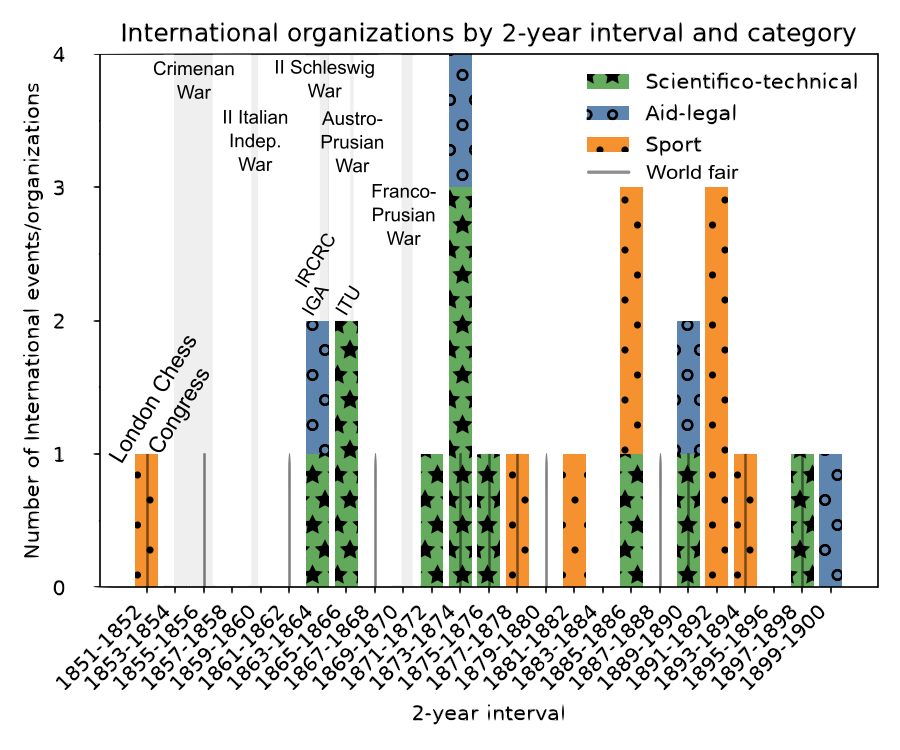
Below I show the number of international organisations created since the London Fair of 1851, together with periods where international conflict happened within Europe, and the major World Fair years, as identified by the Bureau International des Expositions (yes, there is a bureau for that, founded in 1928). Of these early international organisations we find four broad categories: scientifico-technical, political-law, humanitarian-aid-health, and sports (see table below). If we jump to the XXc. we also find several organisations with economical goals, like the Bank for International Settlements (1930), or environmental ones, like the International Whaling Commission (1946).
Number of events or international organisations created per 2-year periods for each category: scientifico-technical, aid-legal, sport overlays with war years in Europe and World Fairs.
There is no general trend between wars and the creation of international organisations, except maybe for the periods after war years, for example after the Italian Wars of Independence (1859-68) and the Franco-Prussian War (1870), which was started after the creative editing of an infamous telegram. There are, though, hundreds of other international and regional fairs that exploded since the mid of the XIXc. Again, this represents the revolution in transport, communication, the unprecedented ease of gathering people in a place, and the willingness to see the advances in scientific, technological, artistic and exploration revolutions happening mostly within the western hemisphere and its colonies. Within this context, people with some means could more easily gather for other contexts, meet, agree to certain conventions, and lobby relevant decision-makers to push particular agendas, many with a standardisation mindset or the need for international cooperation for some greater goal, like treating wounded people better.
In all, the emergence of these international institutions had many forms and flavours. As we have seen with sports, scientifico-technical and humanitarian organisations, some institutions emerged organically and took a while to establish bureaucratic governing bodies, while others were thought out from the beginning as top-down codifications of rules and laws, sometimes governed by institutions, sometimes by regular meetings. The creation, establishment and emergence of new international organisms followed stochastic dynamics, mostly governed by the onset, and ending, of international conflicts.
In this environment, however, we can identify general trends where international institutions emerge and mostly consolidate on the back of a better interconnected planet in terms of human and information flow. From the mid XIXc. there are more and more of these institutions globally, but as we have seen, most follow structures, rules, worldviews, organisational conventions and other procedures rooted in European traditions and innovations. Moreover, these organisms, institutions and proto-bureaus do not seem to deal with random topics, but do have a bias towards dealing with specific topics and interests, namely technical standards, sports rules and competitions, aid and law, economics and debt, and environmental protection. Beyond these, the emergence of global frameworks, institutions, organisations, organisms, frameworks, codifications, standards, administration, corporations and other such structures is rather limited.
For the purpose of our essays, we then will focus on these 5-8 aspects of international coordination, and the bases of these, from organic emergence to nation-state backing.
Finally, I cannot avoid briefly commenting on a couple more legal-political institutions that just appeared at the end of the XIXc. First, the International Parliamentary Union was created in 1889 for the arbitration of international conflicts. It is not for me to assess how effective it has been, but this bureau was one of the initiators of the more famous Permanent Court of Arbitration (PCA) in The Hague in 1899. The PCA was established after a conference at the initiative of Nicolas II of Russia. Nicolas, by the way, managed to immerse himself in most of the conflicts between 1899 and his final demise after the Russian revolutions, famously being ended by massive loads of lead in his body, together with all his family, instead of being handled by the Permanent Court of Arbitration. This kind of political-legal organisation, or the lack of it, or its effectiveness, will be relevant for answering the main question of our text.
Name
Year
Scope
Cathegory
Central Commission for Navigation on the Rhine
1815
Regional
Economical
London Chess Congress
1851
International
Sport
International Committee of the Red Cross (ICRC)
1863
International
Aid-legal
International Geodetic Association
1864
International
Scientifico-technical
International Telegraph Union (now ITU)
1865
International
Scientifico-technical
International Union of Prehistoric and Protohistoric Sciences1866
1866
International
Scientifico-technical
International Congress of Geography
1871
International
Scientifico-technical
International Meteorological Organization (IMO now WMO)
1873
International
Scientifico-technical
International Law Association
1873
International
Aid-legal
International Congress of Orientalists
1873
International
Scientifico-technical
Universal Postal Union (UPU)
1874
International
Technical
International Bureau of Weights and Measures (BIPM)
The humble metric system, as we have seen, was not established immediately. The legacy of the metric that I want to focus on is how it came to be, and what bureau was created to establish, motitor, standarize and update the metric.
The metric gathered support little by little from 1795, until, by 1875, the infamous Metre Convention, with the US being one of its founders! made it the International standard we all know and love, well at least one of these two is true.
The convention did not just stop at pushing for an international, standarised, metric system, no, they created one of the first bureaus. That we will be evaluating for now.
The 1875 one is the Weights and Measures: the International Bureau of Weights and Measures, or in its original french Bureau . They also established a conference (General Conference on Weights and Measures) and a committee (International Committee for Weights and Measures). Again, more on bureaus later, and committees, and conferences, and…
But why, by 1875, was it needed for a French mostassafto be in charge of an international bureau at all? This is the interesting question. What is relevant for the metric system is not the use of units for measurement set by a national administration, but the fact that it implanted the idea that we all must use it and be raised in it.
The french Weights and Measures mostassaf did not came out of nowhere. Going back to the scientific homogenisation, we need to add the germans to the mix.
By 1841, 28 measurements of the magnetic field of the Earth where taken over a six year period. These measurements, all over the planet, where centralised by the “Magnetic Society”, or Magnetische Verein in the original german. This was a society not a bureau, yet. As a society, the compromise was just to gather, standarise and share the measurements, so they could be useful across the planet. There was an extra benefit for endeabour, navigation. Like with the making of accurate clocks to measure longitude, an accurate description of the magnetic field allowed better seafaring transits, as the north and south magnetic poles of the Earth do not coincide with the geographical poles of the planet. Actually, the magnetic ones have a tendency to wander, quite fast indeed (hundreds of kilometres per decade), and even flip! (north becoming south). This was know for decades, or centuries, but was Gauss who in the 1830s started measuring its strength, and latter instigated the creation of the society, with international aims and ambitions.
Later on, the also german based Mitteleuropäische Gradmessung (Central European Arc Measuremen), linked with the need to measure the meridian to estimate the circunference of the Earth, and hence, the metre, was created on 1862. Interestingly, the Mitteleuropäische Gradmessung still exists in the form of the International Association of Geodesy, again, an association and not a bureau. By 1859 it was known that several meridians had not the same length, and that as measurement techniques would advance, the nominal definition of the metre would constantly change, even if so slightly.
A Catalan office —well aware of the Barcelona lie— Calos Ibañez e Ibañez de Ebro, was in charge of the International Association of Geodesy when in 1875 the Meter Convention was stablished. At the time of Carlos running these two pioneering international organisms, these were planned as contributing to increase precision in navigation, cartography and geography, as well as the emerging railways and telegraphs. Railways and telegraphs will come hunting us, but that’s for later.
So, despite the logic of unification being a concept from the particular French Revolution — which linked the metric with revolutionary ideas to make their political movement of decapitating kings (and many others) universal — the universalisation cached up four generations later, and, for the first time the particular Catalan mostassaf was not to be for a town, or state, but for all the planet!
From this story what I want to emphasise is that the importance is the base of knowledge of the standard, more than the standard itself, whatever it is.
How a continuously fighting world of nations came to decide that they could trust a base of knowledge? Moreover, how for the first time —unlike with mathematical, temporal, musical, and punctuational spontaneous standardisation — these nations decided to bureaucratise the process of standardisation with scientific geeks at the front of the first modern international institutions. This how process boils down to write laws that would be shared across borders and mutually understood, plus trust that the mostassaf would be available and willing to keep, share and not abuse its privative and privileged knowledge. Again, remember that the term mostassaf comes from an Arab religious figure of moral and measurement accountability.
So what makes the metric stand? Truly, a handful of things: i) It was the first one designed from the get-go to be universal; ii) it was based on natural units accessible, in principle, to anyone who had the time to finance the measure; iii) it was easy to learn, aligning with mathematical notation, already quite universal and on base 10; iv) it was set to work with technical and scientific communities; v) the scientific communities were expanding, encompassing industrial and geodesical needs for better instruments, better measurements, faster and easier comparisons and sharing of technical information and better land and sea surveys for better administrative oversight (more on administrations later); vi) its creators also kinda pushed for it to be adopted universally, following the spirit of revolution; vii) there were not many alternatives at the time, to be honest.
Let us look at the last option (vii), alternatives? The only real contender for standard measurement used for scientific and technical applications by the end of the XIXc was the British Imperial system (still slightly kept by the US and Liberia). The imperial traces its roots to the standardisation of English measures, as designed by the 13th-century Magna Carta, but standardised by 1496, rectified in 1588 and made the British Imperial system by 1826.
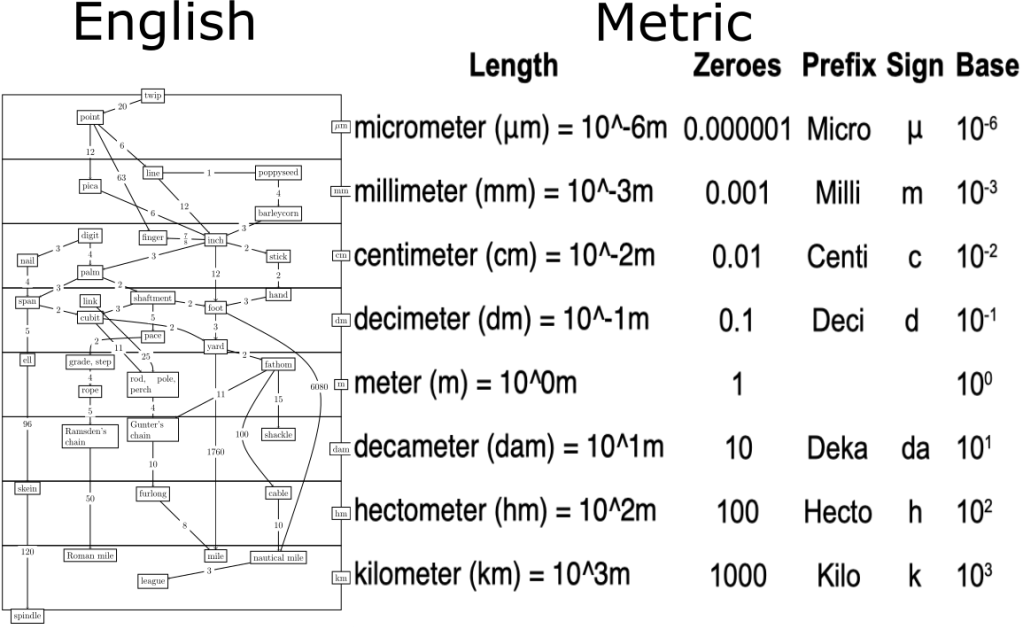
We have the imperial length units. Let us look at these!. The basis is the foot, abbreviated as ft. The multiples are a yard as 3 ft, chain 3×22 ft, furlong 3×220 ft, mile 3×1760 ft, league 3x3x1760 ft. Well, it seems they were trying a base 3, but kinda gave up on it, soon. For the sub-units: twip 1/3^3×640 ft, thou 1/3×4000, barleycorn 1/3^2×4, inch 1/3×4, hand 1/3. OK, OK, kinda keeping with the basis 3 there, sometimes 4 as well, maybe inspired by the 60 for time — 3x4x5 — but also not quite. Now let us look at the distance units at sea: we have the fathom 6.0761 ft, cable 607.61 and nautical mile 6076.1… Now there is a base ten! But not much sense otherwise.
But a visual is better than thousands of words, and words of measures. Here is a side-by-side comparison of units of length in the traditional English system vs the metric one.
Comparison of English customary english and their interrelation with metric
For mass, the basic unit is the pound. Fair enough. But the shorthand for pound is lb. Yeah, we have seen that pound and livre are, in theory, referring to the same old Roman unit, but still, lb looks quite different than p or pn. Anyway, let us see its divisions: grain is 1/7000 lb, drachm is 1/256 lb, stone is 14 lb, quarter 28 lb, hundredweight 112 lb and ton 2240 lb. Little sense, but in base 12 or 60, like time, still makes no sense. For multiples it has base 14 (1, 2, 4, 800). Yet for divisions it has a basis, ehem, no consistent basis. A grain is 1/(14×500) — why 500? Well, a drachm is 1/2^8…
Sorry, I tried.
I will not even try the volume units. A beer pint is just a large half-litre drink. Cheers to that!
The other option could have been the Burmese system. Myanmar still has traditional Burmese units of measurement. The Burmese system maybe has been maintained, in part, because for mass and volume it follows a neat base-two system, in which each unit is a factor 2 bigger than the previous — the metric being a factor 10 between units. Unfortunately, this is not the case for length and area; no, for length the Burmese system is a mess. For example, as of 2010, the state used miles to describe the length of roads, square feet for the size of houses, square kilometres for land area in cities, acres for agricultural areas, kilometres for the dimensions of the country. Still, when I was travelling there in 2015 I did check if they were the US of Asia for the metric, but for reasonable driving they did use km for distances to places and km/h as road speed limit indicators.
So, form the above list, let us focus on points (iv) to (vi): the need, willingness and expansion of technical and scientific domains beyond national borders (more on nations later).
The expansion of the metric is interlinked with these technical and national advancements and ended with some of the first bureaus on the planet.
The republican French, to celebrate the 10th anniversary of the Revolution, did a technical and industrial fair in 1798. This was not much international, as they were in the middle of intense wars, still not called Napoleonic. At the exposition they showed devices demonstrating the new metric system of metres, grams and litres, and, following European fair traditions, they had prizes for outstanding products, mostly fabrics and textiles, but now including innovative technical and industrial devices. One of them was the precursor of the modern pencil, and pencil colours.
They held three more expositions until 1806, and then new ones shall happen every 3 years; this allowed for enough new inventions, geographical explorations, arts, sciences and devices to be developed between events. But by 1809 France was indeed in the middle of the Napoleonic wars.
By 1819 the now French kingdom restarted the expositions, which happened roughly every 4 years.
Then the Kingdom of France decided to revolutionise a bit again and become the kingdom “of the French”. Notice the difference; it will be important later on. Then they decided to make an exposition every 5 years, starting in 1834.
The 1844 one was quite a success internationally, spawning similar fairs in other nations — Bern (1845), Madrid (1845), Saint Petersburg (1848), Lisbon (1849). Then in 1849 there would be the last national exhibition, as in 1851 the British did their Great Crystal Palace Exhibition, which for the first time had the dimension of a world, and not national, fair. From there on, world exhibitions would happen regularly, a bit like the Olympic Games now, and cities would compete with each other to host the event.
These World Fairs, or “the Expos” for us old enough to remember them being a thing, initially were great opportunities for showcasing the most advanced scientific and technological discoveries of the time. This was especially important in an era when more efficient and powerful steam engines, steel, locomotives, rails, and later electricity and telegraph were taking over the European nations and their colonies. In these events, industrialists and scientists from around the world could meet and agree on stuff.
That stuff, my friends, was the metric system, which by the end of the Napoleonic Empire, like decimal time, had gone down the drain. Napoleon reintroduced the customary units, but retained the metre and kilogram for these units to be compared against. The metric systen was also taught at schools and academia. It was simple to teach, as we have seen.
Meanwhile, the metre lived on in other states that were under the influence of the French Empire and retained the metric system, like the Netherlands, Switzerland, and Piedmont, later the Italian kingdom.
And the US, of all places, had a central role for the metre. The Coastal Survey Office, since its inception in 1807, but really by 1836, standardised all the coastal measurements with the metre as its basis.
And even nations that escaped Napoleon, like Portugal, by 1814 adopted the metre, though retaining the traditional names when needed.
Spain, as we have seen with the Catalan measures, had a diverse set of systems. But by 1849 decided to standardise measurements with the metre and kilogram, and by 1851 decided to conduct a survey of the state. The Spanish bureau of measures also adopted and developed new measurement tools to compensate for thermal expansion of the standard metre rods. That made the use of the metre more precise and more manageable. Then it provided standard metres to the Egyptians, and the standard was used throughout France and the German Confederation.
On the first French Universal Exposition in 1855, the Swiss had finished, and presented, their official map with the metre adopted as unit of length, and this was awarded a medal.
Moreover, the Congress of Statistics was held in Paris at the same time as the exposition. There, statisticians, probably tired of wasting time making conversions of units, and probably not happy with the metre being kept by a France-based mostassaf, decided to settle on a uniform decimal system of measures, weights and currencies.
Again, the US pushed for the metric system by 1866. One of the bases of precision balances was in grams and kilograms. In 1866 (made in Bangor, Maine, where I’m writing this now) the legislative organ passed the Metric Act, which defined the metric system in terms of customary units rather than with reference to the international prototype. Interestingly, this anchored the customary measurement units to that of the metre, even if it legislated the other way around.
Then, at the 1867 Exposition Universelle, again in Paris, the statistician geeks formalised the universalisation desire with the creation of a Committee for Weights and Measures and Monies. Now it would not be the French revolutionaries calling for universalisation, but a bunch of geeks with the ears of wealthy industrialists interested in easier technical standards.
That committee finally, after the Franco-Prussian War, created the Bureau, the International Bureau of Weights and Measures, with two governing organs and the headquarters. The newly created German and Italian states already adopted the metric system as their standard. These nations now were part of the bureau, which was tasked to facilitate the standardisation of weights and measures around the world. The bureau had three parts: a conference as a forum for representatives of member states; a committee of metrologists as an advisory board of high standing; the headquarters as the meeting place and laboratory facilities that inform the decision and advisory bodies for decision-making. Corporations, interestingly, often work similarly to that: the conference would be the shareholders’ meeting, and the committee the board of directors.
The Catalan Carlos Ibáñez e Ibáñez de Ibero — the head of the Spanish survey and national measures institute, and maybe familiar with the mostassaf concept — was one of the main pushers of an international standard based on the metre. By the bureau’s creation, he was made the initial president of the committee, the Permanent Committee of the International Metre Commission (confusingly, also named International Committee for Weights and Measures and General Conference on Weights and Measures; do not ask). Being Catalan of origin, Ibáñez, since 1853, also impulsed the remeasurement of the “Barcelona lie”, that is, the Paris meridian, extending the measurement from the Shetland to the Sahara. That effort, and other European meridian measurements, awarded him the first presidency of the International Geodetic Association by 1867.
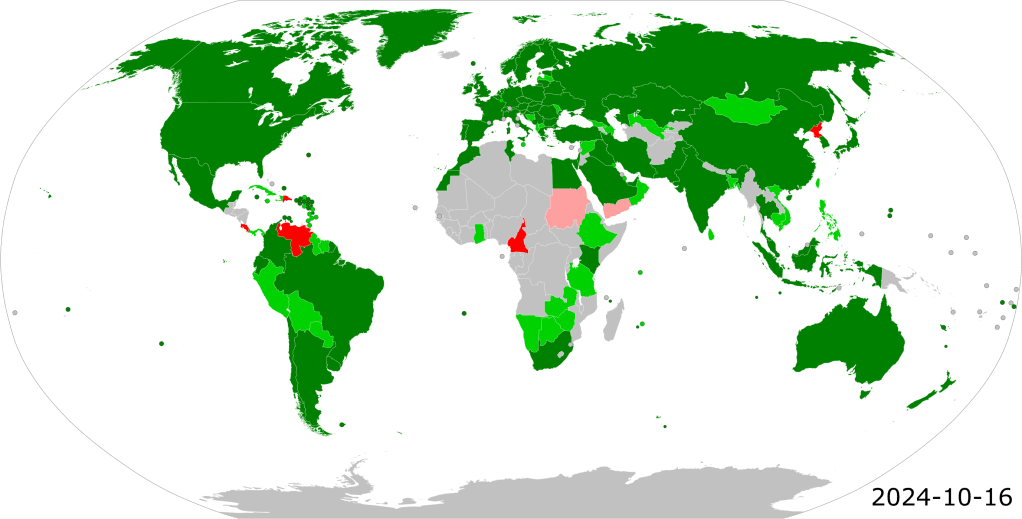
The 1875 Metre Convention put the decision-making of the standard measurement of the planet in a bunch of nation states’ hands. The original signatories being Argentina, Austria-Hungary, Belgium, Brazil, Denmark, France, Germany, Italy, Peru, Portugal, Russia, Spain, Sweden, Switzerland, Ottoman Empire, United States of America (yeah, you have seen it well, US is here!), and Venezuela (which no longer ratifies the Metre Convention).
Metre Convention on the planet. Dark green, member states; light green, associate states; red, former member states; light red, former associate states.
Interestingly enough, the metre is also not completely dominant in the UK, where the standards for the metric system, and the metal piece that defined the kilogram for 160 years, were made.
In the US there is also the fun fact that, unlike the UK, industry is not forced to use the metric system for all their products, despite being one of the original seventeen signatory nations to the Metre Convention.
Therefore, when NASA asked its suppliers to work with the metric system, but one of its suppliers, who procured thrusters for a probe to Mars, worked with customary units of pound-force-seconds, the result of such an integration of two different systems was that the poor Mars Climate Orbiter probe simply went on its sweet way to Mars just to descend to about 57 kilometres above Mars’ surface, instead of its planned orbit at about 150 kilometres. At that height, and without enough angular velocity, and with the drag of the tenuous Martian atmosphere, the orbiter simply produced a nice flame in the atmosphere.
That is the price of not having a unified unit system.
So being the first, and not having many alternatives, plus being relatively memorable and accessible (had to knock at the Parisian mostassaf from time to time, but was a cool person), made the whole system go global, or pay the price if not.
The metric system simply illustrates how national administrations and gatherings of world representatives agree to standards. In the metric case this quasi-standard emerged through technological need, the ease of communication that allowed repeated forums where actors interested in standardisation and sharing could gather and lobby in a uniform way, the relative ease of the new system and its spirit of universalisation, and a specific individual with the right connections and maybe aware of the connection between moral and measurement accountability through an old mostassaf legacy in our lands.
If we compare the metric to the other standards that we have seen — mathematical and musical notation, francas, timekeeping and punctuation — all of these share similarities. Technical advancements for clocks creation and the need of better measurements for navigation and trains in the case of timekeeping; more communication, new instruments and bigger orchestras for music; economic interest for francas; facilitation and economic dissemination for punctuation. With the exception of the calendar, none of these standards had behind them the will of the states or nations. And even the legislation for calendars happened at a customary and slow attrition, state by state, without an international gathering, convention or bureau leading it.
Like the weights and shekel 3000 years ago, we can look at more modern cases of this seemingly spontaneous standardisation originating by the end of the 19th and beginning of the 20th. For example, if you ever used headphones, the connector, or “jack”, to the sound device might have always been the same diameter 1⁄4 in and shape, or have only two–three standards (1/8). Another piece quite familiar to most of us nowadays is the keyboard I am typing this on, which is an almost international standard, called QWERTY, named after the order of the letters on the first keys’ row. Looking elsewhere, the bicycle chain is 0.5 in between pins and 5⁄16 in for roller diameter. The size of cargo containers, 8 ft wide by 8 ft 6 in high and 20 or 40 ft long. Yeah, metric did not make it for jack, bikes and cargo, damn.
More on the emergence of these (and other) standards later.
What we can infer, however, is that standardisation follows a mixed route of informal conformity by useful means of exchange, plus a forcing pace by institutional action. Then, in an interconnected, and colonially dominated, world, the metric system in particular shows the first, or one of the first instances, of how slow attrition to shared standards could be hastened by gatherings and lobbying committees. And how that commitment results in autonomous bureaus that horn in their task. In the experience of THE Metric, the legislative power of national institutions could be weaponised to steer reluctant populations that were happy with their local traditions and units, however clumsy, to adopt new and bureaucratised standards countries away, instead of their local mostassaf. Or shield them, as in the US, however clumsy. A new state-sponsored universal education could get away with old traditions by educating children in new, maybe more memorable, systems.
With the dreaded metric we can see how all the pieces are falling into place to have the ruleset to ask our question: what does humanity want? But before that we need to go through the emerging bureaus and other international organisms that, for now, rule, the World.
And as with many things in these writings, it all starts with the French Republic, the first one, or the French Empire, the first one.
But before, we need to go back to the Babylonians, again.
There is evidence that as far as 3,000 years ago, Mesopotamian merchants established a standardised system of weights that later spread across Europe, effectively forming the first known common Afro-Eurasian market. In a study, thousands of objects used as standards of weight over the course of 2,000 years in an area from Ireland to Mesopotamia weighed nearly the same amount — between 8 and 10.5 grams.
This “spontaneous” standardisation, though, started by copying the Mesopotamian standard, called the shekel, which later became a coinage system, and now is the name for Israel’s currency.
In fact, coins are no more than a stamp into a piece of metal to say that such metal is the value that it claims to be, with the purity of the metal that the stamp issuer claims.
Basically, at some point many cultures in antiquity decided that if a certain king or organism put — insert here his or her face, or symbol, or god — onto a round and flat piece of metal, that would be enough for people to believe that such a metal piece was of such-and-such quality and mass. That is why “pound” is both a weight and a coin. It kinda worked because we still have these small pieces of metal going around in almost every place on the planet, with few counterfeit ones, and many, many faces of mostly old — often dead — dudes.
Therefore, the whole system is based on trust that all the coins are made according to the same mass and purity standard, and that such a standard is known by everybody who is using it. We will see more of the importance of trust in later chapters.
But trust is only needed for the value part of the standard. As we have seen with mathematical and musical notation, punctuation, and francas, a degree of intent and shared interest in communicating, — plus actual political and militaristic control of peoples, and some degree of prestige—, also does the trick, without much need of trust.
But for now, let us jump to the United States now that I am writing this here. Maybe people from the US, and the Myanmar government, do not especially embrace it, but children do not like the Babylonian time keeping much either. Children tend to prefer the legacy of the Republic, the French Republic, the first one.
That is, the metric system. To clarify.
The metric, with a limited set of units that follow a decimal scale, and a conventional nomenclature linking base-10 “words” to multiples (from Greek) — deca, 10, hecto 100, kilo 1000… — and divisions (from Latin) — deci 0.1, centi 0.01, mili 0.001 … — rules the world: the world’s measures (not time; time still is Babylonian, as we have seen).
Compare the French metric to the Babylonian time, with base-60 seconds and minutes, but a 24-hour day, 7-day week, 28- to 31-day months, seasons starting on the 20th or 21st of some months, and years, with some being one day longer than others. Children love to learn the metric, not so much timekeeping.
Before we had a universal measurement system, each yardstick would have a local reference to which it would be computed. For example, going to a marketplace you pour your grain into a container that would tell you how much grain you had and you could sell. Of course that depended on the actual container, and it might change marketplace to marketplace. To this day, I still find some of these containers in market squares set in stone.
But these containers for goods such as grains and olives were not straightforward to describe. For example, for volumes in Catalan-speaking lands we had this:
The quartera was equivalent to the capacity of the container [this container being the one at the market-squares] of the same name. [...]. The aimina is a very old measure that appears in a large number of documents. As submultiples [of the aimaina] there were: the measura, the sester, the cossa, the punyera, the picotí, etc. The barcella was the measure used in the [balearic] islands (where it was divided into 6 almuds or 1/6 of a quartera) and in the Valencian Country (where it was divided into 4 almuds, or 16 quarterons, or 108 mesuretes, equivalent to 1/4 a taleca, or 1/12 of the cafís, or 1/2 fanecà [also the name of a area unit equivalent to 833.3m2, or the land surface that can be cultivated with one faneca of grain ]. The barcella was also used in Tortosa, where it was equal to 3 cutxols, or 6 almuds, or 1/25 of the cafís. For forment [wheat], barley, oats, etc., the cafís is just 25 barcelles [adjusted to the edge of the container]
Did you get dizzy with that trainload of measure names, specific for each township or territory AND to which kind of good it was being measured? I did, and is my language.
This system was so complex that a profession, the mostassaf (accountant), was needed to make sure the measures were respected. The mostassaf was a profession inherited from the Muslim muḥtasib, inspector of public places and behaviour in towns. Measurement was, indeed, in need of public behaviour. Muḥtasibcomes from ḥisbah, or “accountability”. Interestingly, the term also has both meanings in English: moral accountability, and how to account for economic transactions (the profession being accountant). This connection between debt and morality is deeply explored in — slightly cherry-picked and immensely thought-provoking — David Graeber’s 5000 years of dept. In the Aragonese territories the mostassaf had to keep the original measurement patterns and check that the copies had enough precision with his personal seal for the canes (sticks, length), balances (balance, weights), and all the volume units that we have seen.
What is interesting for the linguistic part is that, although these measures varied from town to town, or mostassaf to mostassaf, they were called the same. So these ‘measures’ were similar enough from one place to the neighbour that everybody agreed for that to be the standard, but not quite. Again, like with languages, the measures might have drifted the further away you went from one place, while the name itself might be the same. As I often heard in India: same same, but different.
In fact, that same same but different, and terminological mess is one of the reasons why the estimation of the size of the Earth used by Columbus was so wrong.
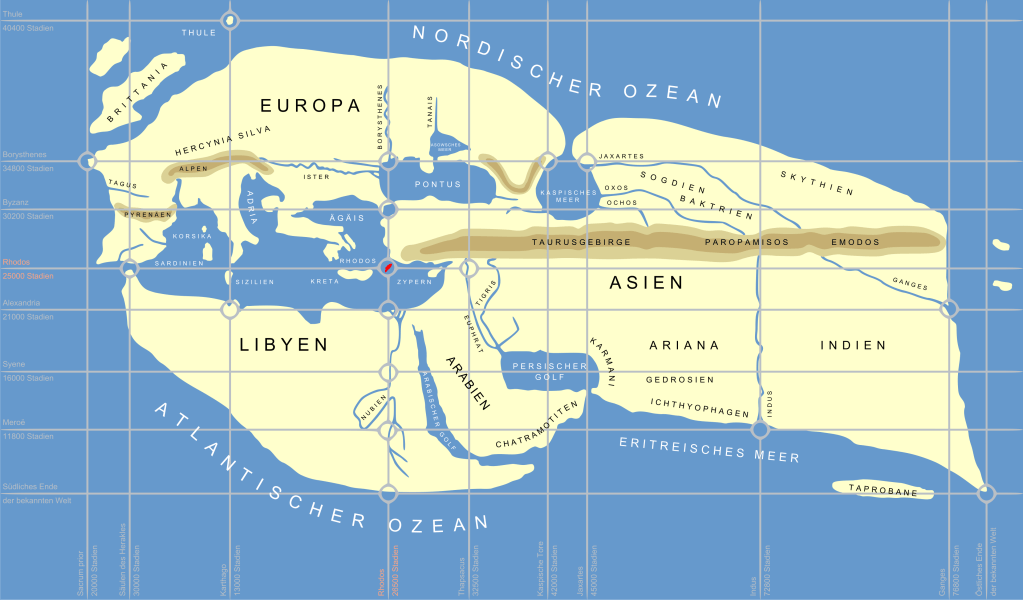
Part of the computations were using the measurement that Eratosthenes of Alexandria did more than 2,000 years before. His measure was about 252,000 “stadia”. But if I tell you that your dog measures 0.008 stadia, you still would not be sure of how long your dog is. For that you would need to translate it to a measure that you are familiar with. Depending on what the equivalences are, your dog could measure 0.00012 km or 95 inches.
This was the problem faced by Columbus and many of his contemporaries. Nobody really cared to pay anybody to measure, on land, the distance between Alexandria and a place south of it where there was no shadow in a well on an equinox day, the Tropic of Cancer.
These armchair thinkers simply quoted Eratosthenes, and the people who copied him over the millennia. But the Olympic games were long gone, and not many “stadion” existed as a reference. Even today, when we can measure archaeological remains of stadia and historical sources, experts argue that the unit could be anywhere between 150 and 210 metres.
Ptolemy took the lower estimation of Earth’s circumference. Later the Arabs translated previous estimations of the circumference of the Earth by Posidonius, Strabo, Hipparchus, Aryabhata and Pliny. They themselves did some extra measurements lead by Al-Khwarizmi, Al-Biruni and Al-Farghani. All of these translations and new measurements, confusingly, was converted to ‘miles’.
However, naming something the same does not mean it is the same.
‘Miles’ for the Arabs are not the ‘imperial’ ones. Moreover, something that at this point should surprise no one: the mile the arabs where using to translate previous Earth size estimates, and their new measures, has no clear conversion to modern units. An Arab mile from these text being interpreted as anywhere between 1,800 and 2,000 metres. Not so bad but still a 10% margin.
In any case, the same number of miles will be about 1/3 bigger or smaller depending on which mile it is. Same same, but different indeed.
This convoluted process ended up being taken by some people, Columbus among them, to be 25–33% smaller than the modern estimate of about 40,000 km for Earth’s circumference. For convenience, to have funding from inland Castilian monarchs with little experience with seafaring, Columbus took the ‘short yardstick’. Lucky he, and the Castilians, was that there was a continent on the way, just shy of 30% of the total landmass of the planet. Not a small serendipitous crash.
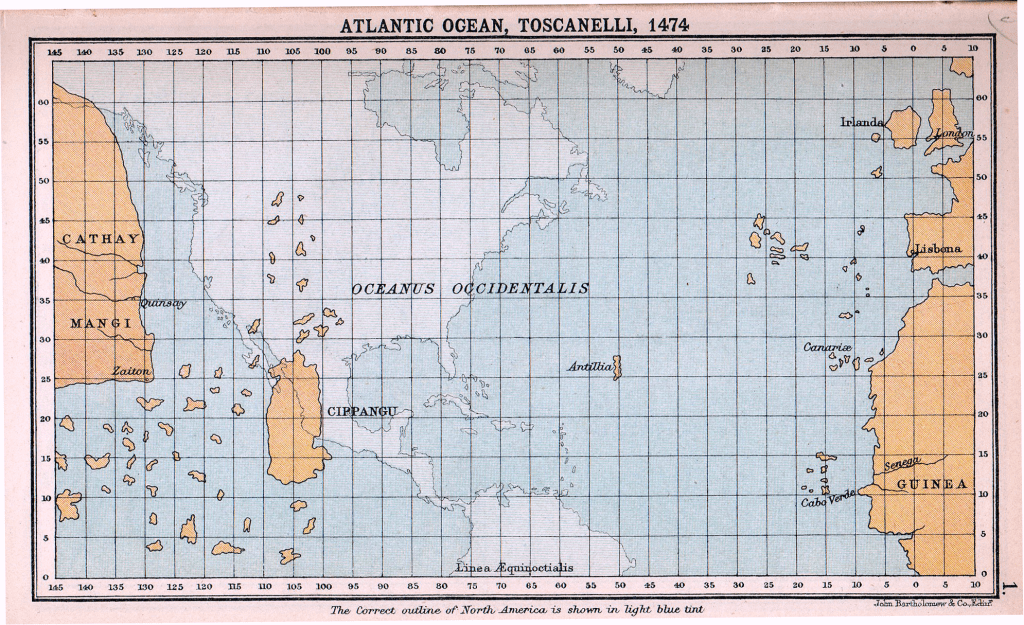
Interpretation of Toscanelli vision of the Atlantic, with approximate placement of the far east (Japan as Ciappangu) and the mythological Antilla island.
This naming confusion, together with other miscalculations like the size of the Eurasian continent, the distance to Japan from the mainland, and the existence of a mythological ‘Antilla’ island east of Japan, made Columbus pitch that he will reach some land about 4,400 km west of the Canary Islands.
He was off by almost 16,000 km if his aim was to reach the vicinity of Japan!
The Taxing Metric
With a continental miscalculation one can see how having universal measurement units helps — unless one has profound ignorance of the continents that exist on the planet to save the day, but condemn, decimate, mutilate and abuse millions of humans who will fall under the administration of that deceiving money-graving person (for more on Columbus’ administration in what was called the ‘Antilles’, modern-day Hispaniola and Cuba, read the reports from his contemporaries).
As transcendental — or not — history-changing Columbus’ blunder and continental serendipity is, this is not the reason for the metric system.
The infamous metric, sadly, comes mainly for taxes, French taxes to be exact.
The metric’s inception was an attempt of unification of measures within France. The kingdom was born out of annexing neighbouring administrations over the centuries, but keeping the local structures mostly intact. Therefore, by the late 18th century it had many different regional measurement systems. The monarchy under King Louis XVI, well on its way to absolutism and centralism, ordered the Academy of Sciences to come up with a unified system. That process was still going on when the Revolution unfolded.
Nowadays, France seems like quite a homogeneous part of the world. Obviously ALL French people wear black-and-white horizontal striped shirts, red-capped berets, are thin and tall, with slim black trousers, both sexes have a spiralling moustache that they continuously apply wax to, making it pointy, while holding a baguette under their arm. While walking, they drink coffee from a delicate porcelain coffee mug sustained only with two fingers.
Beyond exaggerated stereotypes, such clichés just show that such reality is impossible, even more in the case of France.
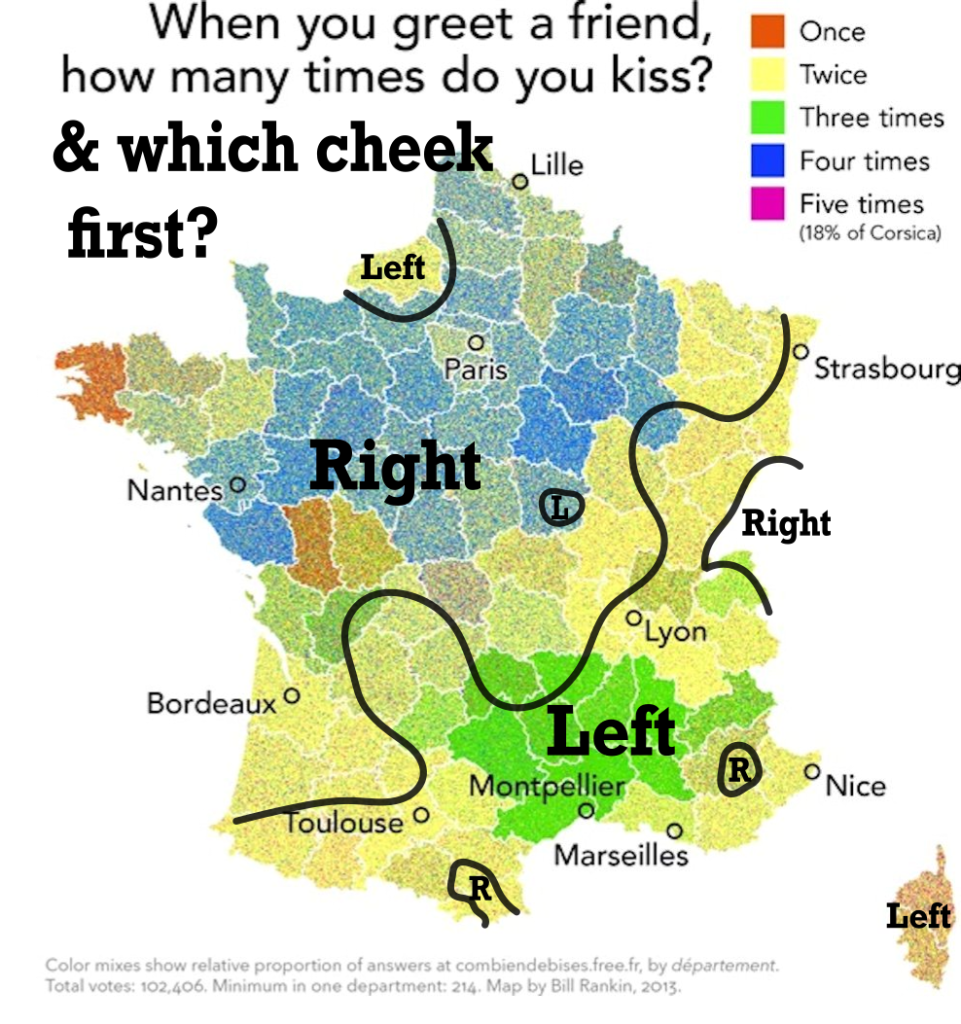
Even today France is one of the most diverse countries in Europe. Up to nine languages are natively spoken there, and its modern borders were not established until after WWII. Moreover, not even kisses are standardised! Depending on which part of the country you are in, you give two, three, or up to four cheek kisses to greet each other. Or you start from the left or right, and these do not even properly overlap (see map).
Adapted from Bill Rankin and Armand Colling (parlez-vous le français?, cheek main direction).
The apparent homogenisation of the metric system actually comes out of that diversity. Citing directly from Wikipedia here: “on the eve of the Revolution in 1789, the eight hundred or so units of measure in use in France had up to a quarter of a million different definitions because the quantity associated with each unit could differ from town to town, and even from trade to trade […] These variations were promoted by local vested interests, but hindered trade and taxation [20][21].
Notice the taxes there. Paris’ post-1789 administration, but pre-republican, had an evident difficulty to grab taxes. The royal piecemeal system evolved over the centuries as a complex administrative, legislative, and executive mosaic landscape that emerged after the ending of the Western Roman Empire, with the monarch only having token powers in much of the lands it had nominal sovereignty over.
The Sun Kings grabbed more and more power over the 17th and 18th centuries, and, simultaneously, squeezed more the French finances. Finally, in a time pre-revolution when finances were in deep trouble — see the origins of the French Revolution — the need emerged to centralise local measures and make them uniform across the land. That kingdom-wide standardisation would nominally aid commerce and taxation.
This standardisation started with length. Scientists already wanted to standardise units — we love that; the fun is in figuring things out, not wasting time in conversions. An initial attempt was metro cattolico, from Greek metron (measure), which is the same root as the metric in music: the counting or rhythm of the melody. It also accounts for meteorology, which is the study of the weather, or accounting for weather conditions one particular place experiences — so much rain, so much cold/hot, so much wind, etc. Accountability can be moral or economic, but, it seems, can also be climatic And in some languages, like Spanish, the weather is called el tiempo, or the passing of time, linking change/weather with meteorology again: a tempo. And cattolico is the same sense as the Catholic Church, which simply means universal church, in opposition to others that were not as universal as them. This did not last long, though.
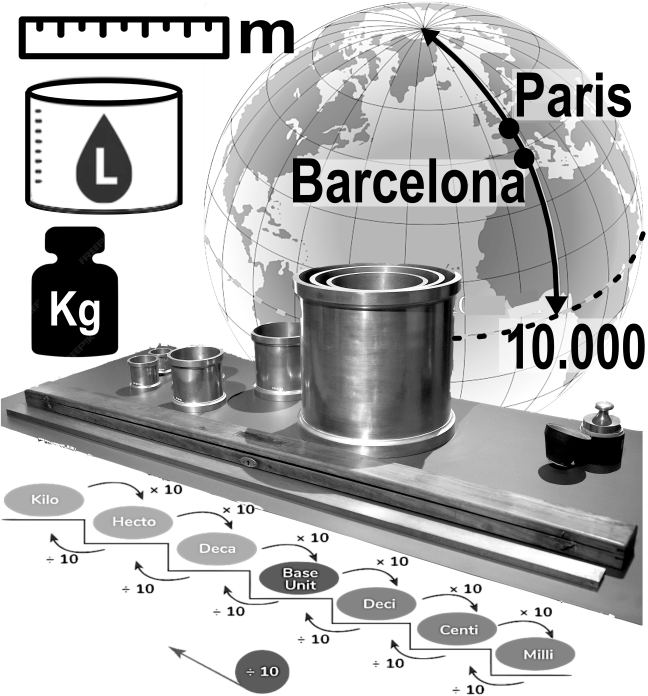
Anyway, the Royal (at that point) académie des sciences decided to base the whole standardisation of measures on the metre. It being a 10,000,000 division of the distance from the North Pole to the Equator following the line that passes through the Paris Observatory, not far from Notre-Dame cathedral. This distance is the Paris meridian arc, at 2°20′14.03″ East. Since this is only ¼ of the circumference of the Earth, the planet has a perimeter of roughly 40,000 km (easy to remember), depending on where you measure it, as it is not a perfectly spherical object but an oblate spheroid.
Moreover, conveniently, the current metre is about two cubits — which is based on human arm length from the tip of the fingers to the elbow — a step (the distance of a human — you know — step), and a yard (the tip of the fingers to the opposite soulder). These length units were widespread in pre-French-Revolutionary Europe, the Mediterranean, and Western Asia.
However, it would not be until 1799 when the current metre was established, and it involves Barcelona, and a lie. Choosing the meridian that crosses the Paris Observatory as the basis of 10,000 km is not only useful for nationalistic reasons. The meridian also allows a long section of land, from sea to sea, in a North–South line in Europe, where distances can be measured with precision, with latitude at each end point, by sea level. The seaside north of Paris is Dunkirk, and to the south the more famous Barcelona. The distance between the two is about 1,075 km, measured by November 1798. The survey manager to the south made an error, estimating the latitude of Barcelona wrong. He remeasured it, but kept it secret. This error would not be disclosed until 1836.
Then académie des sciences used the basis of the metre and water to set the other two standards: weight and volume. The unit of volume shall be that of a cube whose dimensions were a decimal fraction of the unit of length, a.k.a. cubic decimetre, or litre. Then, the weight of distilled water at 0º Celsius (the temperature of melting ice — do not get me started on temperature scales, now that I’m in the US) in that cube shall be, wait for it,
They did not like the grave, or the little grave, which they called gravet (one thousandth of a grave). It did not follow the neat deci, centi, mili categorisation — it should have been milligrave. Then, by 1795, already a republic, the national assembly changed the metric unit of weight to gram, from the Byzantine Empire: one twenty-fourth part of an ounce (two oboli) corresponding to about 1.14 modern grams. So kinda convenient, also a similar name to grain (like wheat grain), though 1 gram is about 20 grains.
Then our beloved litre, defined in 1795 as the volume of one cubic decimetre of water at the temperature of melting ice (0 °C). However, since the kilogram was redefined to be the mass of 1 cubic decimetre of water at its densest point at atmospheric pressure (about 4ºC), then the litre and kilogram no longer match. The story is more complex, but we will leave that for the fearful bureaus — coming soon. The word litre comes from the same root as livre (pound), a unit of weight and the name of the French currency until that moment. Again linguistics shows the equivalencies on peoples minds of volume and weight, which make no actual sense, but we are shaped that way.
For much talk of the litre, it is no longer a unit of the International System, but more on that later. It is still indeed part of the metric system, for the division in multiples of ten, and the kilo, deca, deci and other names for the multiples of 10.
In 1795 the republican France was eager to get more standardisation down their belts. Beyond the m, l, kg trio, they got to standardise the are (100 m2) for area, the franc for currency (from France) —s a side note, the currency was the third one to be on base 10, after the US currency and the Russian one — and the stère (1 m3) of firewood (from Greek, stereós, solid, that’s why people take steroids to have solid muscles, not sure if that’s true but I’ll not bother to check). Yeah, firewood needed standardisation. We are asking what does humanity want; apparently back in 1795 they wanted firewood to have a primary unit of standardisation. The world sure changes.
The académie des sciences and the national assembly tried to standardise time too. It would have been decimal: one republican second being 1/100,000 of a day, so bout 0.864 of a Babylonian one, which actually is closer to one human heart beat per republican second, as the heart usually beats a bit faster than once per babylonian second. But we have seen how that went down the drain because the British did better clocks, as we have seen. So much for French vs British clichés and stereotypes.
Beyond seconds’ failure, the metre and weight also failed at the end of the French Empire, the first one. Well, their definitions, to be exact. Because exactitude was the problem.
For the metre, the “Barcelona lie” had been intended to ensure international reproducibility. Who would have thought! This was impractical. So the world lost tourists from all nations coming to Barcelona to measure its latitude and distance to Dunkirk. The city has other issues with tourists, though. Beyond that, the “Barcelona lie” was a small error compared to the “gravitational lie”, i.e. the Earth’s surface has no exact gravity everywhere on its surface, making the planet not a spheroid but a geoid: a kind of potato, a really smooth potato. In actual terms that means that the meridian arc that crosses Paris’ Observatory is about 2 km longer than estimated, so 10.002 kilometres. Or the metre being 0.2 mm shorter than it should be.
In any case, the meridian measure was abandoned and a metal bar held in Paris was the actual definition. We now had a 19th-century French mostassaf. Not a great progress, but at least the units were easy to remember.
For the gram, the “be water, my friend” did not work either.
Humans tend to put our mind into precision once we get a target. The target was universalisation that could be measured. A mass standard made of water was inconvenient and unstable. It depended on the pressure, which was dependent on other measures. Moreover, even pure water is not “pure water” everywhere in the world. Making it “pure” might be difficult if one only wants H2O molecules in it. And beyond being H2O, the ratio of oxygen and hydrogen isotopes (different masses of an atom) is not constant: it might “weigh” differently even though it occupies the same volume.
Therefore, since you already went to the French mostassaf to ask for a copy of a metal bar for the metre, since you were at the door, why not ask for a copy of a kilogram too? Thus, they made a provisional mass standard of the grave, ehem, kilogram.
This was THE metric for much of the beginning of its history, that is, until the fearful bureaus arrived!
Oh, one more, just one more before we go to the infamous Metric System!
What are we reading now? Yeah, text. But how is it written? It is English using the Latin alphabet (more on that later), but the point I am making is this .
That space between the . and the ‘this’ is not by chance, it is punctuation, which has grown to be another quasi-universal standard, a bit earlier than mathematical and music notation.
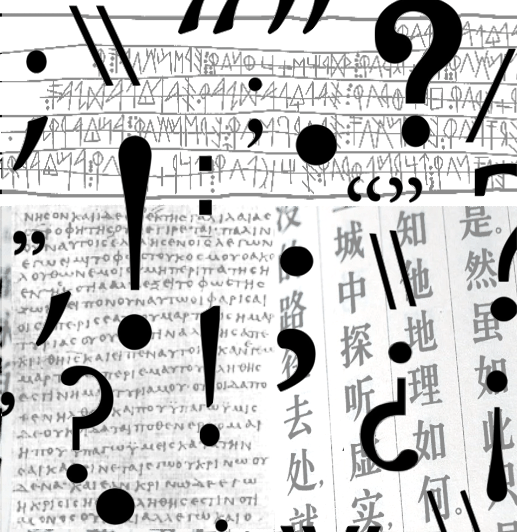
Punctuation, from Latin punctum (dot) — the dashes, squiggles, dots and spaces you are reading now — is so normalised that I barely noticed it until I started this project. Yet it is one of the “global standards” in writing beyond a specific alphabet, quite like algebraic signs are virtually universal among numerical systems beyond the Arabic numbers.
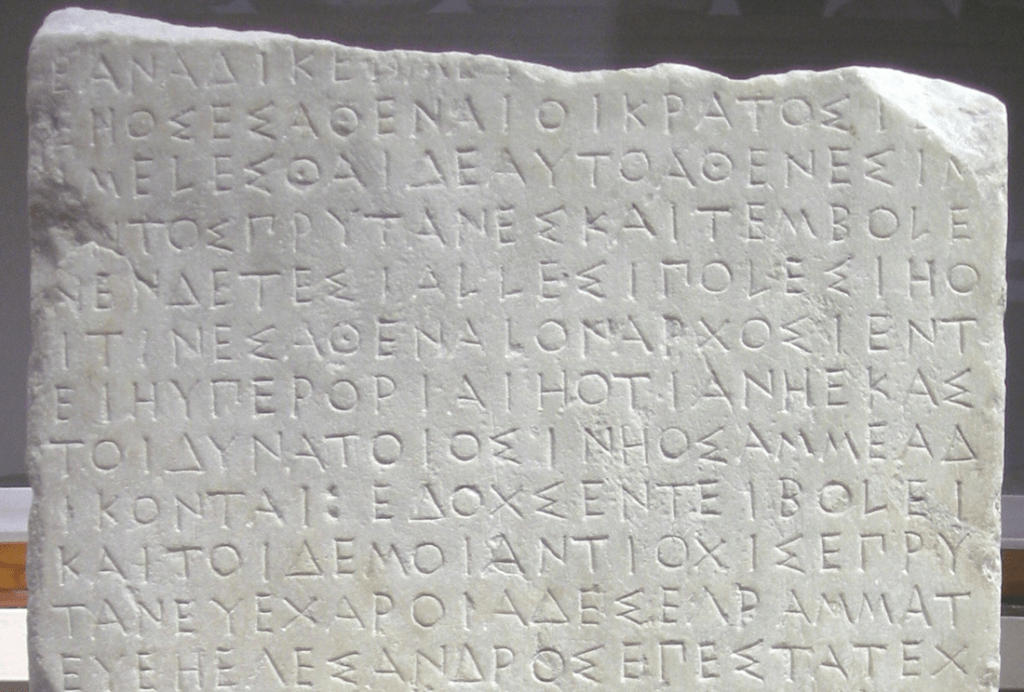
For most of human literary history, texts in many alphabets looked more like this: scripturacontinuawheretherewerenospacebreaksorparagraphs — a long, breathless string of letters rolling inexorably forward. And they still look like this if you are reading Javanese: ꦱꦧꦼꦤ꧀ꦮꦺꦴꦁ ꦏꦭꦲꦶꦂꦫꦏꦺꦏꦟ꧀ꦛꦶꦩꦂꦢꦶꦏꦭꦤ꧀ꦢꦂꦧꦺꦩꦂꦠꦧꦠ꧀ꦭꦤ꧀ꦲꦏ꧀ꦲꦏ꧀ꦏꦁ ꦥꦝ꧉. Here, the way the words themselves are written together, the ups and downs, does indicate a cadence in the reading.
Japanese kanji and Chinese ideograms are still traditionally written without spaces, as each sign, or pair of signs, represents a concept, but modern writing in these systems does tend to use spaces and punctuation, like , (comma) and 。(period).
In fact, the division of words into discrete units of text is kind of artificial, because spoken language does not work like that. It is hard to notice, but when we talk we kind of talk in a scriptio continua, or more aptly, talkacontinua.
Notice next time you talk: we do not add little pauses between words. In written terms: we. Do. Not. Speak. Like. This. And, honestly, that would be a bit of a waste of time.
Our brains have evolved to process around 10 phonemes per second, irrespective of how many words are in there. So we hear them all at once. The record of most phonemes pronounced and understood in one second stands at 23 (depending how one counts phonemes).
That is equivalent to this sentence.
Talked and understood.
In one second.
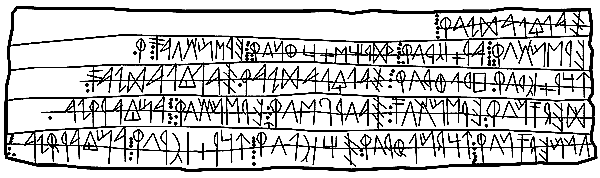
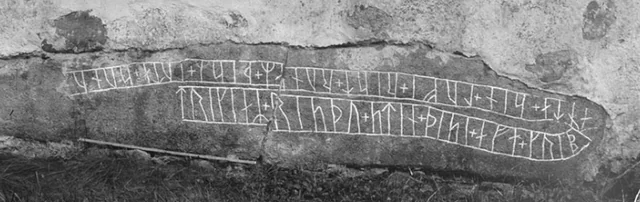
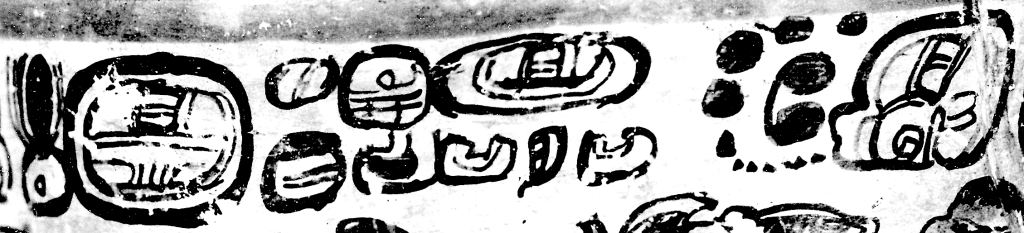
In Latin, writing without punctuation and spaces was known as scriptio continua. It was common in most ancient scripts, including hieroglyphs, cuneiform, Chinese ideograms, Tibetan, Sanskrit, and even the Maya glyphs — maybe with the exception of Old Uigur/Mongol scripts, which connect the phonemes of each word by a vertical twig-like line, thus separating words if the lines were not connected.
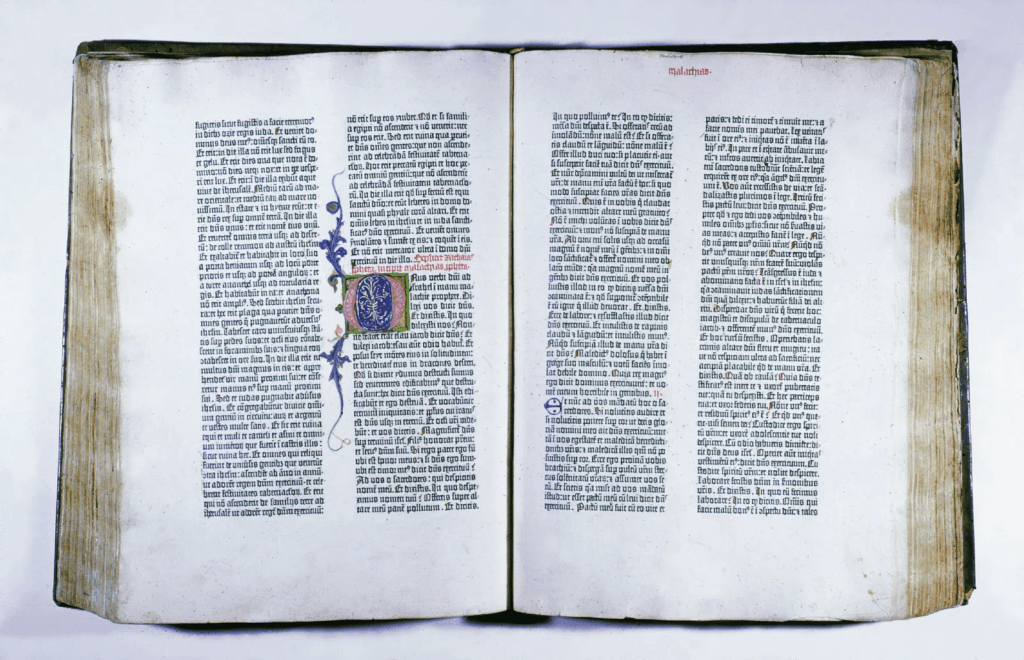
Thus, from the scriptio continua, writing in the pre-printing press world was not simply to store knowledge and pass it on as text. No, the purpose of writing was to assist the performance of the text — kind of like the prompter notes that theatre players use to help deliver the lines. Early texts were supports for the oral tradition, not replacements for it.
Text just travelled as a kind of parasite of the much more popular and extensive oral tradition. Literary text was mostly a device helping with memorisation, which was the core of the whole cultural transmission. And the oral performance was a skill to be kept, practised, valued, specialised and perfected.
The text on papyrus and tablets, in most of the cases, is the equivalent of prompters from the ancient world. Thus punctuation was neither necessary nor standard. Why mark pauses when the pauses already existed in the bodies and memories of the performers?
Reading was not a silent, private act; for most of human history, storytelling has been a performance, usually given by trained bards and poets.
Even today, many cultures which were until recently purely oral in nature, or still are, value immensely the individuals in their group who do keep these oral traditions alive. The more songs and stories you remember, the more appreciated you are and the higher status you have.
Moreover, there are many cases of individuals who, due to old age or life events, have lost sight. Some of these might specialise in oral storytelling and poetry, making them really valued members of their society, despite the difficulties that not having sight might otherwise entail.
The divisions in sentences, the pacing, the pauses — all of that lived in the voice, not on the page. The written text was a mnemonic scaffold, a reminder of what you had already memorised, or at least heard performed professionally. If you were not trained in the piece, staring at lines of continuous text was like, after an all-nighter, being put at a blackboard in front of a class to do complex arithmetic — the kind professor would kindly put you to sit and make you listen instead.
Night-bed reading, as much as many of us love it, is a rather rare and recent tradition.
Again, the classical Greek texts had some visual guidance that can be interpreted as early punctuation.
By the 3rd century BCE, reportedly, Aristophanes of Byzantium introduced a system of dots at different heights — low, middle, high — to represent different lengths of pause. It was not quite “.” “;” “:” yet. The Greeks also experimented with marginal marks, paragraph dividers, and diacritical hints.
Iberian, a different ancient script from the region I am from, Valencia, also has in most instances several dots as separation between words.
In my childhood, I observed these wiggly scripts, which many times seemed more out of the hand of a child than a neatly curated Latin text that we see all around us in print, or even in the old Latin scripts that will be nearby in a museum or exhibition.
In my child-mind, I considered the need for dots in these Iberian scripts to arise naturally due to the seemingly chaotic nature of the writing itself, in contrast to the well-arranged ones, that needed only a clear space. The letters in the above example (read right to left) are uneven. Many of the texts often needed horizontal lines to arrange them, the same way that we children were taught to write between straight lines at different levels. Thus, neat writing handled by experts and people familiar with recitation did not need the ‘wasteful’ separation of spaces, while writing by people (or children) where writing was practised more sparsely used punctuation more often, albeit not overly standardised. In the case of Iberian script itself, only a few thousand rather short texts survive, despite this cultural group extending over hundreds of well-studied settlements, and the script itself being in use for 400 to 600 years.
The later Runic scripts — which incidentally look similar to Iberian — are also short texts, often wiggly and fitted inside guidance lines. Also, only a few thousand runic texts still remain. These, like Iberian texts, commonly have ways of separating words and sentences, like dots, lines, crosses, or sections of a serpent!
Moreover, in Maya texts decorating ceramic vessels, we find one or two thick lines or two or more vertically arranged dots or circles, sometimes with small fiddling fillers added, indicating the end of sentences. These ceramic texts often were, we can say, more amateurish, less elegant and “space-conscious” than the palace walls or surviving codices — a bit like the wiggly Runic and Iberian scripts.
Another clear example of how text was just auxiliary to recitation is the vast genre of didactic poetry.
Humans are quite good at remembering songs and poetry, especially when held under a predictable metric and rhyme. Since in the past text was not ubiquitous as now, people had to memorise most of the important content they needed for technical and theoretical knowledge as rhythmic songs that they would recite. Potions, medications, how to plough a field, how to seduce someone, history, geography, the origin of the universe, atomism, to name a few — all these things were carefully adapted to poetic form once widely used so people could access the memories stored as songs and recitations at the tip of their tongue, when smartphones and Wikipedia were not an option. Or imagine how a pub quiz would be if people started reciting the names of rivers in rhymes to crack an extra few points remembering the fifth longest river of the state. Or the pharmacist recited some poetry to make sure that the medications you are taking are not incompatible with each other.
Interestingly, one of the most influential texts in history, the Qurʾān, contains much of this didactic format. It has a kind of scriptio continua, called rasm. Until 1924 CE, when the Azhar Qurʾān, or Cairo edition (1343 AH), was printed, most, if not all, texts of the Qurʾān were written in a kind of skeletal text containing mainly the consonant pronunciation of the words in the Arabic alphabet, and without the standardised punctuation nor things like ! ? and diacritics.
The Cairo edition now is the most widespread Qurʾānic version. By 1343 AH there were 14 different standardised ‘recitations’ of the Qurʾān, that is, how to read the scriptures orally. The differences are subtle, but a pause can be different, and we know that in punctuation a point or a comma might be critical, so more importantly, the differences are contextually equivalent. The rasm itself was quite homogeneous, though different versions also existed, and the Cairo one chose al-rasm al-ʿuṯmānī as the orthography of the Qurʾān, that version being the shortest one.
As we have seen for the case of musical notation, originally, much of the written text was used as a mnemonic device to help with public recitation, not to read by the bed.
The Qurʾān was mostly intended for that use, as a recitation. In fact the word Qurʾān means ‘he read’ or ‘recited’, clearly spelling the intention of the text to be recited and read aloud. The act of reading the Qurʾān in the original Arabic has been made into an art. Many of the verses and surahs, or sections, have quite a poetic reading to them, and when travelling in Muslim countries it is quite melodic to hear imams reciting parts of the Qurʾān, or the muezzin doing the call for prayer, adhan, in the original Arabic. These rich, art-like forms of oral recitation might explain the long time until it was accepted that the Qurʾān could be printed, because many Muslim clerics initially refused the verses to be ‘soiled’ by a typographic technique.
What the Qurʾān exemplifies beautifully is this long-lived tradition of textual to recited mapping, where text and oral tradition cohabit the same space for centuries, and even such an important text as the Qurʾān was only printed in an accessible reading way accepted by a Muslim authority by 1924 CE, or 1343 years after Hijri.
Beyond the Afro-Eurasia context, Mayas, again in ceramic paintings, also compressed text in such a way that was just the skeletal support of well-known recitatory formulas. These were so standardised and well known that not all elements had to be written. So, like in the “old world” textual traditions, knowledgeable readers simply knew missing parts by heart. In fact, in Maya scripts, the quotative chehen “so they say” basically is saying that the text was conventionally recited, not unlike the Qurʾān.
On the non-Arab, post-Latin European geographies, the discontinuation of many of the philosophical and academic schools existing in the western side of the Roman Empire quickly fell out of fashion due to a multimodal impact of shocks: wars, economic collapse, fragmentation of networks, migration, substitution of the political powers by the “barbarian” populations which generally valued less such cultural traditions, the famine after the volcanic winter of 536, the consequent Justinian pandemic from 541 to 548, and recursive waves. That continuous conflict, famine, and pestilence ruralised much of the urban centres in that side of the world.
Moreover, a kind of “cultural inquisition” by the hands of a more militant branch of Catholic bishops that dismantled institutions linked to ‘pagan’ knowledge, or not emerging from Christian faith, erased much of the previous recitatory practices and transmission of many of the non-Christian texts. This combination of effects made the common parallel co-transmission of scriptio continua and recitation much rarer, especially in the western, or Latin, part of the previous Roman Empire lands.
The inheriting kingdoms and lands, thus, had a much smaller and scattered pool of experts to pass on how to actually read texts. In this environment, people scarcely or never listened to recited texts beyond clerical ones. Thus, when accessing a bloctextofscripturacontinua could be a challenging task for non-initiates without the oral form.
With fewer professional reciters, fewer schools, and fewer trained scholars circulating texts, the ability to “just know” where the pauses and cadences in the scriptio continua were was becoming rarer and rarer. A bit like the Iberian texts, which were quite rare too. This is when Isidore of Seville (560–636 CE), born in Iberia around half a millennium after the Iberian script lost its use, strongly pushed for punctuation standardisation, which many adopted.
By the 7th century, scribes in Ireland were adding more systematic spacing, word division, and symbols to ease public reading. The so-called punctus elevatus, punctus interrogativus, and other medieval marks begin to appear.
The rise of punctuation might be more a story of necessity born from the fading of oral memory, not unlike the rise of emoticons is a necessity born from the need to communicate casual information textually while face-to-face, and even telephonic interaction is fading.
Among the medieval innovations was something resembling our modern question mark. Originally a kind of elevated squiggle or stylised semicolon, it served to mark an interrogative tone in Scripture, telling the reader: here, please raise your voice before the congregation in a questioning way.
Medieval scribal marks were not invented for grammar as we understand it today — they were needed to assist performance in a performance-scarce world. They guided breath, rhythm, emphasis, and tone to the uninitiated. It was a more sophisticated prompting which might need less rehearsal, or initially avoid the need to hear it being recited before performing it. In this way the text can more easily travel by itself, without the need to be accompanied by a person who knew how to properly recite it, not unlike the musical notation that we have seen.
Printing press, killer of recitation
Here is where we introduce the printing press. Not so much revolutionary because it allowed cheaper copies of text to travel further and reach more people, but because it did for punctuation what the metric system later did for measurement: standardisation. Once texts could be mass-produced at a speed far exceeding the capacity to mass-produce and spread reciters, writing needed to be self-sufficient. The recitative transmission could not keep up with the changes, and punctuation was needed to ease rapid access for naïve audiences of new texts.
Punctuation became a technology for comprehension. The Guenberg Bible, looks kinda the scripturacontinua, but does have different punctuation signs and rules. Punctuation will be standardised later. Early presses, like the Venetian Aldine, popularised many of the marks — the comma, semicolon, full stop — in recognisable modern forms. The Aldine press also popularised modern formats of books, in portable “paperback-like” sizes.
Silent reading expanded, literacy without reciters first became affordable, accessible, and then widespread. In the process punctuation became a more standardised system across Europe.
Meanwhile, Arabic used spacing, diacritics, and occasional marks, but not the panoply of Western punctuation.
Outside Europe, South Asian scripts like Devanagari developed marks like the danda (।), but did not have Western equivalents until modernity.
With global printing, colonial administration, missionary presses, and later digital technology, many systems adopted Western punctuation by the 19th–20th centuries: the full stop, comma, question mark, and brackets appear regularly in Mandarin, Korean, Japanese, and Hindi texts today, even alongside entirely different scripts.
So Western punctuation is now nearly universal, though local variations and older indigenous traditions still coexist.
Interestingly, such standardisation emerged and consolidated at the same time as the mathematical and musical one, from XV to XIXc, also the same period of Western domination that we have covered.
Beyond the imperial apparatus, what these standardisations and universalisation show is the need and desire for ways to capture as accurately as possible form and meaning by increasing affordability of the form. These forms (music, accounting/science, recitation) where more accessible and circulated faster by reducing the need to have face to face interaction and transmission of knowledge and information.
While person to person interaction might produce, at first, more nuanced transmission, once the distances to travel, and the ease to copy, made other formats much more abundant than training and shipping living beings, then these dominated, and where even adopted in most of cultures of the world in one way or another.
Once you have trained people on the same codes at different parts of the planet, you do not need to send more trainees, just mroe coding to be processed. Sending a computer code is easier and cheaper than sending the whole computer over, even if you are more warranted that the code will work more accurately in the original computer, or a close reproduction of it. Paper is cheaper than people, if you have people on the other end to read the same signs, send the printed thing, not the person.
The Emoji Epiloge
And just as mass literacy once strained writing’s ability to convey tone, modern digital short-form writing strains it again. Text messages, tweets, and emails lack intonation, facial expression, and gesture — the very things punctuation once tried to restore.
So, almost inevitably, a new form of punctuation emerged: emoticons and emoji.
They compress emotion, tone, irony, and doubt into tiny digital glyphs — modern versions of breath marks, pauses, or rhetorical flourishes. In a way, they represent a second separation of textual and oral traditions: the written is now so independent of the spoken that we need new symbols to compensate for the loss of nuance.
Interestingly, emojis come out of combinations of signs that were not intended as emotional significance, but as grammatical expressions, such as the :), being just a left parenthesis and two dots.
Piggybacking in the interconnected world, many of these emojis emerged across the world, notably Japan, but are standardised as modern glyphs in the US.
Nevertheless, in a short time, emojis have emerged as a new global standard that permeates all the world.
Before entering into the infamous metric system, let us dive deeper into the basics: mutual understanding. We have been dismantling what makes the “Western dominion” narrative so appealing; therefore, we need to look deeper at the foundational building blocks of our new age —where “humanity” can ask itself deeper questions. We have seen how commerce pushes connectivity and enables some basic communication, and how global standards emerge with the examples of timekeeping and mathematical notation. These, however, feel hopelessly limited for any meaningful exchange, as analytic philosophers discovered in the 20th century.
As with our thought experiment on first encounters, to establish an exchange one needs a basic set of communication rules. We have seen that pointing and smiling are human universals. These small gestures, in our thought experiment, allowed the initial connectivity of diverse groups of humans and contain the basic building blocks needed to create connections. To build upon that and ask complex collective questions, we need more sophisticated communication strategies. Fortunately, as illustrated, humans are born with such a strategy —or the capacity for it: language.
Indeed, if one looks at the history of many well-established exchange networks between different peoples, these are often associated with the development of a mutually understandable, but initially basic, pidgin language. As outlined, human brains seem to be made for this relatively easy acquisition of a second, third, fourth, or fifth language. Therefore, we possess not only the drive to learn a language but also the capacity to acquire additional ones —probably linked to the early onset of exchange networks in anatomically modern humans.
In the case of pidgins, these are even more interesting, as a common set of communication bits and pieces is put together on the fly by a diverse group of people who do not share a common language. Pidgins are a more or less complex set of communication strategies based on the languages already spoken by the peoples who come into contact, mixing concepts from different backgrounds. They first establish a basic shared vocabulary around a limited set of objects and actions, as is the case with linguas francas for trade and exchange. How easily pidgins can be constructed, and how organically they are established, further indicates that our brain seems to be built for social communication and for creating shared standards relatively easily, transmitting increasingly complex and abstract concepts that a language captures.
Depending on the depth of contact between the peoples with different backgrounds, the basic code —initially based on a limited shared vocabulary— can evolve to borrow the grammar of one or more of the languages involved. Grammar then becomes the scaffolding on which the vocabulary is built. These are the basic ingredients of a pidgin language. Pidgin languages then become more or less complex depending on the depth of contact, interaction, and areas of life that must be discussed. The most basic form is, as described, pointing, smiling, and saying a few shared words. At the other extreme is the creation of a brand-new language to be used by the descendants of the peoples in contact. At first, nobody speaks a pidgin as their first language. However, many of the pidgins associated with strong exchange networks have grown in complexity until they adopted all the characteristics of a fully-fledged language —spoken by many as a second language and eventually as a first language. At this point, this new language is often called a “creole”.
When a simplified language of a place is used as a trading language —while borrowing many, many, many elements from other languages— this creation is often called a lingua franca. The distinctions between lingua franca, “pidgin”, and “creole” are not clear-cut, and depend on how much influence one specific language had in the creation of the exchange code. However, in all cases, a lingua franca is not an exact copy of the parent language; it often includes vocabulary borrowed from other varieties and languages and always adopts a simplified grammatical structure.
In the case of Lingua Franca itself (or “language of the Franks”), it was in fact a commercial language spoken mostly in the eastern Mediterranean and North Africa. It was brought to these regions by North Italian (Genoese, Venetian, Pisan…) and Catalan sailors. It was not called Franca because it was spoken by the Franks or French, but because during the late Byzantine Empire, “Franks” was a blanket term applied to all Western Europeans due to their prestige after Charlemagne. In fact, over time, that language —used for commerce across the ports of the Mediterranean— was largely influenced by Italian dialects, Catalan, and Occitan more than by French. That early commercial language, lasting from the 10th to the 19th century, is what gave the name to the concept of linguas francas, or a functional language providing basic understanding between many trading peoples with different socio-cultural backgrounds. In this text, franca for short is a functional term, independent of any linguistic history or language structure. That concept can also be applied to pidgins and creoles, or whole languages like Hiri Motu —which is neither creole nor pidgin, but simply a franca from southeast Papua of Austronesian origins used for trading voyages.
Returning to the impressive Malay seafarers and traders, the current Malay language, or Bahasa Indonesia, is a language that originates from Old Malay, mostly spoken in Malacca —the great trading centre that the Portuguese conquered in 1511 CE. Old Malay, also known as Bazaar Malay, Market Malay, or Low Malay, was a trading language used in bazaars and markets, as the name implies. It is considered a pidgin, influenced by contact among Malay, Chinese, Portuguese, and Dutch traders. Old Malay underwent the general simplification typical of pidgins, to the point that the grammar became extremely simple, with no verbal forms for past or future, easy vowel-based pronunciation, and a written code that reflects the spoken language.
Back in 2016, I travelled for a few months through the Malay Peninsula and the Indonesian archipelago. During these trips I could easily pick up a few hundred words which allowed me to have simple context-based conversations despite my general ineptitude with languages. I was surprised by how much understanding could be achieved without even using verbs! The language had evolved such that verbs like ‘go’ and ‘come’ became prepositions like ‘towards’ and ‘from’, allowing me to build simple sentences describing my itineraries without proper verbs. This anecdotal example illustrates how Malay evolved to enable extremely easy preliminary communication.
But Malay is not only a franca. This is exemplified by the extreme complexity and nuance in vocabulary and verbal sophistication required to address your interlocutor based on their relation to you. You need a special way of addressing someone depending on whether they are a man, woman, young, old, or of higher, equal, or lower social status. This likely reflects the language’s other origin: High Malay or Court Malay, used by cultural elites and in courts, where making explicit hierarchical relations was (and still is) crucial.
Today, the language dominates the Indonesian archipelago, the Malay Peninsula and Brunei, and is also widely spoken in Timor-Leste and Singapore. In Singapore, however, the official and de facto trading language is English —but we’ll talk about that trading hub and English later. Malay is spoken as a first language by millions of people, but it is far more common as a secondary language, with almost 300 million speakers. Most of these speakers also know at least one other local language, like Javanese — spoken by nearly 100 million people— or Bazaar Makassar, another franca used by the Bugis, who historically landed on the shores of Western Australia for centuries.
Interestingly enough, modern Malay descends from a language spoken in ancient times in east Borneo. This language also gave rise to Malagasy, spoken by most of the population of distant Madagascar. The language arrived there via Malay seafarers and later traders. Afterwards, Bantu peoples from southeast Africa arrived and mixed with the Austronesians, giving rise to modern Malagasy —the only native language on the island (though it has three main dialect families). Apparently, nobody had the need to create new languages in this 1,500 km-long island.
The Bantu peoples themselves are also the carriers of one of the World’s largest francas: Swahili. It is spoken by up to 150 million people. Originating as a coastal trading language, it spread to the interior of East Africa, connecting the coast to the Great Lakes, and became a franca across the region and a mother tongue for many urban dwellers. It arose in present-day Tanzania during trade between the island of Zanzibar, inland Bantu groups, and Arabs (particularly from Oman). The Omani Imamate and Muscat Sultanate controlled Zanzibar and the Tanzanian coast during the 18th and 19th centuries and held considerable influence through the slave and ivory trade, among others. The name “Swahili” itself comes from the Arabic word for “coast”. Arabic has contributed about 20% of Swahili vocabulary, with words also borrowed from English, Persian, Hindustani, Portuguese, and Malay —the region’s main commerce languages. Like Malay, Swahili has a simplified grammar common in francas, making it easy to learn and pronounce. These traits have made Swahili a contender for a global communication language.
Beyond commercial francas, there are languages used exclusively as cross-border platforms for intergenerational communication, but which are not native to any sizable population. These languages are like frozen structures, called upon to allow a group of people to mutually understand one another.
Classical Latin is one early example of this function. By the 4th century, Romans were already speaking a language quite different from what Augustus spoke 300 years prior. Different parts of the empire used highly dissimilar versions of Latin, and Classical Latin served to maintain a unified system. That “old Latin” was standardised for literary production and, crucially, for imperial administration. After the division of the Roman Empire, the Western Christian Church also adopted a version of Classical Latin for internal operations: Ecclesiastical Latin. Previously, early Christians used mainly Greek and Aramaic —as we willl see.
Over time, Ecclesiastical Latin became the international language of diplomacy, scholastic exchange, and philosophy in Europe, lasting for around a millennium. It was not fully standardised until the 18th century! By then, linguists were eager to fix languages as words changed meaning too quickly —as the analyitical philosopher Russell observed. Ecclesiastical Latin flowed into the emerging sciences. The main works of Copernicus, Kepler, Galileo, and Newton were written in Latin.
But this Latin was a written language —no one really spoke it. And, unlike Swahili or Malay, it was far from easy to learn. Any Latin student knows how difficult it is to memorise its multiple, complex inflections. It became a written fossil spoken by basically no one —except a few geeks. That made the other nerd in the Peano-Russell nomenglature propose a simplified version of Latin, Latino sine flexione, as the Interlingua de Academia. Peano, being Italian, had skin in the game. For us native latin languages speakers, such as my Catalan, a simplified academic Latin would be a great advantage compared to “ahem” we know what. But more on that and created languages to be international standards later.
Today, a stripped-down Latin does survive in science —particularly taxonomy, where the classification of living things (especially plants and animals) uses Latin binomials. For instance, humans are Homo sapiens, wolves are Canis lupus, and rice is Oryza sativa. Many scientific terms —especially in astronomy, physics, and cosmology— are still derived from Latin. So, through science’s dominance as the global system for classifying the world, Latin vocabulary lives on. It has become a kind of global pseudo-language, used by experts worldwide to communicate about shared topics but just as individual words, without any structural coherence.
Latin is but one example of an imperial language transformed into a franca and liturgical language. Another —and much older— example is Aramaic. Aramaic had the advantage of the simplicity of its written form. Unlike the complex cuneiform writing on clay tablets, Aramaic used a simple 22-character alphabet, which made it easier to learn and spread. This accessibility allowed it to be adopted in administration, commerce, and daily communication in a linguistically diverse region. The Achaemenid Empire adopted it as an administrative language, standardising “Imperial Aramaic” alongside Old Persian. Bureaucracy, scribal schools, and widespread official use helped it expand far beyond its original homeland —and its legacy lasted for over a millennium.
As with Latin, Aramaic became the medium of religious texts. Many Jews returning from exile after the fall of the First Temple continued speaking it. Scribes translated the Hebrew Bible into it, and large sections of sacred texts ended up in Aramaic. Other Levantine prophet religions like the Manichaeans also adopted it. One of these, Mandaeism, still survives, and its followers still speak a version of Aramaic. Eastern Christians adopted Syriac —an Aramaic dialect— for theology, hymns, and lengthy religious debates. Aramaic became the franca of the ancient Near East: everyone could participate. Thanks to that, like Latin, the language outlived the empires that spread it.
So, with these examples, we can begin to draw some principles for how linguas francas are established, spread, and sustained across space and time. They tend to offer accessibility benefits, borrow heavily from multiple languages, are often secondary but can become primary languages (especially in cities), and most importantly, serve specific purposes: commerce, administration, religion, or technical use. Perhaps we can even distinguish between written and spoken francas: spoken ones often have simplified grammar, are easier to pronounce, and accommodate mixed/macaroni forms. (Cool word, “macaronic” — look up its history!) Written francas, on the other hand, may retain complex grammar but offer easy ways to record text. Of course, ideographic systems like Mandarin or Japanese kanji present another accessibility puzzle —one we willl explore later, as they are closely tied to another leg of francas: formal state education.
In a world that is becoming more technical, more bureaucratic, and more formally educated, there is now ample space for new linguas francas to be established, maintained, and —for the first time— reach global scale. It is in these languages that we will begin to ask ¿what does humanity want?
Before moving to the quasi-universal metric system —which includes the archaic Babylonian timekeeping— let us focus on probably the first universal lingua franca: mathematics. And not mathematics as in “the language of the Universe”, but mathematics as in “the set of codes, rules, concepts, and ideas that are shared and approximately mutually understood by any human using them”.
As we will see, many linguas francas originate as an often simple code (compared to a general-use language), developed rather quickly to serve a specific function. In many cases, that function has been simple commerce and exchange, where the number of items to “exchange” is limited, and the rules of the game are simple —possibly including locally standardised accounting, such as produce and monetary units, and standardised measures like weights, surfaces, and volumes.
The linguistic and symbolic part of mathematics, therefore, is not so different from commercial linguas francas. What sets it apart is that, as of the 21st century, virtually everybody using “mathematics” as a functional system —mostly algebra and calculus— uses the same notation. In other words, it is universal.
This is not surprising: when one thinks about a universal language, one often refers to mathematics. However, like with timekeeping, how we came to the specific and well-known set of symbols +, =, ÷, ∞, … has its own history.
Mathematics and mathematical notation, although common in the current world, took centuries to take shape. Over generations, it was agreed upon by scientific, technical, and mathematical communities in Europe, the Middle East, and South Asia to use the same kinds of symbols, numbers, and conventions to refer to the same concepts.
Interestingly, these “concepts” themselves were (and are) thought to be universal, even beyond the human realm —i.e. the number 3 is the same in all parts of the Universe. Therefore, unlike goods and commercial language, which had local characteristics, mathematical notation is expected to be written in the same way by everyone using those concepts and wanting to share them, regardless of location. The same applies to signs and symbols like +, =, ÷, ∞, which any reader would most likely recognise regardless of the language being used.
For some reason, written mathematics —often calculus— has always been something of a special case in many cultures. We can write numbers as they are spoken in a given language —like zero, one, two, three in English, or cero, un, dos, tres in Catalan. But often, across many writing systems, numbers have been chosen to be represented by symbols, for example: I, II, III… (Roman, no zero), 0, 1, 2, 3… (Arabic, from South Asia), 𝋠, ·, ··, ··· (Mayan, perhaps the 0 doesn’t display in Unicode), 零, 一, 二, 三 (Chinese, 零 meaning something less than one, yet not nil).
These examples show that from early on, people decided it was better to simplify numerical notation —to the point that doing otherwise seems like suffering. Try writing down the year the Portuguese took control of Malacca in the Common Era calendar: one thousand five hundred and eleven, or one-five-one-one, if simpler. Write it. Stop reading.
How do you feel?
I bet it’s a pain, and it feels right to simply write 1511. A similar thing applies to phone numbers. If you’ve ever used certain online platforms that do not allow phone numbers to be exchanged, you cannot send them using digits. A workaround is to write them out in words —for example, “one hundred and twelve” or “eleven two” instead of 112. It’s not much more effort to spell the numbers, but it still feels like a pain knowing that a shorter, cleaner alternative exists.
Although people must learn two different systems to write numbers —instead of just the phonetic one— which might seem like more effort, in the long run, simplification tends to dominate. This preference for simplicity is similar to what we will see in francas, linguas francas: the adoption of a shared, simplified, functional language is preferred over a fully developed one. So, the basis of our mathematical universality might have less to do with the Universe and more to do with a universal feeling: tediousness.
In the case of mathematics, despite numerals having been used symbolically for millennia, the simplification of other concepts —like “sum”— into symbolic script is a relatively recent development. This is exemplified by the fact that signs equivalent to + are not found in many older written systems while there is a diverse set of equivalent signs to 1. Things like +, and -, are known as “operators” in mathematical terminology. Interestingly, many of these operation symbols —unlike some numerals that are simply dots or lines —have phonetic origins. Phonetic symbols were already present in some numerical systems, like one of the two Greek numerical systems, where they would use Π as five (short for pente, 5 —Π being pi, capital P in Greek), or Δ as ten (short for deka, 10 —Δ being delta, capital D). The other Greek numerical system simply assigned the order of the alphabet to the numbers, being 1, being 2, etc. Many societies around the globe have developed advanced mathematical notations. However, none of them used algebraic notation like + to mean “sum”. Other mathematical systems worked with geometry to describe concepts, or used written linguistic statements.
Linguistic statements was the European method too. Before symbolic expressions, European mathematicians wrote their sums. For example, they would put on paper: “3 plus 5 equals 8”. Since that was a pain —like writing numbers in words— they simplified it to “3 p 5 e 8”. The operations had no proper symbols, just words or shortened initials understood by context. In fact, the sum symbol, +, is one of the earliest to appear in written arithmetic. Although it originated by mid-14th century, it was only commonly used by the 15th century. While there’s no universal agreement on its origin, it most likely comes from a simplified script of et, Latin for “and”, but nobody really knows why.
Algebraic notation to define operations was strongly promoted by the Andalusi mathematician Alī al-Qalaṣādī in the 14th century, where each sign was represented by a letter of the Arabic alphabet —for example, ﻝ for ya‘dilu (meaning “equals”). But it was actually a Welsh mathematician, Robert Recorde, who coined the modern equals sign (=) in the late-16th century. By that time, Europeans were mapping coastlines beyond Europe and the Mediterranean, Copernicus was posthumously publishing his Revolutionibus and the printing press was spreading like powder all over Europe —and people were still tediously writing “is equal to” or aequale est in Latin instead of just “=”. Try to make our kids do mathematics that way and see how long they can hold!
To be fair, most of the notation was standardised by the 20th century in the context of mathematical fields like set theory, groups, graphs, and others that most readers would not be familiar with. In fact, the evolution of mathematical notation and the stages at which one learns it in the educational system are uncannily correlated.
By primary school, around the planet, one learns the first symbols standarised by the 16th century +, −, =, ×, ., √ , ( ).
By mid-high school, one would learn the rest that can be easily written on a modern keyboard or a calculator with one or two keystrokes: ·, ⁄, %, <, >, ∞, ≠, xy , º, cos, sin, tan. These were developed by mid 17th century.
Once one goes on to study sciences in upper high school, one comes into contact with integrals, differentials, functional analysis, binomials: , , , , , . These examples have linguistic roots too, but also “famous personalities” for example Newton’s binomial —Newton was known to have anger issues, that might explain the exclamation mark (!), though it was developed by Christian Kramp. More seriously, Newton’s arch-rival of all times, Leibniz thought that having the right notation was the solution to all human problems —if humans could create a universal logical language, then everyone would be able to understand each other. In the case of mathematics, Leibniz actively corresponded with his peers at the time to convince them that notation should be minimal. That, in fact, has informed most of our modern mathematical symbolism. Going back to our tedious exercise, this decision on minimalism might have a cognitive reasons, human operating memory is limited to about 3 to 5 items, and this storage lasts only few seconds, so it makes sense to develop notation that allows computation and arithmetic to fit well in that memory space. These symbols were common use by the early-19th century, though some, like , by Leipzig were developed earlier or at the same time as the signs ·, ⁄ —these two being simplifications of the product and the division. Many of these symbols cannot be easily typed from your keyboard and need special code to type or display.
By the end of a technical degree like engineering or physics, one gets to know most of the mathematical notation developed by the mid-20th century, with scary things like tensors written using something called Einstein Notation: —Einstein was known to be bored easily, that might explain that he preferred the simplified notation to the degree that dyslexic minds like mine mix these little indices.
Beyond these, one enters into advanced or specialised studies to learn the fancy ones: , , , , , , . Many of these are just substitutions of words that are mathematically “conceptualised”, like the numbers. For example, the Braille-looking , are just symbolic representations of the verbal statements “because” and “therefore”, respectively. Many of these symbols were developed during the late 19th to late 20th century. The most avid use of signs is in the field of mathematical logic, where Peano–Russell notation informs some its rules —Russell was a known geek, self declared to know nothing about aesthetics, that might explain his dislike of using words, which have the tendency to change meaning. Funny how he did not write much about the mostly aesthetical music, which has also a standarised quasi-universal notation, as we will see.
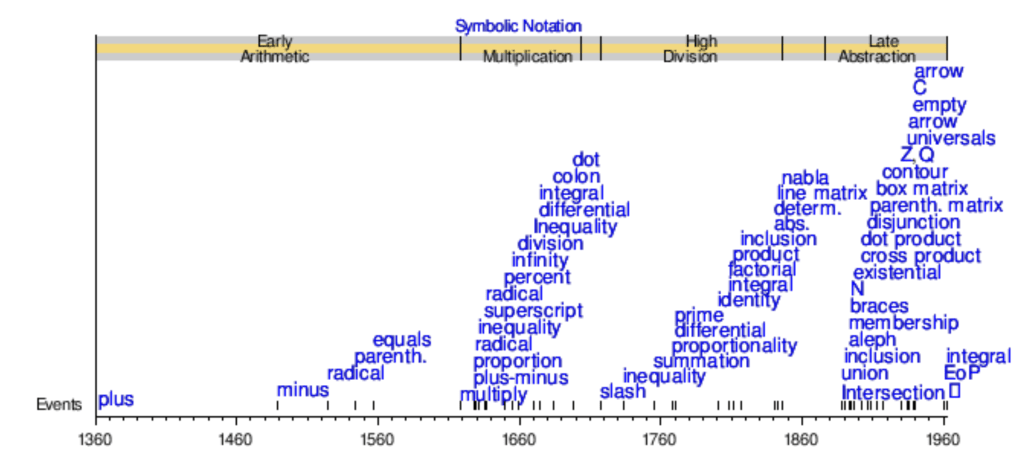
Symbols by approximate “popular” introduction date
Nevertheless, the point at hand with mathematical operational notation is that it took hundreds of years to adopt the standardised form that is now widely used in all the teaching systems around the world. That evolution and standardisation did not happen in isolation, but were interwoven with other branches of knowledge, mainly technical ones. These technical fields needed the rapid adoption of simplified standards that could be learned efficiently by a specialised community of experts. This process can be understood, in part, in a similar way to how linguas francas are constructed —from a simplification of an already existing language— to be the means of exchange and understanding among a subset of people from many different cultural backgrounds who share similar conceptual and material items.
This notation is nothing new by itself. It is just a reflection of human needs —mutual semantic undertanding around a limited subset of concepts— and practical solutions that might have some cognitive biases. What is new is the fact that this notation reached a planetary scale. As we have seen with the spread of communication, that process is just a matter of scale, not of quality. But, in my view, that global scale makes all the significance and sets the question of this book. Mathematical notation, and its quasi-universal use, shows one paradigmatic example of how we arrived there. How we arrive there, or not, and a standard is kept regional, is significant.
Mathematical notation has been the first of such lingua francas to become a standardised language used across the whole planet. It is, however, limited to be used only by someone who needs to do arithmetic —which, in our case, is anyone who has entered a regulated educational system. As we will see, regulated educational systems have reached over 80% of the human population, and are implanted in virtually every new human being born.
Now we have the example of how a truly global language —albeit a limited and specialised one that rides on the back of the universality of what it studies— is created, adopted, and made universal. In particular, this one has been made universal without any clear agreement or premeditated guidance, but rather by the sheer pressure of technical needs and the dominance of Western knowledge systems. Same as with time keeping. Time-keeping, by the way, will come back, and we will see that the universality actually is held by technical needs, mostly as a matter of sailing ships, driving trains and flying planes around the world while knowing where you are also in space.
So, the World has not finished with mathematics as universal communication, other technical and symbolic language are coming. The Metric System is coming, and this time, with bureaus.
One interesting predecessor to unified measurement and standardisation is that of time. Most people might not be aware how puzzling it is that, as of now, across the whole planet we share a common timekeeping system spread throughout most societies of the world. When you look at your watch, you see it divided into 12 or 24 segments, denoting hours, and each hour is divided into 60 units, called minutes. Again, each minute is divided into 60, and we call that division a second. None of this is new to you, but what should surprise all of us is that it is not surprising for most people on the planet! And that’s just it—seconds are the basic unit of measurement of time across the entire world. Why, and how this fact came to be, is not a given. In fact, timekeeping is an extremely aberrant, arbitrary, and silly system if we compare it to the more common numerical system in divisions of 10 (we will see the metric system later on). Why aren’t there 100 seconds in a minute, 100 minutes in an hour, and 10 hours in a day? We could all stop dividing by 60! Our system seems complicated, and it’s not only our adult selves that feel so. My father, who has worked in the educational system all his life, told me that children learn the decimal system quite quickly; however, it takes them much longer to internalise timekeeping. You might have experienced this difficulty yourself as a child, or seen it in your own children if you’ve raised them. Then why does this strange and somewhat difficult system not only exist but is also the same everywhere? Didn’t other parts of the world create different timekeeping systems that made more sense? Why are these no longer around? As we will see, in large part it is because our current international timekeeping standard comes from one of the oldest measures.
Timekeeping is quite common across cultures—perhaps it is a human universal. The easiest division of time is into days, as it is a cycle that dominates all our actions in life, especially our sleep cycles. The next division of time across cultures is usually the cycle of the moon. About 29.3 days have to pass for us to see the moon in the same phase and position in the sky. This moon cycle gives us a close approximation to our current month lengths of 30–31 or 28–29 days. The third rhythm that many cultures pick up on is the annual cycle of the Earth orbiting the Sun. For higher latitudes in both hemispheres, that annual revolution—together with the tilt of the Earth’s axis—gives strong variations between seasons. Days become noticeably longer and shorter along that rhythm, and the weather and natural world follow these changes, with cold during the short days, and heat during the long days. In tropical latitudes, where the variation in the length of the day is not as pronounced, the coming and going of the rainy seasons usually plays a similar role to the cold and hot cycles. In short, most humans around the planet adopted these three naturally occurring cycles as the basic units of time division. When combining the Moon and Sun cycles, this gives us the numbers 12 and 13—i.e. the number of lunar months in a solar year. But this concerns the calendar more than the clock.
We have two main methods of temporal measurement: the calendar and continuous timekeeping, which could in principle be independent of natural cycles. But the calendar is a kind of timekeeping and has given us two numbers to play with. The number 12 is prominent in many counting systems; it even has a specific name in English: a dozen. The number 13, not so much—it is even seen as a “bad luck” number in some cultures. Why is 12 popular and 13 hated, then? This difference is also due to boring calculus. It is easy to divide 12 by 2, 3, 4, and 6. Try doing that with 13—any luck? If you remember your prime numbers, 13 is one of them—only divisible by 1 and itself. Probably, most nerdy ancient people who had to do the tedious task of measuring time preferred the “neat” 12 instead of the unfriendly 13.
But why 60, then, for continuous timekeeping on a watch or clock? Why the 60, 60, 24 division?
We need to start talking about the Babylonians, and how they counted. How do you count using your hands? Most of us would count the number of fingers on each hand, up to 10. But one can increase the amount that can be counted by using the phalanges in each finger. If you count them on the four longer fingers of one hand, that gives you 12—once again this neat nerd number derived from solar and lunar cycles. Then, what better number to divide the daylight hours than 12? But there are an equal number of hours in the night (in equatorial regions), so the number of hours when the sun is out is roughly the same as when the sun is away. If daylight is 12 units and night is 12 units, that gives us the universal 24 divisions of the day: the infamous hours.
Then the 60. Going back to the Babylonian counting, if you count a dozen on, say, your left hand, and on your right hand you keep track of the number of dozens by flexing one finger each time, that gives you five dozens—or a total of 60. If we divide that hour into 60, we get the infamous minutes. The punchline, however, is that despite the importance of 12, the Babylonian sexagesimal system was based on six groups of ten, not five groups of twelve! In any case, that sexagesimal system is the basis for the 60 divisions—or hexagesimal—which the Babylonians also used to divide a circle into angles, another of the universal measures we will examine.
Why the infamous seconds exist, and are simply 60 divisions of a minute, is not such a clear story. Why wasn’t it a division of 10, or 100, or 24? The subunit of a second—a millisecond—is divided into 1,000 units, so 60, although used to define the minutes from an hour, had no need to be used again. What might explain the 60 seconds is another natural unit, quite random at that: the standard resting human heartbeat. If you measure your heartbeat after a period of rest, or just after waking up, there is a high likelihood that you’ll have just over 60 beats per minute.
However the infamous seconds really came to be, the Babylonians standardised them, and due to their central location, vertebrating the Africa–Eurasia connection, seconds, minutes, and hours spread. The large-scale societies around Babylon—such as Egypt, the Greeks, one of their successors Iran, and the polities of the Indian subcontinent—adopted the Babylonian system early on. Crucially, it spread to all the European nations, who then forced it into the administrative apparatus of their colonies, which, as we have seen, covered most of the planet. Even the Chinese adopted a version of the Babylonian sexagesimal division when the Ming dynasty commissioned Xu Guangqi in collaboration with the Jesuits to adapt the Gregorian calendar and timekeeping to the imperial system. Although this reform was only officially adopted during the Qing dynasty in the mid-17th century, it was partly influenced by the Jesuit Johann Adam Schall von Bell and his improved methods of predicting eclipses. Astronomy, we must remember, was deeply linked to astrology in both European and Chinese courts, and astronomers performed the functions of astrologers in advising rulers.
Calendar
Concerning the universality of the Gregorian calendar, it also seems a convoluted, silly, arbitrary system. Why are some months longer than others? Why is your birthday on a Tuesday one year and on a Friday another? There are vastly superior calendar systems out there. Though, some of these alternatives tend to require the addition of a 13th month and a bizarre annual “blank day”, which doesn’t go on the calendar at all. We just chill out, have a holiday, and pretend it’s not there.
The Gregorian calendar has a complicated and protracted history. All the successors of the Roman Empire, and the Christian churches, used the Julian calendar until AD 1582. The Julian calendar, as the name suggests, comes from the Julius Caesar. He borrowed it from the Egyptians and imposed it on the Roman Republic as a more stable alternative to the Roman system. The Catholic Church adopted the Julian calendar at the First Council of Nicaea in AD 325. However, Christians had conflicting ideas on how to celebrate Easter, and it took nearly half a millennium before most Christians agreed to follow the Nicaea rules. In the Egyptian calendar, once every four years a day is added to February. That’s the year when February has 29 days—and some people still joke that those born on that day don’t get to have birthdays.
The problem with adding one day every four years is that, after a few centuries, it messes up the seasons—meaning that the spring and autumn equinoxes, and the summer and winter solstices, begin to drift on the calendar. By the 16th century, this was still a minor issue (only ten days had shifted in 1550 years), and it didn’t seriously affect agricultural practices. However, the motivation for change was religious: the Catholic Church was concerned that Easter might not be celebrated in accordance with the scriptures. Easter follows a lunisolar rule, which causes the date to shift every year: it must occur on the first Sunday after the first full moon of spring. This meant that, technically, Easter could end up being celebrated in winter if the calendar drifted too far—risking some sort of cosmic blunder. It wasn’t equally important for all Christians, as many Eastern Orthodox churches still follow the Julian calendar.
Some sectors of the Catholic Church pushed for reform early on. In the late 15th century, the man chosen to oversee it was a German mathematician with the wonderful name Regiomontanus (Latin for “royal mountain”). Unfortunately, he died before the reform could be implemented. A century passed, during which all the Protestant wars took place. In the aftermath, a diminished Catholic Church finally agreed to set the new calendar—approved by Pope Gregory XIII, who gave the calendar its name. But the Pope could only set the liturgical calendar for the Church. The civil calendar—used by governments—had to be adopted by each administration. Moreover, the emerging Protestant denominations were deeply sceptical of anything coming from the Pope and were not eager to adopt a “papist” invention, even if it made sense. The Puritans even tried to ban Christmas for being too Catholic.
Nevertheless, Catholic powers and administrations such as the Polish–Lithuanian Commonwealth, the Kingdom of Spain (which then included Portugal and most of Italy), and France, as well as their colonies and dependencies, adopted the Gregorian calendar as their administrative standard. Parts of the Netherlands under Spanish control (now Belgium) also adopted it; the rest of the United Provinces followed over the next few decades. So did the Holy Roman Empire, including Austria, Hungary, Bohemia, and many of the German states.
Some Protestant nations, like Denmark and Sweden, also adopted the Gregorian calendar relatively early. Though Sweden did so in a somewhat chaotic way—switching to the Julian calendar, then to the Gregorian, then back again, and finally settling on the Gregorian in 1752, the same year Britain and its colonies adopted it. To avoid referring to the Pope, the British called it “An Act for regulating the Commencement of the Year, and for correcting the Calendar now in Use”. For years, Swiss towns just a few kilometres apart had calendars ten days out of sync—allowing people to celebrate Christmas or Carnival twice in one year!
Later on, Eastern Orthodox countries such as Greece, Serbia, and Russia adopted the Gregorian calendar for civil purposes, though many retained the Julian calendar for liturgical use—or switched to the “New Julian” calendar, making things even more confusing. This is why people in Moscow celebrate Christmas on 7 January (in the standard Gregorian calendar). Others, like Ukraine, have switched to the Gregorian calendar entirely.
The Gregorian calendar is now the de facto global calendar—though it was never formally agreed upon. Administratively, all European countries and their colonies adopted it. Even the Chinese, as we’ve seen, integrated it into imperial systems. Of the few non-colonised countries, only Nepal, Afghanistan, Iran, and Ethiopia still use different civil calendars. Others like Japan, China, Thailand, and Saudi Arabia eventually adopted the Gregorian calendar for administrative purposes—Saudi Arabia only doing so in 2016! Some of these countries still use different systems for counting years or determining the New Year, but their months, leap years, and weekdays follow the Gregorian calendar. In many places—such as the Orthodox Christian and Muslim worlds—two systems coexist: one for liturgy and another for administration. Only Iran’s Solar Hijri calendar, or Shamsi, is more astronomically accurate than the Gregorian. It sets the start of the year to within a second of the spring equinox on Iran’s standard meridian at 52.5° East.
Finally, most international institutions—the United Nations, the Olympics, global research networks—use the Gregorian calendar, reinforcing its role as the de facto global timekeeping standard. Timekeeping—both in hours–minutes–seconds and in calendar form—illustrates how ancient measurement systems, copied or adapted from long-gone administrations like Pharaonic Egypt and Babylon, are still with us and have become near-universal norms, despite never being formally imposed on the entire world.
Later we will see that something like “timekeeping” is not so unquestioned. And that this seemingly universal but rule-less agreement on time has also undergone standardisation—and even the creation of global institutions, as we will see in the case of standard time and the truly infamous leap second—imagine scary quotes. Like the second, double globals, in use and in institunionalised, is what we will need to pay attention to when asking these texts question.
To understand the networks that can establish this project’s question, it would be interesting to reflect on how such networks were created. And for that, one has to reflect on the dominance of the planet by the Western European powers by the end of the 19th century. This dominion, as described before, started with the parallel events of the arrival in the Americas, wiping out about 90% of their pre-contact population, and conquering Malacca after the circumnavigation of Africa. These two events were achieved by two small powers, inhabiting a medium-sized peninsula at the end of the Earth (Finisterre, the end of the land, is in Galicia, north of Portugal). The peninsula lies between the Mediterranean and the Atlantic and was shared with two more kingdoms, Navarra and Aragon, which did not participate in these events. Other Atlantic-facing small powers soon joined the party, with France, the Netherlands and England taking over the lion’s share the century after, and some other colonising efforts conducted by Denmark, Scotland, and even Poland. Once Germany and Italy were created, they eagerly jumped into the “game” as colonial administrators. But beyond the administrations, emigrant European populations, mostly from the western and central portions—but in reality from all over—had huge influences all over the world. And last but not least, Russia, which still holds its colonial land-based empire, conducted overland the same land conquests that the rest of the powers were conducting over the oceans.
To see the effect that about 10 nation-states had over the world, you can go to the modern world political map and start crossing over the countries and territories that at some point fell under their control, be it nominal or real, where they had actual power in deciding much of their political and economic actions.
Colored are 8 Nominally non-colonized modern nations. Turkey is in dashed lines because it can be considered a “European” power. In black is all the parts of the world where a imperial European power or their ex-colonies, plus Japan and China, took over the administration of the land in the last 500 years. Antartica is in white, under the Antarctic Treaty.
All the “New World”—i.e. America—fell under the actual or nominal control of these states or their post-independence nations controlled by European elites.
In Africa, with the exception of present-day Ethiopia (which was occupied for 4–5 years under Fascist Italy), the entire continent was nominally under the control of the Western European nations by the end of the 19th century. The African continent’s political map now bears the scars of that colonisation in the form of the terrible borders left over by the Europeans, which still today force historically antagonistic communities to share a state, while others that were historically unified are now split by an invisible line.
Oceania was swept away by the Europeans, with the Kingdom of Hawaii—one of the last remaining independent archipelagos—losing its sovereignty and most of its population to the US by the end of the 19th century.
In Asia, Portuguese, Dutch, English, French and Russian powers took over most of the land. Only six sovereign administrations were never actually controlled by the Europeans. These were the isolated Japan, large parts of mighty China, Thailand, Afghanistan, Persia (now called Iran), and the Arabian desert now controlled by the Saudis. It is debatable whether the Asian Ottoman Empire controlled parts of Europe, or the European Ottoman Empire controlled parts of Asia, but whichever it is, it had strong European influence in its administration, which can still be seen in modern Turkey. However, unlike Russia, Ottoman rulers did not intermarry with the rest of European aristocracy, in part limiting European influences in the ruling class. Other territories not controlled by the Europeans include Mongolia, which was under Qing Chinese dynastic control and then briefly independent as a puppet state under Soviet influence. Similarly, the two Koreas were under Chinese and then Japanese dominion and colonisation, and then divided in two—with the US influencing the South, and the Soviet Union and China influencing the North. The British had a mixed dominion policy. Oman (with Muscat being a Portuguese trading colony) formerly controlled great parts of the coast of present-day Tanzania due to its lucrative slave trade; that control was destroyed by the British, who then took over most of Oman’s government and internal affairs until the 1970s. Similarly, other sovereign lands—like Bhutan, Nepal, many Indian kingdoms, and Oman—at one point or another left their external political affairs and some internal ones in the hands of the British. Finally, Japan began imitating the European powers and took colonial control over Korea and large parts of China, even creating a puppet state called Manchukuo in Manchu lands in China’s northeast.
For these seven or eight places on the map that can be painted as outside direct colonial control, each suffered, to some extent, imperial influence. Saudi Arabia was mostly empty desert land with few resources until the discovery of oil, and its existence is linked to British foreign policy—to create a Saudi force as a counter-power to the Ottoman Empire at the end of the 19th century. Iran was divided into spheres of influence by the Russians and British, and its modern borders were mostly decided by them. For Afghanistan, its borders were drawn by the British and the Russians, including the strange northeastern “corridor,” which was made the width of the most powerful cannons at the time, so that British and Russian artillery could not shoot each other over Afghan territory. Most of Afghanistan’s external political affairs were controlled by the British. Thailand suffered a similar fate; being between French and British-controlled territories, it was used as a buffer state. The British and the French drew its current borders and split the country into spheres of influence, as in Iran. China was defeated first by the British, and then by a coalition of the British, French, Russians, US, Japanese, and Germans. Though they did not take full control, the British strongly influenced China’s foreign policy for decades, and China was divided into spheres of influence. Japan won several wars against Chinese administrations and took control over large parts of the land before the end of WWII. Japan itself was forced to open its borders and commerce to foreign powers when Tokyo was bombarded by a US armada in the late 19th century, and later—after some mushroom-shaped explosions—was occupied by the US and the British. It was forced to adopt an army for self-defence only and to remain aligned with US interests.
Antarctica was claimed only by European nations, and the Antarctic Treaty, which theoretically reserves these lands for all humanity, was drawn and signed by six European nations. Currently, most of the scientific bases that exist there are European ones.
Out of the roughly 200 sovereign administrations now covering the land masses of the Earth, plus Antarctica, only about seven or eight experienced little direct control by European powers. This simple map illustrates the extent to which European powers exerted near-global influence over the planet 100 years ago. Even today, of these eight territories, only Japan, China, Saudi Arabia and Iran can be said to have—or have had—notable autonomy and influence beyond their borders. Turkey may also be included, depending on which continental perspective is used. Therefore, the world remains dominated by European nations and their administrative legacies. Alternative sovereign administrations with global influence emerge only from four or five distinct cultural backgrounds. These numbers highlight how five Western European nations, and one Eastern European one, took over most of the world.
To illustrate how the Europeans went about conquering the world, let’s go back to the spice islands. The interaction between three European powers and three native sovereign powers provides three different examples of forms of dominion: by annihilation, by trade, or by playing European powers against each other. We can centre the native powers in the two islands of Tidore and Ternate, and the Banda archipelago. Similarly, we can focus on Portugal, Spain, and the Netherlands as the three European powers. As we have seen, the lucrative trade in the spice islands centred on cloves, mace, and nutmeg. Cloves are the dried flowers of a tropical tree found only in Tidore and Ternate (and some other nearby islands). Nutmeg and mace are inside the seeds of another tree, which was only present in the Banda archipelago.
As described, Tidore and Ternate are two small volcanic islands neighbouring each other at a distance of less than two kilometres. To this day, both have rival sultans. At the time of the Portuguese and Spanish arrival, each controlled its respective island and the cloves trade, plus claimed rival control of most lands east of them, all the way to western Papua. Perhaps luckily for them, the Portuguese allied with the Ternate sultanate, while the Spanish soon after allied with the Tidore one. These two sultanates had been long-term neighbouring rivals, but also intermarried, not unlike the Spanish and Portuguese aristocracies. The European powers never conquered the sultanates, although they allied with them and built forts on their territories. The Ternateans were able to expel the Portuguese after a few decades. The Tidoreans used the Spanish as convenient allies against the Ternateans.
Claimed dominions of Ternate (1, upper circle) before the Dutch appeared on the area. Tidore is just slightly south to Ternate, also circled, difficult to see. The Banda archipelago is the small islands (lower circle). Credit to https://apaitukerajaan.blogspot.com/2018/07/sejarah-kesultanan-ternate.html
Things became more complicated after the Dutch East India Company (VOC, founded in 1602 and with authority to declare wars!) took over the nearby Banda islands (Ambon), home to mace and nutmeg.
Soon after, the Ternateans placed themselves under Dutch influence to fend off the Tidoreans allied with the Spanish, who controlled half the island and even captured the sultan. After the Spanish left the area, the sultan rebelled against the VOC but instead lost independence and came under VOC rule. Ternate became the capital of the Moluccas and the wider Indonesian possessions until the Dutch founded Batavia (now Jakarta) in 1619. Today, Ternate is the capital of the North Maluku province of Indonesia, with a population around 200,000. The sultanate continued until 1975 and has now been restored by the royal family in a ceremonial role.
Meanwhile, the Tidorean aristocracy descended into infighting, ditched the Spanish and allied with the Dutch. The VOC convinced the sultan to eradicate all clove trees in his realm to strengthen their monopoly. In compensation, the VOC gave generous donations to the sultan. With the obvious impoverishment that followed losing control of the spices, Tidorean rebels allied with the British, who soon conquered it. Later, the Dutch took back control of the territory—but not before the British took seeds from the clove trees and began planting them elsewhere, beginning the end of the monopoly. The Tidore sultanate lapsed in 1905 and became a regency, but was revived to counter Indonesian independence claims over West Papua. Today, it holds a ceremonial role in the Indonesian state.
Unlike Tidore and Ternate, the Banda Islands—a small archipelago of a maximum 15.000 inhabitants south of Halmahera—were run by orang kaya, or “rich people”. As said, Banda was the only source of nutmeg and mace. These were sold by Arab traders to the Venetians at exorbitant prices. The Bandanese also traded cloves, bird of paradise feathers, massoi bark medicine, and salves. The Portuguese tried to build a fort in the central island but were expelled by the locals and did not return often, buying nutmeg and mace through intermediaries. Initially, the Bandanese were left to their own affairs, but they were unprotected by any other European powers and their artillery.
By 1609, the VOC arrived. To put it mildly, the Bandanese were not exactly enthusiastic about these slightly different Europeans, who brought only wool and odd Dutch crafts in exchange for a monopoly. Like the Portuguese, the Dutch wanted to build a fort. The Bandanese responded in the best way they could—by ambushing and decapitating the VOC representatives. The VOC retaliated, levelling random villages. In the resulting peace treaty, the Bandanese finally allowed a fort.
Meanwhile, two of the islands, the westernmost ones—sadly named Ai and Run—allied with the British East India Company, who began trading with them. The VOC launched an annihilation campaign, first against Ai (Ay in the opening post map), killing all men, while women and children died fleeing or were enslaved. On Run (Rhun in the opening post map), the natives, with the help of several Englishmen, held out for over four years but ultimately lost. Again, the Dutch killed or enslaved all adult men, exiled the women and children, and chopped down every nutmeg tree to prevent English trade. Run is the famous island that was exchanged for Manhattan (New Amsterdam) in 1667. Incredibly, the British did not replant nutmeg trees elsewhere at the time. They would only do so in 1809, during the Napoleonic Wars, ending the Dutch monopoly and making the tragedy of the Bandanese even more sorrowful.
By 1821, the VOC wanted a renewed monopoly so badly that they decided to annihilate the remaining Bandanese. They assembled an invading force of thousands of Dutch and hundreds of Japanese soldiers and launched it on the islands—then home to only a few thousand people. After a failed peace treaty, the invading commander declared that “about 2,500” inhabitants died “of hunger and misery or by the sword,” and that “a good party of women and children” were taken, with not more than 300 escaping. The original natives were enslaved and forced to teach newcomers about nutmeg and mace agriculture. At the cost of genocide—and facilitated by natural plant endemism—the VOC had a monopoly for about 180 years. The British effortlessly invaded in 1796 and 1808, and this time decided to plant nutmeg trees in another former Dutch colony: modern Sri Lanka.
Sadly, Tidore, Ternate, and the Bandas illustrate the fate of many other European colonial efforts until the 20th century: bare survival by cleverly playing European powers against one another, becoming important administrative centres at the loss of complete autonomy or independence, or facing total annihilation and repopulation of blood-stained lands. Despite these different destinies, the outcome was the same: being utterly dominated by Western European administrative frameworks, as we will see in what follows.