Western Dominions

To understand the networks that can establish this project’s question, it would be interesting to reflect on how such networks were created. And for that, one has to reflect on the dominance of the planet by the Western European powers by the end of the 19th century. This dominion, as described before, started with the parallel events of the arrival in the Americas, wiping out about 90% of their pre-contact population, and conquering Malacca after the circumnavigation of Africa. These two events were achieved by two small powers, inhabiting a medium-sized peninsula at the end of the Earth (Finisterre, the end of the land, is in Galicia, north of Portugal). The peninsula lies between the Mediterranean and the Atlantic and was shared with two more kingdoms, Navarra and Aragon, which did not participate in these events. Other Atlantic-facing small powers soon joined the party, with France, the Netherlands and England taking over the lion’s share the century after, and some other colonising efforts conducted by Denmark, Scotland, and even Poland. Once Germany and Italy were created, they eagerly jumped into the “game” as colonial administrators. But beyond the administrations, emigrant European populations, mostly from the western and central portions—but in reality from all over—had huge influences all over the world. And last but not least, Russia, which still holds its colonial land-based empire, conducted overland the same land conquests that the rest of the powers were conducting over the oceans.

To see the effect that about 10 nation-states had over the world, you can go to the modern world political map and start crossing over the countries and territories that at some point fell under their control, be it nominal or real, where they had actual power in deciding much of their political and economic actions.

Colored are 8 Nominally non-colonized modern nations. Turkey is in dashed lines because it can be considered a “European” power. In black is all the parts of the world where a imperial European power or their ex-colonies, plus Japan and China, took over the administration of the land in the last 500 years. Antartica is in white, under the Antarctic Treaty.

All the “New World”—i.e. America—fell under the actual or nominal control of these states or their post-independence nations controlled by European elites.

In Africa, with the exception of present-day Ethiopia (which was occupied for 4–5 years under Fascist Italy), the entire continent was nominally under the control of the Western European nations by the end of the 19th century. The African continent’s political map now bears the scars of that colonisation in the form of the terrible borders left over by the Europeans, which still today force historically antagonistic communities to share a state, while others that were historically unified are now split by an invisible line.

Oceania was swept away by the Europeans, with the Kingdom of Hawaii—one of the last remaining independent archipelagos—losing its sovereignty and most of its population to the US by the end of the 19th century.

In Asia, Portuguese, Dutch, English, French and Russian powers took over most of the land. Only six sovereign administrations were never actually controlled by the Europeans. These were the isolated Japan, large parts of mighty China, Thailand, Afghanistan, Persia (now called Iran), and the Arabian desert now controlled by the Saudis. It is debatable whether the Asian Ottoman Empire controlled parts of Europe, or the European Ottoman Empire controlled parts of Asia, but whichever it is, it had strong European influence in its administration, which can still be seen in modern Turkey. However, unlike Russia, Ottoman rulers did not intermarry with the rest of European aristocracy, in part limiting European influences in the ruling class. Other territories not controlled by the Europeans include Mongolia, which was under Qing Chinese dynastic control and then briefly independent as a puppet state under Soviet influence. Similarly, the two Koreas were under Chinese and then Japanese dominion and colonisation, and then divided in two—with the US influencing the South, and the Soviet Union and China influencing the North. The British had a mixed dominion policy. Oman (with Muscat being a Portuguese trading colony) formerly controlled great parts of the coast of present-day Tanzania due to its lucrative slave trade; that control was destroyed by the British, who then took over most of Oman’s government and internal affairs until the 1970s. Similarly, other sovereign lands—like Bhutan, Nepal, many Indian kingdoms, and Oman—at one point or another left their external political affairs and some internal ones in the hands of the British. Finally, Japan began imitating the European powers and took colonial control over Korea and large parts of China, even creating a puppet state called Manchukuo in Manchu lands in China’s northeast.

For these seven or eight places on the map that can be painted as outside direct colonial control, each suffered, to some extent, imperial influence. Saudi Arabia was mostly empty desert land with few resources until the discovery of oil, and its existence is linked to British foreign policy—to create a Saudi force as a counter-power to the Ottoman Empire at the end of the 19th century. Iran was divided into spheres of influence by the Russians and British, and its modern borders were mostly decided by them. For Afghanistan, its borders were drawn by the British and the Russians, including the strange northeastern “corridor,” which was made the width of the most powerful cannons at the time, so that British and Russian artillery could not shoot each other over Afghan territory. Most of Afghanistan’s external political affairs were controlled by the British. Thailand suffered a similar fate; being between French and British-controlled territories, it was used as a buffer state. The British and the French drew its current borders and split the country into spheres of influence, as in Iran. China was defeated first by the British, and then by a coalition of the British, French, Russians, US, Japanese, and Germans. Though they did not take full control, the British strongly influenced China’s foreign policy for decades, and China was divided into spheres of influence. Japan won several wars against Chinese administrations and took control over large parts of the land before the end of WWII. Japan itself was forced to open its borders and commerce to foreign powers when Tokyo was bombarded by a US armada in the late 19th century, and later—after some mushroom-shaped explosions—was occupied by the US and the British. It was forced to adopt an army for self-defence only and to remain aligned with US interests.

Antarctica was claimed only by European nations, and the Antarctic Treaty, which theoretically reserves these lands for all humanity, was drawn and signed by six European nations. Currently, most of the scientific bases that exist there are European ones.

Out of the roughly 200 sovereign administrations now covering the land masses of the Earth, plus Antarctica, only about seven or eight experienced little direct control by European powers. This simple map illustrates the extent to which European powers exerted near-global influence over the planet 100 years ago. Even today, of these eight territories, only Japan, China, Saudi Arabia and Iran can be said to have—or have had—notable autonomy and influence beyond their borders. Turkey may also be included, depending on which continental perspective is used. Therefore, the world remains dominated by European nations and their administrative legacies. Alternative sovereign administrations with global influence emerge only from four or five distinct cultural backgrounds. These numbers highlight how five Western European nations, and one Eastern European one, took over most of the world.

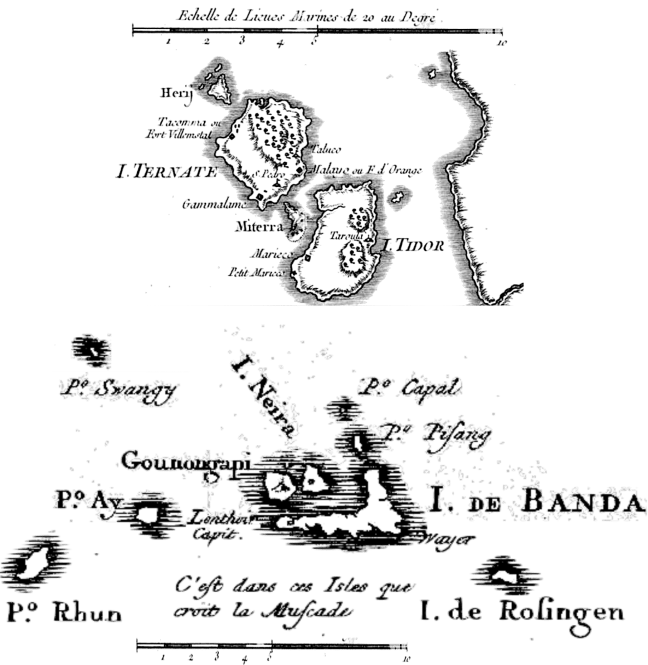
To illustrate how the Europeans went about conquering the world, let’s go back to the spice islands. The interaction between three European powers and three native sovereign powers provides three different examples of forms of dominion: by annihilation, by trade, or by playing European powers against each other. We can centre the native powers in the two islands of Tidore and Ternate, and the Banda archipelago. Similarly, we can focus on Portugal, Spain, and the Netherlands as the three European powers. As we have seen, the lucrative trade in the spice islands centred on cloves, mace, and nutmeg. Cloves are the dried flowers of a tropical tree found only in Tidore and Ternate (and some other nearby islands). Nutmeg and mace are inside the seeds of another tree, which was only present in the Banda archipelago.

As described, Tidore and Ternate are two small volcanic islands neighbouring each other at a distance of less than two kilometres. To this day, both have rival sultans. At the time of the Portuguese and Spanish arrival, each controlled its respective island and the cloves trade, plus claimed rival control of most lands east of them, all the way to western Papua. Perhaps luckily for them, the Portuguese allied with the Ternate sultanate, while the Spanish soon after allied with the Tidore one. These two sultanates had been long-term neighbouring rivals, but also intermarried, not unlike the Spanish and Portuguese aristocracies. The European powers never conquered the sultanates, although they allied with them and built forts on their territories. The Ternateans were able to expel the Portuguese after a few decades. The Tidoreans used the Spanish as convenient allies against the Ternateans.
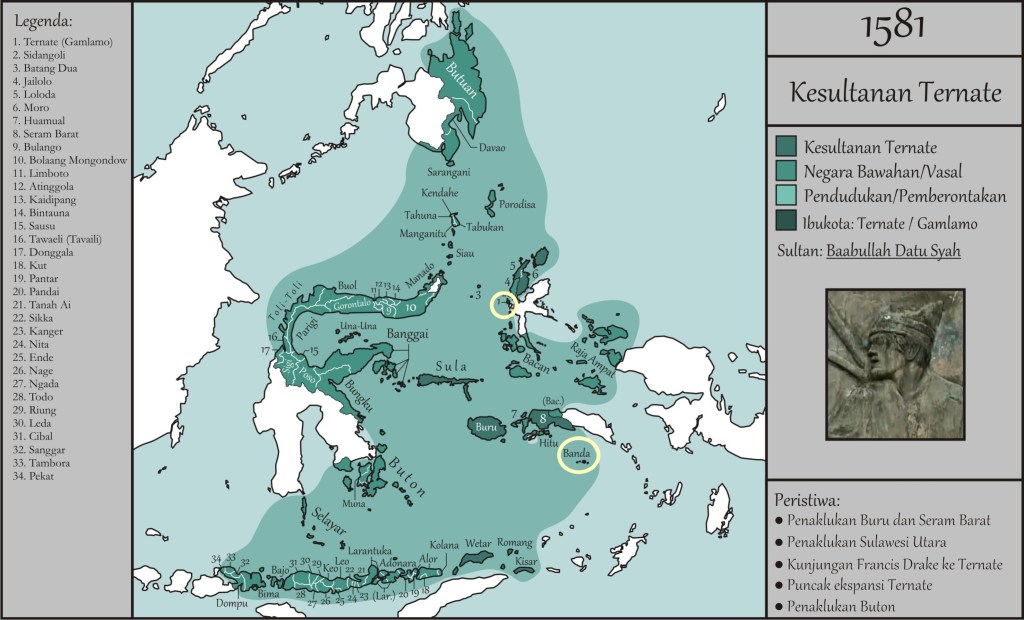
Claimed dominions of Ternate (1, upper circle) before the Dutch appeared on the area. Tidore is just slightly south to Ternate, also circled, difficult to see. The Banda archipelago is the small islands (lower circle). Credit to https://apaitukerajaan.blogspot.com/2018/07/sejarah-kesultanan-ternate.html

Things became more complicated after the Dutch East India Company (VOC, founded in 1602 and with authority to declare wars!) took over the nearby Banda islands (Ambon), home to mace and nutmeg.

Soon after, the Ternateans placed themselves under Dutch influence to fend off the Tidoreans allied with the Spanish, who controlled half the island and even captured the sultan. After the Spanish left the area, the sultan rebelled against the VOC but instead lost independence and came under VOC rule. Ternate became the capital of the Moluccas and the wider Indonesian possessions until the Dutch founded Batavia (now Jakarta) in 1619. Today, Ternate is the capital of the North Maluku province of Indonesia, with a population around 200,000. The sultanate continued until 1975 and has now been restored by the royal family in a ceremonial role.

Meanwhile, the Tidorean aristocracy descended into infighting, ditched the Spanish and allied with the Dutch. The VOC convinced the sultan to eradicate all clove trees in his realm to strengthen their monopoly. In compensation, the VOC gave generous donations to the sultan. With the obvious impoverishment that followed losing control of the spices, Tidorean rebels allied with the British, who soon conquered it. Later, the Dutch took back control of the territory—but not before the British took seeds from the clove trees and began planting them elsewhere, beginning the end of the monopoly. The Tidore sultanate lapsed in 1905 and became a regency, but was revived to counter Indonesian independence claims over West Papua. Today, it holds a ceremonial role in the Indonesian state.

Unlike Tidore and Ternate, the Banda Islands—a small archipelago of a maximum 15.000 inhabitants south of Halmahera—were run by orang kaya, or “rich people”. As said, Banda was the only source of nutmeg and mace. These were sold by Arab traders to the Venetians at exorbitant prices. The Bandanese also traded cloves, bird of paradise feathers, massoi bark medicine, and salves. The Portuguese tried to build a fort in the central island but were expelled by the locals and did not return often, buying nutmeg and mace through intermediaries. Initially, the Bandanese were left to their own affairs, but they were unprotected by any other European powers and their artillery.

By 1609, the VOC arrived. To put it mildly, the Bandanese were not exactly enthusiastic about these slightly different Europeans, who brought only wool and odd Dutch crafts in exchange for a monopoly. Like the Portuguese, the Dutch wanted to build a fort. The Bandanese responded in the best way they could—by ambushing and decapitating the VOC representatives. The VOC retaliated, levelling random villages. In the resulting peace treaty, the Bandanese finally allowed a fort.

Meanwhile, two of the islands, the westernmost ones—sadly named Ai and Run—allied with the British East India Company, who began trading with them. The VOC launched an annihilation campaign, first against Ai (Ay in the opening post map), killing all men, while women and children died fleeing or were enslaved. On Run (Rhun in the opening post map), the natives, with the help of several Englishmen, held out for over four years but ultimately lost. Again, the Dutch killed or enslaved all adult men, exiled the women and children, and chopped down every nutmeg tree to prevent English trade. Run is the famous island that was exchanged for Manhattan (New Amsterdam) in 1667. Incredibly, the British did not replant nutmeg trees elsewhere at the time. They would only do so in 1809, during the Napoleonic Wars, ending the Dutch monopoly and making the tragedy of the Bandanese even more sorrowful.

By 1821, the VOC wanted a renewed monopoly so badly that they decided to annihilate the remaining Bandanese. They assembled an invading force of thousands of Dutch and hundreds of Japanese soldiers and launched it on the islands—then home to only a few thousand people. After a failed peace treaty, the invading commander declared that “about 2,500” inhabitants died “of hunger and misery or by the sword,” and that “a good party of women and children” were taken, with not more than 300 escaping. The original natives were enslaved and forced to teach newcomers about nutmeg and mace agriculture. At the cost of genocide—and facilitated by natural plant endemism—the VOC had a monopoly for about 180 years. The British effortlessly invaded in 1796 and 1808, and this time decided to plant nutmeg trees in another former Dutch colony: modern Sri Lanka.

Sadly, Tidore, Ternate, and the Bandas illustrate the fate of many other European colonial efforts until the 20th century: bare survival by cleverly playing European powers against one another, becoming important administrative centres at the loss of complete autonomy or independence, or facing total annihilation and repopulation of blood-stained lands. Despite these different destinies, the outcome was the same: being utterly dominated by Western European administrative frameworks, as we will see in what follows.

Previous

Next

Revolutions, Scientific Revolutions

The peoples that embarked and supported the exploration of new trading and colonising routes soon discovered that the free-riding of the technological advantage could be easily perpetuated. Thanks to that, the ones that invested in better and faster understanding of the world, plus the technical innovations that that understanding and implementation represented, contributed to a further control of the world’s connectivity. From that on, there were no major barriers to a hyperconnected world. What they could not control by exchange, they would control by overpowering, as the conquest of Malacca, the Aztecs, the Incas demonstrates. If you kept on expanding your technological and resource allocation dominance over other peoples, your system would be the one to dominate, and that’s exactly what the Western nations did over a period of a few centuries.

New trading routes led to an excess of wealth that could be poured into more navigational sophistication, which in turn would make the trading networks more reliable and affordable, freeing more resources for further improvement. Part of these resources went to the birth of modern science, changing forever the way our understanding of the world was established.

To make a boat sail safely from port to port you would rely less and less on divinity and more on your instruments, navigational skills, the capacity to understand the sky, star positions, read the winds, proper sails, masts, ropes to withstand storms, carrying lemons to stop scurvy, social structures to govern a ship and stop mutinies, etc. Those powers that would put scientific knowledge to good use would have in their hands better control of the high seas and the peoples cruising them. Likewise, those who understood better the fabrication techniques could build better vessels, and equip them with better weapons. On the other hand, the faraway encounters would contribute to the scientific understanding of the world, like sea currents, Volta do mar, steady trade winds, or even catamaran technology from the Pacific and front crawl swimming techniques from North, South America, or South Africa.

In fact, Columbus’s error regarding the radius of the Earth (which he was convinced until he died) was due to the preliminary stages of scientific knowledge attempting to describe the world we lived in. In that case, he was mistaken, but the geographers’ community soon recognised the error and corrected it (or lent more credibility to other estimates circulating at the time). This iterative process helped to better understand the world that was opening up before them as they tried to cartograph the new routes faster than they were explored.

From these explorations and shocks to the perceived worldview, it is not difficult to imagine that the notion of an entire landmass the size of the Americas suddenly appearing on maps (over about 20 years) might have led to the acceptance of rethinking the entire Universe. If the Earth contained a whole part of itself that was unknown to the Old Scriptures, how much more knowledge might be out there—waiting to be found, explored, and understood—not through the lens of the Scriptures, but through the lens of something new? These cartographic shifts might easily have been the seeds for scientific enquiry—the seed of the Scientific Revolution.

In fact, it is interesting to reflect on that word, “revolution.” What does it stand for? It comes from the root “to revolve”, which means to spin around. Why—if an entire continent had been missed, and Jerusalem is not the centre of the Earth—could it not be that the Earth is not the centre of the Universe either? That kind of thought might have helped Copernicus push the heliocentric idea: that the model best suited to describe the Universe is not a geocentric one, with the Earth at the centre, but one with the Sun at the centre of the known cosmos. Copernicus was not the first to propose that idea; the Pythagoreans had already supposed the Earth might move, and Aristarchus of Samos proposed a heliocentric model in the 3rd century BCE. Seleucus of Seleucia said something along the same lines in the 2nd century BCE. About 600 years later, in the 5th century, Martianus Capella, from Roman Carthage, proposed that Mercury and Venus spun around the Sun. At about the same time, Aryabhata in Patna, India, proposed that the Earth spins and that the planets orbit the Sun. In the 12th century, Ibn Rushd (Averroes) and Nur ad-Din al-Bitruji of the Cordoba Caliphate were also critical of the geocentric model and proposed alternatives. Their views spread into European intellectual spheres. However, none of these theories gained much traction at the time they were proposed. One can say that the mindset of the people of those generations was not particularly open to such a shift in worldview, nor was it needed for any practical purpose.

To be open to other worldviews becomes more likely if a sweeping 30% extra landmass is literally put on the map. The same world that the Scriptures plus Classical Philosophy were so certain they understood. Even though the Catholic Church did not pay much attention to the fact that the world was different than said, surely minds would become more open—even if obtuse. Moreover, those same conceptualisations ended up making navigation more precise. And the required navigational observations and technical means (star and planet positions, astrolabes, compasses, telescopes, clocks…) helped to question the worldview in a more rigorous way—with the newly discovered facts holding more face value than old beliefs. In short, cosmological views came to serve a practical purpose.

Therefore, the landscape was set. After Europeans became aware of a New Continent, Copernicus was able to push his idea (initially as a short leaflet in 1514), and later publish, after his death, his De revolutionibus orbium coelestium. His heliocentric model was not the one we know today. Copernicus’s model was not that innovative, nor significantly simpler than the Ptolemaic one, because he still needed the use of epicycles (small circumferences around the circular orbit of the planets) to accurately describe the rotation of the planets around the Sun. It would be Kepler—about 70 years later—who, after throwing out his own Mysterium theory of planetary movement because Tycho Brahe’s observations did not match, solved the motion of objects in the Solar System with simple elliptical orbits and delivered us pretty much the view that we now have.

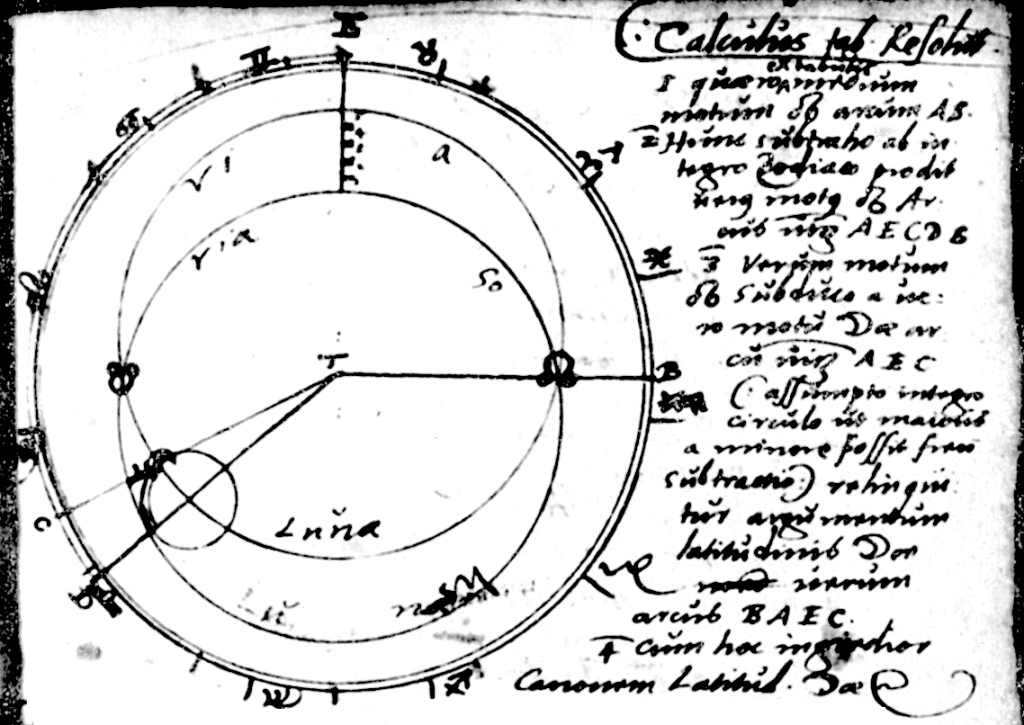
Even after the heliocentric vision of the World was presented, the conviction of perfectly circular orbits was not abandoned, here a drawing trying to explain the elliptic orbit of the moon (Luna) around the Earth (T) with three epicycles. Calculations according to Schöner’s Tabulae resolutae and Reinhold’s Prutenicae Tabulae in lecture notes from 1569

The difference with all the previous scholars—after Copernicus’s posthumous publication—proposing that the Earth was not static, was that the public at the time was much more accepting of the revolution of the Earth thought. A thought that would be revolutionary!

Revolution, at the time, had the meaning that Copernicus used in his title: simply the spinning around of the celestial bodies—how they revolved around the Sun. Revolved, revoluted, revolution. It was a physical description, like that of the revolutions or cycles of an engine, or as one famous revolutions podcaster puts it, “coming full circle”, just to come back to the beginning. Revolution did have, on rare occasions, the meaning of change prior to Copernicus’s work. However, the acceptance of heliocentric theory by the public of the time. It was so disruptive to the mindset of the age, overturning millennia of knowledge and worldview—so Earth-shattering (pun intended)—that the first main word of the work itself, revolutionibus, was adapted less than a century later to mean the overthrow of a political system (the Glorious Revolution in Britain). When transferring the physical meaning to the political one, revolution meant “a circular process under which an old system of values is restored to its original position, with England’s supposed ‘ancient constitution’ being reasserted, rather than formed anew”. At that point the use of the word was far form the meaning that it has now, as a radical new direction, or changing of course of what was before. Soon after, however, the word gained the modern concept of revolution, as used for the French one, which probably someone has heard about. Now revolution is more widely understood as the shattering of a previous political, social, technological—or otherwise—system, and the establishment of a new one: the Glorious Revolution, French Revolution, Industrial Revolution, Agrarian Revolution, Sexual Revolution…

It could be that the people at the time—after the Earth had been kicked aside, given rotation, put in orbit around the Sun, and the stars made still—experienced a mental shift so profound that it allowed for a reshuffling of many pre-existing mentalities. Maybe it can be compared to the shattering effect, almost a rite of passage, that many children in the Western world experience when they realise that Santa Claus is not a real being, but a construct created by society to make them believe that the bringer of presents is this exotic figure from faraway lands, and not their parents or families. For the child, it is already a big impact—and if you experienced that, you probably remember the moment, even if it was decades ago. Then imagine if instead of just one child at a time, it were an entire society realising, more or less simultaneously (within a generation), that the reality they had so strongly believed to be true, no longer was. That is what the so-called Copernican Revolution brought to European thought in the 16th century: a collective, mind-shattering effect. We, as humans, have been toying with these moments ever since. But more about that later.

In fact, the public that was more open to these ideas was also in the midst of another revolutionary movement, which at the time was called a protest, for lack of a better word: Protestantism. If the world, the solar system, the Universe, the Cosmos, was not as the Church claimed—with extra continents unaccounted for, the Earth in motion, and stars being other suns, perhaps with other Earths—then the Church became open to protest and reform. And if protest and reform were possible, then the acceptance of truly exotic ideas—like the Earth revolving—became easier in a society already undergoing profound transitions. In fact, different solar system models were readily adopted by Tycho Brahe and Johannes Kepler, Danish and German astronomers sponsored by Protestant-friendly kings. Meanwhile, Latin astronomers such as Galileo Galilei and Giordano Bruno had major conflicts with the Catholic Church in Northern Italy—Galileo famously tried, Bruno burned at the stake. Bruno’s seven-year trial and sentence to be burned alive was not specifically for his belief that the stars in the sky were other distant suns orbited by other planets, but also because of his rejection of most Catholic doctrines.

The difference between Copernicus in the 16th century and all those who proposed alternative cosmological systems before might be that society was more open to new ideas because of empirical slaps in the face—steadily, repeatedly, forcefully. First, sailors and their investors realised that direct observations could actually shift reality—such as the discovery of a continent, accurate measurement of latitudes and longitudes, and the real size of the Earth’s circumference. Second, astronomers and their sponsors (who were often astrologers for European courts—better predictions meant better horoscopes; the zodiac pays for your smartphone, if you think about it) found that when your health or the outcome of a war depends on the conjunction of Saturn and Jupiter, and your astronomer looks through a telescope and tells you that these planets have rings and moons orbiting them, you might predict better when to wage your next war. Third, traders could more precisely calculate profits or invest in new products—like new dyes and pigments (e.g. scarlet), or learning how to plant species such as pepper, potatoes, tomatoes, tobacco, coconuts, sugar cane, among others, across the world. Actual measurements began to overturn established doctrines one after another; these facts reinforced the critiques of the old system and laid the foundation for an alternative system of establishing knowledge. The Scientific Revolution went hand in hand with the development of better instruments and measurements that define the modern world we experience today.

It was equally important that these new ideas travelled and multiplied faster than ever before. On one hand, naval interconnectivity regularly reached all continents and the major inhabited landmasses of the planet. From there, peoples—willingly or unwillingly—became part of a shared system of exchange, a process that continues today, where nearly every human being is regularly connected to the rest of the world in one form or another. Our present hyperconnected world is extending the reach and frequency of connection to ever more remote places. On the other hand, the printing press allowed for the multiplication of ideas at a rate faster than authorities could suppress them. Even if the works of figures like Copernicus or Bruno were censored, confiscated, destroyed, or burned, it was much more likely that one copy would escape, be read, and be copied again. Before the printing press, Protestant ideas—like those of the Hussites in the 15th century—did not spread far beyond their place of origin (e.g. Bohemia). Later, Prague—with its famous astronomical clock—would host Brahe and Kepler. On the other end of the chain, at the point of reception, Spanish missionaries actively protected indigenous languages (while simultaneously suppressing their cultures) in regions such as Mesoamerica, the Andes, and the Philippines, to prevent indigenous peoples from being exposed to “dangerous” Protestant, Enlightenment, or revolutionary ideas. To this day, these regions preserve some of their linguistic diversity and remain heavily Catholic, with the Philippines being the only nation (alongside the Vatican) that does not permit divorce.

Our hyperconnected and idea-copying world is the one that gave birth to the concept of humanity—a “humanity” that can now begin to ask itself what it wants to do, now that we have the means to communicate with one another, and the resources (or energy levels) to invest a fraction of that energy in specific goals. But before asking that question, we first need to understand the mechanisms by which a hyperconnected people is able to pose it: which networks are activated, in which language communication occurs, with whom that exchange is implemented, and what actions can—or cannot—be taken. What is the agency?

Curiously, one of the early adopters of Copernicus’s thesis was Thomas Digges, who removed the need for the sphere of fixed stars. He proposed the existence of distant stars scattered throughout the Universe. This led him to raise the paradox of the dark sky: in an infinite Universe filled with stars, the sky should look like the surface of the Sun, because in every direction there should be at least one star. Since the sky is black, the Universe cannot be infinite. With that in mind, the Copernican Revolution—which displaced us from the centre of the Universe—is still not complete. It is geographical, but not temporal. Heliocentrism kicked the Earth and its peoples out of the centre of space, but the dark sky placed us in a special time—a time when we can still see the horizon of the visible Universe. Now we are in another special time—the time when humanity is conceptualised. The time to ask: what does humanity want?

Previous

Next