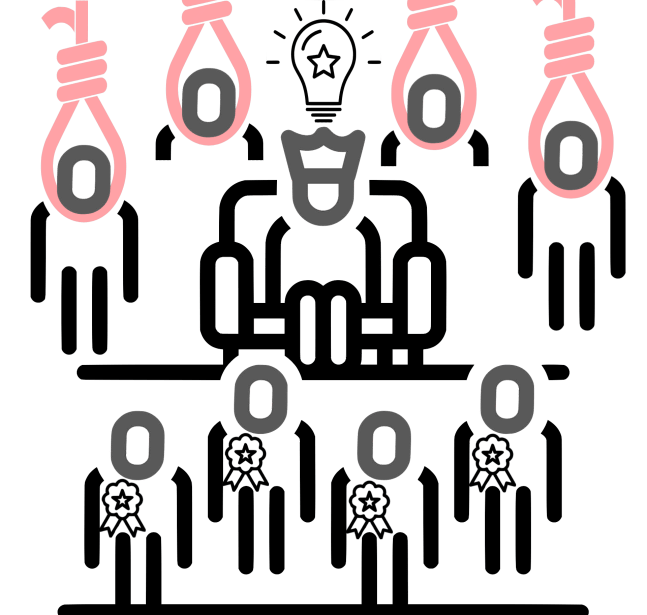
The cultural ideal, privileges and industrial-scale evils

Through my studies of cultural loss, I came across a powerful concept from political sciences, the political ends. This is proposed by Morton Gorden within a process of conflict resolution as the “process by which a government sets limits on what enters the political process”(Gorden 1972:vii).

In an evolutionary perspective, governments come after politics, politics comes after public, and public comes after culture. Since my objective is to focus on humans and humanity, for now, I want to abstract that basic schema beyond governments, to a dynamic that captures most of human behaviour.

For that, I reinterpret the first step of the process “goals”, or “political goals” as pursuing a specific “cultural ideal”. In other words, political goals are culturally generated representations of desired final states.

In that framing, I claim that we can see the political process as the path towards the fulfilment of representations of cultural ideals. Even without a government or collective decision-making, as long as there is an individual who wants to freely express its cultural ideal in a social environment, that can be seen as “politics”.

Simply put, every action to pursue a specific cultural end defines politics.

Goals in a political system reflect patterns in culture. The setting of specific goals represent a choice of objectives from a larger range of possibilities residing within the accessible cultural landscape.

Evolutionarely, my argument is that a cultural ideal, while abstractly shared by a “public”, resides in each of the individuals of that public. While growing up in a public a.k.a. a society, we slowly form a diffuse, ever-changing idea of a cultural ideal.

This sequence: cultural ideal formation – action – politics – ends , is not exclusive to humans, or humanity for that matter.

Let us trace possible evolutionary roots for the pursuit of a “cultural ideal”.

Remember Lekker, the vervet monkey who took over as alpha male, and could eat the popcorn of his preferred colour?

If we accept that the choice in colour of popcorn can be called “cultural”, then Lekker imported his “cultural ideal” when he went to a new group that had a different cultural preference of popcorn colour.

With the alpha-male power and influence Lekker kept eating the colour of popcorn that he was used to eating. By that time (six months later) both colours were equally sweet, so there was no real fitness difference other than the colour. In the case of Lekker, he was able to keep his rather simple “cultural ideal”.

We humans do this conscious and unconscious process all the time while sticking to a cultural ideal. For whatever reason, a “cultural ideal” of how things ought to be is created, and then individuals take constant actions to approach that ideal. In the case of Lekker, he achieved his “ideal” through power. Paraphrasing my earlier definition, these actions were Lekker’s politics.

Again, I call all the actions that one takes towards achieving a cultural ideal, “politics”.

As I’ve written before, Joan Fuster, one famous Valencian intellectual, has the aphorism that “politics is done by you or is done onto you”.

In other words, we are constantly doing politics by expressing or protecting our preferences, and even when not doing so, others will press their preferences and ideals to you. This might be because some humans have a tendency to press their preferences and ideals to others, unlike the vervet monkeys–there is no evidence that Lekker forced his preference of popcorn colour on others.

That’s where conflict arises, our constant cultural dynamics are smelted and we can apply Gorden’s framework.

Another interesting intellectual to summon here is Christofer Boehm. He was a primatologist and anthropologist who developed much of his career characterising egalitarianism and equality in human and non-human primate societies.

One of Boehm’s theses is that primates, us included, show two opposing tendencies, one is to oppress and the other is to fight oppression.

To oppress is what Lekker did when he took over the alpha position. That position allowed him to keep his ways in the new group who ate a different colour of popcorn.

What the difference is between other primates and humans, according to Boehm’s observations, is that in human small scale societies these groups are significantly more egalitarian than other primate groups and large scale societies–despite being a spectrum of social inequality and oppression in these small scale human societies.

This egalitarianism is not because humans have a significantly reduced tendency to oppress others, when compared to other primates, but because the small-scale societies have developed and sustained a set of strategies that effectively manage the emergence of oppressive tendencies and weeds it out before oppressive regimes, like Lekker’s taking over the group.

Interestingly, in many human small scale societies there is no such thing as a permanent “leader” like a Lekker. There is a prestige hierarchy, but leadership roles tend to be emergent and evanescent–situational, task-specific, non-centralised, and often temporary leadership rather than institutionalised or hereditary. In many cases, these roles are shared by a council, the decisions are made in a communal fashion or different leaderships emerge to deal with a specific problem or situation. When the problem is solved, or the situation changes, their particular leadership role can disappear with it like in the case of the axe-makers of the Wahgi.

Going back to cultural ideals, a cultural ideal can pop up, like popcorn, as well as being susceptible to constant change.

The rest of the macaques who, unlike Lekker, adapted to the local popcorn colour had to pay the small price of giving up the privilege of eating their preferred coloured popcorn from six months prior.

In that case, a change in “cultural ideal” had little repercussion other than maybe a reticence to try something they remembered as bitter.

The fact that we have a sense of stability and continuity is even more surprising. Take my grandfather, who had just turned 100 at the time of writing. His World has undergone immense revolutions in worldviews, technological advances, scientific breakthroughs, information and human connectivity, exploration, material wealth, services, ways of living, the concept of family, social bonds, entertainment options… Yet, his life, despite his experience of a civil war and an acrimonious post-war period, has been relatively stable, with a level of continuity and relative comfort unheard of for most of human history on this planet. One hundred rounds around the Sun provide so much and so little at the same time, encompassing the extremes of human existence in one lifetime.

My grandfather, in particular, had no problem adopting the “cultural ideal” of going to school, being removed from it because of warfare, working as a labourer to provide for his family when his father passed away after the war, living in a fascist autarkic economy and then a Catholic capitalist dictatorship, finding a wife – late by the standards of his time – owning a vehicle, benefiting from an incipient welfare state in terms of social security, healthcare and public education for his children, supporting his wife in opening a business, integrating into the European market and benefiting from an influx of wealth because of the valorisation of oranges, experiencing a transition to democracy, public nudity in the media and on the beaches, gifting a home to his children, taking early retirement, receiving a pension, travelling, and even accepting something as strange as homosexuals constituting a legal family and having the right to adopt children.

Throughout these continuous transitions, my grandfather’s “cultural ideal” reconstituted itself one way or another. Other aspects of that ideal have held strong, such as how an orange field should properly be tended, how my haircut should look, or how youngsters should care for elders.

Continuously, change was pushing against his “cultural ideals”, and those of his fellow elders, through technology, conflicts, discoveries, interconnection, integration, exposure and innovation. In the process, their individual “cultural ideals” changed without much push or pull, as if Lekke had adopted the local popcorn colour instead of his preferred one.

Most likely, most, if not all, “cultural ideals” hold little to no intrinsic value as long as holding them does not take one too far from the demands of reality. Reality, then, is just a selective pressure that constantly reshapes individual “cultural ideals”, while the Sunrise Paradox allows societies to be reshaped in the intervening periods.

In a sense, variation in “cultural ideals” is neutral as long as there is no selective pressure, as in the case of the preferred popcorn colour when both colours were equally sweet. The main difference is that cultural ideals might be reshaped constantly and, potentially, at striking speed throughout a human lifetime, though limits might exist on these changes.

The existence of the concept of “humanity” itself, and how it has expanded across human populations around the planet, represents a change in “cultural ideals” for hundreds or thousands of societies.

For most societies, what constitutes a person, or a human, is deeply intertwined with membership of that society, as we have seen in the case of ethnic categories.

Many small-scale societies call themselves “people”, “persons” or “humans” and, by implication, consider others to be “non-humans”. Moreover, across the continents, many groups call those who speak different languages “mutes” or “deaf”. It always makes me smile that Slavic languages use a word meaning “mute” to refer to Germans. For example, in Czech, Germans are Němci, which translates as something like “mute” or “silent”. Surely, German must sound to them, and many others, as if one wishes its speakers did not know how to speak German – apologies to German speakers here.

For most of human history, who speaks the language, or wears the same kind of tattoos and body markers, is WHO a person is. Others are just that: others. Interestingly, others can be a mixture of mythological creatures, animals and other beings that interact with real people but are not themselves considered people. Of course, there are ample exceptions to that in-group/out-group division, and cases of individuals from other ethnicities being adopted into groups that see themselves as the only people do exist. We even practise that kind of adoption with animals or inanimate objects like rivers, which acquire personhood through a system of beliefs, or even legal systems.

The fact that “humanity” exists as a global, all-encompassing term that includes every individual of the Homo sapiens species is something that has had to be built on top of the systematic destruction of “cultural ideals” that had clear definitions of what a “person” is.

What a “human” is fascinates us constantly, across all areas of existence, even when we look to the past. Through my research, I have had the opportunity to work with Neanderthal experts. Despite being considered a different hominin species, we now know that Homo sapiens repeatedly reproduced with Neanderthals, and that all humans outside sub-Saharan Africa are descended from Neanderthals.

The biological definition of “species” becomes blurred here, as Homo sapiens and Neanderthals could reproduce. My colleagues would have no problem referring to Neanderthals as “humans”. To this day, there is a profound debate about how “human” Neanderthals were. To engage in that debate, academics usually base their hypotheses on perceptions of their cognitive capacities and the cultural artefacts that can be found in archaeological contexts. In a way, this means outsourcing what it means to be human to what a given population, tens of thousands of years ago, could leave in the sediments of its settlements.

Again, our artificial classifications based on physical characteristics and cultural or ethnic ones get mixed and blurred, and we extend our newly minted concepts to tens of thousands of years ago. In the case of Neanderthals, this is mostly an academic or philosophical exercise. But who, or what, constitutes humanity has had, and will continue to have, repercussions for generations to come.


The deep fall, from privilege to mass evil

Changing the cultural ideal, like in the case of my grandparent 100 years, or what it means to be human, or the popcorn colour, sometimes seems to be quite neutral, and easy to transition from one state to the other.

However, other changes seem to be torturing for the ones experiencing them and happen at a high cost in terms of well-being for all the ones being involved.

For primates, losing other privileges, like the spot as the alpha male can be much more emotionally gruelling. No more choosing of the best food, being cuddled and deparasitised more than the others, abundant sex… Losing all of that when one is used to it sucks. So it makes sense that evolutionarily we have inherited this strong emotional attachment to privilege.

When I was at a top research institute, the head of the department took a liking to me, so we started organising weekly meetings. I really appreciated that privilege because the guy was hyper-busy and difficult to reach. I also was invited to be a “permanent visitor” to the department, meaning that my access to the institution would be prolonged for as long as the director wanted. I really liked the atmosphere there, beyond the director himself. My colleagues were gorgeous, I made many meaningful friends, the intellectual landscape and seminars were enriching and engaging, and a lot of scientific effervescence and advances were happening there in real time. Also I had access to a climbing wall and free sauna. I love both of these.

I left the institute and went travelling. I had an online meeting with the director and I forgot to cancel it because my mind was somewhere else. He did not take it kindly. I kept joining to the weekly online group meetings, but the interaction felt colder than before. A few months after I wanted to come back for a few weeks visit, and I was told through the administrators that I no longer had not that privilege. I did visit for one day, but I was told by the administrators that I was not being welcomed. I kept appearing at the online meetings still. But after a couple of appearances I was notified that I was begin cut off from access to the digital infrastructure. There were other details, but the important thing is that it felt bad, really bad, terrible, awful. The emotional upheaval, even though it was a slow-motion train crash, felt like one of the worst emotions of my life. I felt guilty over my own actions, but also a sense of powerlessness and injustice.

Luckily, I have this coping mechanism of doing cold dips. Losing the heat of your body quickly reminds you that there are other things in life.

After the final notification of being removed from the online groups, I went for a cold dip on the Baltic Sea in February, and it hit me. The emotional disturbance that I was feeling was the aggregation of losing privileges.

I could understand how that emotion, over thousands of generations of evolution, could potentially build this impressive force of needing to have power to oppress others, to keep the privileges in place. This is my speculation, of course, but the emotional upheaval hints at deep origins.

At that time I probably would have sold my soul if I had the option to gain the kind of power to reverse the perceived injustice and bring back my privileges.

Thankfully, I did not have that option to sell my soul. Plus a cold head, and body, helps to relativize things. Also, the understanding I gained through that upheaval is another coping mechanism for me. Gaining that insight at the price of that privilege felt like a comfort price. And life continues.

My personal experience of losing paradise, losing privilege, combined with the concept of “cultural ideals” politics and oppression allows me to connect with the concept of evil.

I will frame “evil” as understood by the interview with Ben Ferencz, one of the prosecutors of the Nuremberg trials (who was 98 at the time of the interview). In his view, the evil he has studied all his life after the Nuremberg trials was when humans rationally, and cold-mindedly, pursue the oppression and extermination of others at a massive scale.

As he put it:

people in very high places, people of good education and high rank are quite competent at becoming mass murderers against any group that they think threatens either their nationality or their religion or their economic circumstances. I have seen that. These are not crimes committed by devils with horns. These are committed by educated, well intentioned, patriotic people.

Ben was the chief prosecutor, he was 27 years old at the time of the trials. He only had space to prosecute 22 people out of more than 3000. Here is how he selected the ones to persecute:

I had at least 3000 people on detention. All of whom were complicit in mass murder. I selected who to prosecuted based on several factors. First of all, we have them in captivity. [...] I picked those of the highest rank and then checked out their background, from the Nazi party records which we captured in Berlin. Those who had Doctor degrees, and had... Or generals, they got priorities. I picked out 21 or 28, it was we only had 22 seats in the dock. Is that absurd? Of course it is absurd. There were only 22 seats in the dock for the Hermann Goering trial, so we have a selection.

From then on he studied all the cases of genocide, mass murder, war crimes, organised slavery and heinous crimes done at a massive scale across cultures across the planet. He wanted to understand of how people who were so well trained, spoke many languages, had multiple degrees and PhDs were able to do what they did in the final solution and setting up the extermination camps.

His conclusion on what motivated humans to engage in such dark, evil, cold-minded initiatives is that humans do such massive “evils” to others under three motivations: religion, ideology or keeping of privileges.

The third one resonated with me. It was the first time I heard that privilege could be a fundamental part of human nature.

Moreover, the other two motivations–religion and ideology, or patriotism–could be easily seen as cultural mechanisms to regulate privilege through the exercising of power, or its removal (like in revolutions). If Ben’s observations hold true, this might suggest a possible evolutionary mechanism linking the evils of mass murder and privilege.

As with the opening of this texts, understanding the dark side of humanity from a non-judgmental way would be part of our effort.

Understanding that many of our dark dynamics might come from a strong, evolutionarily build, and shaping an emotional package. Often, parts of ideology and religions build on that emotional package to redirect the emotional dynamism of losing privilege, or the fear of losing it. These dynamics are important in shaping what humanity wants.

If we do not develop the cultural infrastructure to regulate the dynamics of privilege we, in societies where oppression can reach industrial scale, and the lack of effective mechanisms to fight it–as the small-scale societies that the likes of Christopher Bohem and James Woodburn described– we are poised to repeat these monstrous acts.

Then, it will be important to understand how, when and in which ways cultural ideals are created, sustained and shaped, because in cultural ideals many privileges are often stored.

Interestingly, with Lekker I have been writing about his individual “cultural ideal” and his actions can be called politics as “the actions taken towards a political ideal”. Both of these are concepts, “cultural ideal” and “politics” here are seen from an individual perspective.

However, what we want to focus on are shared cultural ideals. These, after all, are the ones that truly drive the kind of oppression that genocides and slavery imply. Yes, we humans have that in us, do we want that?

Previous

Revolutions, Scientific Revolutions

The peoples that embarked and supported the exploration of new trading and colonising routes soon discovered that the free-riding of the technological advantage could be easily perpetuated. Thanks to that, the ones that invested in better and faster understanding of the world, plus the technical innovations that that understanding and implementation represented, contributed to a further control of the world’s connectivity. From that on, there were no major barriers to a hyperconnected world. What they could not control by exchange, they would control by overpowering, as the conquest of Malacca, the Aztecs, the Incas demonstrates. If you kept on expanding your technological and resource allocation dominance over other peoples, your system would be the one to dominate, and that’s exactly what the Western nations did over a period of a few centuries.

New trading routes led to an excess of wealth that could be poured into more navigational sophistication, which in turn would make the trading networks more reliable and affordable, freeing more resources for further improvement. Part of these resources went to the birth of modern science, changing forever the way our understanding of the world was established.

To make a boat sail safely from port to port you would rely less and less on divinity and more on your instruments, navigational skills, the capacity to understand the sky, star positions, read the winds, proper sails, masts, ropes to withstand storms, carrying lemons to stop scurvy, social structures to govern a ship and stop mutinies, etc. Those powers that would put scientific knowledge to good use would have in their hands better control of the high seas and the peoples cruising them. Likewise, those who understood better the fabrication techniques could build better vessels, and equip them with better weapons. On the other hand, the faraway encounters would contribute to the scientific understanding of the world, like sea currents, Volta do mar, steady trade winds, or even catamaran technology from the Pacific and front crawl swimming techniques from North, South America, or South Africa.

In fact, Columbus’s error regarding the radius of the Earth (which he was convinced until he died) was due to the preliminary stages of scientific knowledge attempting to describe the world we lived in. In that case, he was mistaken, but the geographers’ community soon recognised the error and corrected it (or lent more credibility to other estimates circulating at the time). This iterative process helped to better understand the world that was opening up before them as they tried to cartograph the new routes faster than they were explored.

From these explorations and shocks to the perceived worldview, it is not difficult to imagine that the notion of an entire landmass the size of the Americas suddenly appearing on maps (over about 20 years) might have led to the acceptance of rethinking the entire Universe. If the Earth contained a whole part of itself that was unknown to the Old Scriptures, how much more knowledge might be out there—waiting to be found, explored, and understood—not through the lens of the Scriptures, but through the lens of something new? These cartographic shifts might easily have been the seeds for scientific enquiry—the seed of the Scientific Revolution.

In fact, it is interesting to reflect on that word, “revolution.” What does it stand for? It comes from the root “to revolve”, which means to spin around. Why—if an entire continent had been missed, and Jerusalem is not the centre of the Earth—could it not be that the Earth is not the centre of the Universe either? That kind of thought might have helped Copernicus push the heliocentric idea: that the model best suited to describe the Universe is not a geocentric one, with the Earth at the centre, but one with the Sun at the centre of the known cosmos. Copernicus was not the first to propose that idea; the Pythagoreans had already supposed the Earth might move, and Aristarchus of Samos proposed a heliocentric model in the 3rd century BCE. Seleucus of Seleucia said something along the same lines in the 2nd century BCE. About 600 years later, in the 5th century, Martianus Capella, from Roman Carthage, proposed that Mercury and Venus spun around the Sun. At about the same time, Aryabhata in Patna, India, proposed that the Earth spins and that the planets orbit the Sun. In the 12th century, Ibn Rushd (Averroes) and Nur ad-Din al-Bitruji of the Cordoba Caliphate were also critical of the geocentric model and proposed alternatives. Their views spread into European intellectual spheres. However, none of these theories gained much traction at the time they were proposed. One can say that the mindset of the people of those generations was not particularly open to such a shift in worldview, nor was it needed for any practical purpose.

To be open to other worldviews becomes more likely if a sweeping 30% extra landmass is literally put on the map. The same world that the Scriptures plus Classical Philosophy were so certain they understood. Even though the Catholic Church did not pay much attention to the fact that the world was different than said, surely minds would become more open—even if obtuse. Moreover, those same conceptualisations ended up making navigation more precise. And the required navigational observations and technical means (star and planet positions, astrolabes, compasses, telescopes, clocks…) helped to question the worldview in a more rigorous way—with the newly discovered facts holding more face value than old beliefs. In short, cosmological views came to serve a practical purpose.

Therefore, the landscape was set. After Europeans became aware of a New Continent, Copernicus was able to push his idea (initially as a short leaflet in 1514), and later publish, after his death, his De revolutionibus orbium coelestium. His heliocentric model was not the one we know today. Copernicus’s model was not that innovative, nor significantly simpler than the Ptolemaic one, because he still needed the use of epicycles (small circumferences around the circular orbit of the planets) to accurately describe the rotation of the planets around the Sun. It would be Kepler—about 70 years later—who, after throwing out his own Mysterium theory of planetary movement because Tycho Brahe’s observations did not match, solved the motion of objects in the Solar System with simple elliptical orbits and delivered us pretty much the view that we now have.

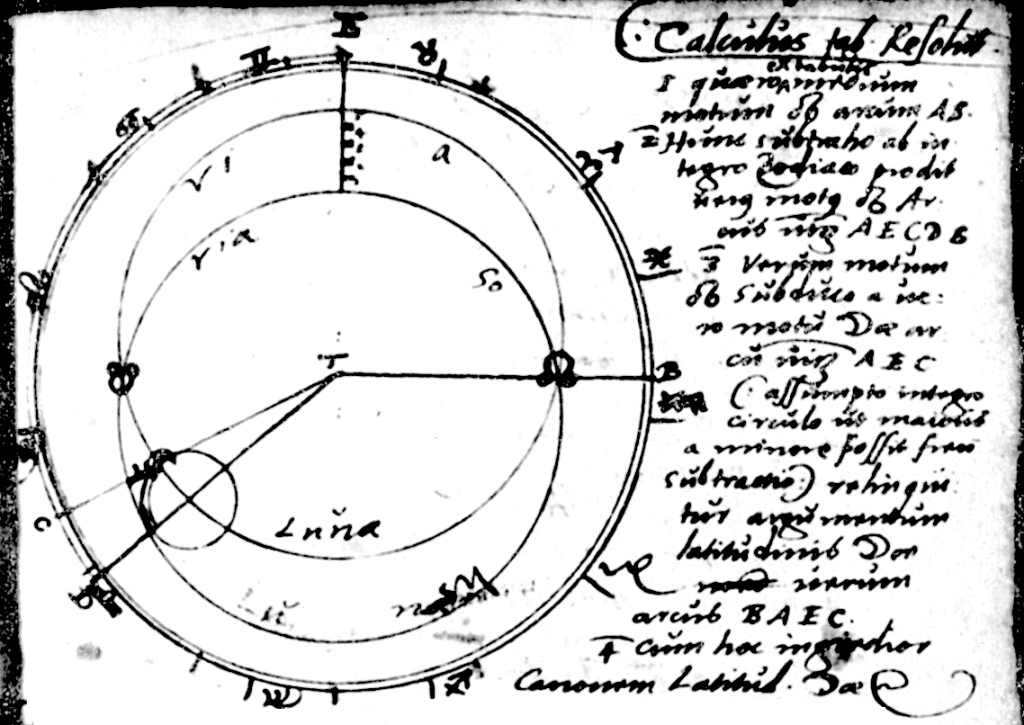
Even after the heliocentric vision of the World was presented, the conviction of perfectly circular orbits was not abandoned, here a drawing trying to explain the elliptic orbit of the moon (Luna) around the Earth (T) with three epicycles. Calculations according to Schöner’s Tabulae resolutae and Reinhold’s Prutenicae Tabulae in lecture notes from 1569

The difference with all the previous scholars—after Copernicus’s posthumous publication—proposing that the Earth was not static, was that the public at the time was much more accepting of the revolution of the Earth thought. A thought that would be revolutionary!

Revolution, at the time, had the meaning that Copernicus used in his title: simply the spinning around of the celestial bodies—how they revolved around the Sun. Revolved, revoluted, revolution. It was a physical description, like that of the revolutions or cycles of an engine, or as one famous revolutions podcaster puts it, “coming full circle”, just to come back to the beginning. Revolution did have, on rare occasions, the meaning of change prior to Copernicus’s work. However, the acceptance of heliocentric theory by the public of the time. It was so disruptive to the mindset of the age, overturning millennia of knowledge and worldview—so Earth-shattering (pun intended)—that the first main word of the work itself, revolutionibus, was adapted less than a century later to mean the overthrow of a political system (the Glorious Revolution in Britain). When transferring the physical meaning to the political one, revolution meant “a circular process under which an old system of values is restored to its original position, with England’s supposed ‘ancient constitution’ being reasserted, rather than formed anew”. At that point the use of the word was far form the meaning that it has now, as a radical new direction, or changing of course of what was before. Soon after, however, the word gained the modern concept of revolution, as used for the French one, which probably someone has heard about. Now revolution is more widely understood as the shattering of a previous political, social, technological—or otherwise—system, and the establishment of a new one: the Glorious Revolution, French Revolution, Industrial Revolution, Agrarian Revolution, Sexual Revolution…

It could be that the people at the time—after the Earth had been kicked aside, given rotation, put in orbit around the Sun, and the stars made still—experienced a mental shift so profound that it allowed for a reshuffling of many pre-existing mentalities. Maybe it can be compared to the shattering effect, almost a rite of passage, that many children in the Western world experience when they realise that Santa Claus is not a real being, but a construct created by society to make them believe that the bringer of presents is this exotic figure from faraway lands, and not their parents or families. For the child, it is already a big impact—and if you experienced that, you probably remember the moment, even if it was decades ago. Then imagine if instead of just one child at a time, it were an entire society realising, more or less simultaneously (within a generation), that the reality they had so strongly believed to be true, no longer was. That is what the so-called Copernican Revolution brought to European thought in the 16th century: a collective, mind-shattering effect. We, as humans, have been toying with these moments ever since. But more about that later.

In fact, the public that was more open to these ideas was also in the midst of another revolutionary movement, which at the time was called a protest, for lack of a better word: Protestantism. If the world, the solar system, the Universe, the Cosmos, was not as the Church claimed—with extra continents unaccounted for, the Earth in motion, and stars being other suns, perhaps with other Earths—then the Church became open to protest and reform. And if protest and reform were possible, then the acceptance of truly exotic ideas—like the Earth revolving—became easier in a society already undergoing profound transitions. In fact, different solar system models were readily adopted by Tycho Brahe and Johannes Kepler, Danish and German astronomers sponsored by Protestant-friendly kings. Meanwhile, Latin astronomers such as Galileo Galilei and Giordano Bruno had major conflicts with the Catholic Church in Northern Italy—Galileo famously tried, Bruno burned at the stake. Bruno’s seven-year trial and sentence to be burned alive was not specifically for his belief that the stars in the sky were other distant suns orbited by other planets, but also because of his rejection of most Catholic doctrines.

The difference between Copernicus in the 16th century and all those who proposed alternative cosmological systems before might be that society was more open to new ideas because of empirical slaps in the face—steadily, repeatedly, forcefully. First, sailors and their investors realised that direct observations could actually shift reality—such as the discovery of a continent, accurate measurement of latitudes and longitudes, and the real size of the Earth’s circumference. Second, astronomers and their sponsors (who were often astrologers for European courts—better predictions meant better horoscopes; the zodiac pays for your smartphone, if you think about it) found that when your health or the outcome of a war depends on the conjunction of Saturn and Jupiter, and your astronomer looks through a telescope and tells you that these planets have rings and moons orbiting them, you might predict better when to wage your next war. Third, traders could more precisely calculate profits or invest in new products—like new dyes and pigments (e.g. scarlet), or learning how to plant species such as pepper, potatoes, tomatoes, tobacco, coconuts, sugar cane, among others, across the world. Actual measurements began to overturn established doctrines one after another; these facts reinforced the critiques of the old system and laid the foundation for an alternative system of establishing knowledge. The Scientific Revolution went hand in hand with the development of better instruments and measurements that define the modern world we experience today.

It was equally important that these new ideas travelled and multiplied faster than ever before. On one hand, naval interconnectivity regularly reached all continents and the major inhabited landmasses of the planet. From there, peoples—willingly or unwillingly—became part of a shared system of exchange, a process that continues today, where nearly every human being is regularly connected to the rest of the world in one form or another. Our present hyperconnected world is extending the reach and frequency of connection to ever more remote places. On the other hand, the printing press allowed for the multiplication of ideas at a rate faster than authorities could suppress them. Even if the works of figures like Copernicus or Bruno were censored, confiscated, destroyed, or burned, it was much more likely that one copy would escape, be read, and be copied again. Before the printing press, Protestant ideas—like those of the Hussites in the 15th century—did not spread far beyond their place of origin (e.g. Bohemia). Later, Prague—with its famous astronomical clock—would host Brahe and Kepler. On the other end of the chain, at the point of reception, Spanish missionaries actively protected indigenous languages (while simultaneously suppressing their cultures) in regions such as Mesoamerica, the Andes, and the Philippines, to prevent indigenous peoples from being exposed to “dangerous” Protestant, Enlightenment, or revolutionary ideas. To this day, these regions preserve some of their linguistic diversity and remain heavily Catholic, with the Philippines being the only nation (alongside the Vatican) that does not permit divorce.

Our hyperconnected and idea-copying world is the one that gave birth to the concept of humanity—a “humanity” that can now begin to ask itself what it wants to do, now that we have the means to communicate with one another, and the resources (or energy levels) to invest a fraction of that energy in specific goals. But before asking that question, we first need to understand the mechanisms by which a hyperconnected people is able to pose it: which networks are activated, in which language communication occurs, with whom that exchange is implemented, and what actions can—or cannot—be taken. What is the agency?

Curiously, one of the early adopters of Copernicus’s thesis was Thomas Digges, who removed the need for the sphere of fixed stars. He proposed the existence of distant stars scattered throughout the Universe. This led him to raise the paradox of the dark sky: in an infinite Universe filled with stars, the sky should look like the surface of the Sun, because in every direction there should be at least one star. Since the sky is black, the Universe cannot be infinite. With that in mind, the Copernican Revolution—which displaced us from the centre of the Universe—is still not complete. It is geographical, but not temporal. Heliocentrism kicked the Earth and its peoples out of the centre of space, but the dark sky placed us in a special time—a time when we can still see the horizon of the visible Universe. Now we are in another special time—the time when humanity is conceptualised. The time to ask: what does humanity want?

Previous

Next

Meeting the Free Papua Movement in the Jungle.

IMG_2354

As with hitchhiking boats, it’s quite easy.

Wake up in the morning, follow some guys in a muddy, labyrinthine, flooded jungle track for almost 2h and you get to the “especial place” gathering.

How to get these people to show you the way is another story, but involves books 😀

Once you reach the nice gathering place you learn how Taro is cultivated: you take the plant, collect the roots (sweetpotato like, but thicker and drier), put the branches on the hole again, wait for 6 months, repeat. They also hunt opossums as meals, food is not a problem :).

Then the gathering, most of the people are old men. Everything starts with a prayer, then a summary of the news. Worryingly they think that by September the UN will vote for West Papua to be independent, UN will send troops to kick out the military and police troops and give them a brand new country.


Well, no, the world does not work that way, while all the same the world does work that way in their minds.


Being of valencian origin, catalan culture,  growing on the ashes (50 years after) of spanish civil war, failed coup attempt 4 years before I was born, ETA terrorism, West Sahara as an ex colony of spain recolonized by Morocco, and the current independence politics going on, thatbcomes handily when  grasping the settings anywhere else in a struggle of any kind.

From its complexities to its simplifications.

I’ll go for its simplifications as it’s simple, far enough, any other thing would be a book and not a blog post.

Shortly: West Papua colony of Netherlands, UN in the 60-70s wants all the “nations” to lose the colony status, the Indonesians want more land (as it was on any “nation” mind the last 500 years), Netherlands controlled Indonesia, it controls West Papua, So West Papua is indonesia, Indonesia controls it now. Locals no happy, struggle, killings, repression, attacks, more repression, hiding, paranoia and fear of the outside world getting in, shutting of information in and out, government afraid, indigenous ignorant and angry. And this is the “simplified”.


I’m told I’m the first foreigner to ever go there, the conflict runs since the 70s (68-69 all started escalating). That can give you an idea of how things are going. Basically as now no foreign press is allowed to roam freely in this part of the country, by law, and the police is really paranoid of that*. On the bright side the new president of Indonesia Jakowi, has said that that has to change, but so far it has not been legislated, nor enforced.


With the simplified context let’s go to the meeting. The info comes from one of the few  mid age members that has some basic English and access to the media that talks about West Papua, only one informant from highly biased sources*. On top of the UN September thing, other news of around West Papua, in Timika (city close to a huge mining company, freeport)  it seems that delegation of the FPM is being closed and many people on the streets protests. I’m shown a picture of women laying on the ground in front of the tyres of a military vehicle.  Other news of other detentions and incidents.

After the participants of the meeting and my guide insist that I “interview” them.

Highly exited I proceed with the task starting with the Capitan of the commando. Soon I realize that what I understand of interview and what they understand it’s quite different. Their understanding is ‘say whatever you want, accept it as truth, finish the speech’, my understanding was ‘ask whatever question you might have, push for the answer’.

It would be obvious to anyone that both are incompatible, it was plain for me too, I was to be used as a recording and distribution machine to the “outside world”, despite that I managed to extract 0, 1 or 2 answers per “interview”.

A dozen “interviews” happened, so I got some questions down the line, but far off from what I would have desired. I wanted to paint a board and clear picture of the situation there, but too much interrogation on my part was confronted with uneasiness, nervous looks to the others and rush to the next “interview” by my translator, where the next on the row will describe his/her position and number on the military branch and talk whatever he wanted to be said, usually repeating what was already spoken before… I don’t think they behaved that way out of fear or to hide something but more because of being highly unused to the situation.


On the simplified side what I got home is:

  • They are really angry at what the Indonesian military and police did and, to some point they felt, where still doing†. Murders, rapes, shootings (one woman sowed me a bullet wound in her palm of when she was a child) and detentions.
  • They are old and tired by the struggle and what that something magical will happen in September that will solve ALL their problems.
  • They feel left behind socially and economically by all the indonesian population living now in Papua.
  • They don’t mind fighting and dying again.
  • They are bond  and mind a lot religion.
  • One at least wouldn’t mind towing away all non Papuans the sooner the better.
  • Worst of all, they feel treated as stupid inferior beings by the Indonesians, whit no mere rights than mere slaves to bis disposed off.

Of all the points obviously the last one sets the reasons why colonialism was so terrible and why despite all the odds against people would risk their lives just to get out of that mentality, specially in a world that does not accept colonialism and slavery any more.


Food between the interviews, taro, vegetables, extremely sweet tea or coffee.

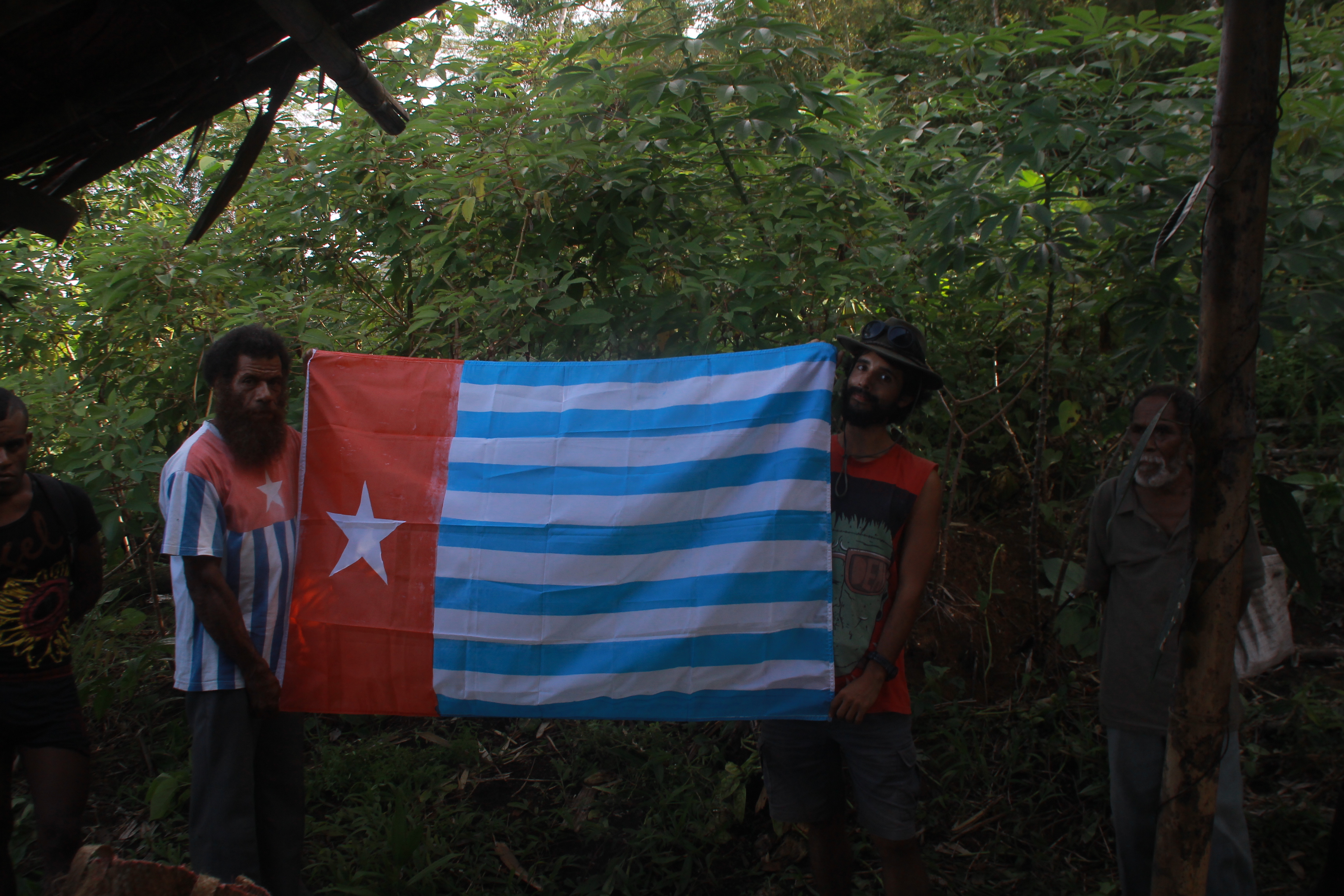
Showing of the “militiamen” armed with machetes and lances. History of the commando, old photos, hand made Flag rising, prayer. Many photos with me posing with different sections of the commando.


Curiously despite the opposition to the Indonesians all the meeting is held in Indonesian language even when everybody could understand the local language.

Also as I mentioned there are not many young people among the units, I’m told they are afraid to continue with the struggle, only those with family reasons join the fight.


On the evening  the sun sting behind the undulating jungle covered lands, the life now revolves around a fire. The hill huts pooping with their brown roofs out of the vegetation provide a resting place. Cooking, telling stories, having warm fire light under the precious shining stars spanning both hemispheres.

A world where life is bountiful and food and warmth is not something to worry about, where the nature is beautiful paradise by default everywhere you go, everywhere you look, where humans managed to put the same old mistakes in a brand oldy new environment.

The fact that I’m not more thrilled about the certainly unlike experience and environment is that I deeply realize how pointless, biased, short sighted and world apart this conflict is, it will take me days to partially overcome that feeling, I don’t think it will ever completely leave me.

It’s like the world does not realize this place exists, is like this place does not know the world exists. Is the world going over the same puzzles again and again and nobody even knows this piece has been created and forgotten in some place of the room?.


*I’ll be the living proof of that media being highly biased in a latter incident  (not that the media is not biased perse, but it can get worse, nor that it’s not understandable either).

† On a notice virtually every indigenous Papuan that i met in 1 month in West Papua lst a family member.


Papua Diaries, 31, Papua free movement demonstration, 8th detention

Oh well Let’s extend 2rd law of solo travelling to not go to demonstrations full of military escort. Well anything that military in some kind of operation. They military/police are rather susceptible and unwise.

IMG-20160615-WA0031

Wake up early and I go towards where my hitch yesterday told me a Papua free demonstration would take place, from the University to the center of the city, it shall be a 20km long march.

I walk to the place, it is full of police and military. I approach a roundabout and next to someone who I think is a reporter I try to take picture of the people gathered there,  but that guy grabs me, another others joins. They tell me that they are police, however the police standing few meters away, by the road does not move an inch.

At the end some of the military and police moves towards us, I thought they would deal with things, instead they grab me and force me to the police station. I get free of they grasp but I walk along them not to get into trouble. Probably the guy who whas taking pictures and first graved me was a plain clothes police.

On the way to the office innumerable other policemen take pictures of me. I smile :), later I will learn that they do so in order to sell them to the press…

What follows at the police office is the usual Indonesian interrogatory, be asked the same questions again and again by 15 different people in the room, is like they don’t hear what I already said. Odd, and starts to be frustrating after 2h. Also they take many pictures of the content of my pockets, over and over, and write several reports in parallel with their smartphone and by hand. Extremely efficient it seems…

The demonstration is organized by a student movement and the police tells me that reporters are not allowed by law. On addition they tell me that they will broke it down in few hours. It’s supposed to be a long march for freedom, from Abepura, where the university is, to Jayapura center, where the local government is.

The Papua Free movement commando that I met previously told me that despite the government is apparently officially allowing free press in papua, that’s not the case on the the grownd. I would dare to say that the old military elite from the military/police forces remaining from the dictatorship is still nervous about here. I’ll be confirm about that by the interrogation police guy next day.

Well it’s easy to understand. Almost everyone I met lost a close familiar and/or friend by their hands, if what the locals told me is true. Families being big it might explain why so many seem affected, but it still describes a brutal repression and murders and rapes well into the 21 century.


Anyway the police is deeply suspicious and is detaining me yet again (for few hours). It does not help that one guy is trying to see all my pictures, where the Papua free movement ones are. Luckily they are buried along thousands of others, but I must already  remove them from my camera. I’m a bit too careless.

My host is called (this time I learned from my last detention and I give his details), when he comes I’m bailed out. Coincidentally he works on the bank that is just in front of where the march that has not been allowed to progress is. Now is just a stand off that takes all day. I therefore can go to the upper floors of the bank and I can watch the demonstration without the police detaining me, good enough, but I would love to mingle there! ugggh, i so much would like to mingle in there and take amazing pictures. My consolation is that i can see it from above.

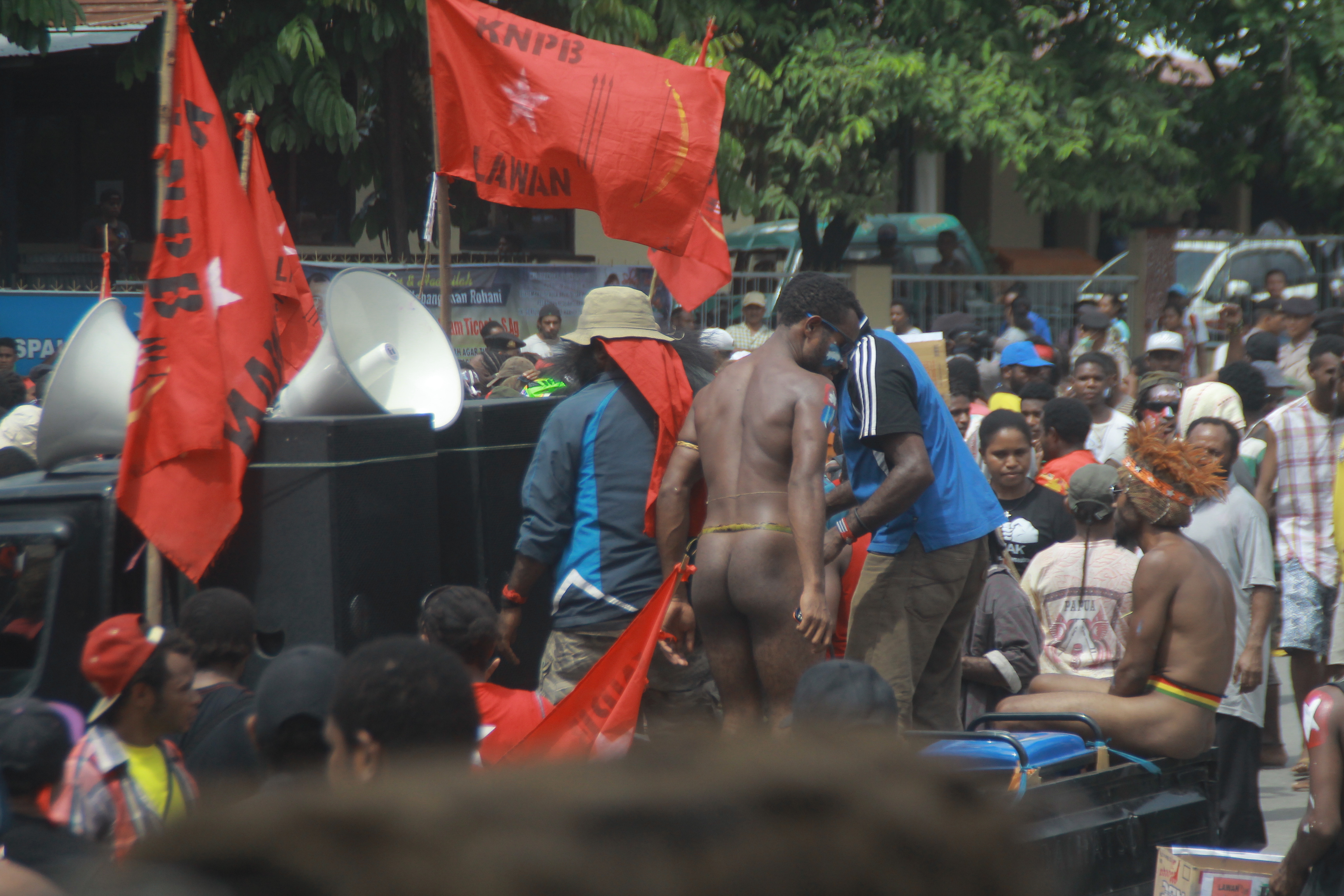
Quite cool, many people with painted faces wearing the west papua flag  and (un)dressed in the traditional way of Wamina (the highlands) with the kotekas, penis covers.

IMG_3480

The demonstration is small anyway, few thousands at best. Yeah not letting it progress only shows the nervousness of the establishment.

In fact, has any pacific demonstration ever changed something? usually is the crack down of those which start change, but the ones that come to my mind that have been pacific and allowed to progress, have done nothing, even if they where massive. Only when you start repression you are endangering yourself. I guess usually power is inherently self preserving stupid. That’s why it has changed hands so many times.


The clever one is self preserving but doesn’t change hands so often.


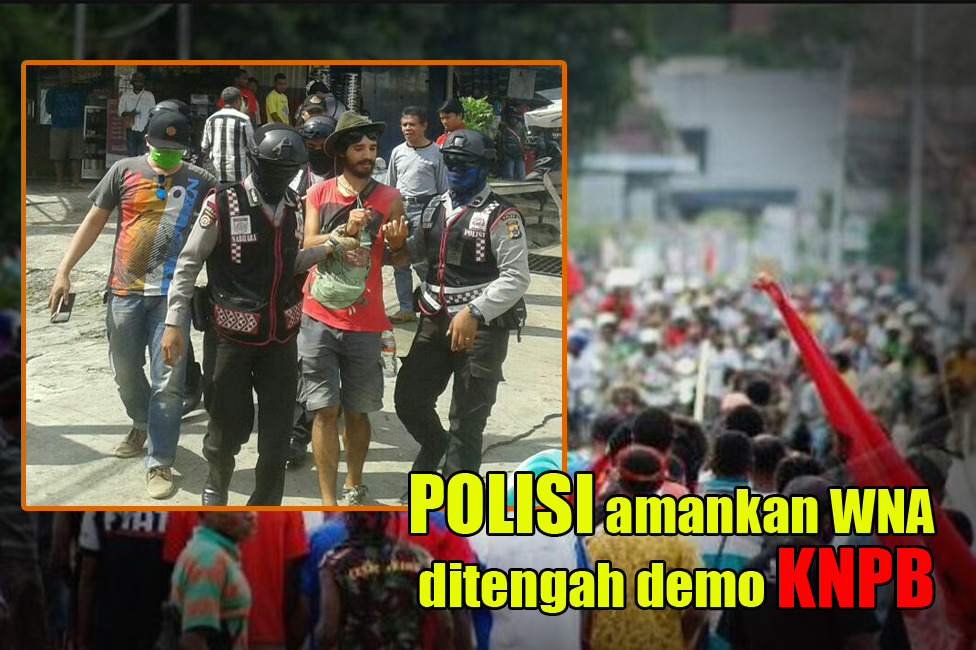
On last note, the police for some reason leaked my details to the press: name, university and what not. That’s how that picture at the beginning of the post happened to be and now is linked with my name, forever or as long google does it 😦

So worried all my life of my details going to the web without my complete supervision and masking and now I’m all over the press. It was translated to english, then catalan, spanish… my PhD supervisor and friends piked it at home. Great…

http://papuanews.id/2016/06/15/polisi-amankan-wna-ditengah-demo-knpb/

Spanish tourist arrested at demonstration in West Papua

http://www.vilaweb.cat/noticies/detenen-un-catala-en-una-manifestacio-a-favor-de-la-independencia-de-papua-occidental/

Btw the reports of my detention have been greatly exaggerated (paraphrasing Twain). Is not a “detention” per se and the headlines saying that thousands others where detained was a complete exaggeration, non was detained, only they where not allowed to advance on the long march, so it became a stand off demonstration.

Anyway as always and as everywhere press does its job in its own way, it has not changed in hundreds of years and I lived through the facts. I shall be happy to experience how the world really works, I don’t feel happy…

Diaris de Borneo, dia 18, política

image

Estic creant un nou sistema polític o nova revolució. Com ja va passar en la meua ideologia prèvia, morta ja, tot passa per l’educació.

Bàsicament cal canviar totalment el sistema educatiu per a que no només arribe a quasi tothom com ha fet prou bé fins ara, si no que a més siga capaç de realment enrriquir i involucrar a tots els individus. Per tal d’així aconseguir coneixements que consideren importants per a tindre control i decisió sobre les seues vides.

Bàsicament em referisc a atenció personalitzada però econòmicament, jaha que ha de mantindre la universalitat. El problema però és com fer-ho. Al nivell que tenim ara és molt difícil trobar la resposta, supose que caldria molta inversió en recerca educativa i interacció social. La recerca social és perquè moltes de les desicions de la majoria de la població no es prenen a nivell individual si no per influencia “veïnal ” (aquelles persones o factors pròxims que influixen les d’edicions).

A grans trets diria que el sistema educatiu actual no és més que una universalització , estandarització i reglamentació de l’educació medieval. Per una banda educació que era per a les elits, basada en la memorització i pràctica dels principals coneixements actuals. Aquesta seria l’educació primària i secundara obligatòria d’ara, i Universitat també.
Mentre que l’altra està basada en l’aprenentatge de les arts i oficis medievals, el que tenia la majoria de la població (ja siga feina manual simple, que s’aprenia a l’indantesa, o oficis complexos que s’aprenien a la joventut).
Aquesta ara estaria representada en la formació profesional d’ara, o dies de pràctiques per a feines simples.
Es a dir, a part de la universalització i reglamentació de l’educació no hi ha hagut més canvi des fa centúries. Cosa que deixa a molts individus  poc preparats ja que la formació del sistema actual és del seu interés o habilitat.

El motiu pel que emfatitzar l’educació per canviar de sistema és per la intuició que cada cop que ha hagut un increment notable de gent formada hi ha hagut una revolució (i.e. els burgesos al s.XVIII i part de la classe treballadora al s.XIX) però hauria d’estudiar si la intuïció té fonament o és coincidència.

Hui  dia llarg d’autostop, 12 vehicles amb sort mesclada, 2 m’han dut vora 30km fora del seu camí per fer-me el favor. Molts han parlat extensament de política i Sarawak i Malaysia i com només es queden un 5% del obtés del petroli i la resta va a desenvolupar la capital. Malaysia no és un país desenvolupat, és una ciutat desenvolupada. Tot això m’ha fet reflexionar sobre sistemes polítics.

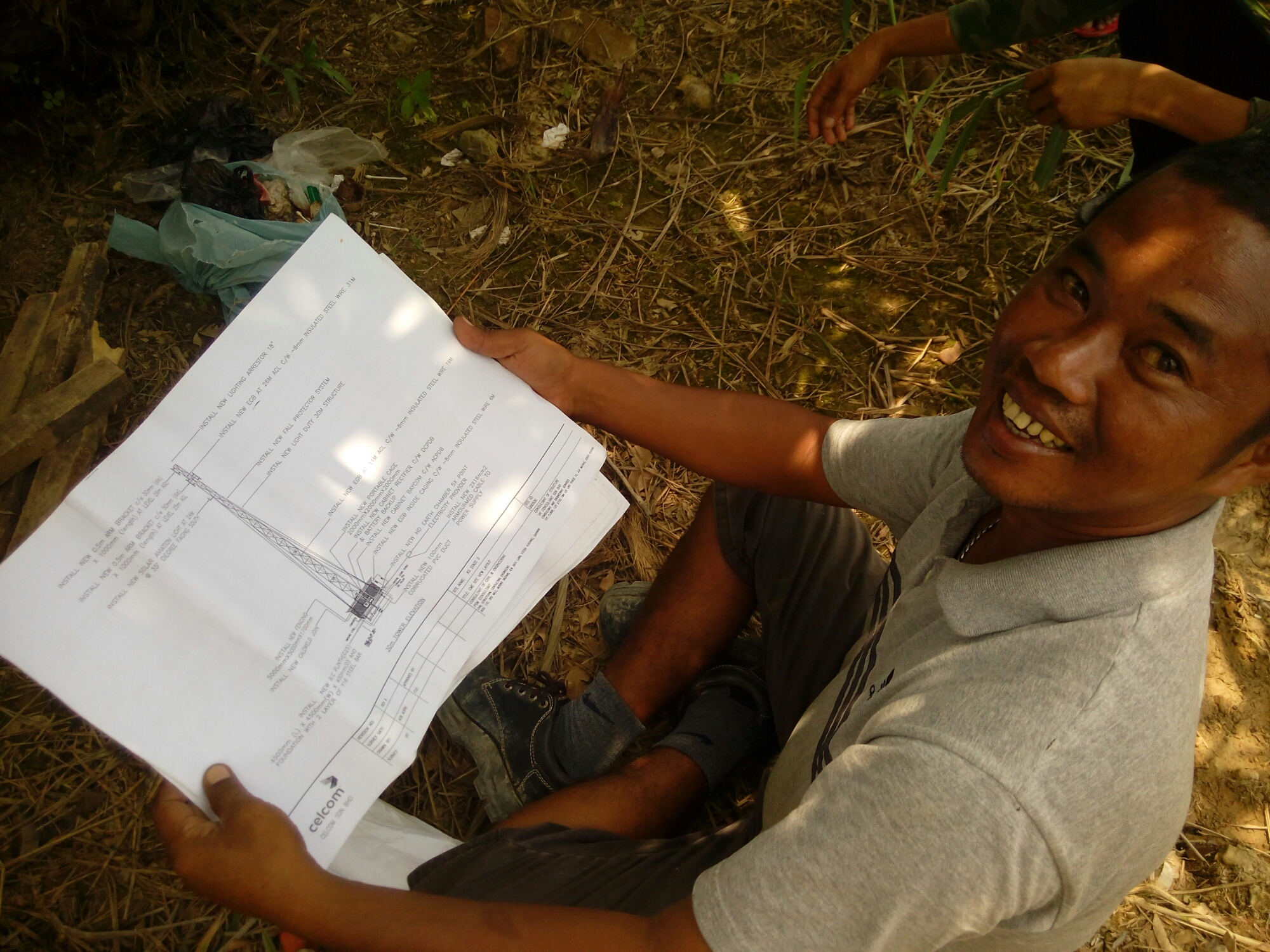
La foto és d’un equip de construcció de torres de comunicació que m’ha agafat i estàn preparant per construir la torre.
També m’ha agafat un curiós autostop que conduïx descals com jo :). Altre n’ha conduit 30min per camins polsegosos fins a una casa llarga de caçadors de caps per recaudar diners. He fet l’autostop a les 22h per 1r cop.
El motiu per que es fera tard és que un autostop estava preocupat que no poguera arribar i ha demanat ajuda a la seua filla que hem esperat per llarg. El següent m’ha invitat a un festí que ha durat més d’1h. Era un treballador de la Shell extremadament interesat en els meus viatges. Després l’última, que va estudiar a Leeds i treballa per a energia i Indústria del govern Brunei em du fins el meu CS, Eve Lee, una pianista que m’espera 40min per dur-me fins sa casa.
Molt bona gent que et trobes en aquest món.