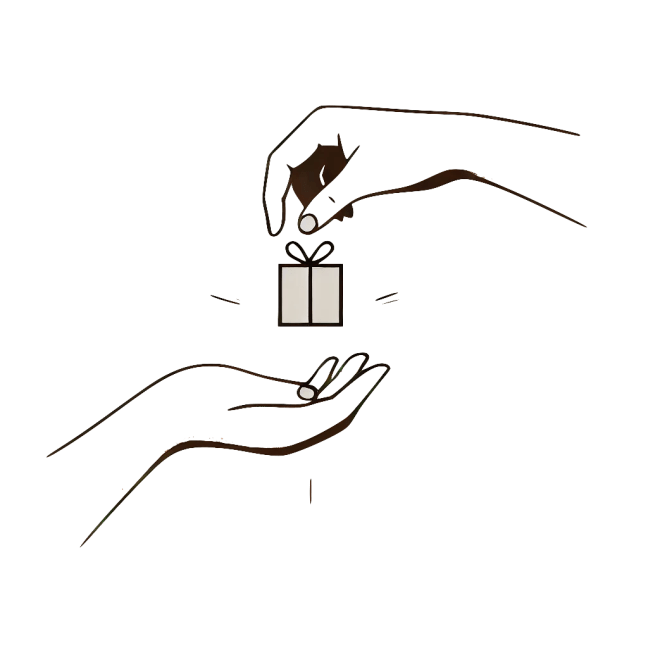
Exchange and Gift-Giving

An amazing behaviour from non-human animals is way seems present giving to their carers. If you own a cat that roams freely outdoors, or know someone who does, you are likely familiar with the slightly unsettling “presents” they bring home. A variety of dead or half-dead creatures—perhaps a headless sparrow on the bed or a twitching cockroach on the pillow—serve as feline offerings. These gifts are likely given because the cat considers you part of its pack, reciprocating the security, shelter, and food you provide. Alternatively, they may be trying to teach you to hunt, much as wild cats do for their young. This is particularly evident among mother cats raising kittens. Similar behaviour can be observed in lions, where females bring back food for the pride’s alpha male, and mothers present cubs with small, disabled prey—sometimes even scorpions with their stingers removed—as part of the hunting learning process of the kitties. Interestingly, this behaviour is one of the few documented examples of “teaching” outside the human realm, a concept debated by researchers studying how learning takes place in humans and non-human animals.

Other animals also engage in gift-giving, though usually in the context of mating rituals. Some species of flies and spiders, for instance, present food or other items to potential partners. Returning to corvids, they have been observed offering gifts to human carers, often in the form of shiny objects. This is intriguing, considering that research suggests corvids are actually afraid of shiny objects. Despite this, the belief persists that magpies and crows are attracted to glistening objects. While corvids have been documented presenting “gifts” to other individuals in experimental settings, these events are rare and not actively pursued, leaving the true motivations behind this behaviour unclear.

Both corvids and non-human apes share remarkable cognitive abilities in problem-solving, tool-making, social interaction, and environmental manipulation. These parallels suggest that complex cognitive skills have evolved multiple times in distantly related species with vastly different brain structures. For example, corvids and parrots perform cognitively demanding tasks at levels comparable to primates, despite having much smaller brains. This suggests that brain connectivity, rather than sheer size, is key to developing advanced problem-solving skills. This apparent case of convergent evolution may indicate that similar social behaviours and strategies are necessary to tackle shared socio-ecological challenges. Yet, while these species follow different paths in tool-making and social learning, we have not yet identified non-human examples of the kind of collaboration seen in human societies.

One potential comparison lies in large-scale infrastructure projects undertaken by collective animal efforts. Social insects provide the most striking examples, constructing elaborate nests, bridges, and even cultivating fungi. However, such projects appear to function at the colony level, with no evidence of inter-colony collaboration. An exception to this rigid structure exists among Argentine fire ants, which freely exchange individuals between related colonies, blurring the lines between distinct social groups. Beyond insects, some social animals also engage in large-scale collaborative construction. Beavers build extensive dams, and sociable weaver birds in southern Africa construct massive communal nests, accommodating hundreds of nesting pairs. These nests feature interior chambers that retain warmth at night and outer compartments that remain cool during the scorching daytime in the Kalahari. However, such complex communal infrastructure has not been observed in corvids, parrots, or non-human apes, though chimpanzees and orangutans do create nests and rudimentary shelters.

What all these collaborative species share is a sophisticated communication system, mutual benefits from group cooperation, a degree of specialisation, and the development of unique strategies tied to their social and environmental contexts.

Humans, however, have taken this a step further. We extend our networks beyond our immediate group through exchange and gift-giving, forming connections that span vast distances. In these exchanges, context is crucial—where the perceived “usefulness” of an object is shaped by the specific environment in which it is found.

Imagine a prehistoric landscape on the East African coast, where groups of foragers live between the Great Lakes and the sea. It is easy to see how these groups would not have access to the same resources. Coastal communities would have abundant seashells and seafood, while those inland would rely on savannah, jungle, or mountain resources, hunting different game and collecting unique plant species. Lakeside groups would have plentiful fish but limited access to large seashells, which would be abundant on the coast. This variation in resources stretches across just 600 kilometres—from Lake Victoria to the sea. No single forager group would regularly traverse such a distance, but a chain of six or seven groups, each moving within a 50-kilometre radius, could establish a web of exchanges over time. Such interactions lay the foundation for trade, gift-giving, and the vast cultural networks that would come to define human societies.

Tool Making <- Previous Next -> Signalling

Tool-making

Tools can be seen as the means to a goal or goals. For example, a similar narrative to the shiny objects one can be constructed. Rare things were just objects to attract mates or facilitate social interaction. But obviously tools are also utensils that expand the range of resources in the environment accessible to a given individual. There are many examples of non-human animals using tools in their natural environments to widen their range of possible nutrient sources. One of the most studied behaviours is the use of stones or logs to crack nuts by non-human primates. We can perform the same exercise if we go to the countryside and see some freshly fallen nuts on the ground. Most likely, we will pick up a rock or a log and crack a few nuts for the pleasure of enjoying that small treat.

More sophisticated strategies for using tools also exist that can not be thought as tools in a strict sense, like fixed elements of an environment. And also more intelligent. I once saw a monkey in Colombia opening a coconut by hitting it against a large tree branch. I can honestly say that I could not have opened the coconut by replicating its technique, nor could I have devised the technique myself, even if I put my mind to it. For those unfamiliar with a fresh coconut, it has an inner hard shell, the same type we see in Monty Python and the Holy Grail. However, it is encased in a fibrous layer, about six inches thick, covered by a thin, smooth outer layer that is difficult to break. If you simply hit the coconut with a rock or throw it to the ground, the fibres absorb the impact, making it frustratingly difficult to access the inner part. Instead of a rock, the macaque had a neat and efficient opening process. It was a complex sequence: hitting the coconut against a large tree branch while standing on it, then rotating the coconut to remove the outer smooth layer and fibres until it had a convenient handle. Then it could crack the hard shell against the tree branch. This was a sophisticated process requiring knowledge, skill, and technique—one I have never seen a human use to open a coconut, and i counted almost about a dozen different ways of doing it on my travels.

Many other sequential, complex examples of tool use exist. In the case of birds, it has been observed that New Caledonian crows can create long-reaching tools out of short, combinable parts—connecting different short sticks to form longer ones that allow them to access food in a puzzle box. Interestingly, in that experiment, as we have seen, only one of the eight crows, called Mango, was able to piece together four or more short sticks. Therefore, intelligence is not evenly distributed among all individuals of the corvid family. Other great apes, including humans, can also use complex tools, especially to extract insects from holes and colonies.

More intriguingly, the other crows did not learn from Mango to apply his technique. His innovation, stemming from his superior intelligence, benefited only himself—perhaps allowing him to gather more food, gain a reproductive advantage, and produce more descendants who might inherit his heightened cognitive abilities. Consequently, knowledge acquired through innovation is retained only indirectly, as a genetic change—a process that occurs very slowly.

Despite their impressive tool use, neither non-human apes, birds, nor any other known species have made the cognitive leap to trading, exchanging objects or knowledge, or gifting them away. Each time a chimpanzee wants to eat ants, it must create an elaborate brush. There is no brush-making chimpanzee who exchanges their higher-than-average ability for food, grooming, or social status. Nor does Mango the crow trade his long tool with less skilled crows. There is no market or ceremony among non-human species where goods, tools, or knowledge are exchanged or given freely.

We will see that more sophisticated behaviour is needed, connectivity will allow the increased complexity of tools.

Rarity and Curiosity <- Previous Next -> Exchange and gift-giving

Language

The most critical basis for communication is language. It is difficult to define what a language is and what it entails. At its core, language is something that can capture deeply complex concepts—both external and internal—and transform them into words with specific meanings that can be shared with others. Therefore, it entails both an internal component, in which the brain must link specific concepts to words and structures of the language, and an external component, in which these words and concepts must be translated into structures that can be broadcast to other individuals. These broadcasts can primarily be via sound, visuals, or touch, but in principle, any channel capable of encoding information should work in order to create structured signals in the form of a language.

There is no clear agreement on how old human languages are. Some argue that they started emerging about 100,000 years ago, while others argue for an even earlier origin. Nevertheless, however they came to be, languages are an integral part of being human, shaping both how our brains function and how we understand and influence the world and ourselves.

Some examples illustrate how wired we are to shape our brains for learning a language. The clearest natural experiment demonstrating the spontaneous learning and generation of languages is that of Nicaraguan Sign Language.

In the 1980s, for the first time in Nicaragua, a school for deaf children was created, bringing together children from all over the country to live and learn in one place. Before this initiative, there was no institutionalised system to teach deaf children how to communicate. As a result, at the time of their arrival, these children’s vocabulary was limited to a few hand gestures used within their families or communities of origin, often in the form of idiolects or cryptophasia (“private languages” usually spoken by one person or between twins).

Compounding this initial lack of complex communication, the teachers at the new school aimed to teach the children lip-reading and Spanish through that method. They discouraged the use of any sign language, believing that the children would put less effort into learning to lip-read. However, lip-reading had very limited success—the children were unable to communicate with their teachers.

Despite this, communication flourished outside the classroom among the children themselves. In the courtyard and throughout their daily activities, they combined the hand gestures and signs from their respective communities and created new ones. This process of creation, sharing, and accumulation spontaneously generated a new language, which rapidly evolved into more complex structures, giving rise to grammar and a more elaborate vocabulary. This increase in complexity and fluency was particularly evident among younger generations of students, who picked up the signs from older peers and refined them with intricate flourishes and added layers of meaning.

This entire process was documented by sign language experts, who were called by the teachers after noticing that the children could communicate fluently with one another but remained incomprehensible to the teachers. Initially, these experts also struggled to understand the children, but by filming them, analysing the footage, and interacting with them using the learned hand gestures, they gradually acquired the language. Most interestingly, over the years, they recorded the cumulative process of increasing complexity, allowing us to witness how the language evolved and standardised rapidly.

Notably, the children were already familiar with a small subset of home signs. However, this is not so different from the basic signs shared by social animals or those we can teach our pets. For example, when I was living in Mallorca, I was responsible for a dog named Gordon. I could tell him “sit,” and he would sit; “down,” and he would lie down; “up,” and he would stand on his hind legs; “la pateta,” and he would sit and give me his left paw. Even more complex instructions, like “We are going for a walk, but first, we need to go to the basement,” were followed correctly—Gordon would go straight to the basement instead of heading directly outside. Not only that, but he also communicated with me: for instance, he would touch his water bowl to indicate it was empty or stand patiently by the courtyard door when he wanted me to open it. Through these examples, one might say that he and I shared basic communication and understanding, but no one would, in their wildest dreams, call that a language. Nor would a language ever emerge from these exchanges. This became especially clear when I said more complex things, like “Could you go to the cupboard, open the door, and bring me a kilogram of rice, please?” or “Do not bark at the neighbour’s dogs!” Gordon could open doors, so that part wasn’t a problem, but the rest was beyond his capabilities.

The case of Nicaraguan Sign Language is particularly important because it demonstrates the evolutionary nature of language within a short time frame and its ability to keep expanding—something that does not occur in any other non-human animal. To be fair, dogs can be trained in more complex ways than my simple set of commands (and one particular, named Chaser, learned can more than 1000 words!), and other animals, such as dolphins, elephants, circus animals, horses, buffaloes, parrots, pigeons, and crows, can learn to respond to basic commands from their human carers. Bonobos, in particular, can learn up to hundreds of hand gestures to communicate basic information with their trainers, and similarly, dolphins can understand basic sentence order. However, this is the maximum extent of their communication; it does not go any further. Nor do animals copy human language to communicate among themselves in more complex ways—not even parrots, which can mimic hundreds of human sounds, spontaneously start using them to communicate with each other. Humans, on the other hand, have the unique capacity to transform simple signals into an elaborate and constantly evolving set of communication codifications.

The connection between language and the brain is deeply rooted in humans, with both being intricately linked, as seen in the Sapir-Whorf hypothesis. Language shapes the brain, and the brain, in turn, shapes language. The latter is evidenced by the fact that certain sounds seem to be more naturally associated with certain concepts—for instance, sharp objects are commonly linked to words with sharper sounds, while round objects tend to be described using softer pronunciations across multiple languages. Language is integral to memory, abstract thinking, and, fascinatingly, self-awareness. Language has been shown to drive much of the brain’s core “hardware”. Languages shape brains to such an extent that, most of the time, we think in a language—or in multiple languages if we are multilingual.

For those who are born deaf, rather than relying on an “inner voice” as spoken-language users do, their thought processes are shaped by visual sign thinking or the sensation of body gestures. Interestingly, deafness has a significantly greater impact on the brain than blindness. People born completely deaf and who never learn sign language fare only slightly better than the rare individuals who grow up without any language exposure. Without language, they fail to develop an “inner voice”, which is crucial for the brain’s ability to process information. This is especially significant in early childhood. Those who are not taught sign language until later in life often have learning problems throughout their lives. It seems that the brain processes sign language exactly as it does spoken language, using the exact same regions.

Communication - Culture <- Previous Next -> Forms of communication

Collaboration

Another important behaviour that humans share with many animals is socialisation and collaborative action. This is observed across a wide range of species, including not just animals but also organisms from other biological kingdoms. There are many examples of this collaborative behaviour.

Cetaceans (whales, killer whales, porpoises, and dolphins) engage in social collaboration to achieve common goals, such as developing feeding strategies and defending against aggressors. A species that is particularly close to us in terms of social behaviour is the wolf. Wolves form small packs of up to forty individuals, working together for survival. Their domesticated relatives, dogs, are also highly social animals capable of interacting with many other species, especially humans, to a remarkably sophisticated degree. This is exemplified by cases where humans have been effectively adopted by dogs, such as in the myth of Romulus and Remus—the legendary founders of Rome—or in more recent historical accounts like that of Marcos Rodríguez Pantoja. Marcos lived among wolves for 11 years after his father sold him to a landowner who entrusted him to a goat-keeper, who later died. Marcos recounted:

“One day I went into a wolf den to play with some puppies that lived there and fell asleep. When I woke up, the wolf mother was cutting deer meat for her puppies. I tried to take a piece from her because I was also hungry, and she swiped at me. When she finished feeding her puppies, she looked at me and threw me a piece of meat. I didn’t want to touch it because I thought she was going to attack me, but she kept bringing it closer with her snout. I picked it up, ate it, and then she came up to me. I thought she was going to bite me, but instead, she stuck out her tongue and started licking me. After that, I was already part of the family. We went everywhere together.”

Marcos also recalled that after reuniting with his father, his father simply asked him for the old jacket he had left behind.

If we extend the concept of collaboration further to include infrastructure, we see that insects and arachnids also exhibit highly cooperative behavior, forming vast colonies. However, these types of social structures are not exclusive to invertebrates; similar cooperative infrastructure-building can be observed in birds, beavers, and many mammals that create dens. In the case of insects, some colonies function almost as single superorganisms, with specialized individuals performing specific tasks or switching between roles as needed. Other social animals, such as meerkats, also have fluctuating specialized roles within their groups, such as caring for the young or standing guard to raise alarms against predators.

For social arachnids, as well as some bird species and most den-dwelling animals, collaboration seems to be primarily focused on building communal nesting or feeding structures. However, outside of these specific activities, they tend to act as individuals.

On the looser end of social structures, we find schools of fish and herds of various land animals. These groups function as dynamic, collective entities where decisions about feeding, protection, and movement are made communally.

Expanding the concept of socialization even further, we can consider co-dependent ecosystems. In such ecosystems, plants and animals—or even plants with other plants, bacteria, and fungi—are so interdependent that they cannot be considered separate entities. Biologists refer to these relationships as symbiotic or, in cases where one organism is significantly larger than the others, as holobionts. A common example of a holobiont is the relationship between a human and their gut bacteria, whereas an example of symbiosis is lichen, which is formed by the mutualistic association between fungi and algae.

The scale of communication and collaboration in most living organisms is usually limited. For example, some ant species form supercolonies containing trillions of individuals, such as the Argentinian fire ant supercolony (Linepithema humile). These supercolonies cooperate with genetically related colonies while competing with unrelated ones, allowing them to dominate newly colonized lands by leveraging globalization. However, despite their vast numbers, their communication networks remain limited to neighboring colonies and do not extend much further.

In contrast, human collaboration is, in principle, boundless. Even in the Palaeolithic era, commercial networks facilitated the exchange of materials over vast distances—hundreds or even thousands of kilometers— with materials transported almost 200kms at least as early as 45,000 years ago. This scale of mobility far exceeded that of individual bands and their immediate neighbours. No other species exhibits such an extensive range of cooperative behaviour.

Even among our closest extinct relatives, there is uncertainty regarding the extent of their social networks. Recent genetic research has shown that a group of Neanderthals remained genetically isolated from neighboring groups—less than a ten-day walk away—for more than 50,000 years. However, this genetic isolation is not unique to Neanderthals. Studies suggest that modern humans, too, have lived in genetic isolation from neighboring communities for tens of thousands of years. For instance, the ancestors of African Pygmy foragers are believed to have diverged from other human populations around 60,000 years ago, though they intermixed more recently in several occasions.

Intelligence <- Previous Next -> Communication

Intelligence

Starting with behavior that can be understood as intelligent, we can focus on tools. These were already present in the Homo lineage and are also shared with many other species on this planet. We can understand tools as macroscopic external elements of an animal’s body that are used to gain access to more resources, security, and reproductive success. More conceptually, tools can also be strategies to achieve the same objectives without the use of any specific external object, other than perhaps geography.

The use of tools can be both learned and innate and is abundant in the animal kingdom. Examples of tool use range from primates using stones and branches to crack nuts or open coconuts, to birds creating complex fishing utensils with their beaks and claws, especially in the family of Corvidae (ravens and crows) and psittacines (parrots). Dolphins, for instance, use the shore or each other to trap their prey.

But tool use can extend far beyond what we would usually consider “intelligence.” For example, creating nests and structures to attract females (as seen in bowerbirds), ants using sticks to build bridges or using fungus to ferment food, chickens eating rocks to aid digestion, hermit crabs using shells and plastic cups, caterpillars using leaves to make cocoons, foxes building dens, and beavers building dams. One could consider these behaviors as simply “innate” tool uses. However, there is ample literature arguing that the “social learning” of animals, whether innate or learned, is difficult to define and differentiateAlthough instances of problem-solving behavior spreading have been observed, such as parrots opening trash bins in Australia.

Interestingly, the spontaneous use of tools—using environmental elements for one’s own benefit—is probably widespread in the animal world. Individuals of many species use tools in controlled lab environments, where they can solve complex puzzles using elements of the system. For example, pigs can play video games, rats solve mazes, and squirrels solve puzzles.

However, despite the shared use of tools among many animal species, we are fundamentally different. This shows that “intelligence,” in the case of humans, might be necessary but not sufficient to explain why we are the way we are. The key difference is culture. Many of the previous examples of animal innovation do not constitute culture. This is because the discoveries of one individual are often not explained or described to fellow individuals of the same species. In the case of puzzle-solving and tool-making, each individual must solve the problem themselves initially, which is an inefficient way of obtaining resources. Not all individuals of the same species show the same dexterity in solving the same puzzles, as we will see in more detail with the case of Mango the crow.

There are examples, though, of chimpanzees who learn from imitating fellow chimps or human instructors on how to open a complex box to obtain food or learn sign language. However, when imitation experiments have been conducted with both chimps and humans, it has been observed that humans tend to repeat every step of the process, even futile ones that do not contribute to obtaining the reward, this seems to be in the contest of our brains being wired for costly rituals, even at a young age. On the other hand, chimps, once they learn which steps are necessary, tend to avoid the unnecessary steps. This indicates that chimps are actually more efficient in problem-solving than humans, avoiding unnecessary steps. However, it also points to the fact that humans are better at copying than our closest relatives, to the point that, even understanding the mechanics of something, we keep extra steps for the sake of reproducibility. Although some dispute these conclusions.

Opening <- Previous Next -> Collaboration

Diari de Sulawesi, dia 10, lluita de bufalos

image

Cororolari de la 1a llei del viatger solitari, si coses no pasen, fes que pasen 🙂

Matí  curiós, la gent continuant dormint al terra mentre altres ja fan vida a l’espai.

Altra sesió de preguntes. En tornen a comparar en jesus, comença a ser inquietant… Massa cristians ací.

Estic anant cap al sud a mig dia i tinc el sol a l’esquena, és  super divertit estar a l’hemisferi sud! 😀

Lluita de bufalos,
Fa 2 dies em digueren que a prop del loc on dormia farien una lluita de bufals d’aigua. La curiositat em pot, i tot i que és  abus animal en públic hi vaig.

Caminar i Autostop. En Renault, un xic jove en prou bon anglès, m’arreplega ja a prop tot i que ens perdem per arrivar.i caminemcamine molt. Hi ha milers de persones, està a rebentar. I ole de fang per tot 😛

Originalment es va fa per als morts d’un poble. És prou comú i cada mes en la zona hi ha 5 o 10 events així.
Però amb el temps ha desenvolupat apostes, cosa que no era tradicional.

Es veu que si talles els testicles als bufals les banyes li creixen llargues. Però eixos animals no són per al combat. Els animals de lluita no fan resre més  en sa vida que combats, i són moooolt cars.

Bé el combat prou decepcionant, el qual és  bo ja que és menys brutal. És com el futbol, molt de temps en que res passa per a tindre uns pocs moments d’excitació. He vist 8 “combats” i en 4 un dels bous ha passat del tema i se n’ha anat. En 2 els bufalos simplement han pasturat i banyat al fang. En un han caminat i xocat un parell de cops, i només hi ha hagut un seriós en que han xocat i s’han enganxat quasi tot el temps.

Tot i això  la gent no s’ha mogut i espera pacient. Supose que això explica en part que els agrade el Fútbol. Molt de temps en que res no passa per a uns pocs moments d’excitació. He de dir que un 70-80% del públic són homes.

M’ha dit en Renault que és normal que en un event (que dura unes 5 o 6 h) un bufalo mora si xoquen fort, però això no ha passat, jo només he estat 2h. Ha dominat la natura pacífica de les bèsties que preferien passar del tema com és de trellat.

Encata hi ha a toraja gent molt major que no té cap religió oficial, només la tradicional. Però estàn morint, el pare de la dona del tio d’en Renault és un cas.

Un buffalo albí amb taques negres i ulls blaus són 900 milions de rupies, 60.000€!

Renault em convida a anar a unes excursions, però plou així que només anem a sa casa, on la seua neboda és autista i son pare no té feina, cosa que fa que hagen d’esperar més  de 2 anys per reunir els fons per fer un bon funeral per la iaia.

M’ensenya unes espases i teixits i monedes de plata de més de 300 anys que les famílies utilitzaven per decorar les cases fa temps.

Després de la plutja torne al secretariat del joves cristians i m’acomiade dels que van a Makasar en bus.

En Birdman, un local de l’associació, em convida a dormir a sa casa. El seu pare sap molt de cultura toraja.

Dormim a un llit al sostre de la casa en construcció XD Per sort hi ha altre sostre de llauna al damunt, plou tota la nit.

Encata hi ha a toraja gent molt major que no té cap religió oficial, només la tradicional. Però estàn morint, el pare de la dona del tio d’en Renault és un cas.

un buffalo albí amb taques negres i ulls blaus són 900 milions de rupies, 60.000€