Global visions to global ideals

Whatever process we focus on to achieve a “global ideology” would be far from any given form of that ideology. However, as we have seen, a “global vision” already exists in certain technical areas. These areas can be seen that as having reached de facto global standardisation. Other process might follow the technical dynamics, we shall investigate what, and how, other aspects of what it means to be a human can reach global ideals.

Similarly with languages, and the primordial diversity that we illustrated when talking about first encounters between diverse human groups, historically the differences between human populations have been enormous, testing the limits of what it means to be human.

Cultural groups have organised themselves in a wide variety of ways, from the way unions are made, kids are raised, division of labour constructed, ways of seeking food and refuge, medicine, artistic expressions, ways of keeping the group knowledge, religious visions and practices… Almost every aspect of what characterises to be human has experienced an explosion in diversity, with the only commonalities being that these aspects are shared by virtually all human populations. Reproduction, food, shelter, language, body modification/ornamentation, artistic and spiritual expressions, being probably the main ones.

Humans also seem to share multiple universal –or quasi-universal– characteristics. As we have seen, these are the smiles and laughter, pointing towards things, the taboo of reproducing with your mother or your son, a division of labour based on gender, food based taboos, religious beliefs and afterlife, a cosmovision, oral traditions and stories, rituals, music and arts, ethnobotanic knowledge, modification of the environment, humour and the use of technologies such as fire, spears, hammers, strings, ropes, baskets and other such tools. Maybe also the fact that we usually laugh across cultures when somebody falls! That is difficult to prove universally, still, it seem that, at least across ten distant foraging societies, pain and misfortune to be a recurring theme.

Although that list of things seems like a huge set of characteristics, that is nothing when compared with the astonishing diversity of human culture. To find common ground within this diversity is what allows to ask a common question.

Common ground is important, because, even if a lingua franca is shared by different cultural groups, the concepts that are encoded by that language shall also be shared if need to be mutually understood. For example, it is useless to have a word to define a food that is only known by one cultural group. We valencians have given to the world the word Paella, and also an emoji. Paella is both the the pan where the meal is cooked, and the meal itself. Many of the readers might not be familiar with the word paella, you can google it and it would be an easy find. For the ones familiar with the word, probably their knowledge came about by eating the dish itself, and not from reading the definition of Paella. Alternatively, one could have eaten a seafood rice “Arroz con Mariscos” in Peru previously, and when reading about paella, without having actually tried it, been able to understand more or less the concept because these meals, and the experience of eating them, are similar enough even though are called differently and traditional Valencian paella not having seafood, but rabbit and chicken.

In summary, new language and concepts have to be incorporated in the first part by experience, like learning a language for the first time, as newborns do. That takes time. A newborn potentially takes about 2 to 3 years to reach language fluidity through the incorporation and linkage of all the concepts that are being incorporated in the brain, with a vocabulary and a grammar associated. And after that period one never really stops learning, as new concepts and vocabulary keep appearing in ones life, even if it is just the names of new people who are integrated into the human community, such as spouses or newborns. No matter what society we live in, language is something that gets richer and richer throughout ones life.

Similarly, when learning a second language it is significantly easier if the language is close to the one that is already known, especially in terms of vocabulary. Concepts in both languages tend to have words that sounds in a similar way or are closely related. With that the effort to learn is little, because there is a common ground where many bridges are already established. On the other hand, when learning distant languages the effort needed is significant, as each word and concept is virtually new and the bridges have to be build one by one in a process that is somehow equivalent to learn how to speak again, though quite distinct as well, as knowing one language already shapes how one adquires others.

With ideologies, and in general cultures, we can make the analogy with the languages. Similar ideologies have already many bridges of mutual understanding, while distant ones have few points of connection where to build a mutual understanding. Often, for people from one culture to understand the other, there is the need to immerse into the other in order to truly absorb all the concepts needed for a mutual understanding. That is time consuming and impractical.

It is difficult for the members of two different ideologies to truly understand the other. In fact, it is the opposite in many cases, ideologies and identities are on occasion build and defined through the radical opposition to the other. What is reinforced is what makes them different. For example, french youth in the 70s and 80s quickly developed Verlan (l’envers, “the inverted” in french). Velan is a complex argot that flips syllabic order in words. The tradition goes back to at least the XIX c., among prisoners, the underworld and popular groups. But by the end of the XX c., it took off as a generational phenomena to create a code that limits who can understand it. It is generally limited to one or two key words per sentence, while mixed with other known argot. Through language, youth could distinguish themselves and create an identity distinct from the older generations and the wider french society, especially in urban ghettos, where these demographics suffer general societal disenfranchisement. Similarly, in Bouganbille, Papua, the Uisai dialect of Buin, inverted the language gender, not only in nouns but throughout all the linguistic system—pronouns, verbs, numerals, demonstratives and adjectives. Since such change is so profound and systematic, some linguists propose that it was a deliberate act by the Uisai to distinguish themselves from the other Buin communities.

Therefore, for practical proposes, the understanding of the other, and willingness to do so, is what constitutes the basis for a needed mutual understanding.

This process, however, builds upon the biased connections that we already have seen in the previous sections: exchange, commerce, colonization, conquest, universal technical languages, a universal natural language, and as we hinted with maps, nation states.

Upon these connections, there are other levels that we will explore it. Mainly, the export of a set of global ideals by Western powers. This process is not merely limited to the Western World, but I argue that most of intercultural conflicts, oppression and disagreements emerge from a handful of behaviours: how one looks, how one eats, how one fucks, how one works, how one owns, how one kills…

Provably even these last words might arise some emotional reaction in some readers. That reaction, indeed I claim, shapes much of what the aims, and limits, of our question.

Moreover, since the Europeans have proceed to export how one looks, how one eats, how one fucks, how one works, how one owns, how one kills; across the world as a dominant culture, they done so in a brick and mortar way, through infrastructure, and the build up of global institutions.

Previous

Next
The Language of Foreign Affairs

Through aviation and other technical advances, English became the first language to achieve universal and almost exclusive reach throughout the planet in specific niche areas, especially technical ones. English was the first natural language to be dominant in so many technical areas—with the small caveat that chemistry and taxonomy have many technical terms based on Latin. Other than that, no language got that uncontested global dominance.

As we all know, now English dominance does not stop there; the fact that I am writing this text in English despite my mother tongue being Catalan already shows it. If one thinks today of a global language, of an international language, of a World language, the first one that comes to mind is English, and one would have to think hard to come up with others.

Other candidates for World languages could be those which have enough speakers or have had past prestige or dominance. Again, we can think of classical Latin and Greek as playing that role in the Mediterranean and Northern Europe for a while. Similarly, within their respective zones of influence, Phoenician, Aramaic, Persian, Arabic, Sanskrit, written Chinese, Mandarin, Khmer, Malay, Quechua and Maya were, and still are, in similar positions as Latin and Greek. Natural languages that also acted as lingua franca.

Other natural languages have also played a role in the technical landscapes, where vocabulary from the language extended far beyond the natural geographical area by giving names to specific technical features. Before WWII, if one wanted to follow the advancement of science as it progressed, it was necessary to be a versed reader in, at least, French, German and English. This is because during the early phases of the industrialisation of Europe these three centres had comparable influence in the creation and propagation of scientific and technological advances. At the time, no one language dominated over the others, even in the small niche world of science and technology. As we have seen, this shared dominance changed with the appearance of new technologies —like aviation and software—that took off especially during the war years and soon afterwards. Maybe there was the little exception of Russian being used for advanced mathematics, theoretical physics, nuclear physics, rocketry and other highly technical and specialised fields, as a heavy amount of research was done in these areas during Soviet times. During the Cold War years it would help to know Russian if one wanted to keep up with the times. Yet, that time for Russian also ended after the collapse of the Soviet Union.

By the mid-XX c. and especially in the XXI c. English has become the default natural language of the World, with no competitor even close to it in terms of reach, number of second-language speakers and its use in many different fields of international reach—from international law to the language of memes. English has influence in culture, the arts, travel, sports, economics, food, science, technology, romance, infrastructure… Probably there is no area in the world that it has not touched in one way or the other, with maybe the exception of really local traditions that have escaped the reach of anthropologists, missionaries or travellers. Each of these does codify the World in the international language by default, English, or they translate to English whatever was captured in another language.

English is the default natural language to approach virtually any aspect of life when one thinks in international or global reach. It is so much so that when I was travelling in Vietnam, I remember the locals talked to me in “foreign language” because they needed to practise with me their “foreign language” skills. For them English was not just a language, but the language that dominated “foreign” relations and affairs, that is, whatever was of international matters. I, as a traveller from afar, was not expected to have as my working language my own Catalan, but just the default language from “foreign lands”. It was not even called English. It had nothing to do with the origin of a kingdom on a small island off the coast of north-western Europe. It was just The Language of Foreign Affairs. That was not just in Vietnam, but I also heard that expression in many other Asian countries. In these nations, any foreigner was expected to be fluent in that “foreign language”. That expectation would not have been so just 100 years ago. At that time Western Europeans and Russia dominated the planet, but there was a bunch of languages that would have been expected to be known by a traveller. Moreover, if the traveller had scientific training, that person would be expected to be familiar with German, French, English and also Russian. And depending on which part of the world you were, most travellers would know Arabic, Persian, Mandarin and Malay, Spanish and Portuguese.

That dozen of “foreign” dominant languages has slimmed down to just one on the podium. English. The first natural language to hold that position alone, and so far, keep it.

Curiously enough, the English language is a kind of “lingua franca” by itself, with some linguists considering it a “mixed language”, creole or pidgin as 29% of its vocabulary is of French origin, 29% Latin, 26% Germanic, and verbs are inflected for tense and number but not for person. Others say otherwise and argue that it is in fact a Koiné language (the simplification of different dialectal forms in contact). But this is mostly a debate of definitions, on how to divide a continuum. This kind of division of a continuum, and the Sorites Paradox, is something we will explore in the future related to what does humanity want.

However English is defined, for whoever has to learn English for the first time, they soon discover that English is quite simple grammatically. It has no gender, only a handful of irregular verbs and most of the vocabulary is quite simple, with many words composed of pairs of others like “water-fall” to designate something that in many other languages has a proper word, like “cascada” used in many Latin languages. And the fact that cascade also exists in English shows another sign of “lingua franca”, that is, of vocabulary emerging from many different origins and backgrounds.

In fact, this mixture comes as no surprise when one knows a bit of the history of the English kingdom.

It was a Roman province thinly controlled by a military elite which was depleted over the dwindling of the Western Roman Empire. The Celtic population there only partially adopted Latin as their vehicular language, and with the power void left by the absence of the Roman legions, other peoples took the opportunity to fill the power vacuum.

Then came the Anglo-Saxons, from present-day northern Germany and southern Denmark. The Angles have left the name to the country and the Saxons many elements of a Germanic language, built upon strata of Celtic and Latin.

After them came the Norse, another Germanic language from northern Denmark and Norway, which contributed to much of the vocabulary like they, them, their. Also, the interaction between two similar but distinct varieties of Germanic languages contributed to the koinezitation of the Germanic variants. It produced a simplification towards a common grammar, which departed from Old English by greatly reducing the inflectional system which was not shared between them. This simplification, for the happiness of many students of English, increased the amount of regular verbs present, and got away with the almost nightmarish inflection systems that haunt the students of German.

Then, soon afterwards came the Normans, who brought with them French. The aristocracy took over what is now England and they brought with them most of the vocabulary that comes from Latin and can be found in modern English, like the word cascade. The Norman aristocracy left much of the vocabulary on the topics related to the elites, including cuisine, where most of the vocabulary comes from French and Latin, like the word cuisine itself. That makes it easy for us Latin speakers to learn the language—once we learn how crazily the English speakers pronounce our words…

Unfortunately, all is not that easy. At some point by the XV c., someone decided to standardise the written form of English. They adopted the way they spoke at the time, what is called “Middle English”. Middle English and Modern English are quite similar in most aspects, but, unfortunately for us, especially if you are dyslexic like me, the main difference is that the whole southern population decided to change the way they pronounced words. That change is known with the grand name of the “Great Vowel Shift”, which affected mainly vowels and diphthongs’ pronunciation, but also how some consonants became silent. This has left us with the horrible challenge of having to remember by heart how words like bite are spelled, because the correspondence with the actual pronunciation bait is low or nonexistent in many cases.

Moreover, the printing press did a small mess. As we have seen with the standardisation of punctuation, early on, spelling standardisation of printed English happened mostly outside England. Books in English were printed mostly in the nearby Netherlands and Germany, as they had a more developed industry. The typesetters, not being profoundly familiar with English, would adapt German or Dutch spellings to write English words, like adding an h to “ghost”, from the Dutch gheest.

To complicate things further, English nerd writers who thought themselves to have command of classical Greek and Latin tried to reinforce supposed Greco-Latin origins of English words. They happily started adding silent letters to reinforce the real—or imagined—links. For example, dout became doubt (to link it to Latin dubitare), and funnily, iland became island because they convinced themselves that the word came from Latin insula and not from ieg-land, from Old English meaning “water land”.

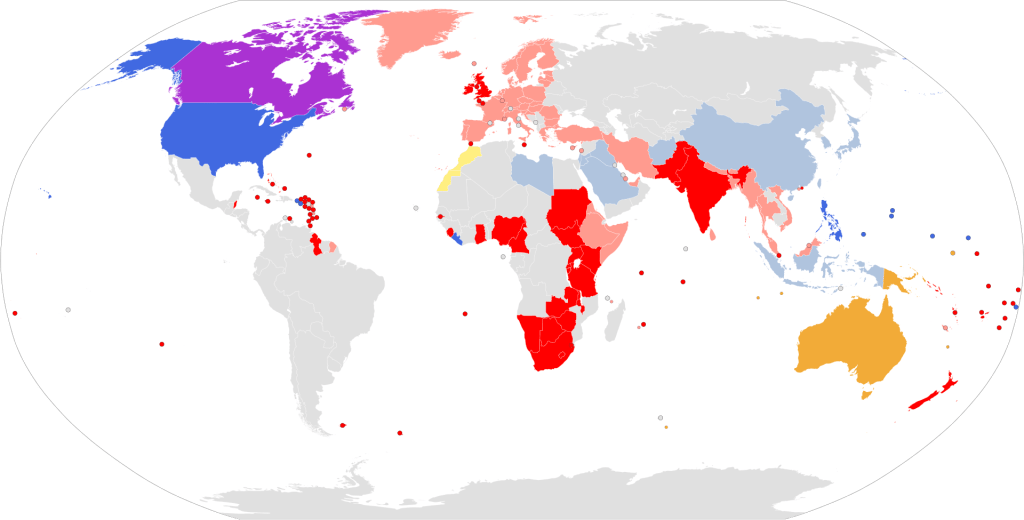
British (red) and US (blue) spelling of the English language.

The current spelling differences between US and British variants come from dictionary initiatives. English is, famously, a language without an institution in charge of standardising and leading change, unlike neighbouring ones like Spanish and French. In the US, a few decades after its independence, the Webster dictionary (1828) got established as the leading reference for spellings and introduced the simplification of words that used to be written with OU and were shortened to O, like color and neighbor. Z replaced S in many endings of words, like analyze and customize, because of Greek roots and is more phonetic. LL was reduced to L in words like metallic and modelling. Meanwhile, British English kept following Johnson’s A Dictionary of the English Language (1755).

Finally, an intriguing attempt at spelling rationalisation came in the saga of the “simplified spelling” movement for US English. The notion here was to scrub English of silent letters and irregular vowel pronunciations, so that have would become hav in a simplified written language. Leading the charge was Melville Dewey, creator of the Dewey Decimal System (oh, you do not know about it? You can guess why, another triumph of standardisation). Melville hilariously demonstrated his commitment to the cause of “simplified spelling” by legally changing his name to Melvil Dui. Dui got his funding from a wealthy donor by 1905, and simplified spelling won support at one point from President Teddy Roosevelt, who tried to instaurate it as the governmental spelling through an executive order. It did not work. The wealthy donor pulled his funding by 1915 with a poignantly spelled note: “I hav been patient long enuf.”

Nevertheless, however easy English is—because of its emergence from a combination of mainly three different linguistic backgrounds—, and however difficult it is—because of the standardisation of it in written form before the Great Vowel Shift and two slightly different standards—, English has become the first natural language to be the dominant and almost universal language of the World. The default cannon, the standard way of communication, the accepted-upon general channel of exchange, the platform upon which to create the connections between different places and peoples of the planet.

English, now, is a truly global codex that, for the first time, has reached and is reaching all aspects of life all around the planet in a way that no other language has ever done on such a scale, depth and speed. A natural language that, like any other language, has adapted, evolved, shifted, transformed, grown, reached new frontiers because of the necessities demanded by its new global role and new global users.

Notwithstanding, the global reach of English and the Anglo-Saxon culture behind it, its dominance happened simply because it has been an opportunistic being that has piggybacked on the extreme connectivity that the planet has taken, starting with the shipping revolution.

Like with Austronesian, the maritime revolution brought a handful of languages to dominate specific locations. But unlike previous connectivity expansion, the new aeronautical and computational revolutions have placed English as the unique global channel of communication.

History could have provided a different outcome, where, like the scientific world before WWII, global communication was shared by a handful of languages. If, like naval powers, different cultures and states reached a similar technological point at a similar rate, other languages might be sitting together for global communication. For example, in aviation the French had an early start with plane-making, and by WWII Germans and Italians had quite advanced military development on planes. Similarly, Polish and German scientists and technicians had early advances in computation, and the USSR and Japan could have invested more in electronics, software development and computation, but never got around to that. It is conceivable that another order could have happened in which a part of the planet rejected the English standard. In fact, that can be partially seen in countries like North Korea, where they firmly reject anything that has hints of Western culture. But nevertheless, even North Korea follows the aviation and software defaults. For better or worse, English stands as a giant alone in the human world.

For this text the fact is that, for now, there is a global acceptance for English to be the default language of communication. That fact, however it is, gives us a tool to address our question, with its usefulness and limits.

In a way, the question of “what humanity wants” can be asked because we, for the first time, can talk in the same language, and it has done so in a somehow passive way, like other standards such as timekeeping. There is not a chunk of the world that is disconnected from that acceptance of the default, there is no major iron curtain that keeps two or more disconnected systems. Since “humanity” has accepted this language, that has allowed English to permeate all the spheres needed for global communication.

Previous

Next

Francas, Linguas Francas

Before entering into the infamous metric system, let us dive deeper into the basics: mutual understanding. We have been dismantling what makes the “Western dominion” narrative so appealing; therefore, we need to look deeper at the foundational building blocks of our new age —where “humanity” can ask itself deeper questions. We have seen how commerce pushes connectivity and enables some basic communication, and how global standards emerge with the examples of timekeeping and mathematical notation. These, however, feel hopelessly limited for any meaningful exchange, as analytic philosophers discovered in the 20th century.

As with our thought experiment on first encounters, to establish an exchange one needs a basic set of communication rules. We have seen that pointing and smiling are human universals. These small gestures, in our thought experiment, allowed the initial connectivity of diverse groups of humans and contain the basic building blocks needed to create connections. To build upon that and ask complex collective questions, we need more sophisticated communication strategies. Fortunately, as illustrated, humans are born with such a strategy —or the capacity for it: language.

Indeed, if one looks at the history of many well-established exchange networks between different peoples, these are often associated with the development of a mutually understandable, but initially basic, pidgin language. As outlined, human brains seem to be made for this relatively easy acquisition of a second, third, fourth, or fifth language. Therefore, we possess not only the drive to learn a language but also the capacity to acquire additional ones —probably linked to the early onset of exchange networks in anatomically modern humans.

In the case of pidgins, these are even more interesting, as a common set of communication bits and pieces is put together on the fly by a diverse group of people who do not share a common language. Pidgins are a more or less complex set of communication strategies based on the languages already spoken by the peoples who come into contact, mixing concepts from different backgrounds. They first establish a basic shared vocabulary around a limited set of objects and actions, as is the case with linguas francas for trade and exchange. How easily pidgins can be constructed, and how organically they are established, further indicates that our brain seems to be built for social communication and for creating shared standards relatively easily, transmitting increasingly complex and abstract concepts that a language captures.

Depending on the depth of contact between the peoples with different backgrounds, the basic code —initially based on a limited shared vocabulary— can evolve to borrow the grammar of one or more of the languages involved. Grammar then becomes the scaffolding on which the vocabulary is built. These are the basic ingredients of a pidgin language. Pidgin languages then become more or less complex depending on the depth of contact, interaction, and areas of life that must be discussed. The most basic form is, as described, pointing, smiling, and saying a few shared words. At the other extreme is the creation of a brand-new language to be used by the descendants of the peoples in contact. At first, nobody speaks a pidgin as their first language. However, many of the pidgins associated with strong exchange networks have grown in complexity until they adopted all the characteristics of a fully-fledged language —spoken by many as a second language and eventually as a first language. At this point, this new language is often called a “creole”.

When a simplified language of a place is used as a trading language —while borrowing many, many, many elements from other languages— this creation is often called a lingua franca. The distinctions between lingua franca, “pidgin”, and “creole” are not clear-cut, and depend on how much influence one specific language had in the creation of the exchange code. However, in all cases, a lingua franca is not an exact copy of the parent language; it often includes vocabulary borrowed from other varieties and languages and always adopts a simplified grammatical structure.

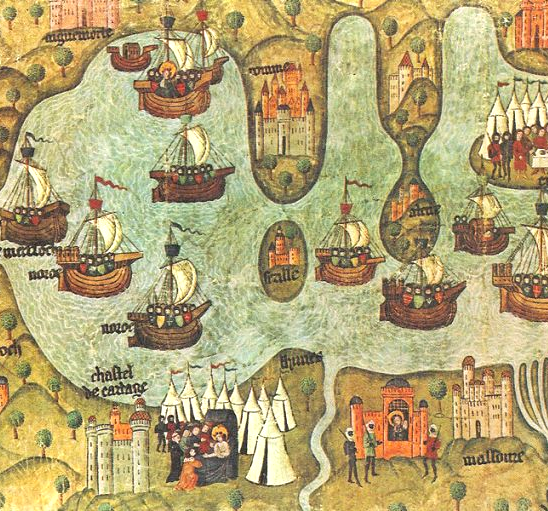
In the case of Lingua Franca itself (or “language of the Franks”), it was in fact a commercial language spoken mostly in the eastern Mediterranean and North Africa. It was brought to these regions by North Italian (Genoese, Venetian, Pisan…) and Catalan sailors. It was not called Franca because it was spoken by the Franks or French, but because during the late Byzantine Empire, “Franks” was a blanket term applied to all Western Europeans due to their prestige after Charlemagne. In fact, over time, that language —used for commerce across the ports of the Mediterranean— was largely influenced by Italian dialects, Catalan, and Occitan more than by French. That early commercial language, lasting from the 10th to the 19th century, is what gave the name to the concept of linguas francas, or a functional language providing basic understanding between many trading peoples with different socio-cultural backgrounds. In this text, franca for short is a functional term, independent of any linguistic history or language structure. That concept can also be applied to pidgins and creoles, or whole languages like Hiri Motu —which is neither creole nor pidgin, but simply a franca from southeast Papua of Austronesian origins used for trading voyages.

Returning to the impressive Malay seafarers and traders, the current Malay language, or Bahasa Indonesia, is a language that originates from Old Malay, mostly spoken in Malacca —the great trading centre that the Portuguese conquered in 1511 CE. Old Malay, also known as Bazaar Malay, Market Malay, or Low Malay, was a trading language used in bazaars and markets, as the name implies. It is considered a pidgin, influenced by contact among Malay, Chinese, Portuguese, and Dutch traders. Old Malay underwent the general simplification typical of pidgins, to the point that the grammar became extremely simple, with no verbal forms for past or future, easy vowel-based pronunciation, and a written code that reflects the spoken language.

Back in 2016, I travelled for a few months through the Malay Peninsula and the Indonesian archipelago. During these trips I could easily pick up a few hundred words which allowed me to have simple context-based conversations despite my general ineptitude with languages. I was surprised by how much understanding could be achieved without even using verbs! The language had evolved such that verbs like ‘go’ and ‘come’ became prepositions like ‘towards’ and ‘from’, allowing me to build simple sentences describing my itineraries without proper verbs. This anecdotal example illustrates how Malay evolved to enable extremely easy preliminary communication.

But Malay is not only a franca. This is exemplified by the extreme complexity and nuance in vocabulary and verbal sophistication required to address your interlocutor based on their relation to you. You need a special way of addressing someone depending on whether they are a man, woman, young, old, or of higher, equal, or lower social status. This likely reflects the language’s other origin: High Malay or Court Malay, used by cultural elites and in courts, where making explicit hierarchical relations was (and still is) crucial.

Today, the language dominates the Indonesian archipelago, the Malay Peninsula and Brunei, and is also widely spoken in Timor-Leste and Singapore. In Singapore, however, the official and de facto trading language is English —but we’ll talk about that trading hub and English later. Malay is spoken as a first language by millions of people, but it is far more common as a secondary language, with almost 300 million speakers. Most of these speakers also know at least one other local language, like Javanese — spoken by nearly 100 million people— or Bazaar Makassar, another franca used by the Bugis, who historically landed on the shores of Western Australia for centuries.

Interestingly enough, modern Malay descends from a language spoken in ancient times in east Borneo. This language also gave rise to Malagasy, spoken by most of the population of distant Madagascar. The language arrived there via Malay seafarers and later traders. Afterwards, Bantu peoples from southeast Africa arrived and mixed with the Austronesians, giving rise to modern Malagasy —the only native language on the island (though it has three main dialect families). Apparently, nobody had the need to create new languages in this 1,500 km-long island.

The Bantu peoples themselves are also the carriers of one of the World’s largest francas: Swahili. It is spoken by up to 150 million people. Originating as a coastal trading language, it spread to the interior of East Africa, connecting the coast to the Great Lakes, and became a franca across the region and a mother tongue for many urban dwellers. It arose in present-day Tanzania during trade between the island of Zanzibar, inland Bantu groups, and Arabs (particularly from Oman). The Omani Imamate and Muscat Sultanate controlled Zanzibar and the Tanzanian coast during the 18th and 19th centuries and held considerable influence through the slave and ivory trade, among others. The name “Swahili” itself comes from the Arabic word for “coast”. Arabic has contributed about 20% of Swahili vocabulary, with words also borrowed from English, Persian, Hindustani, Portuguese, and Malay —the region’s main commerce languages. Like Malay, Swahili has a simplified grammar common in francas, making it easy to learn and pronounce. These traits have made Swahili a contender for a global communication language.

Beyond commercial francas, there are languages used exclusively as cross-border platforms for intergenerational communication, but which are not native to any sizable population. These languages are like frozen structures, called upon to allow a group of people to mutually understand one another.

Classical Latin is one early example of this function. By the 4th century, Romans were already speaking a language quite different from what Augustus spoke 300 years prior. Different parts of the empire used highly dissimilar versions of Latin, and Classical Latin served to maintain a unified system. That “old Latin” was standardised for literary production and, crucially, for imperial administration. After the division of the Roman Empire, the Western Christian Church also adopted a version of Classical Latin for internal operations: Ecclesiastical Latin. Previously, early Christians used mainly Greek and Aramaic —as we willl see.

Over time, Ecclesiastical Latin became the international language of diplomacy, scholastic exchange, and philosophy in Europe, lasting for around a millennium. It was not fully standardised until the 18th century! By then, linguists were eager to fix languages as words changed meaning too quickly —as the analyitical philosopher Russell observed. Ecclesiastical Latin flowed into the emerging sciences. The main works of Copernicus, Kepler, Galileo, and Newton were written in Latin.

But this Latin was a written language —no one really spoke it. And, unlike Swahili or Malay, it was far from easy to learn. Any Latin student knows how difficult it is to memorise its multiple, complex inflections. It became a written fossil spoken by basically no one —except a few geeks. That made the other nerd in the Peano-Russell nomenglature propose a simplified version of Latin, Latino sine flexione, as the  Interlingua de Academia. Peano, being Italian, had skin in the game. For us native latin languages speakers, such as my Catalan, a simplified academic Latin would be a great advantage compared to “ahem” we know what. But more on that and created languages to be international standards later.

Today, a stripped-down Latin does survive in science —particularly taxonomy, where the classification of living things (especially plants and animals) uses Latin binomials. For instance, humans are Homo sapiens, wolves are Canis lupus, and rice is Oryza sativa. Many scientific terms —especially in astronomy, physics, and cosmology— are still derived from Latin. So, through science’s dominance as the global system for classifying the world, Latin vocabulary lives on. It has become a kind of global pseudo-language, used by experts worldwide to communicate about shared topics but just as individual words, without any structural coherence.

Latin is but one example of an imperial language transformed into a franca and liturgical language. Another —and much older— example is Aramaic. Aramaic had the advantage of the simplicity of its written form. Unlike the complex cuneiform writing on clay tablets, Aramaic used a simple 22-character alphabet, which made it easier to learn and spread. This accessibility allowed it to be adopted in administration, commerce, and daily communication in a linguistically diverse region. The Achaemenid Empire adopted it as an administrative language, standardising “Imperial Aramaic” alongside Old Persian. Bureaucracy, scribal schools, and widespread official use helped it expand far beyond its original homeland —and its legacy lasted for over a millennium.

As with Latin, Aramaic became the medium of religious texts. Many Jews returning from exile after the fall of the First Temple continued speaking it. Scribes translated the Hebrew Bible into it, and large sections of sacred texts ended up in Aramaic. Other Levantine prophet religions like the Manichaeans also adopted it. One of these, Mandaeism, still survives, and its followers still speak a version of Aramaic. Eastern Christians adopted Syriac —an Aramaic dialect— for theology, hymns, and lengthy religious debates. Aramaic became the franca of the ancient Near East: everyone could participate. Thanks to that, like Latin, the language outlived the empires that spread it.

So, with these examples, we can begin to draw some principles for how linguas francas are established, spread, and sustained across space and time. They tend to offer accessibility benefits, borrow heavily from multiple languages, are often secondary but can become primary languages (especially in cities), and most importantly, serve specific purposes: commerce, administration, religion, or technical use. Perhaps we can even distinguish between written and spoken francas: spoken ones often have simplified grammar, are easier to pronounce, and accommodate mixed/macaroni forms. (Cool word, “macaronic” — look up its history!) Written francas, on the other hand, may retain complex grammar but offer easy ways to record text. Of course, ideographic systems like Mandarin or Japanese kanji present another accessibility puzzle —one we willl explore later, as they are closely tied to another leg of francas: formal state education.

In a world that is becoming more technical, more bureaucratic, and more formally educated, there is now ample space for new linguas francas to be established, maintained, and —for the first time— reach global scale. It is in these languages that we will begin to ask ¿what does humanity want?

Previous

Next

Mathematics, universal not the way you think

Before moving to the quasi-universal metric system —which includes the archaic Babylonian timekeeping— let us focus on probably the first universal lingua franca: mathematics. And not mathematics as in “the language of the Universe”, but mathematics as in “the set of codes, rules, concepts, and ideas that are shared and approximately mutually understood by any human using them”.

As we will see, many linguas francas originate as an often simple code (compared to a general-use language), developed rather quickly to serve a specific function. In many cases, that function has been simple commerce and exchange, where the number of items to “exchange” is limited, and the rules of the game are simple —possibly including locally standardised accounting, such as produce and monetary units, and standardised measures like weights, surfaces, and volumes.

The linguistic and symbolic part of mathematics, therefore, is not so different from commercial linguas francas. What sets it apart is that, as of the 21st century, virtually everybody using “mathematics” as a functional system —mostly algebra and calculus— uses the same notation. In other words, it is universal.

This is not surprising: when one thinks about a universal language, one often refers to mathematics. However, like with timekeeping, how we came to the specific and well-known set of symbols +, =, ÷, ∞, … has its own history.

Mathematics and mathematical notation, although common in the current world, took centuries to take shape. Over generations, it was agreed upon by scientific, technical, and mathematical communities in Europe, the Middle East, and South Asia to use the same kinds of symbols, numbers, and conventions to refer to the same concepts.

Interestingly, these “concepts” themselves were (and are) thought to be universal, even beyond the human realm —i.e. the number 3 is the same in all parts of the Universe. Therefore, unlike goods and commercial language, which had local characteristics, mathematical notation is expected to be written in the same way by everyone using those concepts and wanting to share them, regardless of location. The same applies to signs and symbols like +, =, ÷, ∞, which any reader would most likely recognise regardless of the language being used.

For some reason, written mathematics —often calculus— has always been something of a special case in many cultures. We can write numbers as they are spoken in a given language —like zero, one, two, three in English, or cero, un, dos, tres in Catalan. But often, across many writing systems, numbers have been chosen to be represented by symbols, for example: I, II, III… (Roman, no zero), 0, 1, 2, 3… (Arabic, from South Asia), 𝋠, ·, ··, ··· (Mayan, perhaps the 0 doesn’t display in Unicode), 零, 一, 二, 三 (Chinese, 零 meaning something less than one, yet not nil).

These examples show that from early on, people decided it was better to simplify numerical notation —to the point that doing otherwise seems like suffering. Try writing down the year the Portuguese took control of Malacca in the Common Era calendar: one thousand five hundred and eleven, or one-five-one-one, if simpler. Write it. Stop reading.

How do you feel?

I bet it’s a pain, and it feels right to simply write 1511. A similar thing applies to phone numbers. If you’ve ever used certain online platforms that do not allow phone numbers to be exchanged, you cannot send them using digits. A workaround is to write them out in words —for example, “one hundred and twelve” or “eleven two” instead of 112. It’s not much more effort to spell the numbers, but it still feels like a pain knowing that a shorter, cleaner alternative exists.

Although people must learn two different systems to write numbers —instead of just the phonetic one— which might seem like more effort, in the long run, simplification tends to dominate. This preference for simplicity is similar to what we will see in francas, linguas francas: the adoption of a shared, simplified, functional language is preferred over a fully developed one. So, the basis of our mathematical universality might have less to do with the Universe and more to do with a universal feeling: tediousness.

In the case of mathematics, despite numerals having been used symbolically for millennia, the simplification of other concepts —like “sum”— into symbolic script is a relatively recent development. This is exemplified by the fact that signs equivalent to + are not found in many older written systems while there is a diverse set of equivalent signs to 1. Things like +, and -, are known as “operators” in mathematical terminology. Interestingly, many of these operation symbols —unlike some numerals that are simply dots or lines —have phonetic origins. Phonetic symbols were already present in some numerical systems, like one of the two Greek numerical systems, where they would use Π as five (short for pente, 5 —Π being pi, capital P in Greek), or Δ as ten (short for deka, 10 —Δ being delta, capital D). The other Greek numerical system simply assigned the order of the alphabet to the numbers, \alpha being 1, \beta being 2, etc. Many societies around the globe have developed advanced mathematical notations. However, none of them used algebraic notation like + to mean “sum”. Other mathematical systems worked with geometry to describe concepts, or used written linguistic statements.

Linguistic statements was the European method too. Before symbolic expressions, European mathematicians wrote their sums. For example, they would put on paper: “3 plus 5 equals 8”. Since that was a pain —like writing numbers in words— they simplified it to “3 p 5 e 8”. The operations had no proper symbols, just words or shortened initials understood by context. In fact, the sum symbol, +, is one of the earliest to appear in written arithmetic. Although it originated by mid-14th century, it was only commonly used by the 15th century. While there’s no universal agreement on its origin, it most likely comes from a simplified script of et, Latin for “and”, but nobody really knows why.

Algebraic notation to define operations was strongly promoted by the Andalusi mathematician Alī al-Qalaṣādī in the 14th century, where each sign was represented by a letter of the Arabic alphabet —for example, ﻝ for ya‘dilu (meaning “equals”). But it was actually a Welsh mathematician, Robert Recorde, who coined the modern equals sign (=) in the late-16th century. By that time, Europeans were mapping coastlines beyond Europe and the Mediterranean, Copernicus was posthumously publishing his Revolutionibus and the printing press was spreading like powder all over Europe —and people were still tediously writing “is equal to” or aequale est in Latin instead of just “=”. Try to make our kids do mathematics that way and see how long they can hold!

To be fair, most of the notation was standardised by the 20th century in the context of mathematical fields like set theory, groups, graphs, and others that most readers would not be familiar with. In fact, the evolution of mathematical notation and the stages at which one learns it in the educational system are uncannily correlated.

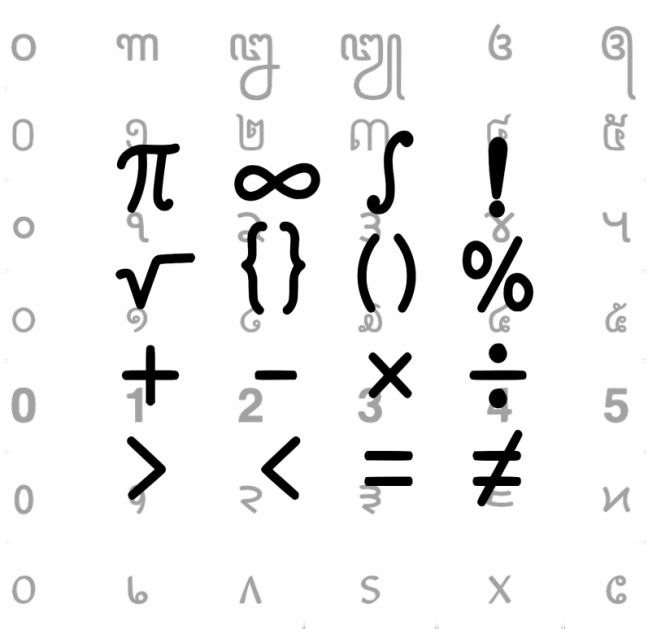
By primary school, around the planet, one learns the first symbols standarised by the 16th century +, −, =, ×, ., √ , ( ).

By mid-high school, one would learn the rest that can be easily written on a modern keyboard or a calculator with one or two keystrokes: ·, ⁄, %, <, >, ∞, ≠, xy , º, cos, sin, tan. These were developed by mid 17th century.

Once one goes on to study sciences in upper high school, one comes into contact with integrals, differentials, functional analysis, binomials: \int, \partial, x', f(x), \sum, \binom{N}{k} = \dfrac{N!}{k!(N-k)!}. These examples have linguistic roots too, but also “famous personalities” for example Newton’s binomial —Newton was known to have anger issues, that might explain the exclamation mark (!), though it was developed by Christian Kramp. More seriously, Newton’s arch-rival of all times, Leibniz thought that having the right notation was the solution to all human problems —if humans could create a universal logical language, then everyone would be able to understand each other. In the case of mathematics, Leibniz actively corresponded with his peers at the time to convince them that notation should be minimal. That, in fact, has informed most of our modern mathematical symbolism. Going back to our tedious exercise, this decision on minimalism might have a cognitive reasons, human operating memory is limited to about 3 to 5 items, and this storage lasts only few seconds, so it makes sense to develop notation that allows computation and arithmetic to fit well in that memory space. These symbols were common use by the early-19th century, though some, like \int, \partial by Leipzig were developed earlier or at the same time as the signs ·, ⁄ —these two being simplifications of the product and the division. Many of these symbols cannot be easily typed from your keyboard and need special code to type or display.

By the end of a technical degree like engineering or physics, one gets to know most of the mathematical notation developed by the mid-20th century, with scary things like tensors written using something called Einstein Notation: \Gamma^{i,j}_{k} —Einstein was known to be bored easily, that might explain that he preferred the simplified notation to the degree that dyslexic minds like mine mix these little indices.

Beyond these, one enters into advanced or specialised studies to learn the fancy ones: \rightarrow, \Cup, \exists, \forall, \vdash, \because, \therefore. Many of these are just substitutions of words that are mathematically “conceptualised”, like the numbers. For example, the Braille-looking \because, \therefore are just symbolic representations of the verbal statements “because” and “therefore”, respectively. Many of these symbols were developed during the late 19th to late 20th century. The most avid use of signs is in the field of mathematical logic, where Peano–Russell notation informs some its rules —Russell was a known geek, self declared to know nothing about aesthetics, that might explain his dislike of using words, which have the tendency to change meaning. Funny how he did not write much about the mostly aesthetical music, which has also a standarised quasi-universal notation, as we will see.
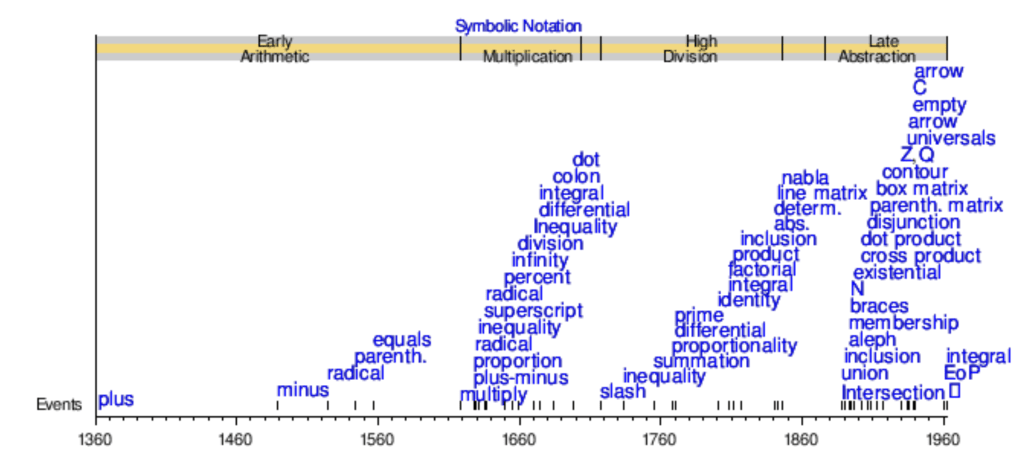
In short, in standard regulated education, one progresses through about 100 years of mathematical notation history every two or three years of modern study —although that is a non-linear accumulation. As one enters logic and set theory, the number of symbols needed run into the low hundreds.

Symbols by approximate “popular” introduction date

Nevertheless, the point at hand with mathematical operational notation is that it took hundreds of years to adopt the standardised form that is now widely used in all the teaching systems around the world. That evolution and standardisation did not happen in isolation, but were interwoven with other branches of knowledge, mainly technical ones. These technical fields needed the rapid adoption of simplified standards that could be learned efficiently by a specialised community of experts. This process can be understood, in part, in a similar way to how linguas francas are constructed —from a simplification of an already existing language— to be the means of exchange and understanding among a subset of people from many different cultural backgrounds who share similar conceptual and material items.

This notation is nothing new by itself. It is just a reflection of human needs —mutual semantic undertanding around a limited subset of concepts— and practical solutions that might have some cognitive biases. What is new is the fact that this notation reached a planetary scale. As we have seen with the spread of communication, that process is just a matter of scale, not of quality. But, in my view, that global scale makes all the significance and sets the question of this book. Mathematical notation, and its quasi-universal use, shows one paradigmatic example of how we arrived there. How we arrive there, or not, and a standard is kept regional, is significant.

Mathematical notation has been the first of such lingua francas to become a standardised language used across the whole planet. It is, however, limited to be used only by someone who needs to do arithmetic —which, in our case, is anyone who has entered a regulated educational system. As we will see, regulated educational systems have reached over 80% of the human population, and are implanted in virtually every new human being born.

Now we have the example of how a truly global language —albeit a limited and specialised one that rides on the back of the universality of what it studies— is created, adopted, and made universal. In particular, this one has been made universal without any clear agreement or premeditated guidance, but rather by the sheer pressure of technical needs and the dominance of Western knowledge systems. Same as with time keeping. Time-keeping, by the way, will come back, and we will see that the universality actually is held by technical needs, mostly as a matter of sailing ships, driving trains and flying planes around the world while knowing where you are also in space.

So, the World has not finished with mathematics as universal communication, other technical and symbolic language are coming. The Metric System is coming, and this time, with bureaus.

Previous

Next

Signalling

Similarly to the bower bird, humans do not have highly visible physical appearance and features. We lack flashy manes, colourful bottoms, prominent cheeks, a crest, or nicely spotted furs. But like the bower birds, we do like to use objects around us as a display. Virtually all human populations on the planet like to wear accessories to their bodies, which, in many cases, increase the visibility of our bodies. Even more, virtually all human populations invest in permanent body modification of one kind or another, from an earring to amputating body parts, like circumcision. However, unlike bower birds, this decoration or modification of the bodies is done by all genders; therefore, it is not only done to attract a mating partner but also to create social links, signalling and assessment of the others, like kids sharing toys or flashing the new shoes.

Both humans and the bower birds make use of visually arousing traits that coevolved with their effect on an audience, mates. However, the incorporation of external elements directly into our body seems to be an almost unique feat of humans among vertebrates. At the moment of writing, only the bearded and Egyptian vultures have been seen to add pigmentation from natural elements like oxide baths or cow excrements to their otherwise white feathers. There is debate whether this is for protection or for mate pairing, with the most recent research pointing that the bond with partners as the most likely explanation. For bearded vultures, the female, who usually is larger than the male, tends to have a stronger red pigmentation due to the oxides, while of the two males that might be in the polygamous trio, the one that copulates the second tends to be of whiter pigmentation. This is similar for the Egyptian vultures, where the more dominant birds tend to be of yellower colour and carry stronger faeces odour. Still there is no clear agreement on their motivation. But it seems that this is an innate, and not cultural, behaviour, as acculturated Egyptian vultures raised in captivity also engage in colouring feathers once they have sources to proceed with the practice. In the non vertebrate word, only some other crustaceans and insects use elements of their environment to incorporate to their body, and usually that is done in order to camouflage, as a protection, or for matting reasons. Examples are hermit craws, caterpillars, octopuses or beetles.

Humans, on the other hand, extensively decorate themselves with external elements in virtually every society that we know of. We also have archeological records with tantalising evidence of objects that could have been used as garments going back as far as 100.000 years. Therefore, body decoration is a trait that is deeply rooted in humans and at least also for the Neanderthals, whom we repeatedly mated.

Going back to our landscape in east Africa, you can imagine that you encounter for the first time with someone that you are unfamiliar with. The first thing that you might notice is the garments that the other is wearing. They might be covered in strange black, red, yellow pigments that are not available in your area, or an extensive use of seashells of strange bones arranged in strangely appealing patterns, feathers and teeth might decorate their necks, torsos, legs, arms and head in completely different ways and fashion that you are used to see.

At this point, many emotions might come to the front, but once the ones related with fear and harm have subsided, the one that might take over you is curiosity, as we discuses with the marbles. Some of the ornaments might resonate with you as a sign of beauty, the same way that when we see a complex seashell on the beach, we have the craving for it, despite not having any use as food or protection. Or we might get attracted to another person’s tattoo, despite not representing how successful in rearing kids that person might be.

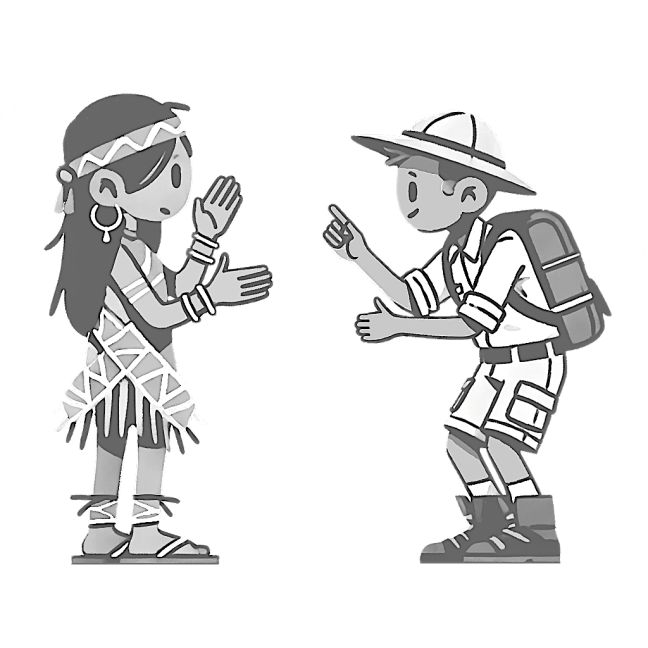
The next careful step might be an approach. You share no language, but at this point, each other probably shares the curiosity. You might point to one of the ornaments that he or she is wearing.

Pointing is, as far as we know, a universal human gesture to indicate a specific emphasis, to draw attention to the direction of what is being pointed at. Not all pointing is done with the index and an extended arm, some cultures use their look and lips or nose to point, but this seems to be an additional gesture other than the one done with the arm. Whichever way the pointing is done, we understand it to be universal and can be shared across first encounters. Even if you saw someone point with their eyes fixed to the target of interest and protrude the lips, you would probably understand the gesture straight away, as the “intention” of gesture seems to be also understood, partially, by other non-human animals.

We can expect this pointing exchange as something that has happened repeatedly all over the world with first encounters. We started to notice this interaction among distant, unknown peoples, especially since the Europeans started their extensive conquest, colonisation and exploration voyages in faraway continents. A first encounter of this kind is illustrated by the account of Cristobal Columbus when reaching the Americas, or the New World, which in fact he thought were islands far away East of Japan. He was caring several books about accounts of European voyagers who had traveled to the Asian continent in the previous centuries. Among these books was Marco Polo’s account of his life and travels in Asia.

Columbus wrote of the first encounter:

I reached the Indies in the first isle I discovered, I took by force some of the natives, that from them we might gain some information of what there was in these parts; and so it was that we immediately understood each other, either by words or signs. They are still with me and still believe that I come from heaven. They were the first to declare this wherever I went, and the others ran from house to house, and to the towns around, crying out, “Come! come! and see the men from heaven!” At every point where I landed and succeeded in talking to them, I gave them some of everything I had cloth and many other things without receiving anything in return, but they are a hopelessly timid people. It is true that since they have gained more confidence and are losing this fear, they are so unsuspicious and so generous with what they possess, that no one who had not seen it would believe it.
They never refuse anything that is asked for. They even offer it themselves, and show so much love that they would give their very hearts.

Letter of Christopher Columbus to Luis de St. Angel on his first voyage to America, 1492

Even if this event unfortunately happened because Columbus was taking natives by force, as you can notice in this account of the first encounter, there seems to be at least a shared drive for communication and signalling. This encounter happened between peoples of different continents who had never shared any communication for at least 10.000 years (if we suppose the Caribs had no knowledge of the Vikings visiting Vinland).

The basis for that first contact seems to be conducted by gesticulations and not by vocal language. We do not understand why gestures seems to be the preferred form to start bridging the communication gap, maybe because its relative simplicity compared to vocal expression, or the existence of these universal gestures like pointing, or expressions, like smiling but within us seems to exist both an innate desire to communicate and the really rudimentary tools to start doing so, which rapidly evolve into a more complex and deeper understanding. At least that is what the case of Columbus illustrates, that in no time he thought he could understand that the captives that he took considered him as a divinity, and that they were communicating so to their countryfolk.

Again, this exchange is not exclusively done by humans, almost any social animal at some point interacts with other social communities of the same species, or even other species. There is a continuous flow of individuals who go from their group and integrate into another. However, the initial conversations are really limited, and no long-term cooperation is established between non-kin groups.

Most interesting is the case of Bonobos. They are highly social creatures that communicate in a rich language. And this communication, at least for body language, goes beyond their own species and cultural groups. There is the observation that humans from Western culture understand most of their facial expressions and some of their natural hand gestures, such as their invitation to play. In the wild, bonobos have contextual messages; they use the same call to mean different things in different situations, and the other bonobos have to take the context into account when determining the meaning. This contextual communication was previously only observed in humans. Furthermore, it was studied that sounds made by human infants and bonobos when they were tickled followed a similar pattern. Also, Bonobos recognise, to a degree, that humans are ignorant and point them towards hidden objects. These behaviours probably indicate that the richness and depth of human communication goes far back in evolutionary terms, as humans and bonobo lineages diverged about 4 million years ago.

But a much more distant social animal able to communicate are bees. A scouting bee is known to have really complex patterns of dancing and gestures to point to fellow bees in the bee colony where to find certain kinds of food. However, unlike humans, no bee has been seen that goes to another colony to tell the same thing, or that they might exploit together a certain area, or build a bigger nest in cooperation with another colony to fend off bad weather or predators. No, solutions to each of these problems have to be found within the colony, and no viable complex communication exists with external groups that we are aware of.

For non-human social animals, where an individual that migrates from one group to another, the newly arrived individuals adopt or conform to the traditions of the host group and do not return or communicate between groups. Or in the case of alpha males, they can impose their traditions. For example, experimenters trained wild vervet monkeys with corn of two different colours, one blue and the other pink (the researchers chose these because they were the colours of their genitals; that is how science is done). The blue and yellow popcorn tasted sweet or bitter, respectively, for half of the groups, and the other way around for the other half. They quickly learned to avoid the bitter taste with the respective colours. Four months later, after several baby monkeys had been born, the communities were again offered the coloured corn, although this time neither had the bitter taste. Then, both adults and infant monkeys strongly preferred the same colour as before, despite neither being bitter! This behaviour reminds to the rejection of food by humans when they are offered food with strange colours, but perfectly edible otherwise. The baby monkeys who had no previous exposure to the bitter taste, almost all of them just ate the same as the mothers. Interestingly, during that period, ten male monkeys migrated to a group that preferred the opposite colour as the one they were habituated. After observing the locals, nine out of ten shifted to the local preference of colour, giving up their habit. The only exception was that of Lekker, a male that on arrival simply took the position as the dominant male upon arrival to the new group. This male continued his own habit, ignoring the locals and forcing his choice on the new group.

This experiment with monkeys can be similar to one conformity experiment done with humans. In a waiting room, an unsuspecting woman is surrounded by actors who rise up after a beep sound in the room. After 3 beeps, and seeing that every other person raises up after the beep, the woman rises up like the rest of them. Then, one by one, all the actors leave the room until only the unsuspecting woman remains. Even when she is alone, she keeps standing up after beeping. Then another unsuspecting man enters the room, and after seeing and talking with the woman rising up, he joins her. More and more people crowd in, and they keep adopting the odd behaviour after two or three beeps, with the exception of one male that took several more beeps to conform. Funny enough, as the repetitions happen, the movement of all of them becomes more coordinated, like a music band playing in synchrony. But there is no real communication in these cases, just examples of conformist adaptation. The members that entered the group would conform to whatever tradition was followed unless a new member took a position of dominance.

Whatever is happening with the monkeys and the popcorn seems to be similar to the humans and the waiting room. Some entrenched social learning mechanisms are taking the reigns of the individuals of each group to facilitate for the transmission of random cultural knowledge. This transmission is truly random in the case of these two experiments, but we can put the transmission in the context of an evolutionary pressure. For example, in the case of the monkeys, bitter taste is usually poisonous in nature, so colour → biter → poisonous; therefore, by keeping with the colour, one avoids the danger of poison even if the bitter is no longer there. But if one migrates to a new environment, it is better to follow the local norm, both to feel to fit in and because local differences might be different –when in Rome do as the Romans. Lekker, the lone dominant male could go away with unchanging behaviour because truly the corn that he preferred was neither bitter nor poisonous. For the case of humans, it can be the same. Social conditioning might have evolved deeply, and it can be punished for not bending to the local norm, even if that contradicts the previous behaviour. That can relate to how people wearing clothes in a nudist beach feel uncomfortable and might be frowned upon by the nudists. Only people with a strong moral superiority would not conform and not care, like when colonists did not adapt their clothing to the places they were conquering but imposed theirs. While, exceptionally, western conquerors and explorers would “go native” if they were surrounded fully by the local culture.

A good example of adopting into the new group, or avoiding adaptation is the case of Gonzalo Guerrero and Gerónimo de Aguilar in the early stages of the conquest of Mexico. After a shipwreck, both where captured by the mayas in Yucatan amnd initially escaped together but got separated on their scape. Gonzalo Guerrero, after 20 days running through the jungle, arrived to a costal community were they made him became a slave. However soon after, after showing his skills as luthier, carpenter and his value in battle he assisted the Mayan lord Nachan Can’s as a general, fighting against other Maya groups and the Castilians. Gonzalo probably tattooed or marked his face and wore big earrings which changed the shape of his ears. He married one of Can Nachan’s daughters and fathered three euro-american children, probably the first mestizos. The story tells that he died at his 64 or 65 years fighting the Europeans, dressed, painted and ceremonially marked like the Mayas. In contrast, Gerónimo de Aguilar, was a seminarist, and never married or wed a native, but adopted local clothing and later despised European ones and partially forgot how to speak Castilian (spanish) after 7 years. He also became a warrior and a general for his later master Ahmay, who seemed to have second thoughts about sacrificing or killing him, but kept him alive and set him free because he valued his military skills. Aguilar, introducing European tactics like not capturing enemies alive, which where really useful in battles. However, unlike Guerrero, he later joined Hernan Cortés and assisted him in his conquests of Mexico, using his knowledge of the years living with the locals for that. He died covered in handicapping buboes as a soldier of the Castillians, making us wonder if these were syphilis buboes and he did wed somebody after he returned to the Europeans.

Previous

Next

Language

The most critical basis for communication is language. It is difficult to define what a language is and what it entails. At its core, language is something that can capture deeply complex concepts—both external and internal—and transform them into words with specific meanings that can be shared with others. Therefore, it entails both an internal component, in which the brain must link specific concepts to words and structures of the language, and an external component, in which these words and concepts must be translated into structures that can be broadcast to other individuals. These broadcasts can primarily be via sound, visuals, or touch, but in principle, any channel capable of encoding information should work in order to create structured signals in the form of a language.

There is no clear agreement on how old human languages are. Some argue that they started emerging about 100,000 years ago, while others argue for an even earlier origin. Nevertheless, however they came to be, languages are an integral part of being human, shaping both how our brains function and how we understand and influence the world and ourselves.

Some examples illustrate how wired we are to shape our brains for learning a language. The clearest natural experiment demonstrating the spontaneous learning and generation of languages is that of Nicaraguan Sign Language.

In the 1980s, for the first time in Nicaragua, a school for deaf children was created, bringing together children from all over the country to live and learn in one place. Before this initiative, there was no institutionalised system to teach deaf children how to communicate. As a result, at the time of their arrival, these children’s vocabulary was limited to a few hand gestures used within their families or communities of origin, often in the form of idiolects or cryptophasia (“private languages” usually spoken by one person or between twins).

Compounding this initial lack of complex communication, the teachers at the new school aimed to teach the children lip-reading and Spanish through that method. They discouraged the use of any sign language, believing that the children would put less effort into learning to lip-read. However, lip-reading had very limited success—the children were unable to communicate with their teachers.

Despite this, communication flourished outside the classroom among the children themselves. In the courtyard and throughout their daily activities, they combined the hand gestures and signs from their respective communities and created new ones. This process of creation, sharing, and accumulation spontaneously generated a new language, which rapidly evolved into more complex structures, giving rise to grammar and a more elaborate vocabulary. This increase in complexity and fluency was particularly evident among younger generations of students, who picked up the signs from older peers and refined them with intricate flourishes and added layers of meaning.

This entire process was documented by sign language experts, who were called by the teachers after noticing that the children could communicate fluently with one another but remained incomprehensible to the teachers. Initially, these experts also struggled to understand the children, but by filming them, analysing the footage, and interacting with them using the learned hand gestures, they gradually acquired the language. Most interestingly, over the years, they recorded the cumulative process of increasing complexity, allowing us to witness how the language evolved and standardised rapidly.

Notably, the children were already familiar with a small subset of home signs. However, this is not so different from the basic signs shared by social animals or those we can teach our pets. For example, when I was living in Mallorca, I was responsible for a dog named Gordon. I could tell him “sit,” and he would sit; “down,” and he would lie down; “up,” and he would stand on his hind legs; “la pateta,” and he would sit and give me his left paw. Even more complex instructions, like “We are going for a walk, but first, we need to go to the basement,” were followed correctly—Gordon would go straight to the basement instead of heading directly outside. Not only that, but he also communicated with me: for instance, he would touch his water bowl to indicate it was empty or stand patiently by the courtyard door when he wanted me to open it. Through these examples, one might say that he and I shared basic communication and understanding, but no one would, in their wildest dreams, call that a language. Nor would a language ever emerge from these exchanges. This became especially clear when I said more complex things, like “Could you go to the cupboard, open the door, and bring me a kilogram of rice, please?” or “Do not bark at the neighbour’s dogs!” Gordon could open doors, so that part wasn’t a problem, but the rest was beyond his capabilities.

The case of Nicaraguan Sign Language is particularly important because it demonstrates the evolutionary nature of language within a short time frame and its ability to keep expanding—something that does not occur in any other non-human animal. To be fair, dogs can be trained in more complex ways than my simple set of commands (and one particular, named Chaser, learned can more than 1000 words!), and other animals, such as dolphins, elephants, circus animals, horses, buffaloes, parrots, pigeons, and crows, can learn to respond to basic commands from their human carers. Bonobos, in particular, can learn up to hundreds of hand gestures to communicate basic information with their trainers, and similarly, dolphins can understand basic sentence order. However, this is the maximum extent of their communication; it does not go any further. Nor do animals copy human language to communicate among themselves in more complex ways—not even parrots, which can mimic hundreds of human sounds, spontaneously start using them to communicate with each other. Humans, on the other hand, have the unique capacity to transform simple signals into an elaborate and constantly evolving set of communication codifications.

The connection between language and the brain is deeply rooted in humans, with both being intricately linked, as seen in the Sapir-Whorf hypothesis. Language shapes the brain, and the brain, in turn, shapes language. The latter is evidenced by the fact that certain sounds seem to be more naturally associated with certain concepts—for instance, sharp objects are commonly linked to words with sharper sounds, while round objects tend to be described using softer pronunciations across multiple languages. Language is integral to memory, abstract thinking, and, fascinatingly, self-awareness. Language has been shown to drive much of the brain’s core “hardware”. Languages shape brains to such an extent that, most of the time, we think in a language—or in multiple languages if we are multilingual.

For those who are born deaf, rather than relying on an “inner voice” as spoken-language users do, their thought processes are shaped by visual sign thinking or the sensation of body gestures. Interestingly, deafness has a significantly greater impact on the brain than blindness. People born completely deaf and who never learn sign language fare only slightly better than the rare individuals who grow up without any language exposure. Without language, they fail to develop an “inner voice”, which is crucial for the brain’s ability to process information. This is especially significant in early childhood. Those who are not taught sign language until later in life often have learning problems throughout their lives. It seems that the brain processes sign language exactly as it does spoken language, using the exact same regions.

Communication - Culture <- Previous Next -> Forms of communication

Previous

Next

Growth of communication- Culture

All of the previous examples I have highlighted until now, show living beings collaborating and cooperating require a basic feature: communication. Communication involves shared channels in which the individuals that form a group or interaction have cues and signals that can be understood by other members and entities. These are mainly visual, chemical, acoustical, and vibrational cues. With these cues, the basic structure of formations larger than the individual exists, allowing for the generation of other ways of interacting with the environment that individuals alone cannot achieve.

Out of the three bases of global reach (intelligence, collaboration, and communication), I will focus on communication as the most critical for our understanding of how we got here—that is, the capacity to communicate at many and diverse levels and across a wide range of scales. From really superficial to deeply technical ones, from proximity to global.

At some point in this arrangement, a complex cognitive structure emerged in the form of language. This sophisticated communication would encompass most forms of categorising the external and internal world of individuals in any group united by communication. Many debates concerning the limits of knowledge originate from analysing where our knowledge of the world around us is constrained by language. These debates span back centuries, for example G. Berkeley’s, A Treatise on Principles of Human Knowledge (1710) or J. Locke’s Essay Concerning Human Understanding (1690), or take really interesting forms, like the Sapir-Whorf effect, where language might shape the essence of how we see our world. For example, many languages do not have words for numbers larger than 3 or 4, but might have hundreds of words for different scents, which we lack.

In any case, at some point language was used not only for the communication between members of in-groups, but also with external groups, becoming a federation of groups, as anthropological research shows. That is where everything really changed, where “Culture” emerged in the sophisticated form that we know and where information, collaboration, exchange, reduction of conflict and complex networks would extend the wealth of possibilities of how interact and shape our environment. This level of inter-group communication is something that has not been achieved successfully by any other living thing on this planet —maybe with the exception of the Fire Ants, and they are a only doing it for the last 100 years or so. As humans, we achieved the creation of a structure —culture— which allows detailed communication between virtually all the members of our species.

Once communication between groups emerges, everything changes. This accumulative communication allows for the complexity of the tools we use to be open-ended, as the evolution of technology and tools like large particle accelerators or space satellite constellations shows.

Communication is also open-ended, meaning that it can potentially keep increasing indefinitely, probably linked to the complexity of tools. In nature, communication channels tend to be very limited and do not show growth or evolution by themselves, while human languages are always in continuous evolution—incorporating new concepts and terms, combining existing ones, losing or forgetting others, and actually forging what is needed. This applies not only to language but also to symbols, signs, experiences, training, repetitions, etc. This indefinite addition of communication elements adapts to achieve the desired level of communication, understanding, and sharing of the initial information. To put it simply, to pass on a specific message. This depth of communication also requires boundless collaboration to construct the complex concepts needed for sophisticated knowledge.

All in all, this open-ended way of sharing messages has created what we have come to know as culture and cultural evolution—the body of messaging and knowledge that is passed from one generation to another, with the capacity to add new pieces to that pool or lose them. Moreover, we have, in principle, the limitless capacity to transmit accumulated knowledge and messages to other human beings, as long as there is a shared communication channel.

Collaboration <- Previous Next -> Language

Previous

Next