The Language of Foreign Affairs

Through aviation and other technical advances, English became the first language to achieve universal and almost exclusive reach throughout the planet in specific niche areas, especially technical ones. English was the first natural language to be dominant in so many technical areas—with the small caveat that chemistry and taxonomy have many technical terms based on Latin. Other than that, no language got that uncontested global dominance.

As we all know, now English dominance does not stop there; the fact that I am writing this text in English despite my mother tongue being Catalan already shows it. If one thinks today of a global language, of an international language, of a World language, the first one that comes to mind is English, and one would have to think hard to come up with others.

Other candidates for World languages could be those which have enough speakers or have had past prestige or dominance. Again, we can think of classical Latin and Greek as playing that role in the Mediterranean and Northern Europe for a while. Similarly, within their respective zones of influence, Phoenician, Aramaic, Persian, Arabic, Sanskrit, written Chinese, Mandarin, Khmer, Malay, Quechua and Maya were, and still are, in similar positions as Latin and Greek. Natural languages that also acted as lingua franca.

Other natural languages have also played a role in the technical landscapes, where vocabulary from the language extended far beyond the natural geographical area by giving names to specific technical features. Before WWII, if one wanted to follow the advancement of science as it progressed, it was necessary to be a versed reader in, at least, French, German and English. This is because during the early phases of the industrialisation of Europe these three centres had comparable influence in the creation and propagation of scientific and technological advances. At the time, no one language dominated over the others, even in the small niche world of science and technology. As we have seen, this shared dominance changed with the appearance of new technologies —like aviation and software—that took off especially during the war years and soon afterwards. Maybe there was the little exception of Russian being used for advanced mathematics, theoretical physics, nuclear physics, rocketry and other highly technical and specialised fields, as a heavy amount of research was done in these areas during Soviet times. During the Cold War years it would help to know Russian if one wanted to keep up with the times. Yet, that time for Russian also ended after the collapse of the Soviet Union.

By the mid-XX c. and especially in the XXI c. English has become the default natural language of the World, with no competitor even close to it in terms of reach, number of second-language speakers and its use in many different fields of international reach—from international law to the language of memes. English has influence in culture, the arts, travel, sports, economics, food, science, technology, romance, infrastructure… Probably there is no area in the world that it has not touched in one way or the other, with maybe the exception of really local traditions that have escaped the reach of anthropologists, missionaries or travellers. Each of these does codify the World in the international language by default, English, or they translate to English whatever was captured in another language.

English is the default natural language to approach virtually any aspect of life when one thinks in international or global reach. It is so much so that when I was travelling in Vietnam, I remember the locals talked to me in “foreign language” because they needed to practise with me their “foreign language” skills. For them English was not just a language, but the language that dominated “foreign” relations and affairs, that is, whatever was of international matters. I, as a traveller from afar, was not expected to have as my working language my own Catalan, but just the default language from “foreign lands”. It was not even called English. It had nothing to do with the origin of a kingdom on a small island off the coast of north-western Europe. It was just The Language of Foreign Affairs. That was not just in Vietnam, but I also heard that expression in many other Asian countries. In these nations, any foreigner was expected to be fluent in that “foreign language”. That expectation would not have been so just 100 years ago. At that time Western Europeans and Russia dominated the planet, but there was a bunch of languages that would have been expected to be known by a traveller. Moreover, if the traveller had scientific training, that person would be expected to be familiar with German, French, English and also Russian. And depending on which part of the world you were, most travellers would know Arabic, Persian, Mandarin and Malay, Spanish and Portuguese.

That dozen of “foreign” dominant languages has slimmed down to just one on the podium. English. The first natural language to hold that position alone, and so far, keep it.

Curiously enough, the English language is a kind of “lingua franca” by itself, with some linguists considering it a “mixed language”, creole or pidgin as 29% of its vocabulary is of French origin, 29% Latin, 26% Germanic, and verbs are inflected for tense and number but not for person. Others say otherwise and argue that it is in fact a Koiné language (the simplification of different dialectal forms in contact). But this is mostly a debate of definitions, on how to divide a continuum. This kind of division of a continuum, and the Sorites Paradox, is something we will explore in the future related to what does humanity want.

However English is defined, for whoever has to learn English for the first time, they soon discover that English is quite simple grammatically. It has no gender, only a handful of irregular verbs and most of the vocabulary is quite simple, with many words composed of pairs of others like “water-fall” to designate something that in many other languages has a proper word, like “cascada” used in many Latin languages. And the fact that cascade also exists in English shows another sign of “lingua franca”, that is, of vocabulary emerging from many different origins and backgrounds.

In fact, this mixture comes as no surprise when one knows a bit of the history of the English kingdom.

It was a Roman province thinly controlled by a military elite which was depleted over the dwindling of the Western Roman Empire. The Celtic population there only partially adopted Latin as their vehicular language, and with the power void left by the absence of the Roman legions, other peoples took the opportunity to fill the power vacuum.

Then came the Anglo-Saxons, from present-day northern Germany and southern Denmark. The Angles have left the name to the country and the Saxons many elements of a Germanic language, built upon strata of Celtic and Latin.

After them came the Norse, another Germanic language from northern Denmark and Norway, which contributed to much of the vocabulary like they, them, their. Also, the interaction between two similar but distinct varieties of Germanic languages contributed to the koinezitation of the Germanic variants. It produced a simplification towards a common grammar, which departed from Old English by greatly reducing the inflectional system which was not shared between them. This simplification, for the happiness of many students of English, increased the amount of regular verbs present, and got away with the almost nightmarish inflection systems that haunt the students of German.

Then, soon afterwards came the Normans, who brought with them French. The aristocracy took over what is now England and they brought with them most of the vocabulary that comes from Latin and can be found in modern English, like the word cascade. The Norman aristocracy left much of the vocabulary on the topics related to the elites, including cuisine, where most of the vocabulary comes from French and Latin, like the word cuisine itself. That makes it easy for us Latin speakers to learn the language—once we learn how crazily the English speakers pronounce our words…

Unfortunately, all is not that easy. At some point by the XV c., someone decided to standardise the written form of English. They adopted the way they spoke at the time, what is called “Middle English”. Middle English and Modern English are quite similar in most aspects, but, unfortunately for us, especially if you are dyslexic like me, the main difference is that the whole southern population decided to change the way they pronounced words. That change is known with the grand name of the “Great Vowel Shift”, which affected mainly vowels and diphthongs’ pronunciation, but also how some consonants became silent. This has left us with the horrible challenge of having to remember by heart how words like bite are spelled, because the correspondence with the actual pronunciation bait is low or nonexistent in many cases.

Moreover, the printing press did a small mess. As we have seen with the standardisation of punctuation, early on, spelling standardisation of printed English happened mostly outside England. Books in English were printed mostly in the nearby Netherlands and Germany, as they had a more developed industry. The typesetters, not being profoundly familiar with English, would adapt German or Dutch spellings to write English words, like adding an h to “ghost”, from the Dutch gheest.

To complicate things further, English nerd writers who thought themselves to have command of classical Greek and Latin tried to reinforce supposed Greco-Latin origins of English words. They happily started adding silent letters to reinforce the real—or imagined—links. For example, dout became doubt (to link it to Latin dubitare), and funnily, iland became island because they convinced themselves that the word came from Latin insula and not from ieg-land, from Old English meaning “water land”.
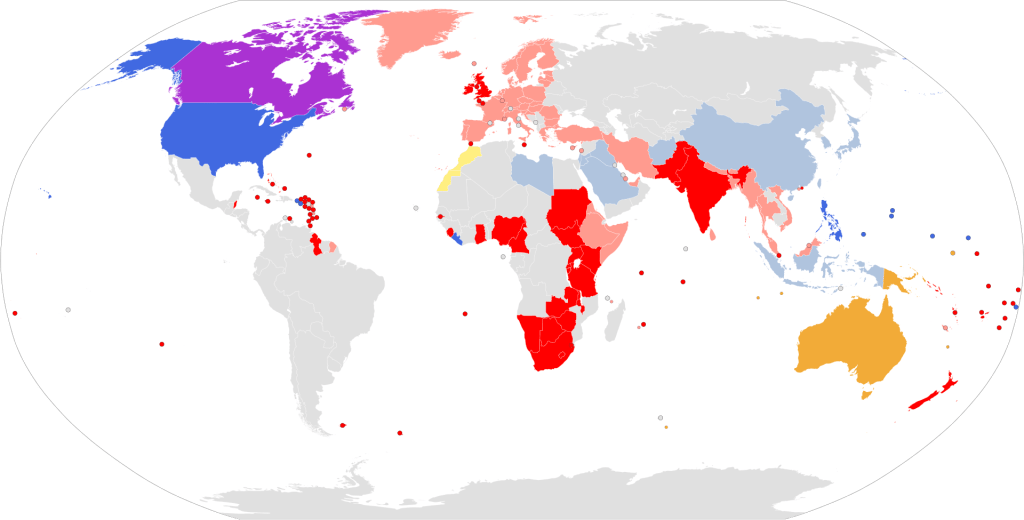
British (red) and US (blue) spelling of the English language.

The current spelling differences between US and British variants come from dictionary initiatives. English is, famously, a language without an institution in charge of standardising and leading change, unlike neighbouring ones like Spanish and French. In the US, a few decades after its independence, the Webster dictionary (1828) got established as the leading reference for spellings and introduced the simplification of words that used to be written with OU and were shortened to O, like color and neighbor. Z replaced S in many endings of words, like analyze and customize, because of Greek roots and is more phonetic. LL was reduced to L in words like metallic and modelling. Meanwhile, British English kept following Johnson’s A Dictionary of the English Language (1755).

Finally, an intriguing attempt at spelling rationalisation came in the saga of the “simplified spelling” movement for US English. The notion here was to scrub English of silent letters and irregular vowel pronunciations, so that have would become hav in a simplified written language. Leading the charge was Melville Dewey, creator of the Dewey Decimal System (oh, you do not know about it? You can guess why, another triumph of standardisation). Melville hilariously demonstrated his commitment to the cause of “simplified spelling” by legally changing his name to Melvil Dui. Dui got his funding from a wealthy donor by 1905, and simplified spelling won support at one point from President Teddy Roosevelt, who tried to instaurate it as the governmental spelling through an executive order. It did not work. The wealthy donor pulled his funding by 1915 with a poignantly spelled note: “I hav been patient long enuf.”

Nevertheless, however easy English is—because of its emergence from a combination of mainly three different linguistic backgrounds—, and however difficult it is—because of the standardisation of it in written form before the Great Vowel Shift and two slightly different standards—, English has become the first natural language to be the dominant and almost universal language of the World. The default cannon, the standard way of communication, the accepted-upon general channel of exchange, the platform upon which to create the connections between different places and peoples of the planet.

English, now, is a truly global codex that, for the first time, has reached and is reaching all aspects of life all around the planet in a way that no other language has ever done on such a scale, depth and speed. A natural language that, like any other language, has adapted, evolved, shifted, transformed, grown, reached new frontiers because of the necessities demanded by its new global role and new global users.

Notwithstanding, the global reach of English and the Anglo-Saxon culture behind it, its dominance happened simply because it has been an opportunistic being that has piggybacked on the extreme connectivity that the planet has taken, starting with the shipping revolution.

Like with Austronesian, the maritime revolution brought a handful of languages to dominate specific locations. But unlike previous connectivity expansion, the new aeronautical and computational revolutions have placed English as the unique global channel of communication.

History could have provided a different outcome, where, like the scientific world before WWII, global communication was shared by a handful of languages. If, like naval powers, different cultures and states reached a similar technological point at a similar rate, other languages might be sitting together for global communication. For example, in aviation the French had an early start with plane-making, and by WWII Germans and Italians had quite advanced military development on planes. Similarly, Polish and German scientists and technicians had early advances in computation, and the USSR and Japan could have invested more in electronics, software development and computation, but never got around to that. It is conceivable that another order could have happened in which a part of the planet rejected the English standard. In fact, that can be partially seen in countries like North Korea, where they firmly reject anything that has hints of Western culture. But nevertheless, even North Korea follows the aviation and software defaults. For better or worse, English stands as a giant alone in the human world.

For this text the fact is that, for now, there is a global acceptance for English to be the default language of communication. That fact, however it is, gives us a tool to address our question, with its usefulness and limits.

In a way, the question of “what humanity wants” can be asked because we, for the first time, can talk in the same language, and it has done so in a somehow passive way, like other standards such as timekeeping. There is not a chunk of the world that is disconnected from that acceptance of the default, there is no major iron curtain that keeps two or more disconnected systems. Since “humanity” has accepted this language, that has allowed English to permeate all the spheres needed for global communication.

Previous

Next
Francas, Linguas Francas

Before entering into the infamous metric system, let us dive deeper into the basics: mutual understanding. We have been dismantling what makes the “Western dominion” narrative so appealing; therefore, we need to look deeper at the foundational building blocks of our new age —where “humanity” can ask itself deeper questions. We have seen how commerce pushes connectivity and enables some basic communication, and how global standards emerge with the examples of timekeeping and mathematical notation. These, however, feel hopelessly limited for any meaningful exchange, as analytic philosophers discovered in the 20th century.

As with our thought experiment on first encounters, to establish an exchange one needs a basic set of communication rules. We have seen that pointing and smiling are human universals. These small gestures, in our thought experiment, allowed the initial connectivity of diverse groups of humans and contain the basic building blocks needed to create connections. To build upon that and ask complex collective questions, we need more sophisticated communication strategies. Fortunately, as illustrated, humans are born with such a strategy —or the capacity for it: language.

Indeed, if one looks at the history of many well-established exchange networks between different peoples, these are often associated with the development of a mutually understandable, but initially basic, pidgin language. As outlined, human brains seem to be made for this relatively easy acquisition of a second, third, fourth, or fifth language. Therefore, we possess not only the drive to learn a language but also the capacity to acquire additional ones —probably linked to the early onset of exchange networks in anatomically modern humans.

In the case of pidgins, these are even more interesting, as a common set of communication bits and pieces is put together on the fly by a diverse group of people who do not share a common language. Pidgins are a more or less complex set of communication strategies based on the languages already spoken by the peoples who come into contact, mixing concepts from different backgrounds. They first establish a basic shared vocabulary around a limited set of objects and actions, as is the case with linguas francas for trade and exchange. How easily pidgins can be constructed, and how organically they are established, further indicates that our brain seems to be built for social communication and for creating shared standards relatively easily, transmitting increasingly complex and abstract concepts that a language captures.

Depending on the depth of contact between the peoples with different backgrounds, the basic code —initially based on a limited shared vocabulary— can evolve to borrow the grammar of one or more of the languages involved. Grammar then becomes the scaffolding on which the vocabulary is built. These are the basic ingredients of a pidgin language. Pidgin languages then become more or less complex depending on the depth of contact, interaction, and areas of life that must be discussed. The most basic form is, as described, pointing, smiling, and saying a few shared words. At the other extreme is the creation of a brand-new language to be used by the descendants of the peoples in contact. At first, nobody speaks a pidgin as their first language. However, many of the pidgins associated with strong exchange networks have grown in complexity until they adopted all the characteristics of a fully-fledged language —spoken by many as a second language and eventually as a first language. At this point, this new language is often called a “creole”.

When a simplified language of a place is used as a trading language —while borrowing many, many, many elements from other languages— this creation is often called a lingua franca. The distinctions between lingua franca, “pidgin”, and “creole” are not clear-cut, and depend on how much influence one specific language had in the creation of the exchange code. However, in all cases, a lingua franca is not an exact copy of the parent language; it often includes vocabulary borrowed from other varieties and languages and always adopts a simplified grammatical structure.

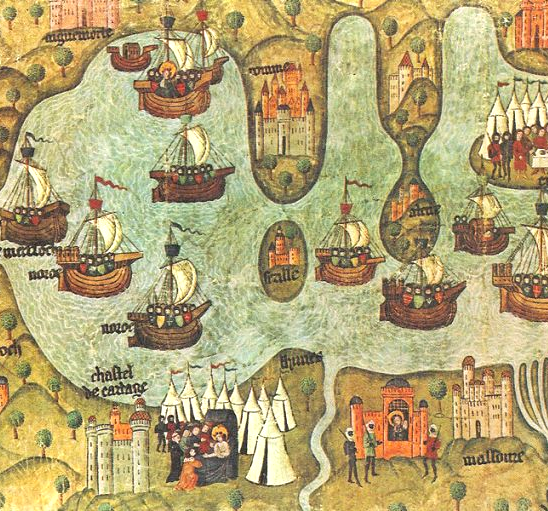
In the case of Lingua Franca itself (or “language of the Franks”), it was in fact a commercial language spoken mostly in the eastern Mediterranean and North Africa. It was brought to these regions by North Italian (Genoese, Venetian, Pisan…) and Catalan sailors. It was not called Franca because it was spoken by the Franks or French, but because during the late Byzantine Empire, “Franks” was a blanket term applied to all Western Europeans due to their prestige after Charlemagne. In fact, over time, that language —used for commerce across the ports of the Mediterranean— was largely influenced by Italian dialects, Catalan, and Occitan more than by French. That early commercial language, lasting from the 10th to the 19th century, is what gave the name to the concept of linguas francas, or a functional language providing basic understanding between many trading peoples with different socio-cultural backgrounds. In this text, franca for short is a functional term, independent of any linguistic history or language structure. That concept can also be applied to pidgins and creoles, or whole languages like Hiri Motu —which is neither creole nor pidgin, but simply a franca from southeast Papua of Austronesian origins used for trading voyages.

Returning to the impressive Malay seafarers and traders, the current Malay language, or Bahasa Indonesia, is a language that originates from Old Malay, mostly spoken in Malacca —the great trading centre that the Portuguese conquered in 1511 CE. Old Malay, also known as Bazaar Malay, Market Malay, or Low Malay, was a trading language used in bazaars and markets, as the name implies. It is considered a pidgin, influenced by contact among Malay, Chinese, Portuguese, and Dutch traders. Old Malay underwent the general simplification typical of pidgins, to the point that the grammar became extremely simple, with no verbal forms for past or future, easy vowel-based pronunciation, and a written code that reflects the spoken language.

Back in 2016, I travelled for a few months through the Malay Peninsula and the Indonesian archipelago. During these trips I could easily pick up a few hundred words which allowed me to have simple context-based conversations despite my general ineptitude with languages. I was surprised by how much understanding could be achieved without even using verbs! The language had evolved such that verbs like ‘go’ and ‘come’ became prepositions like ‘towards’ and ‘from’, allowing me to build simple sentences describing my itineraries without proper verbs. This anecdotal example illustrates how Malay evolved to enable extremely easy preliminary communication.

But Malay is not only a franca. This is exemplified by the extreme complexity and nuance in vocabulary and verbal sophistication required to address your interlocutor based on their relation to you. You need a special way of addressing someone depending on whether they are a man, woman, young, old, or of higher, equal, or lower social status. This likely reflects the language’s other origin: High Malay or Court Malay, used by cultural elites and in courts, where making explicit hierarchical relations was (and still is) crucial.

Today, the language dominates the Indonesian archipelago, the Malay Peninsula and Brunei, and is also widely spoken in Timor-Leste and Singapore. In Singapore, however, the official and de facto trading language is English —but we’ll talk about that trading hub and English later. Malay is spoken as a first language by millions of people, but it is far more common as a secondary language, with almost 300 million speakers. Most of these speakers also know at least one other local language, like Javanese — spoken by nearly 100 million people— or Bazaar Makassar, another franca used by the Bugis, who historically landed on the shores of Western Australia for centuries.

Interestingly enough, modern Malay descends from a language spoken in ancient times in east Borneo. This language also gave rise to Malagasy, spoken by most of the population of distant Madagascar. The language arrived there via Malay seafarers and later traders. Afterwards, Bantu peoples from southeast Africa arrived and mixed with the Austronesians, giving rise to modern Malagasy —the only native language on the island (though it has three main dialect families). Apparently, nobody had the need to create new languages in this 1,500 km-long island.

The Bantu peoples themselves are also the carriers of one of the World’s largest francas: Swahili. It is spoken by up to 150 million people. Originating as a coastal trading language, it spread to the interior of East Africa, connecting the coast to the Great Lakes, and became a franca across the region and a mother tongue for many urban dwellers. It arose in present-day Tanzania during trade between the island of Zanzibar, inland Bantu groups, and Arabs (particularly from Oman). The Omani Imamate and Muscat Sultanate controlled Zanzibar and the Tanzanian coast during the 18th and 19th centuries and held considerable influence through the slave and ivory trade, among others. The name “Swahili” itself comes from the Arabic word for “coast”. Arabic has contributed about 20% of Swahili vocabulary, with words also borrowed from English, Persian, Hindustani, Portuguese, and Malay —the region’s main commerce languages. Like Malay, Swahili has a simplified grammar common in francas, making it easy to learn and pronounce. These traits have made Swahili a contender for a global communication language.

Beyond commercial francas, there are languages used exclusively as cross-border platforms for intergenerational communication, but which are not native to any sizable population. These languages are like frozen structures, called upon to allow a group of people to mutually understand one another.

Classical Latin is one early example of this function. By the 4th century, Romans were already speaking a language quite different from what Augustus spoke 300 years prior. Different parts of the empire used highly dissimilar versions of Latin, and Classical Latin served to maintain a unified system. That “old Latin” was standardised for literary production and, crucially, for imperial administration. After the division of the Roman Empire, the Western Christian Church also adopted a version of Classical Latin for internal operations: Ecclesiastical Latin. Previously, early Christians used mainly Greek and Aramaic —as we willl see.

Over time, Ecclesiastical Latin became the international language of diplomacy, scholastic exchange, and philosophy in Europe, lasting for around a millennium. It was not fully standardised until the 18th century! By then, linguists were eager to fix languages as words changed meaning too quickly —as the analyitical philosopher Russell observed. Ecclesiastical Latin flowed into the emerging sciences. The main works of Copernicus, Kepler, Galileo, and Newton were written in Latin.

But this Latin was a written language —no one really spoke it. And, unlike Swahili or Malay, it was far from easy to learn. Any Latin student knows how difficult it is to memorise its multiple, complex inflections. It became a written fossil spoken by basically no one —except a few geeks. That made the other nerd in the Peano-Russell nomenglature propose a simplified version of Latin, Latino sine flexione, as the  Interlingua de Academia. Peano, being Italian, had skin in the game. For us native latin languages speakers, such as my Catalan, a simplified academic Latin would be a great advantage compared to “ahem” we know what. But more on that and created languages to be international standards later.

Today, a stripped-down Latin does survive in science —particularly taxonomy, where the classification of living things (especially plants and animals) uses Latin binomials. For instance, humans are Homo sapiens, wolves are Canis lupus, and rice is Oryza sativa. Many scientific terms —especially in astronomy, physics, and cosmology— are still derived from Latin. So, through science’s dominance as the global system for classifying the world, Latin vocabulary lives on. It has become a kind of global pseudo-language, used by experts worldwide to communicate about shared topics but just as individual words, without any structural coherence.

Latin is but one example of an imperial language transformed into a franca and liturgical language. Another —and much older— example is Aramaic. Aramaic had the advantage of the simplicity of its written form. Unlike the complex cuneiform writing on clay tablets, Aramaic used a simple 22-character alphabet, which made it easier to learn and spread. This accessibility allowed it to be adopted in administration, commerce, and daily communication in a linguistically diverse region. The Achaemenid Empire adopted it as an administrative language, standardising “Imperial Aramaic” alongside Old Persian. Bureaucracy, scribal schools, and widespread official use helped it expand far beyond its original homeland —and its legacy lasted for over a millennium.

As with Latin, Aramaic became the medium of religious texts. Many Jews returning from exile after the fall of the First Temple continued speaking it. Scribes translated the Hebrew Bible into it, and large sections of sacred texts ended up in Aramaic. Other Levantine prophet religions like the Manichaeans also adopted it. One of these, Mandaeism, still survives, and its followers still speak a version of Aramaic. Eastern Christians adopted Syriac —an Aramaic dialect— for theology, hymns, and lengthy religious debates. Aramaic became the franca of the ancient Near East: everyone could participate. Thanks to that, like Latin, the language outlived the empires that spread it.

So, with these examples, we can begin to draw some principles for how linguas francas are established, spread, and sustained across space and time. They tend to offer accessibility benefits, borrow heavily from multiple languages, are often secondary but can become primary languages (especially in cities), and most importantly, serve specific purposes: commerce, administration, religion, or technical use. Perhaps we can even distinguish between written and spoken francas: spoken ones often have simplified grammar, are easier to pronounce, and accommodate mixed/macaroni forms. (Cool word, “macaronic” — look up its history!) Written francas, on the other hand, may retain complex grammar but offer easy ways to record text. Of course, ideographic systems like Mandarin or Japanese kanji present another accessibility puzzle —one we willl explore later, as they are closely tied to another leg of francas: formal state education.

In a world that is becoming more technical, more bureaucratic, and more formally educated, there is now ample space for new linguas francas to be established, maintained, and —for the first time— reach global scale. It is in these languages that we will begin to ask ¿what does humanity want?

Previous

Next

Language

The most critical basis for communication is language. It is difficult to define what a language is and what it entails. At its core, language is something that can capture deeply complex concepts—both external and internal—and transform them into words with specific meanings that can be shared with others. Therefore, it entails both an internal component, in which the brain must link specific concepts to words and structures of the language, and an external component, in which these words and concepts must be translated into structures that can be broadcast to other individuals. These broadcasts can primarily be via sound, visuals, or touch, but in principle, any channel capable of encoding information should work in order to create structured signals in the form of a language.

There is no clear agreement on how old human languages are. Some argue that they started emerging about 100,000 years ago, while others argue for an even earlier origin. Nevertheless, however they came to be, languages are an integral part of being human, shaping both how our brains function and how we understand and influence the world and ourselves.

Some examples illustrate how wired we are to shape our brains for learning a language. The clearest natural experiment demonstrating the spontaneous learning and generation of languages is that of Nicaraguan Sign Language.

In the 1980s, for the first time in Nicaragua, a school for deaf children was created, bringing together children from all over the country to live and learn in one place. Before this initiative, there was no institutionalised system to teach deaf children how to communicate. As a result, at the time of their arrival, these children’s vocabulary was limited to a few hand gestures used within their families or communities of origin, often in the form of idiolects or cryptophasia (“private languages” usually spoken by one person or between twins).

Compounding this initial lack of complex communication, the teachers at the new school aimed to teach the children lip-reading and Spanish through that method. They discouraged the use of any sign language, believing that the children would put less effort into learning to lip-read. However, lip-reading had very limited success—the children were unable to communicate with their teachers.

Despite this, communication flourished outside the classroom among the children themselves. In the courtyard and throughout their daily activities, they combined the hand gestures and signs from their respective communities and created new ones. This process of creation, sharing, and accumulation spontaneously generated a new language, which rapidly evolved into more complex structures, giving rise to grammar and a more elaborate vocabulary. This increase in complexity and fluency was particularly evident among younger generations of students, who picked up the signs from older peers and refined them with intricate flourishes and added layers of meaning.

This entire process was documented by sign language experts, who were called by the teachers after noticing that the children could communicate fluently with one another but remained incomprehensible to the teachers. Initially, these experts also struggled to understand the children, but by filming them, analysing the footage, and interacting with them using the learned hand gestures, they gradually acquired the language. Most interestingly, over the years, they recorded the cumulative process of increasing complexity, allowing us to witness how the language evolved and standardised rapidly.

Notably, the children were already familiar with a small subset of home signs. However, this is not so different from the basic signs shared by social animals or those we can teach our pets. For example, when I was living in Mallorca, I was responsible for a dog named Gordon. I could tell him “sit,” and he would sit; “down,” and he would lie down; “up,” and he would stand on his hind legs; “la pateta,” and he would sit and give me his left paw. Even more complex instructions, like “We are going for a walk, but first, we need to go to the basement,” were followed correctly—Gordon would go straight to the basement instead of heading directly outside. Not only that, but he also communicated with me: for instance, he would touch his water bowl to indicate it was empty or stand patiently by the courtyard door when he wanted me to open it. Through these examples, one might say that he and I shared basic communication and understanding, but no one would, in their wildest dreams, call that a language. Nor would a language ever emerge from these exchanges. This became especially clear when I said more complex things, like “Could you go to the cupboard, open the door, and bring me a kilogram of rice, please?” or “Do not bark at the neighbour’s dogs!” Gordon could open doors, so that part wasn’t a problem, but the rest was beyond his capabilities.

The case of Nicaraguan Sign Language is particularly important because it demonstrates the evolutionary nature of language within a short time frame and its ability to keep expanding—something that does not occur in any other non-human animal. To be fair, dogs can be trained in more complex ways than my simple set of commands (and one particular, named Chaser, learned can more than 1000 words!), and other animals, such as dolphins, elephants, circus animals, horses, buffaloes, parrots, pigeons, and crows, can learn to respond to basic commands from their human carers. Bonobos, in particular, can learn up to hundreds of hand gestures to communicate basic information with their trainers, and similarly, dolphins can understand basic sentence order. However, this is the maximum extent of their communication; it does not go any further. Nor do animals copy human language to communicate among themselves in more complex ways—not even parrots, which can mimic hundreds of human sounds, spontaneously start using them to communicate with each other. Humans, on the other hand, have the unique capacity to transform simple signals into an elaborate and constantly evolving set of communication codifications.

The connection between language and the brain is deeply rooted in humans, with both being intricately linked, as seen in the Sapir-Whorf hypothesis. Language shapes the brain, and the brain, in turn, shapes language. The latter is evidenced by the fact that certain sounds seem to be more naturally associated with certain concepts—for instance, sharp objects are commonly linked to words with sharper sounds, while round objects tend to be described using softer pronunciations across multiple languages. Language is integral to memory, abstract thinking, and, fascinatingly, self-awareness. Language has been shown to drive much of the brain’s core “hardware”. Languages shape brains to such an extent that, most of the time, we think in a language—or in multiple languages if we are multilingual.

For those who are born deaf, rather than relying on an “inner voice” as spoken-language users do, their thought processes are shaped by visual sign thinking or the sensation of body gestures. Interestingly, deafness has a significantly greater impact on the brain than blindness. People born completely deaf and who never learn sign language fare only slightly better than the rare individuals who grow up without any language exposure. Without language, they fail to develop an “inner voice”, which is crucial for the brain’s ability to process information. This is especially significant in early childhood. Those who are not taught sign language until later in life often have learning problems throughout their lives. It seems that the brain processes sign language exactly as it does spoken language, using the exact same regions.

Communication - Culture <- Previous Next -> Forms of communication

Previous

Next

Diaris de Borneo, dia 18, política

image

Estic creant un nou sistema polític o nova revolució. Com ja va passar en la meua ideologia prèvia, morta ja, tot passa per l’educació.

Bàsicament cal canviar totalment el sistema educatiu per a que no només arribe a quasi tothom com ha fet prou bé fins ara, si no que a més siga capaç de realment enrriquir i involucrar a tots els individus. Per tal d’així aconseguir coneixements que consideren importants per a tindre control i decisió sobre les seues vides.

Bàsicament em referisc a atenció personalitzada però econòmicament, jaha que ha de mantindre la universalitat. El problema però és com fer-ho. Al nivell que tenim ara és molt difícil trobar la resposta, supose que caldria molta inversió en recerca educativa i interacció social. La recerca social és perquè moltes de les desicions de la majoria de la població no es prenen a nivell individual si no per influencia “veïnal ” (aquelles persones o factors pròxims que influixen les d’edicions).

A grans trets diria que el sistema educatiu actual no és més que una universalització , estandarització i reglamentació de l’educació medieval. Per una banda educació que era per a les elits, basada en la memorització i pràctica dels principals coneixements actuals. Aquesta seria l’educació primària i secundara obligatòria d’ara, i Universitat també.
Mentre que l’altra està basada en l’aprenentatge de les arts i oficis medievals, el que tenia la majoria de la població (ja siga feina manual simple, que s’aprenia a l’indantesa, o oficis complexos que s’aprenien a la joventut).
Aquesta ara estaria representada en la formació profesional d’ara, o dies de pràctiques per a feines simples.
Es a dir, a part de la universalització i reglamentació de l’educació no hi ha hagut més canvi des fa centúries. Cosa que deixa a molts individus  poc preparats ja que la formació del sistema actual és del seu interés o habilitat.

El motiu pel que emfatitzar l’educació per canviar de sistema és per la intuició que cada cop que ha hagut un increment notable de gent formada hi ha hagut una revolució (i.e. els burgesos al s.XVIII i part de la classe treballadora al s.XIX) però hauria d’estudiar si la intuïció té fonament o és coincidència.

Hui  dia llarg d’autostop, 12 vehicles amb sort mesclada, 2 m’han dut vora 30km fora del seu camí per fer-me el favor. Molts han parlat extensament de política i Sarawak i Malaysia i com només es queden un 5% del obtés del petroli i la resta va a desenvolupar la capital. Malaysia no és un país desenvolupat, és una ciutat desenvolupada. Tot això m’ha fet reflexionar sobre sistemes polítics.

La foto és d’un equip de construcció de torres de comunicació que m’ha agafat i estàn preparant per construir la torre.
També m’ha agafat un curiós autostop que conduïx descals com jo :). Altre n’ha conduit 30min per camins polsegosos fins a una casa llarga de caçadors de caps per recaudar diners. He fet l’autostop a les 22h per 1r cop.
El motiu per que es fera tard és que un autostop estava preocupat que no poguera arribar i ha demanat ajuda a la seua filla que hem esperat per llarg. El següent m’ha invitat a un festí que ha durat més d’1h. Era un treballador de la Shell extremadament interesat en els meus viatges. Després l’última, que va estudiar a Leeds i treballa per a energia i Indústria del govern Brunei em du fins el meu CS, Eve Lee, una pianista que m’espera 40min per dur-me fins sa casa.
Molt bona gent que et trobes en aquest món.