
Let us first focus on rarity, which is conceptually easier to grasp. For some reason, we are extremely attracted to rarity. Imagine this thought experiment: there is a room full of white marbles on the floor, with just one or two red marbles, and you are allowed to pick three of them. Which ones would you choose? I can venture to say that you would probably pick the red ones.
Now, consider another room where another person is also allowed to pick just three marbles. However, in this room, the colours are inverted—one or two are white marbles, while the rest are red. Neither of you knows about the inverted arrangement.
Once both of you exit the room, you are allowed to see what the other has picked.
If there were only two red marbles in the room, you would have one or two red marbles and the rest white. Meanwhile, you would see that the other person also has one or two red marbles.
If you were now allowed to exchange marbles, which ones would you pick? The context has changed—both of you have more or less the same number of red and white marbles, but most likely, due to your previous experience, the other person would desire your white marbles while you would desire their red ones.
Other strategies might emerge, though. For example, given the possible rarity and imbalance of colours, you might choose to hold on to one white marble just in case.
This simple thought experiment illustrates how complex rarity becomes. Despite this, we have an innate mechanism that drives us to desire it. Marbles are completely useless in everyday life, and their being white or red makes no actual difference. There is no rational thought behind it—only the impulse to gather the rare.
We do not know where the desire for rarity comes from or how exclusive it is to humans. Perhaps the behaviour originates from selecting ripe fruit. However, similar curiosity and rarity-seeking behaviour can be observed in bowerbirds. These birds, native to Papua and Northern Australia, have no natural predators. Like birds of paradise, male bowerbirds have evolved complex courtship strategies. While birds of paradise have developed colourful feathers and elaborate courtship dances over generations, the plain-looking bowerbird has instead developed the ability to construct intricate and colourful structures—so-called “courting nests”—as part of its courtship strategy.
Males take years (four to seven) to learn how to build these structures, which can span several metres. These nests take weeks to construct using sticks, straws, shiny stones, and pebbles. Interestingly, bowerbirds have begun incorporating plastic rubbish into their nests. Each element is carefully arranged in complex structures that even manipulate depth perception, much like a Baroque painting, in order to attract a mate—or several. In many of these structures, a plastic piece—often an especially unattractive one, such as a torn energy bar wrapper or a crushed plastic bottle—occupies a central position. Perhaps this is not due to intrinsic beauty, but rather because of contextual rarity. Curiously, these birds also follow local trends, observing and copying the constructions of others. Young bowerbirds learn by imitating their older relatives, initially building crude and atypically coloured nests. This behaviour is particularly evident in species such as the Satin, Vogelkop (Amblyornis inornatus), MacGregor’s, and Great Bowerbirds.
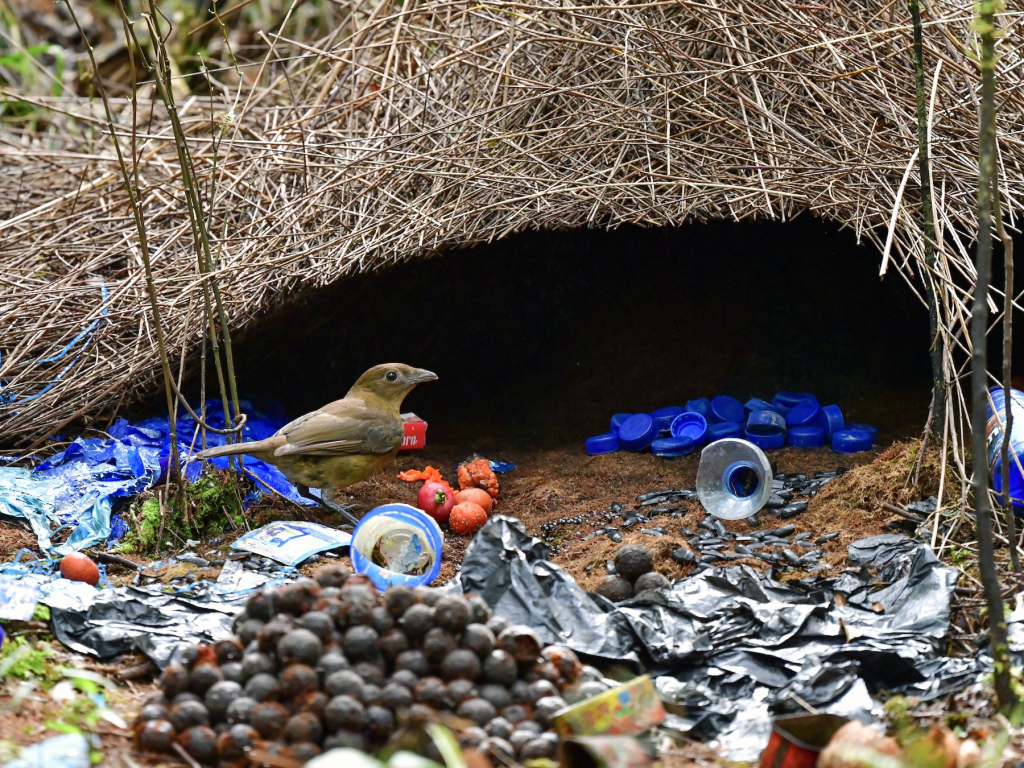
Perhaps we desire marbles for the same reason—they are shiny, rare objects that can be used to attract potential mates or simply to gain the attention of our social peers. A child, for instance, may wish to show off a rare new toy to their family and friends or flaunt a shiny new pair of shoes.
Regardless of the underlying reasons, what bowerbirds lack is a system of exchange in which they can trade their surplus of blue plastic caps for an impressive white-and-green toothbrush two nests away. Instead, they resort to stealing decorations from their neighbours in an effort to attract mates. However, stealing is time-consuming and inefficient; the thief must wait until the other bird is away, sneak in, and then return to their nest with the prize. During this period, they are neither gathering food nor tending to their nest, and they are also vulnerable to theft themselves. It is far more efficient to exchange ornaments or to give them away in the hope of reciprocity—or, as some anthropologists suggest, to create a debt bond.
Beyond the intriguing fact that modern plastics have entered their courtship rituals, bowerbirds offer insight into a fundamental human desire: the pursuit of beauty taken to an extreme, combined with the imperative to reproduce. This will be analysed further in the texts.
From the small to the global <- Previous Next -> Tool making
Previous
Next

 humanitywants.org