Global visions to global ideals

Whatever process we focus on to achieve a “global ideology” would be far from any given form of that ideology. However, as we have seen, a “global vision” already exists in certain technical areas. These areas can be seen that as having reached de facto global standardisation. Other process might follow the technical dynamics, we shall investigate what, and how, other aspects of what it means to be a human can reach global ideals.

Similarly with languages, and the primordial diversity that we illustrated when talking about first encounters between diverse human groups, historically the differences between human populations have been enormous, testing the limits of what it means to be human.

Cultural groups have organised themselves in a wide variety of ways, from the way unions are made, kids are raised, division of labour constructed, ways of seeking food and refuge, medicine, artistic expressions, ways of keeping the group knowledge, religious visions and practices… Almost every aspect of what characterises to be human has experienced an explosion in diversity, with the only commonalities being that these aspects are shared by virtually all human populations. Reproduction, food, shelter, language, body modification/ornamentation, artistic and spiritual expressions, being probably the main ones.

Humans also seem to share multiple universal –or quasi-universal– characteristics. As we have seen, these are the smiles and laughter, pointing towards things, the taboo of reproducing with your mother or your son, a division of labour based on gender, food based taboos, religious beliefs and afterlife, a cosmovision, oral traditions and stories, rituals, music and arts, ethnobotanic knowledge, modification of the environment, humour and the use of technologies such as fire, spears, hammers, strings, ropes, baskets and other such tools. Maybe also the fact that we usually laugh across cultures when somebody falls! That is difficult to prove universally, still, it seem that, at least across ten distant foraging societies, pain and misfortune to be a recurring theme.

Although that list of things seems like a huge set of characteristics, that is nothing when compared with the astonishing diversity of human culture. To find common ground within this diversity is what allows to ask a common question.

Common ground is important, because, even if a lingua franca is shared by different cultural groups, the concepts that are encoded by that language shall also be shared if need to be mutually understood. For example, it is useless to have a word to define a food that is only known by one cultural group. We valencians have given to the world the word Paella, and also an emoji. Paella is both the the pan where the meal is cooked, and the meal itself. Many of the readers might not be familiar with the word paella, you can google it and it would be an easy find. For the ones familiar with the word, probably their knowledge came about by eating the dish itself, and not from reading the definition of Paella. Alternatively, one could have eaten a seafood rice “Arroz con Mariscos” in Peru previously, and when reading about paella, without having actually tried it, been able to understand more or less the concept because these meals, and the experience of eating them, are similar enough even though are called differently and traditional Valencian paella not having seafood, but rabbit and chicken.

In summary, new language and concepts have to be incorporated in the first part by experience, like learning a language for the first time, as newborns do. That takes time. A newborn potentially takes about 2 to 3 years to reach language fluidity through the incorporation and linkage of all the concepts that are being incorporated in the brain, with a vocabulary and a grammar associated. And after that period one never really stops learning, as new concepts and vocabulary keep appearing in ones life, even if it is just the names of new people who are integrated into the human community, such as spouses or newborns. No matter what society we live in, language is something that gets richer and richer throughout ones life.

Similarly, when learning a second language it is significantly easier if the language is close to the one that is already known, especially in terms of vocabulary. Concepts in both languages tend to have words that sounds in a similar way or are closely related. With that the effort to learn is little, because there is a common ground where many bridges are already established. On the other hand, when learning distant languages the effort needed is significant, as each word and concept is virtually new and the bridges have to be build one by one in a process that is somehow equivalent to learn how to speak again, though quite distinct as well, as knowing one language already shapes how one adquires others.

With ideologies, and in general cultures, we can make the analogy with the languages. Similar ideologies have already many bridges of mutual understanding, while distant ones have few points of connection where to build a mutual understanding. Often, for people from one culture to understand the other, there is the need to immerse into the other in order to truly absorb all the concepts needed for a mutual understanding. That is time consuming and impractical.

It is difficult for the members of two different ideologies to truly understand the other. In fact, it is the opposite in many cases, ideologies and identities are on occasion build and defined through the radical opposition to the other. What is reinforced is what makes them different. For example, french youth in the 70s and 80s quickly developed Verlan (l’envers, “the inverted” in french). Velan is a complex argot that flips syllabic order in words. The tradition goes back to at least the XIX c., among prisoners, the underworld and popular groups. But by the end of the XX c., it took off as a generational phenomena to create a code that limits who can understand it. It is generally limited to one or two key words per sentence, while mixed with other known argot. Through language, youth could distinguish themselves and create an identity distinct from the older generations and the wider french society, especially in urban ghettos, where these demographics suffer general societal disenfranchisement. Similarly, in Bouganbille, Papua, the Uisai dialect of Buin, inverted the language gender, not only in nouns but throughout all the linguistic system—pronouns, verbs, numerals, demonstratives and adjectives. Since such change is so profound and systematic, some linguists propose that it was a deliberate act by the Uisai to distinguish themselves from the other Buin communities.

Therefore, for practical proposes, the understanding of the other, and willingness to do so, is what constitutes the basis for a needed mutual understanding.

This process, however, builds upon the biased connections that we already have seen in the previous sections: exchange, commerce, colonization, conquest, universal technical languages, a universal natural language, and as we hinted with maps, nation states.

Upon these connections, there are other levels that we will explore it. Mainly, the export of a set of global ideals by Western powers. This process is not merely limited to the Western World, but I argue that most of intercultural conflicts, oppression and disagreements emerge from a handful of behaviours: how one looks, how one eats, how one fucks, how one works, how one owns, how one kills…

Provably even these last words might arise some emotional reaction in some readers. That reaction, indeed I claim, shapes much of what the aims, and limits, of our question.

Moreover, since the Europeans have proceed to export how one looks, how one eats, how one fucks, how one works, how one owns, how one kills; across the world as a dominant culture, they done so in a brick and mortar way, through infrastructure, and the build up of global institutions.

Previous

Next
The Language of Foreign Affairs

Through aviation and other technical advances, English became the first language to achieve universal and almost exclusive reach throughout the planet in specific niche areas, especially technical ones. English was the first natural language to be dominant in so many technical areas—with the small caveat that chemistry and taxonomy have many technical terms based on Latin. Other than that, no language got that uncontested global dominance.

As we all know, now English dominance does not stop there; the fact that I am writing this text in English despite my mother tongue being Catalan already shows it. If one thinks today of a global language, of an international language, of a World language, the first one that comes to mind is English, and one would have to think hard to come up with others.

Other candidates for World languages could be those which have enough speakers or have had past prestige or dominance. Again, we can think of classical Latin and Greek as playing that role in the Mediterranean and Northern Europe for a while. Similarly, within their respective zones of influence, Phoenician, Aramaic, Persian, Arabic, Sanskrit, written Chinese, Mandarin, Khmer, Malay, Quechua and Maya were, and still are, in similar positions as Latin and Greek. Natural languages that also acted as lingua franca.

Other natural languages have also played a role in the technical landscapes, where vocabulary from the language extended far beyond the natural geographical area by giving names to specific technical features. Before WWII, if one wanted to follow the advancement of science as it progressed, it was necessary to be a versed reader in, at least, French, German and English. This is because during the early phases of the industrialisation of Europe these three centres had comparable influence in the creation and propagation of scientific and technological advances. At the time, no one language dominated over the others, even in the small niche world of science and technology. As we have seen, this shared dominance changed with the appearance of new technologies —like aviation and software—that took off especially during the war years and soon afterwards. Maybe there was the little exception of Russian being used for advanced mathematics, theoretical physics, nuclear physics, rocketry and other highly technical and specialised fields, as a heavy amount of research was done in these areas during Soviet times. During the Cold War years it would help to know Russian if one wanted to keep up with the times. Yet, that time for Russian also ended after the collapse of the Soviet Union.

By the mid-XX c. and especially in the XXI c. English has become the default natural language of the World, with no competitor even close to it in terms of reach, number of second-language speakers and its use in many different fields of international reach—from international law to the language of memes. English has influence in culture, the arts, travel, sports, economics, food, science, technology, romance, infrastructure… Probably there is no area in the world that it has not touched in one way or the other, with maybe the exception of really local traditions that have escaped the reach of anthropologists, missionaries or travellers. Each of these does codify the World in the international language by default, English, or they translate to English whatever was captured in another language.

English is the default natural language to approach virtually any aspect of life when one thinks in international or global reach. It is so much so that when I was travelling in Vietnam, I remember the locals talked to me in “foreign language” because they needed to practise with me their “foreign language” skills. For them English was not just a language, but the language that dominated “foreign” relations and affairs, that is, whatever was of international matters. I, as a traveller from afar, was not expected to have as my working language my own Catalan, but just the default language from “foreign lands”. It was not even called English. It had nothing to do with the origin of a kingdom on a small island off the coast of north-western Europe. It was just The Language of Foreign Affairs. That was not just in Vietnam, but I also heard that expression in many other Asian countries. In these nations, any foreigner was expected to be fluent in that “foreign language”. That expectation would not have been so just 100 years ago. At that time Western Europeans and Russia dominated the planet, but there was a bunch of languages that would have been expected to be known by a traveller. Moreover, if the traveller had scientific training, that person would be expected to be familiar with German, French, English and also Russian. And depending on which part of the world you were, most travellers would know Arabic, Persian, Mandarin and Malay, Spanish and Portuguese.

That dozen of “foreign” dominant languages has slimmed down to just one on the podium. English. The first natural language to hold that position alone, and so far, keep it.

Curiously enough, the English language is a kind of “lingua franca” by itself, with some linguists considering it a “mixed language”, creole or pidgin as 29% of its vocabulary is of French origin, 29% Latin, 26% Germanic, and verbs are inflected for tense and number but not for person. Others say otherwise and argue that it is in fact a Koiné language (the simplification of different dialectal forms in contact). But this is mostly a debate of definitions, on how to divide a continuum. This kind of division of a continuum, and the Sorites Paradox, is something we will explore in the future related to what does humanity want.

However English is defined, for whoever has to learn English for the first time, they soon discover that English is quite simple grammatically. It has no gender, only a handful of irregular verbs and most of the vocabulary is quite simple, with many words composed of pairs of others like “water-fall” to designate something that in many other languages has a proper word, like “cascada” used in many Latin languages. And the fact that cascade also exists in English shows another sign of “lingua franca”, that is, of vocabulary emerging from many different origins and backgrounds.

In fact, this mixture comes as no surprise when one knows a bit of the history of the English kingdom.

It was a Roman province thinly controlled by a military elite which was depleted over the dwindling of the Western Roman Empire. The Celtic population there only partially adopted Latin as their vehicular language, and with the power void left by the absence of the Roman legions, other peoples took the opportunity to fill the power vacuum.

Then came the Anglo-Saxons, from present-day northern Germany and southern Denmark. The Angles have left the name to the country and the Saxons many elements of a Germanic language, built upon strata of Celtic and Latin.

After them came the Norse, another Germanic language from northern Denmark and Norway, which contributed to much of the vocabulary like they, them, their. Also, the interaction between two similar but distinct varieties of Germanic languages contributed to the koinezitation of the Germanic variants. It produced a simplification towards a common grammar, which departed from Old English by greatly reducing the inflectional system which was not shared between them. This simplification, for the happiness of many students of English, increased the amount of regular verbs present, and got away with the almost nightmarish inflection systems that haunt the students of German.

Then, soon afterwards came the Normans, who brought with them French. The aristocracy took over what is now England and they brought with them most of the vocabulary that comes from Latin and can be found in modern English, like the word cascade. The Norman aristocracy left much of the vocabulary on the topics related to the elites, including cuisine, where most of the vocabulary comes from French and Latin, like the word cuisine itself. That makes it easy for us Latin speakers to learn the language—once we learn how crazily the English speakers pronounce our words…

Unfortunately, all is not that easy. At some point by the XV c., someone decided to standardise the written form of English. They adopted the way they spoke at the time, what is called “Middle English”. Middle English and Modern English are quite similar in most aspects, but, unfortunately for us, especially if you are dyslexic like me, the main difference is that the whole southern population decided to change the way they pronounced words. That change is known with the grand name of the “Great Vowel Shift”, which affected mainly vowels and diphthongs’ pronunciation, but also how some consonants became silent. This has left us with the horrible challenge of having to remember by heart how words like bite are spelled, because the correspondence with the actual pronunciation bait is low or nonexistent in many cases.

Moreover, the printing press did a small mess. As we have seen with the standardisation of punctuation, early on, spelling standardisation of printed English happened mostly outside England. Books in English were printed mostly in the nearby Netherlands and Germany, as they had a more developed industry. The typesetters, not being profoundly familiar with English, would adapt German or Dutch spellings to write English words, like adding an h to “ghost”, from the Dutch gheest.

To complicate things further, English nerd writers who thought themselves to have command of classical Greek and Latin tried to reinforce supposed Greco-Latin origins of English words. They happily started adding silent letters to reinforce the real—or imagined—links. For example, dout became doubt (to link it to Latin dubitare), and funnily, iland became island because they convinced themselves that the word came from Latin insula and not from ieg-land, from Old English meaning “water land”.

British (red) and US (blue) spelling of the English language.

The current spelling differences between US and British variants come from dictionary initiatives. English is, famously, a language without an institution in charge of standardising and leading change, unlike neighbouring ones like Spanish and French. In the US, a few decades after its independence, the Webster dictionary (1828) got established as the leading reference for spellings and introduced the simplification of words that used to be written with OU and were shortened to O, like color and neighbor. Z replaced S in many endings of words, like analyze and customize, because of Greek roots and is more phonetic. LL was reduced to L in words like metallic and modelling. Meanwhile, British English kept following Johnson’s A Dictionary of the English Language (1755).

Finally, an intriguing attempt at spelling rationalisation came in the saga of the “simplified spelling” movement for US English. The notion here was to scrub English of silent letters and irregular vowel pronunciations, so that have would become hav in a simplified written language. Leading the charge was Melville Dewey, creator of the Dewey Decimal System (oh, you do not know about it? You can guess why, another triumph of standardisation). Melville hilariously demonstrated his commitment to the cause of “simplified spelling” by legally changing his name to Melvil Dui. Dui got his funding from a wealthy donor by 1905, and simplified spelling won support at one point from President Teddy Roosevelt, who tried to instaurate it as the governmental spelling through an executive order. It did not work. The wealthy donor pulled his funding by 1915 with a poignantly spelled note: “I hav been patient long enuf.”

Nevertheless, however easy English is—because of its emergence from a combination of mainly three different linguistic backgrounds—, and however difficult it is—because of the standardisation of it in written form before the Great Vowel Shift and two slightly different standards—, English has become the first natural language to be the dominant and almost universal language of the World. The default cannon, the standard way of communication, the accepted-upon general channel of exchange, the platform upon which to create the connections between different places and peoples of the planet.

English, now, is a truly global codex that, for the first time, has reached and is reaching all aspects of life all around the planet in a way that no other language has ever done on such a scale, depth and speed. A natural language that, like any other language, has adapted, evolved, shifted, transformed, grown, reached new frontiers because of the necessities demanded by its new global role and new global users.

Notwithstanding, the global reach of English and the Anglo-Saxon culture behind it, its dominance happened simply because it has been an opportunistic being that has piggybacked on the extreme connectivity that the planet has taken, starting with the shipping revolution.

Like with Austronesian, the maritime revolution brought a handful of languages to dominate specific locations. But unlike previous connectivity expansion, the new aeronautical and computational revolutions have placed English as the unique global channel of communication.

History could have provided a different outcome, where, like the scientific world before WWII, global communication was shared by a handful of languages. If, like naval powers, different cultures and states reached a similar technological point at a similar rate, other languages might be sitting together for global communication. For example, in aviation the French had an early start with plane-making, and by WWII Germans and Italians had quite advanced military development on planes. Similarly, Polish and German scientists and technicians had early advances in computation, and the USSR and Japan could have invested more in electronics, software development and computation, but never got around to that. It is conceivable that another order could have happened in which a part of the planet rejected the English standard. In fact, that can be partially seen in countries like North Korea, where they firmly reject anything that has hints of Western culture. But nevertheless, even North Korea follows the aviation and software defaults. For better or worse, English stands as a giant alone in the human world.

For this text the fact is that, for now, there is a global acceptance for English to be the default language of communication. That fact, however it is, gives us a tool to address our question, with its usefulness and limits.

In a way, the question of “what humanity wants” can be asked because we, for the first time, can talk in the same language, and it has done so in a somehow passive way, like other standards such as timekeeping. There is not a chunk of the world that is disconnected from that acceptance of the default, there is no major iron curtain that keeps two or more disconnected systems. Since “humanity” has accepted this language, that has allowed English to permeate all the spheres needed for global communication.

Previous

Next

The sound of music

To keep postponing the Metric, let us explore another metric — the music metric. Since my music ignorance is as immense as music is —and I do deeply apologise to all he music lovers out there— I take metric to mean notation.

As we all know, sound is difficult to record compared to visual signals. We have pictorial art going all the way back to 60.000, to 80.000 years, but no record of sounds before the invention of gramophones and ceramic disks. Though we do have evidence of music being played at least 40.000 years ago, with evidence of close to 200 fragments ivory or bone flutes, whistles, and pipes and a conch shell horn. Percussive instruments can be traced to the same period, with mammoth bones as drums, and reindeer-antler as drum sticks and possible rattles (Morley, 2013). However, from the beginning of music to the first sound records, the only way to play music created previously was either to have an unbroken sequence of people remembering how to play it, or to encode it in a system that could be reproduced later — either by other humans or by moving machines.

As always, the Greeks and Babylonians (Sumerians, to be exact) had already dealt with the encoding of music, but music is an immensely complicated language, and these scripts were only able to store the strings, the intervals, and tuning parts of the music.

The bit that is often told about the Greeks is the mythical Pythagoras. Beyond his triangles — which mostly were a well-established Egyptian knowledge — the Pythagoreans linked music and ‘harmony’ with mathematics, which they copied from the Babylonians this time. (Interestingly, the Chinese Shí-èr-lǜ scale follows the same logic.) Beyond copying and being attributed things he did not create, Pythagoras did make the musical and mathematical ‘divinity’ a religious sect by the 6th century BCE — if you want to perpetuate nerdy, complex, boring knowledge, you’d better make a religion out of it. In instruments, pitches, notes that were a half or 3/2 apart ‘sounded’ good. With strings, this is related to length, but also tension or tuning. Pythagoras and his followers could not resist giving this a ‘mystical’ meaning, trying to fit existence into his ‘divine’ vision — but reality, as it turned out, had other ideas.

What Pythagoras actually discovered — before wrapping it in mysticism — was that the harmonics of strings resonate with each other, a simple fact of physics that our ears have evolved to enjoy. From what we understand now, it is mostly a coupling of harmonics in strings and “overtones” in general. In other words, when an instrument produces a ‘pitch’, it gives off not just one pure wave but many smaller ones that resonate with it — and these combine to sound harmonious because they complement each other. Then, if you add another tone that also resonates with the primary frequency, or some of the overtones, that is also harmonious.

Our auditory system also resonates with nearby frequencies, which is why we find it oddly unsettling when two notes are almost — but not quite — the same. And there is a cultural layer on top. If you hear something that is slightly dissonant often enough, it will “sound good enough” not to care. It’s only when we hear music from another culture — one that divides its scales differently, using another temperament — that we start to notice those dissonances. Once your ear adjusts to the new metric, returning to the old one feels oddly off for a while.

And again, we go to Western Europe to observe the origins of most modern music notation. In this case, it started with the singing of prayers. As you can notice, voice is a continuum; there is no predefined ‘do’ or ‘re’. So voice, and music, had to be discretised into common units that everybody could ‘aspire’ to. This standardisation, inspired by the mathematical spirit of universality, was thought to be divine — which made following Pythagoras rather straightforward. Until it wasn’t (but more on that later).

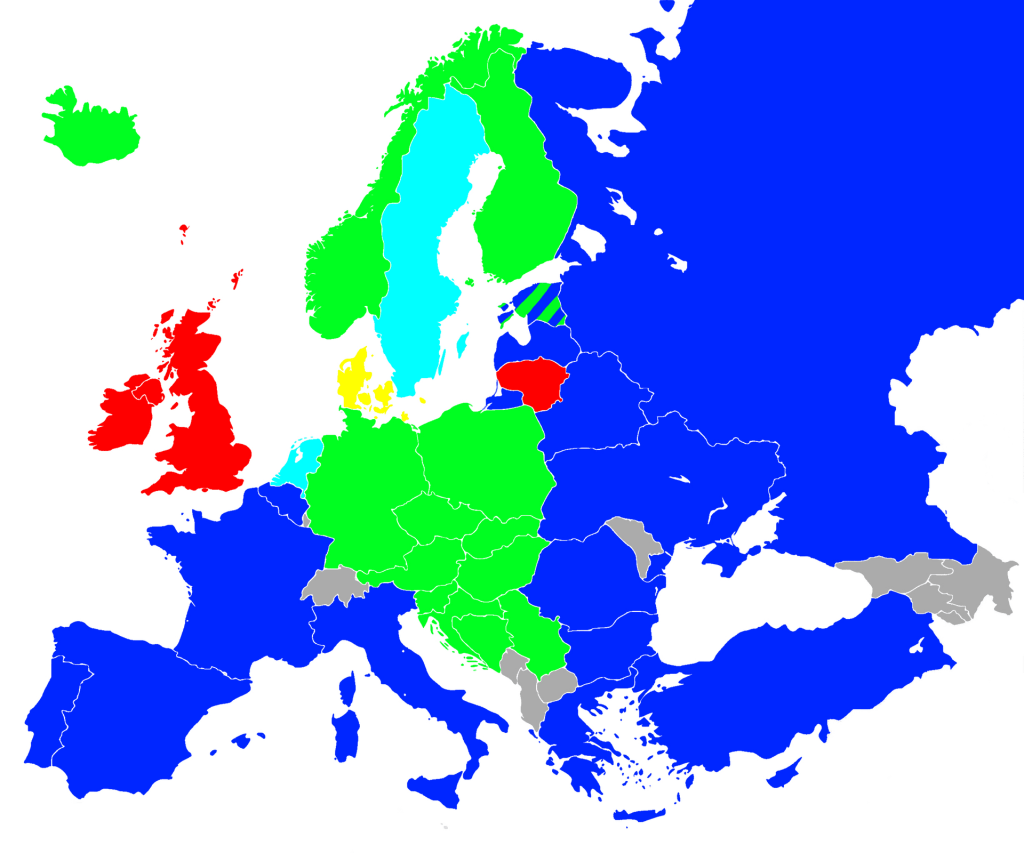
Before the well-known pitch system, what ecclesiastical choruses did by the 10th century was to annotate when the melody went ‘up’ or ‘down’ on top of the lyrics. Then a reference line was added to show the relative high and low of the melody. From there, by the 11th century, more lines were added above and below to structure the pitches in a standardised way. In parallel, it was necessary to know what the actual ‘pitch’ was, and that’s where the same guy who started adding the extra lines developed solmisation, with the familiar Do–Re–Mi–Fa–Sol–La–Ti (or Si) sequence appearing (though Ut instead of Do). This provided seven basic notes, which mirrored pre-existing scales like the Byzantine Pa–Vu–Ga–Di–Ke–Zo–Ni and the Indian svaras Sa–Re–Ga–Ma–Pa–Dha–Ni. This naming (blue in map below), however, was never fully standardised: the British preferred C–D–E–F–G–A–B (red in the map), as in guitar chords (E–A–D–G–B), while Germans and neighbouring regions (green, yellow, and sky blue in the map) used C–D–E–F–G–A–H.

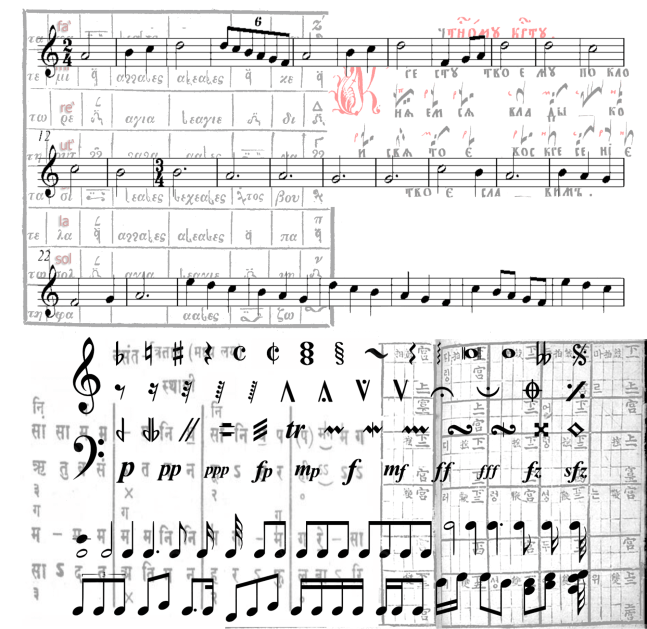
If one doubles around the central note, this provides the conventional twelve notes to be placed on top of the five-line staff developed by the 13th century. If you place a symbol on top of the five lines, plus four in between them, and two more on top and bottom, you have eleven spots; adding one more small line (a ledger line) at the bottom when needed is easy and gives the Babylonian twelve. At this point, we have something that looks a lot like the modern musical staff, or pentagram, and symbols that look a bit like the familiar ‘white’ [whole note], ‘black’, and ‘round’ musical notes. These symbols, known as ‘neumes’, took longer to standardise; there was still variety until around 1700, but by then most European notation had settled into the familiar form — even recognisable to a musically challenged person like me. Five thin lines, a ‘clef’ symbol at the beginning, and the pleasant ant-like procession of pitch along them. But like mathematics, musical notation is immense!
For the temperament, or tuning itself, Pythagorean (Babylonian and Chinese) fixing of the twelve notes to perfect ratios of 1/2, 3/2, 2/3 and their powers (C 1⁄1, D 9⁄8, E 81⁄64, F 4⁄3, G 3⁄2, A 27⁄16, B 243⁄128, C 2⁄1) failed because, contrary to belief, some of these pitches do not sound harmonious when played together — particularly something called the Wolf interval. It also made it difficult to shift the scale up or down beyond the twelve notes, since the spacing between them was uneven. To solve this, particularly for string instruments with many keys, like the piano, equal temperament became the standard by the 18th century, in which the distance between notes is, as the name suggests, equal. Developed independently in Europe and China in the XVI c., in mathematical terms each frequency interval is 1/12 of the octave (the distance between the highest pitch and the lowest), and the ratio between consecutive intervals is 12√2 — all equal in a logarithmic scale.

There is much more to it than that, and music notation and temperament have been evolving ever since, not unlike mathematics, with hundreds of signs emerging. Moreover, other familiar notations like the C–D–E–F–G–A–B guitar chords are ever-present. And music notation beyond the Western one is rich and diverse. But acknowledging my immense ignorance of music — and the fact that the basics have been quite established and spread around the world — I will limit myself to this standard that, like mathematical notation beyond numerals, has taken over the world.

From then — plus a few more inventions in tuning, non–string-pipe instruments, and electronic music among others — we have the fascinating fact that music written in one period can be played by future or distant musicians who have never heard it, as long as they possess the relevant knowledge and skill.

That transfer of sound into visual form (and back) is a truly fascinating invention — a collective effort across generations showing how sensory experience can be encoded, standardised, shared, and reinterpreted again and again. And, for better or worse, this very standardisation enables immense creativity while also stifling non-standard forms — a kind of ‘Western’ myopia, or more aptly, tone-deafness.

Thus, to recount: by the year 1800, and to this day, we have the following global or quasi-global standards — timekeeping, the calendar, mathematical notation, the Copernican principle, music notation, and temperament. These are not that many, but we will see that the other topics introduced — commerce and francas — will play a dominant role in the following two centuries.

Plus the infamous metric system! Nobody expects the metric system.

Previous

Next

Curiosity and rarity, from the small to the global

In the previous chapter, we established that humans are remarkable communicators, with the roots of language deeply wired into our brains and our methods of processing information. We share aspects of this nature with other animals, such as songbirds. There are also limitations within human communities, where individuals or groups have difficulty creating communication channels at a deep level due to differences in processing information—whether because of the brain’s wiring or due to cultural or professional distance. However, what makes us clearly distinct in the realm of communication from anything else that we know is that we seek to communicate as much as possible with our surroundings—even with our dogs, plants, and everyday objects. Children talk to their toys, and I have even seen my flatmate talk to his kombucha jar. Communication appears to be a universal need for humans, to the extent that it seems boundless within human communities. As mentioned, one human community would not only converse internally but would most likely also engage with its neighbours, with multiculturalism inbuilt in who we are.

The history of humanity is not plagued by conflict but by collaboration. As we have seen with the Palaeolithic trading networks—which spanned hundreds of kilometres—rare minerals, tools, shells or bones (what remains in the archaeological record) were found far away from their natural sources. These remains are much further afield and more widespread across the territory than what a human community would likely have been able to travel and carry with them.

The most likely explanation for that archaeological record is that exchange networks emerged through trading, whereby some communities exchanged goods with their neighbours. This exchange would have involved the same goods passing from hand to hand repeatedly until they reached distant places, across tens of pairs of hands.

This trading is not a minor matter; it involves a series of complex cognitive abilities, as well as the will and means to exchange information with neighbours who may have almost no connection to the community where the goods originated. First, one must understand the value and rarity of the materials to be exchanged. Their value might arise primarily from their rarity or usefulness. These are not simple concepts in themselves—rarity and usefulness are deeply contextual. One might combine these concepts under the term “desirability”, but that is an even more complex notion.

In the following texts, we will see how, from these small seeds, it is possible to reach Global communication and it is almost inevitable as proficiency in mutual understanding emerges, consolidates and improves over time.

Forms of communication <- Previous Next -> Rarity and curiosity

Previous

Next