
Going back to your encounter with a stranger in East Africa, the stranger might point to one especially appealing shell garment that you are wearing. You might decide to gift it away to create a bond, and it might not be a high price to pay because, back home, there are plenty more. Therefore, you might give away more spares, as we have seen Columbus did with cloth. To reciprocate, the stranger might give some of the ore. And with that, you might part ways, the only thing remaining from the encounter being an exchange or gifting of goods. The other person will go back to her or his community and show off the newly acquired item. Between curiosity and desire, more members of the same group might crave more of such objects. Then they might go in the general direction where the first object was found. Or, alternatively, the initial individual will go back to gather more. The same can happen with you and your home group returning to the meeting point.
However it is, after your exchange with the stranger, a link has already been established between distant groups. And maybe, after the first initial gift-giving from you or the others, a more constant exchange can be produced. Initially, you do not know where to obtain their shells, nor do they know where to obtain your ore—only that you know how to obtain it from each other. They actually get the shells not from the source but from another group. And these from another, and so on, until getting to the coast. It might be more efficient to continue doing so than to start the long journey, hundreds of kilometres away into the unknown, to get to the sea and obtain the sea shells directly. Same with the ore, food, spices or other objects. It is more valuable to keep good relations with your neighbours, if there is something to gain, than going solo.
With that thought experiment, we see how a basic exchange network and collaboration is established. Such a network, however, does not seem to be sustainable, as once the desire and rarity of an item are gone, the need for the network might erode.
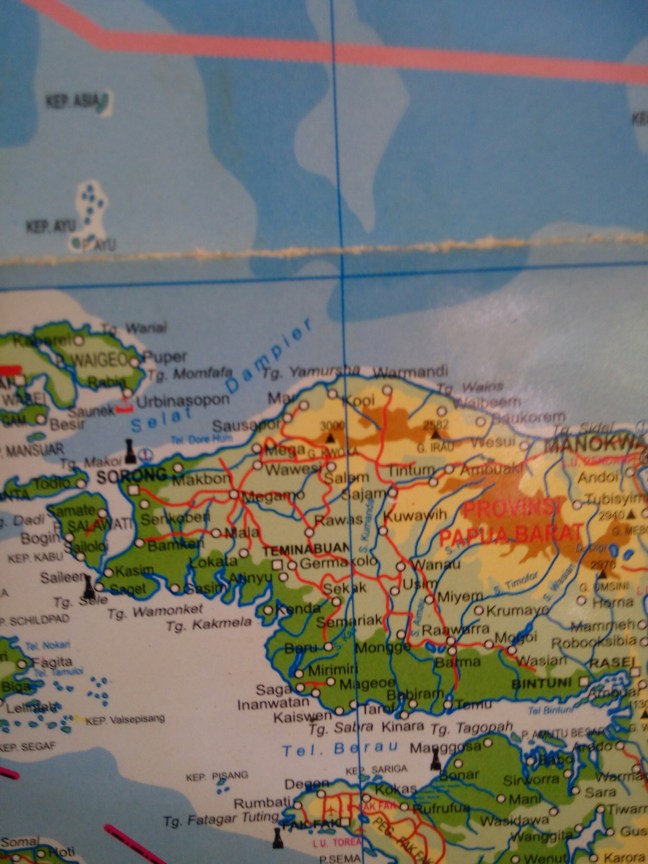
With more useful items beyond rarity, like tools, that network and cooperation might be strengthened. This has often happened with specialised tool-making communities. For example, in the hinterlands of Papua, in the Wahgi Valley, existed the Tuman quarries, with stones of sufficient quality to make high-quality stone axes. These stones were not found in many other places in the highlands of Papua, and the quarries and the axe-making process were solely controlled by the Tungei people. They were excellent stone-axe makers, an activity to which they dedicated most of their time. That produced a high-quality product that they exchanged with people all around the region. The trade was not only in other goods, but also in dedicated rituals, respect, holding them in high esteem, and providing women to the Tungei community. They had access to the stones and the means to extract them in an efficient communal way. Every few years, they quarried as a whole community in expeditions that lasted for months. They also had access to the main source, so they had a higher number of people with the knowledge and skills on how to prepare them—both giving shape to the blade and hafting the T-shaped handle. With that knowledge, they were able to trade for goods far beyond their immediate neighbourhood.
However, the main exchange of the stone axes was for marriage. In their area, most marriages were arranged through a complex exchange of goods between the original community of the women and the receiving one. Sea shells, ropes, pigs, feathers of the birds of paradise, and salt were used in the exchange. But in the case of the Tungei, the stone axes were used profusely to buy wives, which allowed them to be relatively wealthy, because they were the source of the stones. They would be the petrol producers of the highlands! More than two-thirds of the marriages of the Tungei were with women from external communities with whom they traded. Interestingly, they did not trade with faraway groups like the coastal ones, but they did receive, through many intermediaries, the shells coming from there.
This dominion of the trading network of the Tuman quarries collapsed when patrols from the colonial era, and later the Papua New Guinea state, routinely accessed the area and brought with them steel axes and plenty of seashells, which they gifted to the locals or traded in large quantities. Needless to say, steel axes were much more appreciated. They were more efficient—cutting one tree in a day instead of several days with the stone ones—lasted longer, and were sharper, allowing them to be used for more refined work. With the European arrival of trade goods, the marriage pattern of the Tungei swiftly changed, with only half of brides being from exogenous communities. This reflects economic changes resulting from the loss of the axe trade.
On the other hand, other Papuan communities like the Goroka still traded axes well after the steel axes and pearl shells had saturated their communities. That is because they had a specialised workforce that was in charge of mining and crafting the Dom Gaima “bride axes”—large ceremonial stone axes so big and elaborate that they were crafted in a non-functional way. They were used for bride price and display purposes, and so were a sign of prestige.
In conclusion, the thought experiments and examples show how trade, commerce, needs, rarity, crafting, prestige, and aesthetically attractive items, plus basic communication, allow the establishment of rudimentary networks that extended much further than the basic interactions a community would have with its neighbours. The basic desire, need, and curiosity for what lies beyond might have created the roots for collaborative action.
But beyond the seeds of networks, there is the establishment of strong bonds. There are many ways in which these can be maintained, with one basic mechanism being intergroup marriages. Once the network and the trust between neighbouring groups are created, exogenous marriages can follow. In fact, this is quite common in nature, where many social animals have one group member who, after reaching maturity, travels, mingles, and often reproduces in a new group. Curiously, in the case of our closest relatives—the chimpanzees—females tend to migrate to a new group as teenagers. For bonobos, it is also usually the case that females migrate, though it is not rare for males to do so, while females from high-ranking matriarchs remain in their natal group. This exogenous mating and breeding is quite common in humans. The difference lies in the diversity of strategies. Exogenous reproduction is not always the case, and many human groups display a whole spectrum of migration patterns: from only females, to only males, to a mix, or exclusively endogamous systems. On top of that, there are complex kinship strategies regarding whom one can marry, from clan systems spanning hundreds of kilometres to, on the contrary, first-cousin marriages. Contrary to popular belief, first-cousin marriages are among the most genetically fertile unions. So keep in mind: if you want to have many children, have a lot of unprotected intercourse with one of your first cousins—like Darwin did.
Another way of strengthening networks is that of debt or gift exchanges. Many academics point out that one way to keep social relations alive, strong, and reciprocal is to build them upon accountability in the form of an unpaid debt or the need to return gifts. That happens continuously in our daily lives—when friends or family do us a favour, we “feel indebted” to them. The debt is not precisely measured (i.e., there is no numerical value assigned) and might never be returned in the same exact form—it might even be rejected by the giver—but it can be given to somebody else, like when someone pays for your dinner and you later do the same for someone else to keep the balance of the world. A good example of this is the Toraja, in central Sulawesi. Their current culture invests massively in the funerals of their people. When a family member dies, the body is kept at home for years and considered still a member of the family, even being served meals daily. It is kept until the extended family can secure enough funds to hold a massive funeral—one anecdote told to me was of a family that kept the body for 20 years before finally holding the funeral. Once the body is placed in a permanent tomb—which can be a sarcophagus in the rock, hanging on cliffs, in caves, or in a grain storage-like structure—the person is considered to be truly dead. Despite that, they parade many of the mummies every year over Christmas, dressing them in new clothes, jewellery, even sunglasses. At the funerals, guests are given large gifts. However, these are not “debt-free” gifts. Each gift is recorded, along with which family it was given to, with the expectation that when invited to a funeral by that family, the gift-givers will be given something of equal or similar value—or they will lose face. One young person I spoke with there told me that “Torajas are indebted from the womb of their mothers”. Debt is inherited if you belong to a specific family and culture.
Beyond marriages and debt, infrastructure is a way to keep long-distance connections over generations and across large areas. For example, roads might extend much further than the migration routes a group would typically follow, and information—in the form of basic agreed signs and trade-related language—would travel along these early infrastructures. Once infrastructure is created, it might stabilise a distant connection, though it comes at a cost. Maintenance can be expensive. Bridges must be built and maintained by the people on both sides of a river—or rebuilt repeatedly, like the Q’ichwa Chaka rope bridge rebuilt every year using a species of grass, despite a modern bridge being nearby. One theory posits that this is the future of humanity: the maintenance of an ever-expanding technological sphere—or technosphere (which we will explore further in the future).
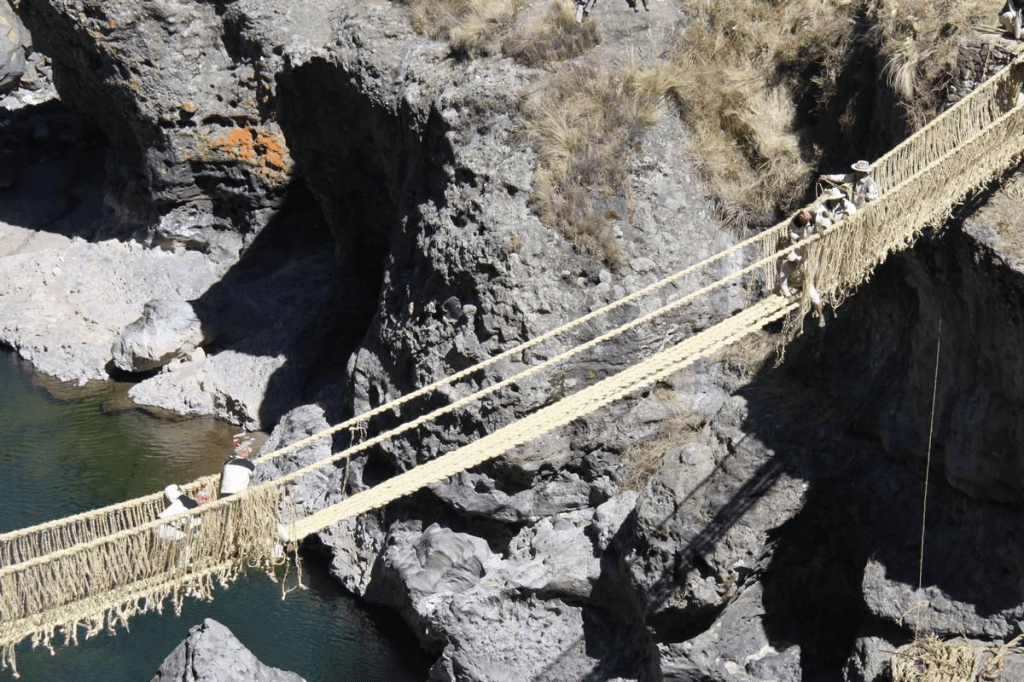
Once the boundary of vicinity is broken, using this array of methods, connection might expand unhindered to take over the planet in a universal way. But, as we have seen, maintaining all of this is costly, and motivation may be lacking. Why should I learn seven different languages? Why should I tire myself travelling to another village with different food and unfamiliar people? Why should I marry into another community where none of my loved ones can protect me if things go sour? Why should I be indebted to traditions and infrastructure before I’m even born? Many of these costs may have prevented communication from expanding and stabilising any faster than it has—and it hasn’t happened until relatively recently in part due to major geographic obstacles like oceans, swamps, and mountain ranges, as well as cultural taboos and long, expensive trade networks. But if those obstacles didn’t exist, there would be nothing stopping a valued good or service—existing only in one place—from eventually reaching every other part of the world, along with all the communication needed to sustain that. This was exemplified by species trade and related colonisation— but we’ll talk about that in the next section.
Previous
Next




 humanitywants.org