Through my studies of cultural loss, I came across a powerful concept from political science: the political ends. This is proposed by Morton Gorden within a process of conflict resolution as the “process by which a government sets limits on what enters the political process” (Gorden 1972:vii).
From an evolutionary perspective, governments come after politics, politics comes after the public, and the public comes after culture. Since my objective is to focus on humans and humanity, for now, I want to abstract that basic schema beyond governments, to a dynamic that captures most of human behaviour.
For that, I reinterpret the first step of the process, “goals” or “political goals”, as pursuing a specific “cultural ideal”. In other words, political goals are culturally generated representations of desired final states.
In that framing, I claim that we can see the political process as the path towards the fulfilment of representations of cultural ideals. Even without a government or collective decision-making, as long as there is an individual who wants to freely express their cultural ideal in a social environment, that can be seen as “politics”.
Simply put, every action to pursue a specific cultural end defines politics.
Goals in a political system reflect patterns in culture. The setting of specific goals represents a choice of objectives from a larger range of possibilities residing within the accessible cultural landscape.
Evolutionarily, my argument is that a cultural ideal, while abstractly shared by a “public”, resides in each of the individuals of that public. While growing up in a public, a.k.a. a society, we slowly form a diffuse, ever-changing idea of a cultural ideal.
This sequence—cultural ideal formation – action – politics – ends—is not exclusive to humans, or humanity for that matter.
Let us trace possible evolutionary roots for the pursuit of a “cultural ideal”.
Remember Lekker, the vervet monkey who took over as alpha male, and could eat the popcorn of his preferred colour?
If we accept that the choice in colour of popcorn can be called “cultural”, then Lekker imported his “cultural ideal” when he went to a new group that had a different cultural preference of popcorn colour.
With the alpha-male power and influence Lekker kept eating the colour of popcorn that he was used to eating. By that time (six months later) both colours were equally sweet, so there was no real fitness difference other than the colour. In the case of Lekker, he was able to keep his rather simple “cultural ideal”.
We humans go through this conscious and unconscious process all the time while sticking to a cultural ideal. For whatever reason, a “cultural ideal” of how things ought to be is created, and then individuals take constant actions to approach that ideal. In the case of Lekker, he achieved his “ideal” through power. Paraphrasing my earlier definition, these actions were Lekker’s politics.
Again, I call all the actions that one takes towards achieving a cultural ideal “politics”.
As I’ve written before, Joan Fuster, a famous Valencian intellectual, has the aphorism that “politics is done by you or is done onto you”.
In other words, we are constantly doing politics by expressing or protecting our preferences, and even when not doing so, others will press their preferences and ideals on us. This might be because some humans have a tendency to press their preferences and ideals on others, unlike the vervet monkeys—there is no evidence that Lekker forced his preference for a particular popcorn colour on others.
That’s where conflict arises: our constant cultural dynamics are smelted together, and we can apply Gorden’s framework.
Another interesting intellectual to summon here is Christofer Boehm. He was a primatologist and anthropologist who developed much of his career characterising egalitarianism and equality in human and non-human primate societies.
One of Boehm’s theses is that primates, us included, show two opposing tendencies: one is to oppress and the other is to fight oppression.
To oppress is what Lekker did when he took over the alpha position. That position allowed him to keep his ways in the new group, which ate a different colour of popcorn.
The difference between other primates and humans, according to Boehm’s observations, is that human small-scale societies are significantly more egalitarian than other primate groups and large-scale societies—despite there being a spectrum of social inequality and oppression in these small-scale human societies.
This egalitarianism is not because humans have a significantly reduced tendency to oppress others, compared with other primates, but because small-scale societies have developed and sustained a set of strategies that effectively manage the emergence of oppressive tendencies and weed them out before oppressive regimes, like Lekker’s taking over the group.
Interestingly, in many human small scale societies there is no such thing as a permanent “leader” like a Lekker. There is a prestige hierarchy, but leadership roles tend to be emergent and evanescent–situational, task-specific, non-centralised, and often temporary leadership rather than institutionalised or hereditary. In many cases, these roles are shared by a council, the decisions are made in a communal fashion or different leaderships emerge to deal with a specific problem or situation. When the problem is solved, or the situation changes, their particular leadership role can disappear with it like in the case of the axe-makers of the Wahgi.
The Sunrise Paradox
The change in cultural ideals that I glossed over is a major dynamic, and probably one that we do not understand well. In my understanding, a big part of the dynamics of cultural ideal change is guided by the concepts of “invented reality”, “collective imagination” or “imagined order” that proponents like Yuval Noah Harari have popularised (here a link for a critique). Concepts like these are not that far from the literary magical realism, in which the supernatural and the quotidian blend seamlessly.
I will call all of these concepts “induced reality”, meaning the reality that exists in an individual’s mind due to previous experiences or social influence. An “induced reality”, therefore, is nothing more than an imperfect mapping, or understanding, of reality. Like maps, which are imperfect representations of the world, an “induced reality” is the state of being convinced, and emotionally bound to the idea, that reality functions in a specific way, or is that way, as in the popcorn experiment with the vervet monkeys.
We have this kind of paradigm constantly in the scientific world, where models, theories, hypotheses and theorems constitute our “map” of reality, our “recreated world” that should work in actual reality. We, of course, are trained to be sceptical about this mapping, knowing that it is incomplete and susceptible to change, to different degrees. That is why each scientific discipline has sophisticated methodologies to test how, when and in what ways our inventions accurately “map” reality or fail to do so. When these methodologies reveal failures, we embark on the systematic, time-consuming process of the “scientific method”: testing, modifying and proposing new “induced realities” where possible, over and over again.
But scientists did not invent this process of continuous testing. We have just perfected it with a plethora of systematic, ever-evolving methods that are accepted by specific communities trained in them. Beyond science, every cosmovision—an all-encompassing worldview through which reality is perceived, formed and “induced” through myths, stories and acquired knowledge—has seeds of the scientific process of testing and retesting. However, the methods used within these worldviews are neither systematic nor consistently reiterated, and they operate on widely different timescales for testing, remembering or losing the acquired knowledge in the process. That cosmovision constitutes part of a cultural ideal, and, to challenge it, reality has to come crashing through the doors of the “induced reality”.
Within that context, let me present the Sunrise Paradox.
Imagine that you, or someone or something with a lot of influence, could convince a sizeable portion of the population, say 20%, that something as absurd as the Sun not rising tomorrow is “reality”. The Sunrise Paradox says that, despite the Sun rising the next morning, the socio-economic fabric of the society in which that population is embedded would have changed today.
The Sunrise Paradox tries to capture what happens between an “induced reality” that can change the world and a “reality crash”, where the world tells the population that their “induced reality” is all but inappropriate. In the case of the Sunrise Paradox, that time is one day, or one evening, but in the case of other “induced realities”, that time in between can be reasonably long. In general, the paradox illustrates how there can be a consequential interval between the adoption of a conviction about the world and its correction by experience.
That means that we humans constantly reshape our socio-economic fabric thanks to the combined power of holding unquestioned “induced realities” for periods of time, plus the drive to act towards achieving a given “cultural ideal”.
The dynamics of this potentially changing landscape are fascinating, especially because the “cultural ideal” and “induced reality” are often interconnected and co-evolving, but dependent on environmental conditions. Here, I take a “cultural ideal” to be an aspirational sense of how cultural items should be. For example, as a Valencian, I have a really particular ideal of how a paella should be properly cooked and eaten, and as a paella cook, I aspire to reach the perfection of that particular ideal, only failing to do so each time, as perfection does not exist but can be gradually approached. On the other hand, an “induced reality” is how a particular part of reality is perceived, such as the belief that popcorn is bitter because of its colour.
To make the distinction between the two, let us look at another example from my culture. In my lands, when I was a kid, the “cultural ideal” was a place where young children believed that the Three Magi Kings—our equivalent to Santa Claus—brought presents at Christmas. Children whose “induced reality” was shaped by that shared “cultural ideal” held those views. In my case, though, my “induced reality” when I was a kid was that City Council workers dressed as the Magi Kings and, on the night of 5 January, brought presents to each of our houses, as we left the windows open and they could access our homes through ladders, like firefighters. That was my “induced reality”. It was different from the “cultural ideal”, but I still bought into the social effort to make believe that all the efforts we kids made to prepare for the Magi Kings’ arrival made sense. My particular “imagined reality” was a mismatch between actual reality and the “cultural ideal” of the time, but it still worked to maintain the wonder and intrigue of strangers bringing presents to one’s home.
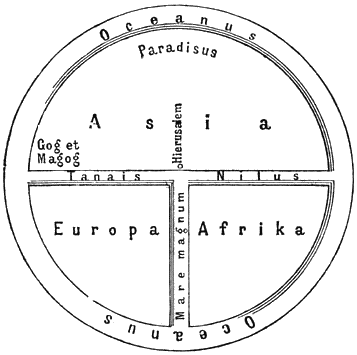
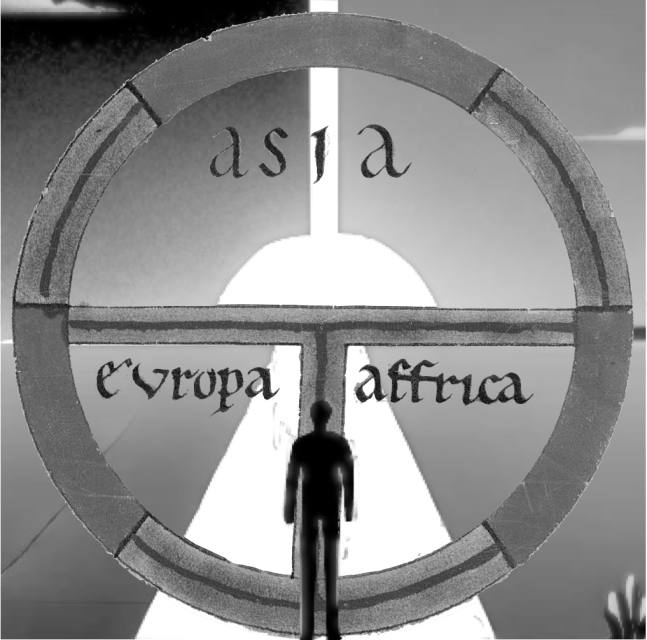
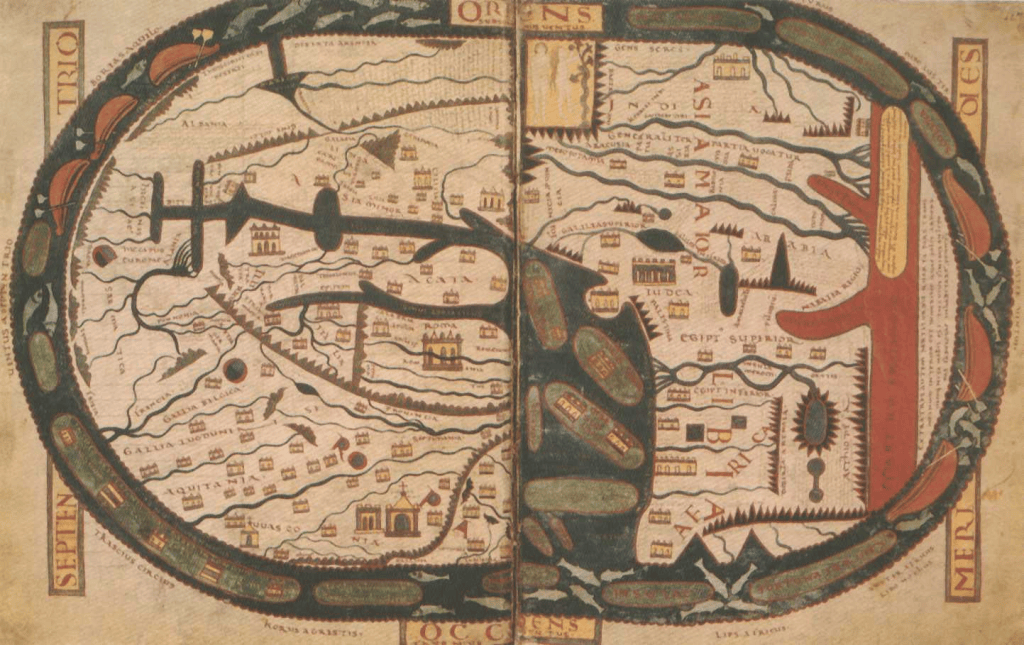
Still, the relationship is more complicated than that. In cases of dire partial information, as with us children, sometimes the “cultural ideal” and “induced reality” seem to be interchangeable. This is illustrated by the featured image of this text. The circular framing is a T-O map, (or Isidoran map) (or Isidoran map), that is, how some Mediterranean theologians of the time wanted to see the Earth as created by God, with the landmasses divided into three parts, Asia occupying half of it, and Africa and Europe occupying the other two quarters, with Jerusalem at its centre. In the case of the T-O maps, the “cultural ideal” of how the Earth should be coincided with the “induced reality” of a partial understanding of how the seas and oceans were distributed around the landmasses. If one ignored the actual shape of the land, a T-O approximation made theological sense, and Jerusalem could be placed at the centre, with each continent being the territory of one of Noah’s sons: Shem, Japheth and Ham. Interestingly, like my childhood self, some cartographers tried to combine the actual reality of the landmasses and seas not being perfect straight lines with the ideal of how the Earth ought to be, producing interesting hybrids, as seen below.
Seeing how mutable “cultural ideals” and “induced realities” are, the fact that we have a sense of stability and continuity in either of them is even more surprising, as they can change repeatedly within a single lifetime while people still experience their lives as relatively continuous.
Take my grandfather, who had just turned 100 at the time of writing. His world has undergone immense revolutions in worldviews, technological advances, scientific breakthroughs, information and human connectivity, exploration, material wealth, services, ways of living, the concept of family, social bonds, entertainment options… Yet, his life, despite his experience of a civil war and an acrimonious post-war period, has been relatively stable, with a level of continuity and relative comfort unheard of for most of human history on this planet. One hundred rounds around the Sun provide so much and so little at the same time, encompassing the extremes of human existence in one lifetime.
My grandfather, in particular, had no problem adopting the “cultural ideal” of going to school, being removed from it because of warfare, working as a labourer to provide for his family when his father passed away after the war, living in a fascist autarkic economy and then a Catholic capitalist dictatorship, finding a wife—late by the standards of his time—owning a vehicle, benefiting from an incipient welfare state in terms of social security, healthcare and public education for his children, supporting his wife in opening a business, integrating into the European market and benefiting from an influx of wealth because of the valorisation of oranges, experiencing a transition to democracy, public nudity in the media and on the beaches, gifting a home to his children, taking early retirement, receiving a pension, travelling, and even accepting something as strange as homosexuals constituting a legal family and having the right to adopt children.
Throughout these continuous transitions, my grandfather’s “cultural ideal” reconstituted itself one way or another. Other aspects of that ideal have held strong, such as how an orange field should properly be tended, how my haircut should look, or how youngsters should care for elders.
Interestingly, what was reshaping his “cultural ideals”—what the Culture ought to be—was pushing against his “induced realities”—what the World is—and those of his fellow elders, through technology, conflicts, discoveries, interconnection, integration, exposure and innovation. In the process of updating their “induced realities”, their individual “cultural ideals” changed without much push or pull, as if Lekker had adopted the local popcorn colour instead of his preferred one.
Most, if not all, “induced realities” hold little to no intrinsic value as long as holding them does not take one too far from the demands of reality. Actual reality—experiencing the Sun rising—is then just one among several selective pressures that might reshape individual “induced realities”, while the Sunrise Paradox allows societies to be reshaped in the intervening periods. These intervening periods allow “cultural ideals” to exist in a more or less stable form while the beliefs supporting them are not challenged. Equally, while “induced realities” are not tested, ideals might change if there is no cost.
In a sense, variation in “cultural ideals” is neutral as long as there is no selective pressure, i.e. if they are built on top of an “induced reality” that is not harmful, as in the case of the preferred popcorn colour when both colours were equally sweet. That way, cultural ideals might be reshaped constantly and, potentially, at striking speed throughout a human lifetime, though limits might exist on these changes. A “cultural ideal” can pop up, like popcorn, at any time, while an “induced reality” provides the framework for it to exist.
However, there is a cost to change. The vervet monkeys who, unlike Lekker, adapted to the local popcorn colour had to pay the small price of giving up the privilege of eating their preferred-coloured popcorn from six months prior. I cannot claim that they had a “cultural ideal” of how the colour of the popcorn to be eaten should be, but the low-ranking individuals did eat the non-socially preferred colour when not in sight of others, so they surely had to update their “induced reality” at a price.
In that case, a change in “induced reality” had little repercussion other than perhaps a reluctance to try something they remembered as bitter.
Next, we will see the costs and consequences of challenging an “induced reality”, especially when renouncing a percieved privileged “cultural ideal”.
Previous


One thought on “The Cultural Ideal and the Sunrise Paradox”