Aviation, One language to rule them all

From roads let us go to the next technology in transport, the sky!

But first let us briefly return to our beloved Metric as an example of how the institutionalisation of technical terms has changed how most of the people on the planet see themselves. For example, the metric is even applied to such delicate aspects of our life as how much our newborn baby weighs.

So if the Metric is so intertwined in our everyday lives, it is interesting to look at one of the first and most powerful real universalisations that actually does not use the metric: aviation. For anybody familiar with planes, they will notice that many of the indications of flight control, altitude, distances, meteorological information and other measures are in what is called the Imperial system. I.e. in feet, knots, miles etc.

Aviation, like road traffic, greatly benefits from a common universal language, and in this case it has achieved it. As with the other nascent scientifico-technical internationalisations, aviation’s global language arises hand in hand with the rapid growth and usage of the new technology, and now the neighbours are not just overland but also over air. Therefore, as with the telegraph, the previously semi-disconnected UK and US administrations are much more susceptible to fold into common standards with the rest of the western world, or in this case, to impose them.

Little more than 100 years ago, almost nobody had ever flown. Thirty years later planes were used to bomb and burn entire cities, like in the case of Guernica, sadly the most noticeable example of the use of the new aerial technology aimed at the destruction of civilian life. A decade later, after WWII, planes were routinely crossing the Atlantic. That rapid expansion needed close collaboration to manage these vehicles across multiple lands and cultural codes. No one would want to have signalling that would confound the pilots or the machine maintenance because different protocols were used in each of the landing areas, nasty results ahead otherwise.

In the early beginnings of cross-Atlantic flight, six nations grouped to divide the Atlantic into ten zones. Each zone had a letter representing that zone, and a station providing radio relay, radio navigation beacons, weather reports and rescue alerts if an aircraft went down.

To coordinate the radio signals, administrations had to agree to common protocols, technologies, radio frequencies, languages, measures and so on and so forth. That was the beginning of international flight.

Since we jumped to after WWII, the United Nations is already up and running (we will deal in detail with the UN in later sections). Therefore, it fell into the hands of the UN to set up an agency organising all the protocols and regulations of air flight: the International Civil Aviation Organization (ICAO). The ICAO has virtually universal participation (192 out of 193 nations in the UN — only Liechtenstein is out, as it lacks an international airport, but so does the puny Monaco and that does not stop it from being an ICAO member). Then, because, well, virtually everything else in the world was in Metric at the time, the ICAO’s guidelines recommended that the needed units to coordinate flight be based on the metric system.

They failed.

The fact that aviation is in Imperial lies down to the usual suspects, the US and the UK. In the basic framework that we set, technology, independent administrations and colonialism, aviation is a good example of the first-mover advantage of a big administration. A big part of the aviation sector was established in the US, especially at the moment that aviation became really international, just with the onset of WWII. From that moment, inertia took over, and whatever units the dominant player was using, these became the ones to be kept, until now. The US and UK never forced their hands. In this case, the standard just became and now in planes you find this:

  • Feet for height
  • Knots for airspeed (Nautical Miles/Hour)
  • Nautical Miles or feet for distance
  • Statute Miles or feet for weather (visibility and Runway Visual Range)
  • Inches of Mercury for altimeter settings
  • Pounds/square inch for pressure
  • Pounds for the fuel quantity on the aircraft
  • Pounds/hour for fuel flow
  • Gallons to order/purchase fuel

But, wait, what about the Cold War, how did the Soviet bloc adopt an “imperial” system? you might ask. You did well to ask, the aviation sector of the former USSR republics, North Korea and China. However, Russia changed their system to imperial in 2017 for practical purposes of internationalisation, showing how inertia can hamper or shift standardisation – we will talk about inertia and its relevance in the human world later on.

The aviation system is a good example of how things work on the drive to universalisation. Again, it is a technology linked with a global connectivity which forces the policymaking institutions and a highly technical sector to agree to a common understanding. Here geographical extension, technique, technology, communication, policies and standards go hand in hand to establish a more or less established global agreement, with the limits of inertia and the fight between two standards, the traditional one (Imperial) and the scientifico-technical one (Metric).

Nevertheless, the universal I want to focus on for aviation is another, its language for communication, where a natural language (although highly technified) took over. Only one spoken and written language is used in the sector, that language is known by everybody in aviation. That is a global spoken language.

My father once told me that English was in the past a planetary language because all in aviation used English. The moment that English was adopted in aviation might be the first time that a language is truly universal among one specific sector: traffic controllers and all pilots who fly internationally. In the aviation case we have the bases of a natural language becoming a global phenomenon, although circumscribed to a really technical sector. In this case, though, for the first time there were no local variations or the connivance of two or more standards. One language to rule them all.

In the same way that the Imperial system is the dominant (but not exclusive) measurement system in aviation, English became the dominant and exclusive language in aviation, despite what the ICAO logo at the beginning of this entry shows.

Nevertheless, the language, despite being a natural language, was limited to professional usage. I do not see the air traffic controllers writing poetry based on the level of English that they need for their work. In fact it is a kind of technical language: adverse yaw, downwash, squawk… are mostly obscure for anybody using English but not working in the aeronautic sector.

In the case of aviation, like the signage for cars, the need for a common universal language arises from the rapid growth and usage of a new technology, and administrations doing what administrations do best: administer.

The process of embracing a unified rule code has had slightly more success than the Vienna Convention for road signs. Aviation has achieved not only the existence of ICAO with virtually universal participation, but also the language of communication in the aeronautic sector, that is, the spoken and written language is only one and has to be known by anybody working in the sector. Now, at a planetary scale a single language is uniquely present in the sector.

Like we have seen before, the aviation system presents the process of universalisation through technical development, administrative interaction and imperialism. Again, aviation is a technology linked with a global connectivity which forces the policymaking institutions and a highly technical sector to agree to a common understanding. Here geographical extension, technique, technology, communication, policies and standards go hand in hand to establish a global agreement. Impressively though, in the aviation case tradition is the one that has kept the two technical standards (Imperial and Metric), but has, for the first time, erased natural language diversity. Aviation = English globally.

We have the emergence of a natural language becoming a global phenomenon. We will see the limits of natural languages becoming the vehicular communication of technical or niche sectors, but for now we have seen that aviation was the first, or one of the first, sectors to break the crystal ceiling of a unique global language taking over one piece of the world. Aviation has increased the connectivity of the planet and has made accessible and affordable rapid travelling times for a huge chunk of the world’s population. However, it has not yet reached the vast majority of the population.

For now, I leave you with the fact that, for as long as humanity has existed, English now constitutes the first truly, and unique, global language that has relatively easy access for learning and use, from technical to everything else. If the metric is used for something so tender as the weight of a newborn baby, imagine what a whole language is doing, and will do, to us.

Previous

Next
Roads: rules and signs

Let’s leave bureaus, sports, aid and law for a bit, and focus on one more scientifico-technical standard that emerged on the back of technological development at the beginning of the XXc.

The world had not finished with mathematics, music and signs as technical or symbolic languages. A much more passionate topic rolls on: road signage!

As with clocks (timekeeping), religion and administration (the calendar), accounting (mathematical signs), the printing press (punctuation), musical instruments (music sheets), geodesics and administration (the metric), statistics (significance and error conventions), the telegraph (the Morse code), the World Fairs (places for technonerds to meet), the railways (time zones), bicycles (standardised parts) and typewriting (QWERTY keyboards), the motorised vehicles that were taking over the planet at the beginning of the XXc were poised to push some convention upon us.

We might be familiar with the signs that emerge on the side of roads. They might be circular, squares, triangles, octagons, or sideways squares (diamonds), shields and house-like shapes (pentagons). Their colours would be red, white, blue, yellow, green, with the occasional brown, pink, or orange. There are also luminescent ones, with colours that change, usually from green to orange and to red. These signs have a combination of standardised pictures, messages and numbers to convey an almost global meaning. These signs are expected to be understood by the people who go about on the roads with their motor vehicles.

The signs and traffic lights did not exist before the clogging of the pre-existing roads with these fast vehicles, though bicycle clubs were the first ones to experiment with road signage, especially indicating slopes. The new road conditions called for easily identifiable signs to be read quickly by any driver, no matter their origin. So, with the fast, and numerous, vehicles the signs went up. Soon enough people in Europe were aware that the signs had to be shared across national borders, otherwise vehicles crossing from one country to another could be confused by different meanings. Speed of reaction was, and still is, crucial.

Following the international conventions that we have seen emerging from the end of the XIXc. on the back of technical inventions and imperial powers, they organised what probably is one of the most boring conferences in history. In 1909 the European vehicle associations met in Paris to decide on a small set of common traffic signs. They did a similar thing in 1931 and 1949 in Geneva to unify a larger set of signs on a European scale. By 1968 security triumphed over boredom, they met in Vienna and created the “Vienna Convention on Road Signs and Signals”, aiming to make traffic signalling universal for the whole planet.

They failed.

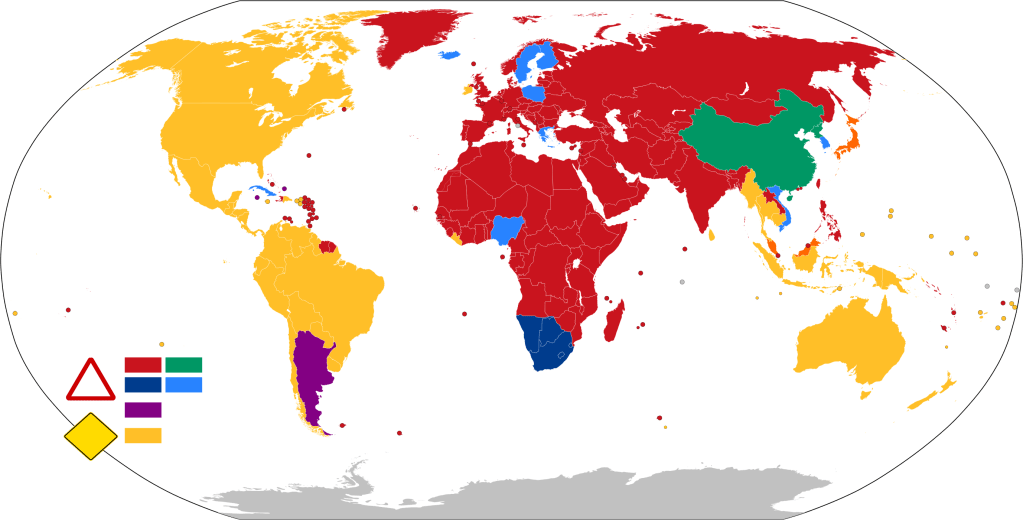
Map of "danger" sing shapes on by country. Red, blues, green denote triangles use  ad warning or danger. Yellow and orange indicate diamonds use. Purple has both.
Map of “danger” sing shapes on by country. Red, blues, green denote triangles use ad warning or danger. Yellow and orange indicate diamonds use. Purple has both.

Currently, there are two main road sign standards on the planet, plus a lot of other stuff in between. One of them is the European one, which gave the world the “Vienna Convention”, adopted by 68 countries (roughly red on the map), and the North American one, boringly called the “Manual on Uniform Traffic Control Devices for Streets and Highways” (MUTCDSH), and used, with many variants, in the yellow countries on the map. But not all is well and standard in the US for the MUTCDSH, as some states engaged in Typefacewars, maybe the most bland wars in history. In southern Africa, ten countries use the also engaging name of the Southern African Development Community – Road Traffic Signs Manual (SADC-RTSM).

Road traffic sign from South Africa, as encoded in the Southern African Development Community – Road Traffic Signs Manual

But even in MUTCDSH- and SADC-RTSM-derived countries, The Convention forms the basis of much of the traffic signage, or is similar enough. If a non-Irish European drives through the US, most of the signs would be immediately familiar. The biggest differences between The Convention and Non-Convention countries are that speed limits and obligatory signs are rectangular, and yellow diamonds with black signs are used as warnings. Instead, The Convention uses round signs for speed limits and obligatory signs and an upward-pointing red and white triangle for warnings — also shared by SADC-RTSM, but one might find different animals. Even that difference between Convention and Non-Convention danger signs is not much, as an upward-pointing triangle is just the upper half of a diamond, therefore it is not much of a stretch of the imagination to understand the other.

The story of road signage does not stop in the 20th century! In 2025, the Global Forum for Road Traffic Safety (another global boring organism that rules your life but you probably never heard about) passed a resolution to replace the entire text of the Convention! The exciting road-signage path rolls ahead!

We then took this little traffic diversion to show three ingredients that we will see from now on shaping many of the global questions of the planet. First, an agglomeration of big and middle-sized countries that are in close proximity to each other and need to share a convention for the benefit of them all find terms to agree with each other. Second, when new technology standards — especially related to communication — emerge and extend, the consolidation into commonly agreed rules tends to take shape relatively fast. Third, colonial powers force the conventions into colonised territories without the input of the societies under dominion.

Roads, moreover, are the paramount example of infrastructure. It is needed, inherited, maintained over generations and represents connectivity like nothing else. For much of the modern world, the combination of technology and infrastructure drives the need for a — virtually — universal language. Coordination forces create the political motivation for neighbouring, independent administrations to sit down at a table and try to agree on a common set of conventions. Once a standard achieves enough maturity through this process of regional standardisation, technological development and colonial imposition, the parts of the planet that are still not part of this dynamic are more likely simply to adopt that standard. New players, then, either adopt it or at least have it in consideration.

With these three characteristics, it is easy to see how Europe is the place in the World that has the most influence in shaping much of the standards and internationalisation, as we have seen in the Western Dominions entry.

Similarly, exceptions to these three general trends are easy to see, with densely populated islands that have not been colonised recently, like the Japanese archipelago and Great Britain, and big countries like China and the US. The US and the UK in part explain the survival of two Western standard flavours, as they were big enough, isolated enough and innovative enough to consolidate and protect their own conventions, but still share much with the rest of international protocols.

This kind of mindset and framework would be important for our question of what humanity wants.

Previous

Next

International organisations

With the metric system we have seen the emergence of the first international organisations, with the Metric Convention being established in 1875. This came in parallel to the establishment of the Internationale Erdmessung (Association Geodésique Internationale), which was established in 1886, but traces its roots to the Mitteleuropäische Gradmessung (Central European Arc Measurement) in 1862.

Checkmate

But before that we need to go back to London’s 1851 Great Exhibition. Similarly to how scientists used the excuse to meet and set off meetings and gatherings to improve measurement, London’s chess community felt obliged to do something similar for chess. A good question hanging in the air is, “what happened with other communities, like dancers, sports, card games, medics, lawyers, botanists, etc.?”. Maybe these did gather, but unlike the tech and chess nerds, not much continuity happened. It also helped that chess players were often older gentlemen with relatively easy access to resources to play their pastime. Compared to physical sports, this is my speculation, people at the time had little tolerance for sweaty youngsters.

In the case of chess, they might have felt inclined to organise a chess congress because, by that time, chess rules had been mostly standardised, but needed a final international agreement to complete the standardisation of the moves, chess notation, and agree to time limits to avoid “out-sitting” opponents. Even the design of the pieces stabilised around the Staunton chess set by 1849. Moreover, there were European and transatlantic antecedents of gathering to play chess against each other, like in 1834 in London and 1843 in Paris. However, the London organisers considered that there would not be time for a single “Chess Parliament” session to handle both a competition and the standardisation process, so it was expected that a series of Chess congresses could address the normative issues.

After the London Chess Congress event, more tournaments were organised in 58, 62, 66, 70, 72, 73, 78, 82 and 83. After that, a tradition emerged of a world champion being decided by a match between the reigning champion and a challenger. When a challenger was identified, financial backing would be raised for a match or tournament.

After the first world tournament held officially in that format in 1886, by 1887 the American Chess Congress started work on drawing up regulations for the future conduct of world championship contests. These were not standardised until the 1940s, though, and changed several times after.

However, a unified governing body of world chess did not materialise until 1920, so the universalisation of rules and gatherings emerged as a bottom-up convergence and willingness to gather, compete and galvanise an international bulging community of chess nerds, ehem, aficionados who could meet on the back of the interconnectedness of the technical world, steamships and railroads to budge heads against each other.

bep, bep, bep, beeeeeep, beeeeeep, beeeeeep, bep, bep, bep

Let’s now focus on that interconnectedness by looking this time at one of the earliest emergences of governance of information sharing through a new, and now vanishing, technology, the humble telegraph. We already introduced the telegraph as the fragile electronic transcontinental communication by 1858 in the [section fragile communication] where cables were laid, and lasted for weeks, then years.

Again, the German-speaking states led the way in homogenisation of standards and creating a bureau to handle the telegraphic connection and telecommunication between states.

Following the interconnection with railroads, the Prussians and Austrians connected Berlin and Vienna with a telegraph by 1849, along the railroad that connected them. They formalised the connection by a treaty ruling the “installation and use of electromagnetic telegraphs for the exchange of international dispatches.” By 1850, Prussia signed agreements with Saxony and Bavaria. Boringly, this followed similar agreements for mail exchange. Treaties simply aimed to control the flow of messages and the procedures for exchanging them at national borders, as well as the application of tariffs.

However, these treaties were the basis of the Austro-German Telegraph Union (AGTU), which was established on 25 July 1850 in Dresden. Unlike mail, telegraphy was a new and constantly evolving medium; therefore, the AGTU should organise periodic telegraph conferences to review and revise treaties, such as pricing. By 1857, with the addition of new German states, the individual treaties were unified into one in the Stuttgart Convention.

Finally, membership of the AGTU was made available to other countries, even non-German ones, and to some private companies. The Kingdom of Lombardy-Venetia, the Netherlands, the Duchies of Modena and Parma, Tuscany, and the Papal States also joined the AGTU, despite not being Austro-German. In 1852 Belgium, France and Prussia met in Paris to agree on standardised conventions.

However, French being French, they had to create their own system. In late 1855, in Paris, they founded the West European Telegraph Union (WETU), together with Belgium, the Kingdom of Sardinia, and Switzerland. The WETU also admitted other countries and private companies, some of them laying submarine telegraph cables to Britain (by 1850)! Portugal, the Netherlands, the Grand Duchy of Tuscany, the Duchies of Modena and Parma, the Papal States, and the Kingdom of the Two Sicilies joined. Notice that the Netherlands and the Papal States joined the two separate unions. During the 1850s, there was a gradual process of convergence and overlapping of the two unions’ activities and conventions.

Since many of the states were already intermingled these two organisations, they needed to merge them one way or the other. In 1858 the Brussels Convention created pan-European conventions. The conventions stablished conventions i.e. standards. Yes, not the most clear language, but that is how one end up with multiple standards. But for they credit, by 1859 the two organisations aligned almost all their provisions through, you-know-what, a new convention! The Berne one this time.

Having three almost equal, but not consistent, conventions made routing of telegrams a bit of hair-splitting sometimes. By 1861 most European countries, and even Algeria, had joined the Brussels one (all but Britain, who had private telegraph networks).

The rapid growth of the new technology and its use needed standardisation. By 1865, soon after the arc-measurement, the European countries met in Paris at the auspices of the lesser-known Napoleon, Napoleon III, to deal with the emerging electronic telecommunication. The participants dropped the Austro-German and Western European parts to create the International Telegraph Union (ITU), mostly based on the initial austor-german conventions, but making them a consistent set among all participants. In a joke of destiny, the end of the lesser-known and ill-tempered emperor Napoleon came from a redacted, ill-interpreted telegram five years later. We all know that texting and emotions are not easy. Telegrams were the texting of the 19th century. Had they stuck to letters, we do not know how history would have been.

Since the texts had to be codified across languages and borders, but most countries used the Latin alphabet, they adopted the Morse code and its instruments as the standard to represent letters. Interestingly, the code had been developed on another continent, America, by Samuel Morse in 1844 in the US. For Russia and other eastern European regions, Cyrillic had an equivalent in Morse code, developed by 1856. If you are curious about non-alphabetic Morse codes, the Chinese one is quite interesting.

For the first time, regulations, tariffs, and technology were harmonised across all of Europe, as far as its borders with Africa and Asia. Three years later, in 1868, the second International Telegraph Conference was held in Vienna. It focused on technical and administrative issues, rather than diplomacy. Significantly, the conference established a permanent ITU Bureau in Berne.

I’m telling the story of the ITU in some detail because, like the metric system, it represents one of the first international institutions to emerge from the technical, scientific and map-making needs of industrialists, commercial interests and states.

In this case, bilateral agreements that looked much like each other quickly expanded into a multilateral agreement and the creation of an international bureau. The rapid development was spearheaded and pushed by the rapid expansion of the new technologies and methods that benefited from standardisation and homogenisation across the world.

The beginning of this section is the code for SOS in radiotelegraphs, established in 1905 by the Germans as simply being three short beeps, three long ones, and three short ones for ships, just for easy identification and memorability. The equivalent Morse letters being S, O, S, which gave the informal name for oral memorability. Better say SOS than three dots / three dashes / three dots, frankly…

The code was used for distress signals for ships at sea, and later extended for distress calling in general, aimed at a natural human willingness to help other beings in distress. We can look at that natural willingness, which is commonly called humanitarianism, and is quite central to our texts.

Red is the new white

Tracing one of the oldest international movements for the establishment of aid in war –one of the darkest instances of human behaviour– we can look at the establishment of the Red Crescent and Red Cross. The story is quite well known (at least for somebody who volunteered there), so I would not go deep into it. Shortly, it came at the initiative of a Swiss magnate (hence the original logo) who was appalled in 1859 at witnessing first-hand the human misery of dead and dying wounded soldiers after a battle in the Second War for Italian Independence. In the aftermath of the battle, there was a near-total lack of medical attendance and basic care for such human beings, which he tried to compensate for by helping himself and bringing aid from neighbouring regions to attend to those who could be taken care of. By 1862 he published a book of the experience. The tale resonated quickly, and he explicitly advocated the formation of national voluntary relief organisations and an international treaty regulating humanitarian and medical care in case of conflict.

By 1863 the magnate and his supporters managed to organise an international conference in Geneva with representatives from European governments, non-governmental organisations and the emerging International Committee of the Red Cross, where the basic principles of the book, and the common distinctive protection symbol, were introduced. Again, like with the AGTU, they convened to organise further conferences to enact the basic concepts. By the next year representatives of the US, Brazil and Mexico were invited. The Committee that year adopted the First Geneva Convention. By 1865 the Ottoman Empire adopted the Red Crescent as a symbol as a colour-reversal of the flag of the Ottoman Empire, just as the Red Cross was a colour-reversal of the Swiss flag.

The development of the Red Crescent and Red Cross was through national adoption of the Geneva Convention, and the creation of national societies by nation-states around the world as a sign of prestige and a form of popular volunteer work.

The establishment of internalisation

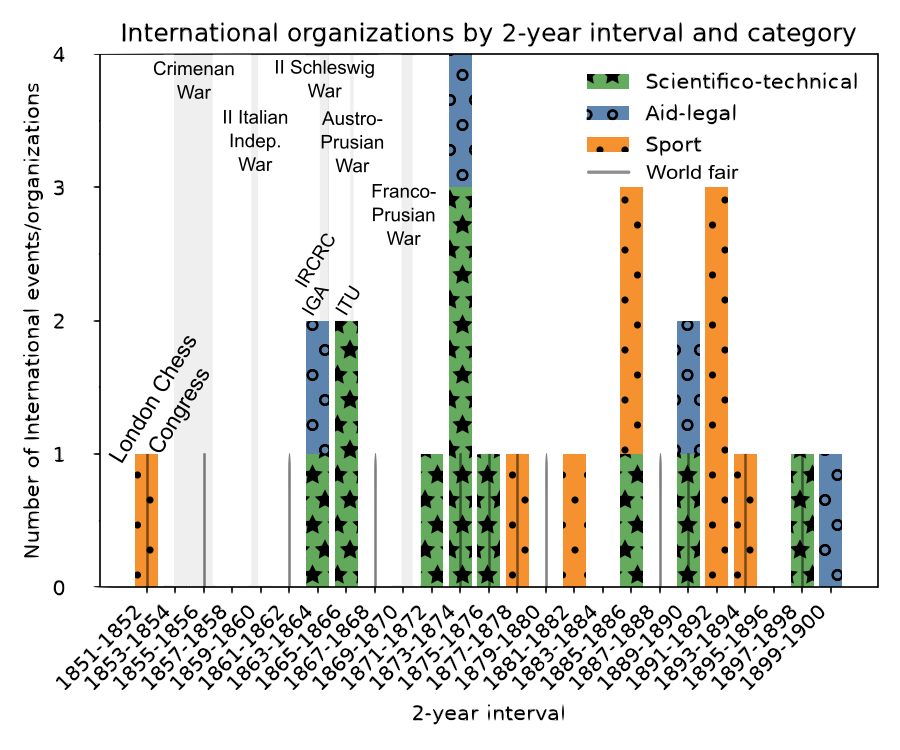
Below I show the number of international organisations created since the London Fair of 1851, together with periods where international conflict happened within Europe, and the major World Fair years, as identified by the Bureau International des Expositions (yes, there is a bureau for that, founded in 1928). Of these early international organisations we find four broad categories: scientifico-technical, political-law, humanitarian-aid-health, and sports (see table below). If we jump to the XXc. we also find several organisations with economical goals, like the Bank for International Settlements (1930), or environmental ones, like the International Whaling Commission (1946).

Number of events or international organisations created per 2-year periods for each category: scientifico-technical, aid-legal, sport overlays with war years in Europe and World Fairs.

There is no general trend between wars and the creation of international organisations, except maybe for the periods after war years, for example after the Italian Wars of Independence (1859-68) and the Franco-Prussian War (1870), which was started after the creative editing of an infamous telegram. There are, though, hundreds of other international and regional fairs that exploded since the mid of the XIXc. Again, this represents the revolution in transport, communication, the unprecedented ease of gathering people in a place, and the willingness to see the advances in scientific, technological, artistic and exploration revolutions happening mostly within the western hemisphere and its colonies. Within this context, people with some means could more easily gather for other contexts, meet, agree to certain conventions, and lobby relevant decision-makers to push particular agendas, many with a standardisation mindset or the need for international cooperation for some greater goal, like treating wounded people better.

In all, the emergence of these international institutions had many forms and flavours. As we have seen with sports, scientifico-technical and humanitarian organisations, some institutions emerged organically and took a while to establish bureaucratic governing bodies, while others were thought out from the beginning as top-down codifications of rules and laws, sometimes governed by institutions, sometimes by regular meetings. The creation, establishment and emergence of new international organisms followed stochastic dynamics, mostly governed by the onset, and ending, of international conflicts.

In this environment, however, we can identify general trends where international institutions emerge and mostly consolidate on the back of a better interconnected planet in terms of human and information flow. From the mid XIXc. there are more and more of these institutions globally, but as we have seen, most follow structures, rules, worldviews, organisational conventions and other procedures rooted in European traditions and innovations. Moreover, these organisms, institutions and proto-bureaus do not seem to deal with random topics, but do have a bias towards dealing with specific topics and interests, namely technical standards, sports rules and competitions, aid and law, economics and debt, and environmental protection. Beyond these, the emergence of global frameworks, institutions, organisations, organisms, frameworks, codifications, standards, administration, corporations and other such structures is rather limited.

For the purpose of our essays, we then will focus on these 5-8 aspects of international coordination, and the bases of these, from organic emergence to nation-state backing.

Finally, I cannot avoid briefly commenting on a couple more legal-political institutions that just appeared at the end of the XIXc. First, the International Parliamentary Union was created in 1889 for the arbitration of international conflicts. It is not for me to assess how effective it has been, but this bureau was one of the initiators of the more famous Permanent Court of Arbitration (PCA) in The Hague in 1899. The PCA was established after a conference at the initiative of Nicolas II of Russia. Nicolas, by the way, managed to immerse himself in most of the conflicts between 1899 and his final demise after the Russian revolutions, famously being ended by massive loads of lead in his body, together with all his family, instead of being handled by the Permanent Court of Arbitration. This kind of political-legal organisation, or the lack of it, or its effectiveness, will be relevant for answering the main question of our text.

NameYearScopeCathegory
Central Commission for Navigation on the Rhine1815RegionalEconomical
London Chess Congress1851InternationalSport
International Committee of the Red Cross (ICRC)1863InternationalAid-legal
International Geodetic Association1864InternationalScientifico-technical
International Telegraph Union (now ITU)1865InternationalScientifico-technical
International Union of Prehistoric and Protohistoric Sciences18661866InternationalScientifico-technical
International Congress of Geography1871InternationalScientifico-technical
International Meteorological Organization (IMO now WMO)1873InternationalScientifico-technical
International Law Association1873InternationalAid-legal
International Congress of Orientalists1873InternationalScientifico-technical
Universal Postal Union (UPU)1874InternationalTechnical
International Bureau of Weights and Measures (BIPM)1875InternationalScientifico-technical
Wimbledon Tennis1877InternationalSport
International Gymnastics Federation1881InternationalSport
International Statistical Institute (ISI)1885InternationalScientifico-technical
International Football Association Board1886InternationalSport
World Rugby1886InternationalSport
Inter-Parliamentary Union (IPU)1889InternationalAid-legal
International Congress of Zoology1889InternationalScientifico-technical
International Skating Union1892InternationalSport
International Rowing Federation1892InternationalSport
International Cycling Association1892InternationalSport
International Olympic Committee (IOC)1894InternationalSport
International Congress of Mathematics1897InternationalScientifico-technical
Permanent Court of Arbitration (PCA)1899InternationalAid-legal

Previous

Next