Through aviation and other technical advances, English became the first language to achieve universal and almost exclusive reach throughout the planet in specific niche areas, especially technical ones. English was the first natural language to be dominant in so many technical areas—with the small caveat that chemistry and taxonomy have many technical terms based on Latin. Other than that, no language got that uncontested global dominance.
As we all know, now English dominance does not stop there; the fact that I am writing this text in English despite my mother tongue being Catalan already shows it. If one thinks today of a global language, of an international language, of a World language, the first one that comes to mind is English, and one would have to think hard to come up with others.
Other candidates for World languages could be those which have enough speakers or have had past prestige or dominance. Again, we can think of classical Latin and Greek as playing that role in the Mediterranean and Northern Europe for a while. Similarly, within their respective zones of influence, Phoenician, Aramaic, Persian, Arabic, Sanskrit, written Chinese, Mandarin, Khmer, Malay, Quechua and Maya were, and still are, in similar positions as Latin and Greek. Natural languages that also acted as lingua franca.
Other natural languages have also played a role in the technical landscapes, where vocabulary from the language extended far beyond the natural geographical area by giving names to specific technical features. Before WWII, if one wanted to follow the advancement of science as it progressed, it was necessary to be a versed reader in, at least, French, German and English. This is because during the early phases of the industrialisation of Europe these three centres had comparable influence in the creation and propagation of scientific and technological advances. At the time, no one language dominated over the others, even in the small niche world of science and technology. As we have seen, this shared dominance changed with the appearance of new technologies —like aviation and software—that took off especially during the war years and soon afterwards. Maybe there was the little exception of Russian being used for advanced mathematics, theoretical physics, nuclear physics, rocketry and other highly technical and specialised fields, as a heavy amount of research was done in these areas during Soviet times. During the Cold War years it would help to know Russian if one wanted to keep up with the times. Yet, that time for Russian also ended after the collapse of the Soviet Union.
By the mid-XX c. and especially in the XXI c. English has become the default natural language of the World, with no competitor even close to it in terms of reach, number of second-language speakers and its use in many different fields of international reach—from international law to the language of memes. English has influence in culture, the arts, travel, sports, economics, food, science, technology, romance, infrastructure… Probably there is no area in the world that it has not touched in one way or the other, with maybe the exception of really local traditions that have escaped the reach of anthropologists, missionaries or travellers. Each of these does codify the World in the international language by default, English, or they translate to English whatever was captured in another language.
English is the default natural language to approach virtually any aspect of life when one thinks in international or global reach. It is so much so that when I was travelling in Vietnam, I remember the locals talked to me in “foreign language” because they needed to practise with me their “foreign language” skills. For them English was not just a language, but the language that dominated “foreign” relations and affairs, that is, whatever was of international matters. I, as a traveller from afar, was not expected to have as my working language my own Catalan, but just the default language from “foreign lands”. It was not even called English. It had nothing to do with the origin of a kingdom on a small island off the coast of north-western Europe. It was just The Language of Foreign Affairs. That was not just in Vietnam, but I also heard that expression in many other Asian countries. In these nations, any foreigner was expected to be fluent in that “foreign language”. That expectation would not have been so just 100 years ago. At that time Western Europeans and Russia dominated the planet, but there was a bunch of languages that would have been expected to be known by a traveller. Moreover, if the traveller had scientific training, that person would be expected to be familiar with German, French, English and also Russian. And depending on which part of the world you were, most travellers would know Arabic, Persian, Mandarin and Malay, Spanish and Portuguese.
That dozen of “foreign” dominant languages has slimmed down to just one on the podium. English. The first natural language to hold that position alone, and so far, keep it.
Curiously enough, the English language is a kind of “lingua franca” by itself, with some linguists considering it a “mixed language”, creole or pidgin as 29% of its vocabulary is of French origin, 29% Latin, 26% Germanic, and verbs are inflected for tense and number but not for person. Others say otherwise and argue that it is in fact a Koiné language (the simplification of different dialectal forms in contact). But this is mostly a debate of definitions, on how to divide a continuum. This kind of division of a continuum, and the Sorites Paradox, is something we will explore in the future related to what does humanity want.
However English is defined, for whoever has to learn English for the first time, they soon discover that English is quite simple grammatically. It has no gender, only a handful of irregular verbs and most of the vocabulary is quite simple, with many words composed of pairs of others like “water-fall” to designate something that in many other languages has a proper word, like “cascada” used in many Latin languages. And the fact that cascade also exists in English shows another sign of “lingua franca”, that is, of vocabulary emerging from many different origins and backgrounds.
In fact, this mixture comes as no surprise when one knows a bit of the history of the English kingdom.
It was a Roman province thinly controlled by a military elite which was depleted over the dwindling of the Western Roman Empire. The Celtic population there only partially adopted Latin as their vehicular language, and with the power void left by the absence of the Roman legions, other peoples took the opportunity to fill the power vacuum.
Then came the Anglo-Saxons, from present-day northern Germany and southern Denmark. The Angles have left the name to the country and the Saxons many elements of a Germanic language, built upon strata of Celtic and Latin.
After them came the Norse, another Germanic language from northern Denmark and Norway, which contributed to much of the vocabulary like they, them, their. Also, the interaction between two similar but distinct varieties of Germanic languages contributed to the koinezitation of the Germanic variants. It produced a simplification towards a common grammar, which departed from Old English by greatly reducing the inflectional system which was not shared between them. This simplification, for the happiness of many students of English, increased the amount of regular verbs present, and got away with the almost nightmarish inflection systems that haunt the students of German.
Then, soon afterwards came the Normans, who brought with them French. The aristocracy took over what is now England and they brought with them most of the vocabulary that comes from Latin and can be found in modern English, like the word cascade. The Norman aristocracy left much of the vocabulary on the topics related to the elites, including cuisine, where most of the vocabulary comes from French and Latin, like the word cuisine itself. That makes it easy for us Latin speakers to learn the language—once we learn how crazily the English speakers pronounce our words…
Unfortunately, all is not that easy. At some point by the XV c., someone decided to standardise the written form of English. They adopted the way they spoke at the time, what is called “Middle English”. Middle English and Modern English are quite similar in most aspects, but, unfortunately for us, especially if you are dyslexic like me, the main difference is that the whole southern population decided to change the way they pronounced words. That change is known with the grand name of the “Great Vowel Shift”, which affected mainly vowels and diphthongs’ pronunciation, but also how some consonants became silent. This has left us with the horrible challenge of having to remember by heart how words like bite are spelled, because the correspondence with the actual pronunciation bait is low or nonexistent in many cases.
Moreover, the printing press did a small mess. As we have seen with the standardisation of punctuation, early on, spelling standardisation of printed English happened mostly outside England. Books in English were printed mostly in the nearby Netherlands and Germany, as they had a more developed industry. The typesetters, not being profoundly familiar with English, would adapt German or Dutch spellings to write English words, like adding an h to “ghost”, from the Dutch gheest.
To complicate things further, English nerd writers who thought themselves to have command of classical Greek and Latin tried to reinforce supposed Greco-Latin origins of English words. They happily started adding silent letters to reinforce the real—or imagined—links. For example, dout became doubt (to link it to Latin dubitare), and funnily, iland became island because they convinced themselves that the word came from Latin insula and not from ieg-land, from Old English meaning “water land”.
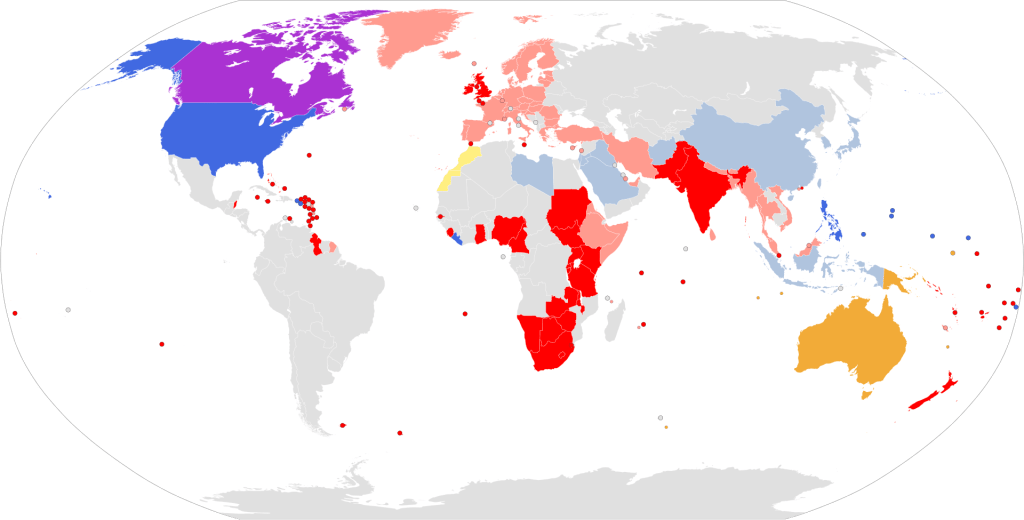
The current spelling differences between US and British variants come from dictionary initiatives. English is, famously, a language without an institution in charge of standardising and leading change, unlike neighbouring ones like Spanish and French. In the US, a few decades after its independence, the Webster dictionary (1828) got established as the leading reference for spellings and introduced the simplification of words that used to be written with OU and were shortened to O, like color and neighbor. Z replaced S in many endings of words, like analyze and customize, because of Greek roots and is more phonetic. LL was reduced to L in words like metallic and modelling. Meanwhile, British English kept following Johnson’s A Dictionary of the English Language (1755).
Finally, an intriguing attempt at spelling rationalisation came in the saga of the “simplified spelling” movement for US English. The notion here was to scrub English of silent letters and irregular vowel pronunciations, so that have would become hav in a simplified written language. Leading the charge was Melville Dewey, creator of the Dewey Decimal System (oh, you do not know about it? You can guess why, another triumph of standardisation). Melville hilariously demonstrated his commitment to the cause of “simplified spelling” by legally changing his name to Melvil Dui. Dui got his funding from a wealthy donor by 1905, and simplified spelling won support at one point from President Teddy Roosevelt, who tried to instaurate it as the governmental spelling through an executive order. It did not work. The wealthy donor pulled his funding by 1915 with a poignantly spelled note: “I hav been patient long enuf.”
Nevertheless, however easy English is—because of its emergence from a combination of mainly three different linguistic backgrounds—, and however difficult it is—because of the standardisation of it in written form before the Great Vowel Shift and two slightly different standards—, English has become the first natural language to be the dominant and almost universal language of the World. The default cannon, the standard way of communication, the accepted-upon general channel of exchange, the platform upon which to create the connections between different places and peoples of the planet.
English, now, is a truly global codex that, for the first time, has reached and is reaching all aspects of life all around the planet in a way that no other language has ever done on such a scale, depth and speed. A natural language that, like any other language, has adapted, evolved, shifted, transformed, grown, reached new frontiers because of the necessities demanded by its new global role and new global users.
Notwithstanding, the global reach of English and the Anglo-Saxon culture behind it, its dominance happened simply because it has been an opportunistic being that has piggybacked on the extreme connectivity that the planet has taken, starting with the shipping revolution.
Like with Austronesian, the maritime revolution brought a handful of languages to dominate specific locations. But unlike previous connectivity expansion, the new aeronautical and computational revolutions have placed English as the unique global channel of communication.
History could have provided a different outcome, where, like the scientific world before WWII, global communication was shared by a handful of languages. If, like naval powers, different cultures and states reached a similar technological point at a similar rate, other languages might be sitting together for global communication. For example, in aviation the French had an early start with plane-making, and by WWII Germans and Italians had quite advanced military development on planes. Similarly, Polish and German scientists and technicians had early advances in computation, and the USSR and Japan could have invested more in electronics, software development and computation, but never got around to that. It is conceivable that another order could have happened in which a part of the planet rejected the English standard. In fact, that can be partially seen in countries like North Korea, where they firmly reject anything that has hints of Western culture. But nevertheless, even North Korea follows the aviation and software defaults. For better or worse, English stands as a giant alone in the human world.
For this text the fact is that, for now, there is a global acceptance for English to be the default language of communication. That fact, however it is, gives us a tool to address our question, with its usefulness and limits.
In a way, the question of “what humanity wants” can be asked because we, for the first time, can talk in the same language, and it has done so in a somehow passive way, like other standards such as timekeeping. There is not a chunk of the world that is disconnected from that acceptance of the default, there is no major iron curtain that keeps two or more disconnected systems. Since “humanity” has accepted this language, that has allowed English to permeate all the spheres needed for global communication.
Previous
 humanitywants.org