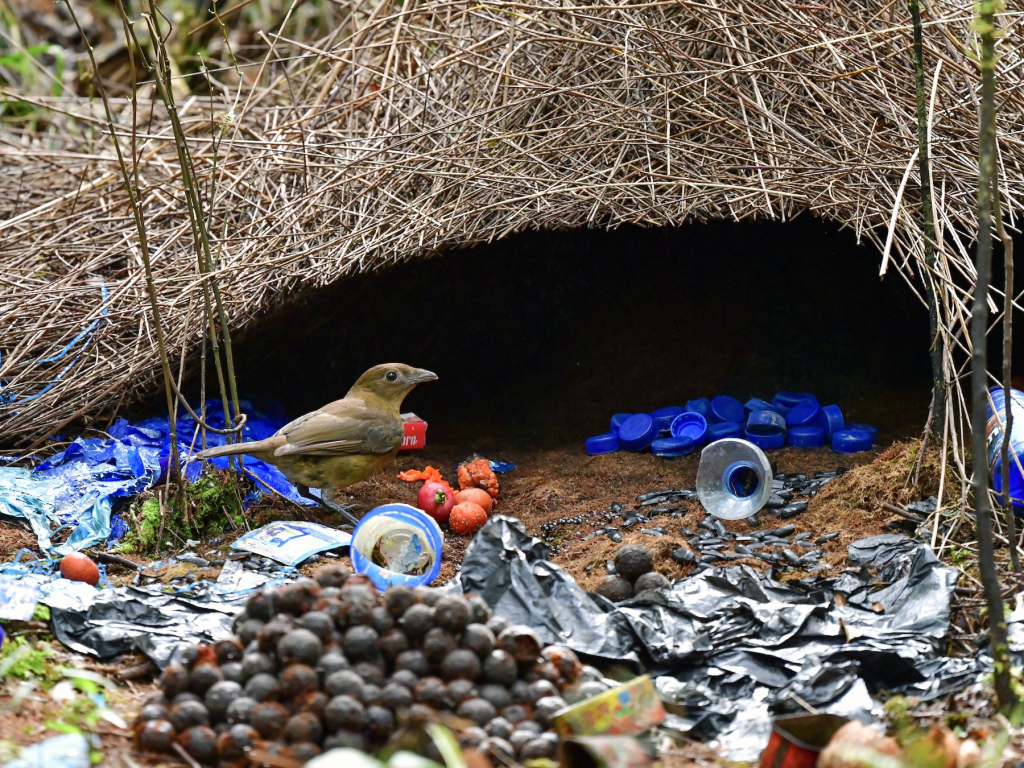
Similarly to the bower bird, humans do not have highly visible physical appearance and features. We lack flashy manes, colourful bottoms, prominent cheeks, a crest, or nicely spotted furs. But like the bower birds, we do like to use objects around us as a display. Virtually all human populations on the planet like to wear accessories to their bodies, which, in many cases, increase the visibility of our bodies. Even more, virtually all human populations invest in permanent body modification of one kind or another, from an earring to amputating body parts, like circumcision. However, unlike bower birds, this decoration or modification of the bodies is done by all genders; therefore, it is not only done to attract a mating partner but also to create social links, signalling and assessment of the others, like kids sharing toys or flashing the new shoes.
Both humans and the bower birds make use of visually arousing traits that coevolved with their effect on an audience, mates. However, the incorporation of external elements directly into our body seems to be an almost unique feat of humans among vertebrates. At the moment of writing, only the bearded and Egyptian vultures have been seen to add pigmentation from natural elements like oxide baths or cow excrements to their otherwise white feathers. There is debate whether this is for protection or for mate pairing, with the most recent research pointing that the bond with partners as the most likely explanation. For bearded vultures, the female, who usually is larger than the male, tends to have a stronger red pigmentation due to the oxides, while of the two males that might be in the polygamous trio, the one that copulates the second tends to be of whiter pigmentation. This is similar for the Egyptian vultures, where the more dominant birds tend to be of yellower colour and carry stronger faeces odour. Still there is no clear agreement on their motivation. But it seems that this is an innate, and not cultural, behaviour, as acculturated Egyptian vultures raised in captivity also engage in colouring feathers once they have sources to proceed with the practice. In the non vertebrate word, only some other crustaceans and insects use elements of their environment to incorporate to their body, and usually that is done in order to camouflage, as a protection, or for matting reasons. Examples are hermit craws, caterpillars, octopuses or beetles.
Humans, on the other hand, extensively decorate themselves with external elements in virtually every society that we know of. We also have archeological records with tantalising evidence of objects that could have been used as garments going back as far as 100.000 years. Therefore, body decoration is a trait that is deeply rooted in humans and at least also for the Neanderthals, whom we repeatedly mated.
Going back to our landscape in east Africa, you can imagine that you encounter for the first time with someone that you are unfamiliar with. The first thing that you might notice is the garments that the other is wearing. They might be covered in strange black, red, yellow pigments that are not available in your area, or an extensive use of seashells of strange bones arranged in strangely appealing patterns, feathers and teeth might decorate their necks, torsos, legs, arms and head in completely different ways and fashion that you are used to see.
At this point, many emotions might come to the front, but once the ones related with fear and harm have subsided, the one that might take over you is curiosity, as we discuses with the marbles. Some of the ornaments might resonate with you as a sign of beauty, the same way that when we see a complex seashell on the beach, we have the craving for it, despite not having any use as food or protection. Or we might get attracted to another person’s tattoo, despite not representing how successful in rearing kids that person might be.
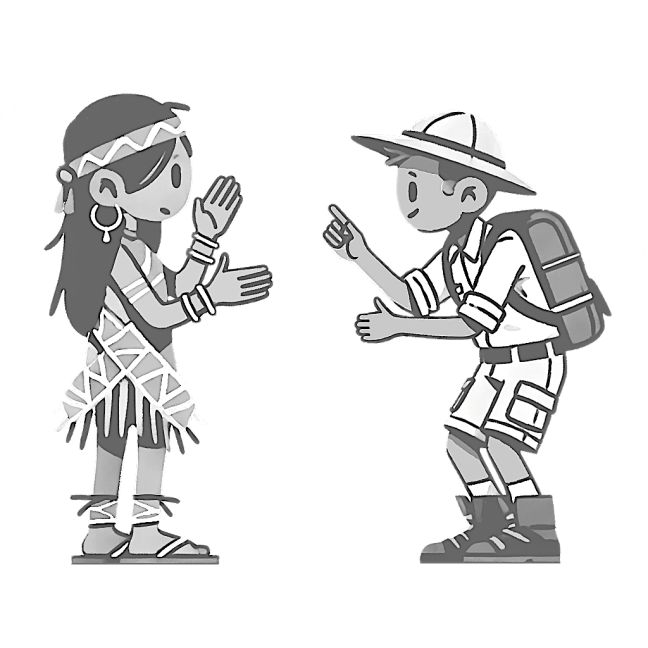
The next careful step might be an approach. You share no language, but at this point, each other probably shares the curiosity. You might point to one of the ornaments that he or she is wearing.
Pointing is, as far as we know, a universal human gesture to indicate a specific emphasis, to draw attention to the direction of what is being pointed at. Not all pointing is done with the index and an extended arm, some cultures use their look and lips or nose to point, but this seems to be an additional gesture other than the one done with the arm. Whichever way the pointing is done, we understand it to be universal and can be shared across first encounters. Even if you saw someone point with their eyes fixed to the target of interest and protrude the lips, you would probably understand the gesture straight away, as the “intention” of gesture seems to be also understood, partially, by other non-human animals.
We can expect this pointing exchange as something that has happened repeatedly all over the world with first encounters. We started to notice this interaction among distant, unknown peoples, especially since the Europeans started their extensive conquest, colonisation and exploration voyages in faraway continents. A first encounter of this kind is illustrated by the account of Cristobal Columbus when reaching the Americas, or the New World, which in fact he thought were islands far away East of Japan. He was caring several books about accounts of European voyagers who had traveled to the Asian continent in the previous centuries. Among these books was Marco Polo’s account of his life and travels in Asia.
Columbus wrote of the first encounter:
I reached the Indies in the first isle I discovered, I took by force some of the natives, that from them we might gain some information of what there was in these parts; and so it was that we immediately understood each other, either by words or signs. They are still with me and still believe that I come from heaven. They were the first to declare this wherever I went, and the others ran from house to house, and to the towns around, crying out, “Come! come! and see the men from heaven!” At every point where I landed and succeeded in talking to them, I gave them some of everything I had cloth and many other things without receiving anything in return, but they are a hopelessly timid people. It is true that since they have gained more confidence and are losing this fear, they are so unsuspicious and so generous with what they possess, that no one who had not seen it would believe it.They never refuse anything that is asked for. They even offer it themselves, and show so much love that they would give their very hearts.Letter of Christopher Columbus to Luis de St. Angel on his first voyage to America, 1492
Even if this event unfortunately happened because Columbus was taking natives by force, as you can notice in this account of the first encounter, there seems to be at least a shared drive for communication and signalling. This encounter happened between peoples of different continents who had never shared any communication for at least 10.000 years (if we suppose the Caribs had no knowledge of the Vikings visiting Vinland).
The basis for that first contact seems to be conducted by gesticulations and not by vocal language. We do not understand why gestures seems to be the preferred form to start bridging the communication gap, maybe because its relative simplicity compared to vocal expression, or the existence of these universal gestures like pointing, or expressions, like smiling but within us seems to exist both an innate desire to communicate and the really rudimentary tools to start doing so, which rapidly evolve into a more complex and deeper understanding. At least that is what the case of Columbus illustrates, that in no time he thought he could understand that the captives that he took considered him as a divinity, and that they were communicating so to their countryfolk.
Again, this exchange is not exclusively done by humans, almost any social animal at some point interacts with other social communities of the same species, or even other species. There is a continuous flow of individuals who go from their group and integrate into another. However, the initial conversations are really limited, and no long-term cooperation is established between non-kin groups.
Most interesting is the case of Bonobos. They are highly social creatures that communicate in a rich language. And this communication, at least for body language, goes beyond their own species and cultural groups. There is the observation that humans from Western culture understand most of their facial expressions and some of their natural hand gestures, such as their invitation to play. In the wild, bonobos have contextual messages; they use the same call to mean different things in different situations, and the other bonobos have to take the context into account when determining the meaning. This contextual communication was previously only observed in humans. Furthermore, it was studied that sounds made by human infants and bonobos when they were tickled followed a similar pattern. Also, Bonobos recognise, to a degree, that humans are ignorant and point them towards hidden objects. These behaviours probably indicate that the richness and depth of human communication goes far back in evolutionary terms, as humans and bonobo lineages diverged about 4 million years ago.
But a much more distant social animal able to communicate are bees. A scouting bee is known to have really complex patterns of dancing and gestures to point to fellow bees in the bee colony where to find certain kinds of food. However, unlike humans, no bee has been seen that goes to another colony to tell the same thing, or that they might exploit together a certain area, or build a bigger nest in cooperation with another colony to fend off bad weather or predators. No, solutions to each of these problems have to be found within the colony, and no viable complex communication exists with external groups that we are aware of.
For non-human social animals, where an individual that migrates from one group to another, the newly arrived individuals adopt or conform to the traditions of the host group and do not return or communicate between groups. Or in the case of alpha males, they can impose their traditions. For example, experimenters trained wild vervet monkeys with corn of two different colours, one blue and the other pink (the researchers chose these because they were the colours of their genitals; that is how science is done). The blue and yellow popcorn tasted sweet or bitter, respectively, for half of the groups, and the other way around for the other half. They quickly learned to avoid the bitter taste with the respective colours. Four months later, after several baby monkeys had been born, the communities were again offered the coloured corn, although this time neither had the bitter taste. Then, both adults and infant monkeys strongly preferred the same colour as before, despite neither being bitter! This behaviour reminds to the rejection of food by humans when they are offered food with strange colours, but perfectly edible otherwise. The baby monkeys who had no previous exposure to the bitter taste, almost all of them just ate the same as the mothers. Interestingly, during that period, ten male monkeys migrated to a group that preferred the opposite colour as the one they were habituated. After observing the locals, nine out of ten shifted to the local preference of colour, giving up their habit. The only exception was that of a male that on arrival simply took the position as the dominant male upon arrival to the new group. This male continued his own habit, ignoring the locals and forcing his choice on the new group.
This experiment with monkeys can be similar to one conformity experiment done with humans. In a waiting room, an unsuspecting woman is surrounded by actors who rise up after a beep sound in the room. After 3 beeps, and seeing that every other person raises up after the beep, the woman rises up like the rest of them. Then, one by one, all the actors leave the room until only the unsuspecting woman remains. Even when she is alone, she keeps standing up after beeping. Then another unsuspecting man enters the room, and after seeing and talking with the woman rising up, he joins her. More and more people crowd in, and they keep adopting the odd behaviour after two or three beeps, with the exception of one male that took several more beeps to conform. Funny enough, as the repetitions happen, the movement of all of them becomes more coordinated, like a music band playing in synchrony. But there is no real communication in these cases, just examples of conformist adaptation. The members that entered the group would conform to whatever tradition was followed unless a new member took a position of dominance.
Whatever is happening with the monkeys and the popcorn seems to be similar to the humans and the waiting room. Some entrenched social learning mechanisms are taking the reigns of the individuals of each group to facilitate for the transmission of random cultural knowledge. This transmission is truly random in the case of these two experiments, but we can put the transmission in the context of an evolutionary pressure. For example, in the case of the monkeys, bitter taste is usually poisonous in nature, so colour → biter → poisonous; therefore, by keeping with the colour, one avoids the danger of poison even if the bitter is no longer there. But if one migrates to a new environment, it is better to follow the local norm, both to feel to fit in and because local differences might be different –when in Rome do as the Romans. The lone dominant male could go away with unchanging behaviour because truly the corn that he preferred was neither bitter nor poisonous. For the case of humans, it can be the same. Social conditioning might have evolved deeply, and it can be punished for not bending to the local norm, even if that contradicts the previous behaviour. That can relate to how people wearing clothes in a nudist beach feel uncomfortable and might be frowned upon by the nudists. Only people with a strong moral superiority would not conform and not care, like when colonists did not adapt their clothing to the places they were conquering but imposed theirs. While, exceptionally, western conquerors and explorers would “go native” if they were surrounded fully by the local culture.
A good example of adopting into the new group, or avoiding adaptation is the case of Gonzalo Guerrero and Gerónimo de Aguilar in the early stages of the conquest of Mexico. After a shipwreck, both where captured by the mayas in Yucatan amnd initially escaped together but got separated on their scape. Gonzalo Guerrero, after 20 days running through the jungle, arrived to a costal community were they made him became a slave. However soon after, after showing his skills as luthier, carpenter and his value in battle he assisted the Mayan lord Nachan Can’s as a general, fighting against other Maya groups and the Castilians. Gonzalo probably tattooed or marked his face and wore big earrings which changed the shape of his ears. He married one of Can Nachan’s daughters and fathered three euro-american children, probably the first mestizos. The story tells that he died at his 64 or 65 years fighting the Europeans, dressed, painted and ceremonially marked like the Mayas. In contrast, Gerónimo de Aguilar, was a seminarist, and never married or wed a native, but adopted local clothing and later despised European ones and partially forgot how to speak Castilian (spanish) after 7 years. He also became a warrior and a general for his later master Ahmay, who seemed to have second thoughts about sacrificing or killing him, but kept him alive and set him free because he valued his military skills. Aguilar, introducing European tactics like not capturing enemies alive, which where really useful in battles. However, unlike Guerrero, he later joined Hernan Cortés and assisted him in his conquests of Mexico, using his knowledge of the years living with the locals for that. He died covered in handicapping buboes as a soldier of the Castillians, making us wonder if these were syphilis buboes and he did wed somebody after he returned to the Europeans.
Previous
Next


 humanitywants.org