
With the metric system we have seen the emergence of the first international organisations, with the Metric Convention being established in 1875. This came in parallel to the establishment of the Internationale Erdmessung (Association Geodésique Internationale), which was established in 1886, but traces its roots to the Mitteleuropäische Gradmessung (Central European Arc Measurement) in 1862.
Checkmate
But before that we need to go back to London’s 1851 Great Exhibition. Similarly to how scientists used the excuse to meet and set off meetings and gatherings to improve measurement, London’s chess community felt obliged to do something similar for chess. A good question hanging in the air is, “what happened with other communities, like dancers, sports, card games, medics, lawyers, botanists, etc.?”. Maybe these did gather, but unlike the tech and chess nerds, not much continuity happened. It also helped that chess players were often older gentlemen with relatively easy access to resources to play their pastime. Compared to physical sports, this is my speculation, people at the time had little tolerance for sweaty youngsters.
In the case of chess, they might have felt inclined to organise a chess congress because, by that time, chess rules had been mostly standardised, but needed a final international agreement to complete the standardisation of the moves, chess notation, and agree to time limits to avoid “out-sitting” opponents. Even the design of the pieces stabilised around the Staunton chess set by 1849. Moreover, there were European and transatlantic antecedents of gathering to play chess against each other, like in 1834 in London and 1843 in Paris. However, the London organisers considered that there would not be time for a single “Chess Parliament” session to handle both a competition and the standardisation process, so it was expected that a series of Chess congresses could address the normative issues.
After the London Chess Congress event, more tournaments were organised in 58, 62, 66, 70, 72, 73, 78, 82 and 83. After that, a tradition emerged of a world champion being decided by a match between the reigning champion and a challenger. When a challenger was identified, financial backing would be raised for a match or tournament.
After the first world tournament held officially in that format in 1886, by 1887 the American Chess Congress started work on drawing up regulations for the future conduct of world championship contests. These were not standardised until the 1940s, though, and changed several times after.
However, a unified governing body of world chess did not materialise until 1920, so the universalisation of rules and gatherings emerged as a bottom-up convergence and willingness to gather, compete and galvanise an international bulging community of chess nerds, ehem, aficionados who could meet on the back of the interconnectedness of the technical world, steamships and railroads to budge heads against each other.
bep, bep, bep, beeeeeep, beeeeeep, beeeeeep, bep, bep, bep
Let’s now focus on that interconnectedness by looking this time at one of the earliest emergences of governance of information sharing through a new, and now vanishing, technology, the humble telegraph. We already introduced the telegraph as the fragile electronic transcontinental communication by 1858 in the [section fragile communication] where cables were laid, and lasted for weeks, then years.
Again, the German-speaking states led the way in homogenisation of standards and creating a bureau to handle the telegraphic connection and telecommunication between states.
Following the interconnection with railroads, the Prussians and Austrians connected Berlin and Vienna with a telegraph by 1849, along the railroad that connected them. They formalised the connection by a treaty ruling the “installation and use of electromagnetic telegraphs for the exchange of international dispatches.” By 1850, Prussia signed agreements with Saxony and Bavaria. Boringly, this followed similar agreements for mail exchange. Treaties simply aimed to control the flow of messages and the procedures for exchanging them at national borders, as well as the application of tariffs.
However, these treaties were the basis of the Austro-German Telegraph Union (AGTU), which was established on 25 July 1850 in Dresden. Unlike mail, telegraphy was a new and constantly evolving medium; therefore, the AGTU should organise periodic telegraph conferences to review and revise treaties, such as pricing. By 1857, with the addition of new German states, the individual treaties were unified into one in the Stuttgart Convention.
Finally, membership of the AGTU was made available to other countries, even non-German ones, and to some private companies. The Kingdom of Lombardy-Venetia, the Netherlands, the Duchies of Modena and Parma, Tuscany, and the Papal States also joined the AGTU, despite not being Austro-German. In 1852 Belgium, France and Prussia met in Paris to agree on standardised conventions.
However, French being French, they had to create their own system. In late 1855, in Paris, they founded the West European Telegraph Union (WETU), together with Belgium, the Kingdom of Sardinia, and Switzerland. The WETU also admitted other countries and private companies, some of them laying submarine telegraph cables to Britain (by 1850)! Portugal, the Netherlands, the Grand Duchy of Tuscany, the Duchies of Modena and Parma, the Papal States, and the Kingdom of the Two Sicilies joined. Notice that the Netherlands and the Papal States joined the two separate unions. During the 1850s, there was a gradual process of convergence and overlapping of the two unions’ activities and conventions.
Since many of the states were already intermingled these two organisations, they needed to merge them one way or the other. In 1858 the Brussels Convention created pan-European conventions. The conventions stablished conventions i.e. standards. Yes, not the most clear language, but that is how one end up with multiple standards. But for they credit, by 1859 the two organisations aligned almost all their provisions through, you-know-what, a new convention! The Berne one this time.
Having three almost equal, but not consistent, conventions made routing of telegrams a bit of hair-splitting sometimes. By 1861 most European countries, and even Algeria, had joined the Brussels one (all but Britain, who had private telegraph networks).
The rapid growth of the new technology and its use needed standardisation. By 1865, soon after the arc-measurement, the European countries met in Paris at the auspices of the lesser-known Napoleon, Napoleon III, to deal with the emerging electronic telecommunication. The participants dropped the Austro-German and Western European parts to create the International Telegraph Union (ITU), mostly based on the initial austor-german conventions, but making them a consistent set among all participants. In a joke of destiny, the end of the lesser-known and ill-tempered emperor Napoleon came from a redacted, ill-interpreted telegram five years later. We all know that texting and emotions are not easy. Telegrams were the texting of the 19th century. Had they stuck to letters, we do not know how history would have been.
Since the texts had to be codified across languages and borders, but most countries used the Latin alphabet, they adopted the Morse code and its instruments as the standard to represent letters. Interestingly, the code had been developed on another continent, America, by Samuel Morse in 1844 in the US. For Russia and other eastern European regions, Cyrillic had an equivalent in Morse code, developed by 1856. If you are curious about non-alphabetic Morse codes, the Chinese one is quite interesting.
For the first time, regulations, tariffs, and technology were harmonised across all of Europe, as far as its borders with Africa and Asia. Three years later, in 1868, the second International Telegraph Conference was held in Vienna. It focused on technical and administrative issues, rather than diplomacy. Significantly, the conference established a permanent ITU Bureau in Berne.
I’m telling the story of the ITU in some detail because, like the metric system, it represents one of the first international institutions to emerge from the technical, scientific and map-making needs of industrialists, commercial interests and states.
In this case, bilateral agreements that looked much like each other quickly expanded into a multilateral agreement and the creation of an international bureau. The rapid development was spearheaded and pushed by the rapid expansion of the new technologies and methods that benefited from standardisation and homogenisation across the world.
The beginning of this section is the code for SOS in radiotelegraphs, established in 1905 by the Germans as simply being three short beeps, three long ones, and three short ones for ships, just for easy identification and memorability. The equivalent Morse letters being S, O, S, which gave the informal name for oral memorability. Better say SOS than three dots / three dashes / three dots, frankly…
The code was used for distress signals for ships at sea, and later extended for distress calling in general, aimed at a natural human willingness to help other beings in distress. We can look at that natural willingness, which is commonly called humanitarianism, and is quite central to our texts.
Red is the new white
Tracing one of the oldest international movements for the establishment of aid in war –one of the darkest instances of human behaviour– we can look at the establishment of the Red Crescent and Red Cross. The story is quite well known (at least for somebody who volunteered there), so I would not go deep into it. Shortly, it came at the initiative of a Swiss magnate (hence the original logo) who was appalled in 1859 at witnessing first-hand the human misery of dead and dying wounded soldiers after a battle in the Second War for Italian Independence. In the aftermath of the battle, there was a near-total lack of medical attendance and basic care for such human beings, which he tried to compensate for by helping himself and bringing aid from neighbouring regions to attend to those who could be taken care of. By 1862 he published a book of the experience. The tale resonated quickly, and he explicitly advocated the formation of national voluntary relief organisations and an international treaty regulating humanitarian and medical care in case of conflict.
By 1863 the magnate and his supporters managed to organise an international conference in Geneva with representatives from European governments, non-governmental organisations and the emerging International Committee of the Red Cross, where the basic principles of the book, and the common distinctive protection symbol, were introduced. Again, like with the AGTU, they convened to organise further conferences to enact the basic concepts. By the next year representatives of the US, Brazil and Mexico were invited. The Committee that year adopted the First Geneva Convention. By 1865 the Ottoman Empire adopted the Red Crescent as a symbol as a colour-reversal of the flag of the Ottoman Empire, just as the Red Cross was a colour-reversal of the Swiss flag.
The development of the Red Crescent and Red Cross was through national adoption of the Geneva Convention, and the creation of national societies by nation-states around the world as a sign of prestige and a form of popular volunteer work.
The establishment of internalisation
Below I show the number of international organisations created since the London Fair of 1851, together with periods where international conflict happened within Europe, and the major World Fair years, as identified by the Bureau International des Expositions (yes, there is a bureau for that, founded in 1928). Of these early international organisations we find four broad categories: scientifico-technical, political-law, humanitarian-aid-health, and sports (see table below). If we jump to the XXc. we also find several organisations with economical goals, like the Bank for International Settlements (1930), or environmental ones, like the International Whaling Commission (1946).
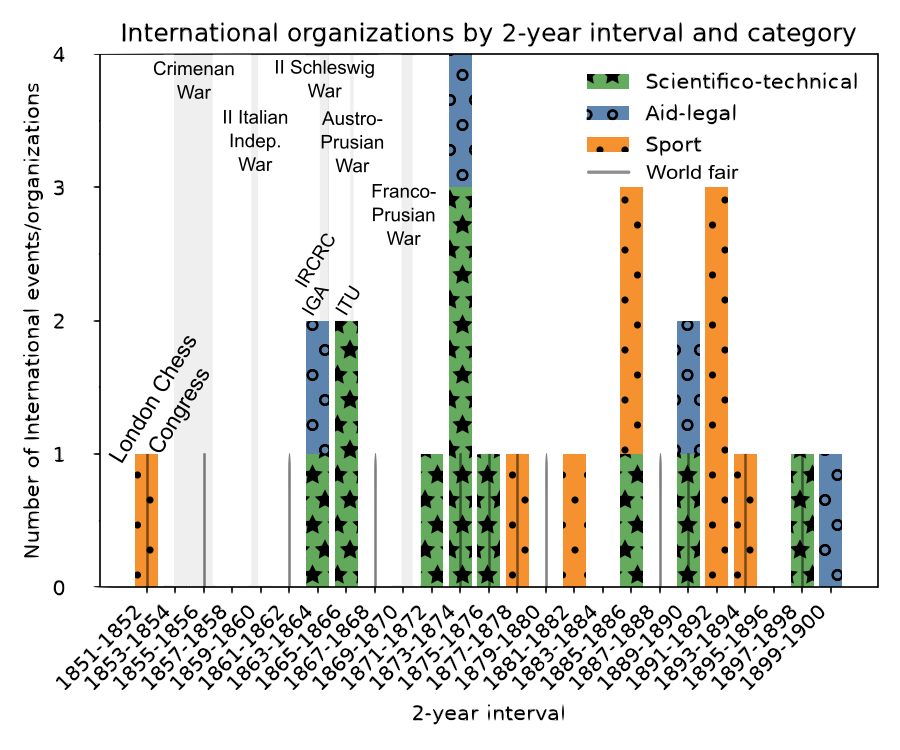
There is no general trend between wars and the creation of international organisations, except maybe for the periods after war years, for example after the Italian Wars of Independence (1859-68) and the Franco-Prussian War (1870), which was started after the creative editing of an infamous telegram. There are, though, hundreds of other international and regional fairs that exploded since the mid of the XIXc. Again, this represents the revolution in transport, communication, the unprecedented ease of gathering people in a place, and the willingness to see the advances in scientific, technological, artistic and exploration revolutions happening mostly within the western hemisphere and its colonies. Within this context, people with some means could more easily gather for other contexts, meet, agree to certain conventions, and lobby relevant decision-makers to push particular agendas, many with a standardisation mindset or the need for international cooperation for some greater goal, like treating wounded people better.
In all, the emergence of these international institutions had many forms and flavours. As we have seen with sports, scientifico-technical and humanitarian organisations, some institutions emerged organically and took a while to establish bureaucratic governing bodies, while others were thought out from the beginning as top-down codifications of rules and laws, sometimes governed by institutions, sometimes by regular meetings. The creation, establishment and emergence of new international organisms followed stochastic dynamics, mostly governed by the onset, and ending, of international conflicts.
In this environment, however, we can identify general trends where international institutions emerge and mostly consolidate on the back of a better interconnected planet in terms of human and information flow. From the mid XIXc. there are more and more of these institutions globally, but as we have seen, most follow structures, rules, worldviews, organisational conventions and other procedures rooted in European traditions and innovations. Moreover, these organisms, institutions and proto-bureaus do not seem to deal with random topics, but do have a bias towards dealing with specific topics and interests, namely technical standards, sports rules and competitions, aid and law, economics and debt, and environmental protection. Beyond these, the emergence of global frameworks, institutions, organisations, organisms, frameworks, codifications, standards, administration, corporations and other such structures is rather limited.
For the purpose of our essays, we then will focus on these 5-8 aspects of international coordination, and the bases of these, from organic emergence to nation-state backing.
Finally, I cannot avoid briefly commenting on a couple more legal-political institutions that just appeared at the end of the XIXc. First, the International Parliamentary Union was created in 1889 for the arbitration of international conflicts. It is not for me to assess how effective it has been, but this bureau was one of the initiators of the more famous Permanent Court of Arbitration (PCA) in The Hague in 1899. The PCA was established after a conference at the initiative of Nicolas II of Russia. Nicolas, by the way, managed to immerse himself in most of the conflicts between 1899 and his final demise after the Russian revolutions, famously being ended by massive loads of lead in his body, together with all his family, instead of being handled by the Permanent Court of Arbitration. This kind of political-legal organisation, or the lack of it, or its effectiveness, will be relevant for answering the main question of our text.
| Name | Year | Scope | Cathegory |
|---|---|---|---|
| Central Commission for Navigation on the Rhine | 1815 | Regional | Economical |
| London Chess Congress | 1851 | International | Sport |
| International Committee of the Red Cross (ICRC) | 1863 | International | Aid-legal |
| International Geodetic Association | 1864 | International | Scientifico-technical |
| International Telegraph Union (now ITU) | 1865 | International | Scientifico-technical |
| International Union of Prehistoric and Protohistoric Sciences1866 | 1866 | International | Scientifico-technical |
| International Congress of Geography | 1871 | International | Scientifico-technical |
| International Meteorological Organization (IMO now WMO) | 1873 | International | Scientifico-technical |
| International Law Association | 1873 | International | Aid-legal |
| International Congress of Orientalists | 1873 | International | Scientifico-technical |
| Universal Postal Union (UPU) | 1874 | International | Technical |
| International Bureau of Weights and Measures (BIPM) | 1875 | International | Scientifico-technical |
| Wimbledon Tennis | 1877 | International | Sport |
| International Gymnastics Federation | 1881 | International | Sport |
| International Statistical Institute (ISI) | 1885 | International | Scientifico-technical |
| International Football Association Board | 1886 | International | Sport |
| World Rugby | 1886 | International | Sport |
| Inter-Parliamentary Union (IPU) | 1889 | International | Aid-legal |
| International Congress of Zoology | 1889 | International | Scientifico-technical |
| International Skating Union | 1892 | International | Sport |
| International Rowing Federation | 1892 | International | Sport |
| International Cycling Association | 1892 | International | Sport |
| International Olympic Committee (IOC) | 1894 | International | Sport |
| International Congress of Mathematics | 1897 | International | Scientifico-technical |
| Permanent Court of Arbitration (PCA) | 1899 | International | Aid-legal |
Previous
Next