The humble metric system, as we have seen, was not established immediately. The legacy of the metric that I want to focus on is how it came to be, and what bureau was created to establish, motitor, standarize and update the metric.
The metric gathered support little by little from 1795, until, by 1875, the infamous Metre Convention, with the US being one of its founders! made it the International standard we all know and love, well at least one of these two is true.
The convention did not just stop at pushing for an international, standarised, metric system, no, they created one of the first bureaus. That we will be evaluating for now.
The 1875 one is the Weights and Measures: the International Bureau of Weights and Measures, or in its original french Bureau . They also established a conference (General Conference on Weights and Measures) and a committee (International Committee for Weights and Measures). Again, more on bureaus later, and committees, and conferences, and…
But why, by 1875, was it needed for a French mostassaf to be in charge of an international bureau at all? This is the interesting question. What is relevant for the metric system is not the use of units for measurement set by a national administration, but the fact that it implanted the idea that we all must use it and be raised in it.
The french Weights and Measures mostassaf did not came out of nowhere. Going back to the scientific homogenisation, we need to add the germans to the mix.
By 1841, 28 measurements of the magnetic field of the Earth where taken over a six year period. These measurements, all over the planet, where centralised by the “Magnetic Society”, or Magnetische Verein in the original german. This was a society not a bureau, yet. As a society, the compromise was just to gather, standarise and share the measurements, so they could be useful across the planet. There was an extra benefit for endeabour, navigation. Like with the making of accurate clocks to measure longitude, an accurate description of the magnetic field allowed better seafaring transits, as the north and south magnetic poles of the Earth do not coincide with the geographical poles of the planet. Actually, the magnetic ones have a tendency to wander, quite fast indeed (hundreds of kilometres per decade), and even flip! (north becoming south). This was know for decades, or centuries, but was Gauss who in the 1830s started measuring its strength, and latter instigated the creation of the society, with international aims and ambitions.
Later on, the also german based Mitteleuropäische Gradmessung (Central European Arc Measuremen), linked with the need to measure the meridian to estimate the circunference of the Earth, and hence, the metre, was created on 1862. Interestingly, the Mitteleuropäische Gradmessung still exists in the form of the International Association of Geodesy, again, an association and not a bureau. By 1859 it was known that several meridians had not the same length, and that as measurement techniques would advance, the nominal definition of the metre would constantly change, even if so slightly.
A Catalan office —well aware of the Barcelona lie— Calos Ibañez e Ibañez de Ebro, was in charge of the International Association of Geodesy when in 1875 the Meter Convention was stablished. At the time of Carlos running these two pioneering international organisms, these were planned as contributing to increase precision in navigation, cartography and geography, as well as the emerging railways and telegraphs. Railways and telegraphs will come hunting us, but that’s for later.
So, despite the logic of unification being a concept from the particular French Revolution — which linked the metric with revolutionary ideas to make their political movement of decapitating kings (and many others) universal — the universalisation cached up four generations later, and, for the first time the particular Catalan mostassaf was not to be for a town, or state, but for all the planet!
From this story what I want to emphasise is that the importance is the base of knowledge of the standard, more than the standard itself, whatever it is.
How a continuously fighting world of nations came to decide that they could trust a base of knowledge? Moreover, how for the first time —unlike with mathematical, temporal, musical, and punctuational spontaneous standardisation — these nations decided to bureaucratise the process of standardisation with scientific geeks at the front of the first modern international institutions. This how process boils down to write laws that would be shared across borders and mutually understood, plus trust that the mostassaf would be available and willing to keep, share and not abuse its privative and privileged knowledge. Again, remember that the term mostassaf comes from an Arab religious figure of moral and measurement accountability.
So what makes the metric stand? Truly, a handful of things:
i) It was the first one designed from the get-go to be universal;
ii) it was based on natural units accessible, in principle, to anyone who had the time to finance the measure;
iii) it was easy to learn, aligning with mathematical notation, already quite universal and on base 10;
iv) it was set to work with technical and scientific communities;
v) the scientific communities were expanding, encompassing industrial and geodesical needs for better instruments, better measurements, faster and easier comparisons and sharing of technical information and better land and sea surveys for better administrative oversight (more on administrations later);
vi) its creators also kinda pushed for it to be adopted universally, following the spirit of revolution;
vii) there were not many alternatives at the time, to be honest.
Let us look at the last option (vii), alternatives? The only real contender for standard measurement used for scientific and technical applications by the end of the XIXc was the British Imperial system (still slightly kept by the US and Liberia). The imperial traces its roots to the standardisation of English measures, as designed by the 13th-century Magna Carta, but standardised by 1496, rectified in 1588 and made the British Imperial system by 1826.
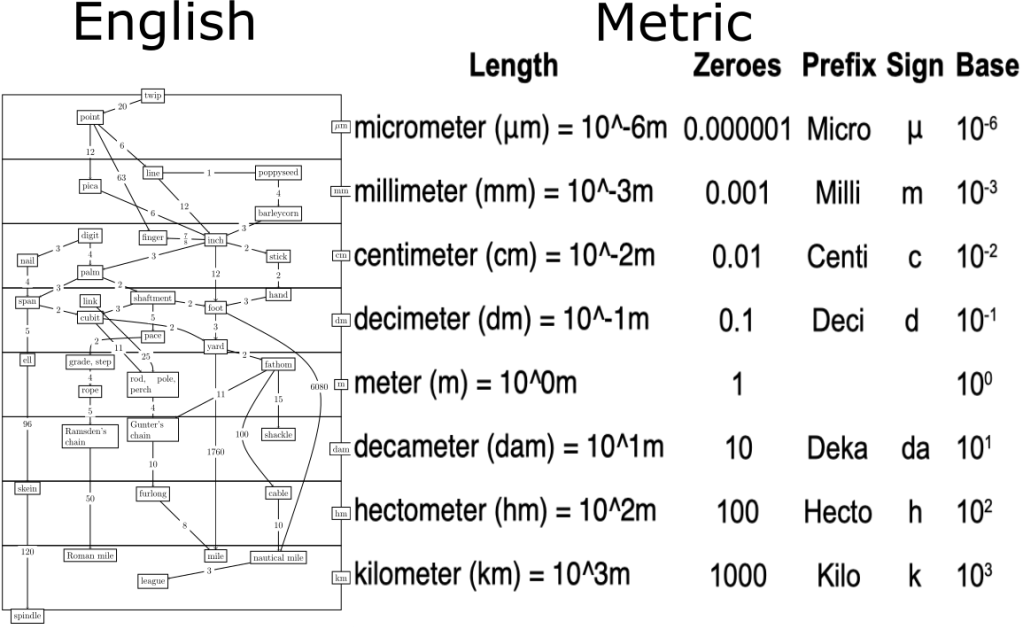
We have the imperial length units. Let us look at these!. The basis is the foot, abbreviated as ft. The multiples are a yard as 3 ft, chain 3×22 ft, furlong 3×220 ft, mile 3×1760 ft, league 3x3x1760 ft. Well, it seems they were trying a base 3, but kinda gave up on it, soon. For the sub-units: twip 1/3^3×640 ft, thou 1/3×4000, barleycorn 1/3^2×4, inch 1/3×4, hand 1/3. OK, OK, kinda keeping with the basis 3 there, sometimes 4 as well, maybe inspired by the 60 for time — 3x4x5 — but also not quite. Now let us look at the distance units at sea: we have the fathom 6.0761 ft, cable 607.61 and nautical mile 6076.1… Now there is a base ten! But not much sense otherwise.
But a visual is better than thousands of words, and words of measures. Here is a side-by-side comparison of units of length in the traditional English system vs the metric one.
For mass, the basic unit is the pound. Fair enough. But the shorthand for pound is lb. Yeah, we have seen that pound and livre are, in theory, referring to the same old Roman unit, but still, lb looks quite different than p or pn. Anyway, let us see its divisions: grain is 1/7000 lb, drachm is 1/256 lb, stone is 14 lb, quarter 28 lb, hundredweight 112 lb and ton 2240 lb. Little sense, but in base 12 or 60, like time, still makes no sense. For multiples it has base 14 (1, 2, 4, 800). Yet for divisions it has a basis, ehem, no consistent basis. A grain is 1/(14×500) — why 500? Well, a drachm is 1/2^8…
Sorry, I tried.
I will not even try the volume units. A beer pint is just a large half-litre drink.
Cheers to that!
The other option could have been the Burmese system. Myanmar still has traditional Burmese units of measurement. The Burmese system maybe has been maintained, in part, because for mass and volume it follows a neat base-two system, in which each unit is a factor 2 bigger than the previous — the metric being a factor 10 between units. Unfortunately, this is not the case for length and area; no, for length the Burmese system is a mess. For example, as of 2010, the state used miles to describe the length of roads, square feet for the size of houses, square kilometres for land area in cities, acres for agricultural areas, kilometres for the dimensions of the country. Still, when I was travelling there in 2015 I did check if they were the US of Asia for the metric, but for reasonable driving they did use km for distances to places and km/h as road speed limit indicators.
So, form the above list, let us focus on points (iv) to (vi): the need, willingness and expansion of technical and scientific domains beyond national borders (more on nations later).
The expansion of the metric is interlinked with these technical and national advancements and ended with some of the first bureaus on the planet.
The republican French, to celebrate the 10th anniversary of the Revolution, did a technical and industrial fair in 1798. This was not much international, as they were in the middle of intense wars, still not called Napoleonic. At the exposition they showed devices demonstrating the new metric system of metres, grams and litres, and, following European fair traditions, they had prizes for outstanding products, mostly fabrics and textiles, but now including innovative technical and industrial devices. One of them was the precursor of the modern pencil, and pencil colours.
They held three more expositions until 1806, and then new ones shall happen every 3 years; this allowed for enough new inventions, geographical explorations, arts, sciences and devices to be developed between events. But by 1809 France was indeed in the middle of the Napoleonic wars.
By 1819 the now French kingdom restarted the expositions, which happened roughly every 4 years.
Then the Kingdom of France decided to revolutionise a bit again and become the kingdom “of the French”. Notice the difference; it will be important later on. Then they decided to make an exposition every 5 years, starting in 1834.
The 1844 one was quite a success internationally, spawning similar fairs in other nations — Bern (1845), Madrid (1845), Saint Petersburg (1848), Lisbon (1849). Then in 1849 there would be the last national exhibition, as in 1851 the British did their Great Crystal Palace Exhibition, which for the first time had the dimension of a world, and not national, fair. From there on, world exhibitions would happen regularly, a bit like the Olympic Games now, and cities would compete with each other to host the event.
These World Fairs, or “the Expos” for us old enough to remember them being a thing, initially were great opportunities for showcasing the most advanced scientific and technological discoveries of the time. This was especially important in an era when more efficient and powerful steam engines, steel, locomotives, rails, and later electricity and telegraph were taking over the European nations and their colonies. In these events, industrialists and scientists from around the world could meet and agree on stuff.
That stuff, my friends, was the metric system, which by the end of the Napoleonic Empire, like decimal time, had gone down the drain. Napoleon reintroduced the customary units, but retained the metre and kilogram for these units to be compared against. The metric systen was also taught at schools and academia. It was simple to teach, as we have seen.
Meanwhile, the metre lived on in other states that were under the influence of the French Empire and retained the metric system, like the Netherlands, Switzerland, and Piedmont, later the Italian kingdom.
And the US, of all places, had a central role for the metre. The Coastal Survey Office, since its inception in 1807, but really by 1836, standardised all the coastal measurements with the metre as its basis.
And even nations that escaped Napoleon, like Portugal, by 1814 adopted the metre, though retaining the traditional names when needed.
Spain, as we have seen with the Catalan measures, had a diverse set of systems. But by 1849 decided to standardise measurements with the metre and kilogram, and by 1851 decided to conduct a survey of the state. The Spanish bureau of measures also adopted and developed new measurement tools to compensate for thermal expansion of the standard metre rods. That made the use of the metre more precise and more manageable. Then it provided standard metres to the Egyptians, and the standard was used throughout France and the German Confederation.
On the first French Universal Exposition in 1855, the Swiss had finished, and presented, their official map with the metre adopted as unit of length, and this was awarded a medal.
Moreover, the Congress of Statistics was held in Paris at the same time as the exposition. There, statisticians, probably tired of wasting time making conversions of units, and probably not happy with the metre being kept by a France-based mostassaf, decided to settle on a uniform decimal system of measures, weights and currencies.
Again, the US pushed for the metric system by 1866. One of the bases of precision balances was in grams and kilograms. In 1866 (made in Bangor, Maine, where I’m writing this now) the legislative organ passed the Metric Act, which defined the metric system in terms of customary units rather than with reference to the international prototype. Interestingly, this anchored the customary measurement units to that of the metre, even if it legislated the other way around.
Then, at the 1867 Exposition Universelle, again in Paris, the statistician geeks formalised the universalisation desire with the creation of a Committee for Weights and Measures and Monies. Now it would not be the French revolutionaries calling for universalisation, but a bunch of geeks with the ears of wealthy industrialists interested in easier technical standards.
That committee finally, after the Franco-Prussian War, created the Bureau, the International Bureau of Weights and Measures, with two governing organs and the headquarters. The newly created German and Italian states already adopted the metric system as their standard. These nations now were part of the bureau, which was tasked to facilitate the standardisation of weights and measures around the world. The bureau had three parts: a conference as a forum for representatives of member states; a committee of metrologists as an advisory board of high standing; the headquarters as the meeting place and laboratory facilities that inform the decision and advisory bodies for decision-making. Corporations, interestingly, often work similarly to that: the conference would be the shareholders’ meeting, and the committee the board of directors.
The Catalan Carlos Ibáñez e Ibáñez de Ibero — the head of the Spanish survey and national measures institute, and maybe familiar with the mostassaf concept — was one of the main pushers of an international standard based on the metre. By the bureau’s creation, he was made the initial president of the committee, the Permanent Committee of the International Metre Commission (confusingly, also named International Committee for Weights and Measures and General Conference on Weights and Measures; do not ask). Being Catalan of origin, Ibáñez, since 1853, also impulsed the remeasurement of the “Barcelona lie”, that is, the Paris meridian, extending the measurement from the Shetland to the Sahara. That effort, and other European meridian measurements, awarded him the first presidency of the International Geodetic Association by 1867.
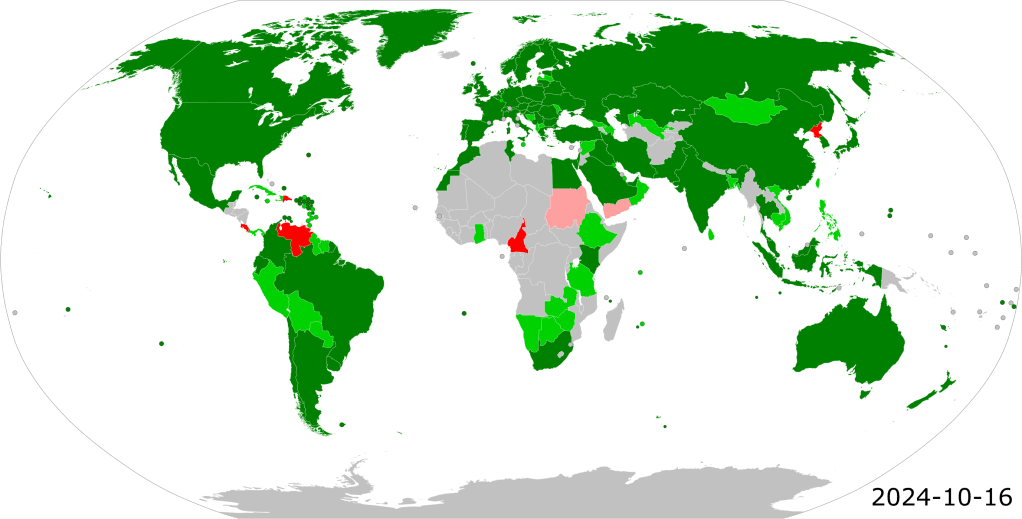
The 1875 Metre Convention put the decision-making of the standard measurement of the planet in a bunch of nation states’ hands. The original signatories being Argentina, Austria-Hungary, Belgium, Brazil, Denmark, France, Germany, Italy, Peru, Portugal, Russia, Spain, Sweden, Switzerland, Ottoman Empire, United States of America (yeah, you have seen it well, US is here!), and Venezuela (which no longer ratifies the Metre Convention).
Interestingly enough, the metre is also not completely dominant in the UK, where the standards for the metric system, and the metal piece that defined the kilogram for 160 years, were made.
In the US there is also the fun fact that, unlike the UK, industry is not forced to use the metric system for all their products, despite being one of the original seventeen signatory nations to the Metre Convention.
Therefore, when NASA asked its suppliers to work with the metric system, but one of its suppliers, who procured thrusters for a probe to Mars, worked with customary units of pound-force-seconds, the result of such an integration of two different systems was that the poor Mars Climate Orbiter probe simply went on its sweet way to Mars just to descend to about 57 kilometres above Mars’ surface, instead of its planned orbit at about 150 kilometres. At that height, and without enough angular velocity, and with the drag of the tenuous Martian atmosphere, the orbiter simply produced a nice flame in the atmosphere.
That is the price of not having a unified unit system.
So being the first, and not having many alternatives, plus being relatively memorable and accessible (had to knock at the Parisian mostassaf from time to time, but was a cool person), made the whole system go global, or pay the price if not.
The metric system simply illustrates how national administrations and gatherings of world representatives agree to standards. In the metric case this quasi-standard emerged through technological need, the ease of communication that allowed repeated forums where actors interested in standardisation and sharing could gather and lobby in a uniform way, the relative ease of the new system and its spirit of universalisation, and a specific individual with the right connections and maybe aware of the connection between moral and measurement accountability through an old mostassaf legacy in our lands.
If we compare the metric to the other standards that we have seen — mathematical and musical notation, francas, timekeeping and punctuation — all of these share similarities. Technical advancements for clocks creation and the need of better measurements for navigation and trains in the case of timekeeping; more communication, new instruments and bigger orchestras for music; economic interest for francas; facilitation and economic dissemination for punctuation. With the exception of the calendar, none of these standards had behind them the will of the states or nations. And even the legislation for calendars happened at a customary and slow attrition, state by state, without an international gathering, convention or bureau leading it.
Like the weights and shekel 3000 years ago, we can look at more modern cases of this seemingly spontaneous standardisation originating by the end of the 19th and beginning of the 20th. For example, if you ever used headphones, the connector, or “jack”, to the sound device might have always been the same diameter 1⁄4 in and shape, or have only two–three standards (1/8). Another piece quite familiar to most of us nowadays is the keyboard I am typing this on, which is an almost international standard, called QWERTY, named after the order of the letters on the first keys’ row. Looking elsewhere, the bicycle chain is 0.5 in between pins and 5⁄16 in for roller diameter. The size of cargo containers, 8 ft wide by 8 ft 6 in high and 20 or 40 ft long. Yeah, metric did not make it for jack, bikes and cargo, damn.
More on the emergence of these (and other) standards later.
What we can infer, however, is that standardisation follows a mixed route of informal conformity by useful means of exchange, plus a forcing pace by institutional action. Then, in an interconnected, and colonially dominated, world, the metric system in particular shows the first, or one of the first instances, of how slow attrition to shared standards could be hastened by gatherings and lobbying committees. And how that commitment results in autonomous bureaus that horn in their task. In the experience of THE Metric, the legislative power of national institutions could be weaponised to steer reluctant populations that were happy with their local traditions and units, however clumsy, to adopt new and bureaucratised standards countries away, instead of their local mostassaf. Or shield them, as in the US, however clumsy. A new state-sponsored universal education could get away with old traditions by educating children in new, maybe more memorable, systems.
With the dreaded metric we can see how all the pieces are falling into place to have the ruleset to ask our question: what does humanity want? But before that we need to go through the emerging bureaus and other international organisms that, for now, rule, the World.
Previous
 humanitywants.org