Unstructured, draft outlines and chapters of a book trying to unveil what does that question mean, why we can ask it, who can act upon it, and possible answers
Let’s leave bureaus, sports, aid and law for a bit, and focus on one more scientifico-technical standard that emerged on the back of technological development at the beginning of the XXc.
The world had not finished with mathematics, music and signs as technical or symbolic languages. A much more passionate topic rolls on: road signage!
As with clocks (timekeeping), religion and administration (the calendar), accounting (mathematical signs), the printing press (punctuation), musical instruments (music sheets), geodesics and administration (the metric), statistics (significance and error conventions), the telegraph (the Morse code), the World Fairs (places for technonerds to meet), the railways (time zones), bicycles (standardised parts) and typewriting (QWERTY keyboards), the motorised vehicles that were taking over the planet at the beginning of the XXc were poised to push some convention upon us.
We might be familiar with the signs that emerge on the side of roads. They might be circular, squares, triangles, octagons, or sideways squares (diamonds), shields and house-like shapes (pentagons). Their colours would be red, white, blue, yellow, green, with the occasional brown, pink, or orange. There are also luminescent ones, with colours that change, usually from green to orange and to red. These signs have a combination of standardised pictures, messages and numbers to convey an almost global meaning. These signs are expected to be understood by the people who go about on the roads with their motor vehicles.
The signs and traffic lights did not exist before the clogging of the pre-existing roads with these fast vehicles, though bicycle clubs were the first ones to experiment with road signage, especially indicating slopes. The new road conditions called for easily identifiable signs to be read quickly by any driver, no matter their origin. So, with the fast, and numerous, vehicles the signs went up. Soon enough people in Europe were aware that the signs had to be shared across national borders, otherwise vehicles crossing from one country to another could be confused by different meanings. Speed of reaction was, and still is, crucial.
Following the international conventions that we have seen emerging from the end of the XIXc. on the back of technical inventions and imperial powers, they organised what probably is one of the most boring conferences in history. In 1909 the European vehicle associations met in Paris to decide on a small set of common traffic signs. They did a similar thing in 1931 and 1949 in Geneva to unify a larger set of signs on a European scale. By 1968 security triumphed over boredom, they met in Vienna and created the “Vienna Convention on Road Signs and Signals”, aiming to make traffic signalling universal for the whole planet.
They failed.
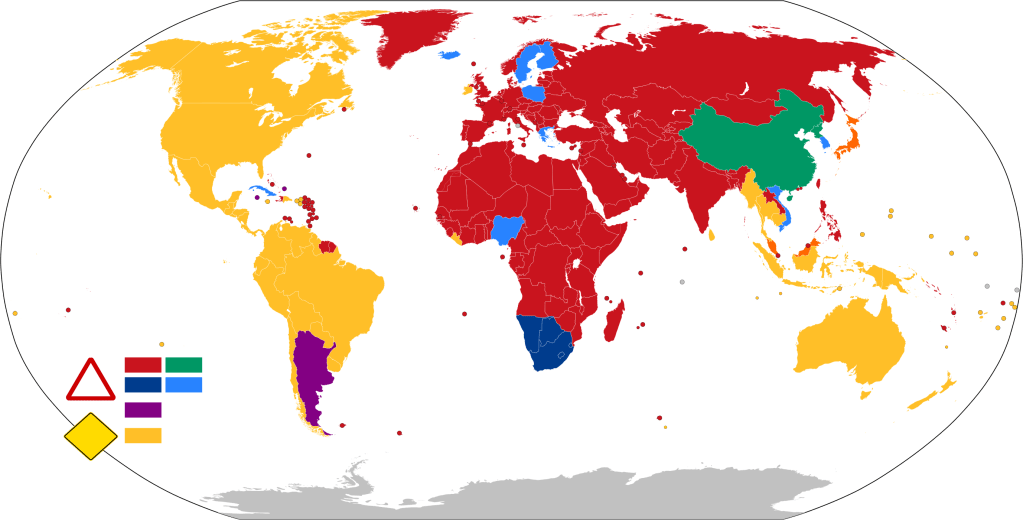
Map of “danger” sing shapes on by country. Red, blues, green denote triangles use ad warning or danger. Yellow and orange indicate diamonds use. Purple has both.
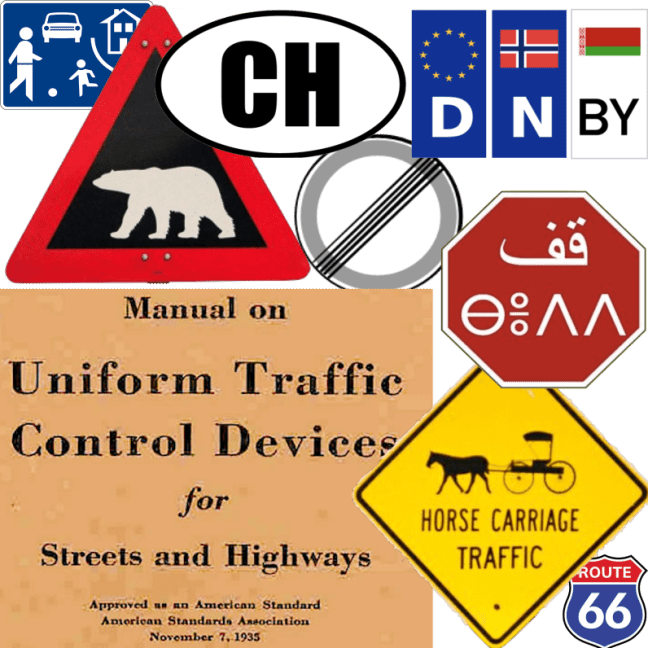
Currently, there are two main road sign standards on the planet, plus a lot of other stuff in between. One of them is the European one, which gave the world the “Vienna Convention”, adopted by 68 countries (roughly red on the map), and the North American one, boringly called the “Manual on Uniform Traffic Control Devices for Streets and Highways” (MUTCDSH), and used, with many variants, in the yellow countries on the map. But not all is well and standard in the US for the MUTCDSH, as some states engaged in Typefacewars, maybe the most bland wars in history. In southern Africa, ten countries use the also engaging name of the Southern African Development Community – Road Traffic Signs Manual (SADC-RTSM).
Road traffic sign from South Africa, as encoded in the Southern African Development Community – Road Traffic Signs Manual
But even in MUTCDSH- and SADC-RTSM-derived countries, The Convention forms the basis of much of the traffic signage, or is similar enough. If a non-Irish European drives through the US, most of the signs would be immediately familiar. The biggest differences between The Convention and Non-Convention countries are that speed limits and obligatory signs are rectangular, and yellow diamonds with black signs are used as warnings. Instead, The Convention uses round signs for speed limits and obligatory signs and an upward-pointing red and white triangle for warnings — also shared by SADC-RTSM, but one might find different animals. Even that difference between Convention and Non-Convention danger signs is not much, as an upward-pointing triangle is just the upper half of a diamond, therefore it is not much of a stretch of the imagination to understand the other.
We then took this little traffic diversion to show three ingredients that we will see from now on shaping many of the global questions of the planet. First, an agglomeration of big and middle-sized countries that are in close proximity to each other and need to share a convention for the benefit of them all find terms to agree with each other. Second, when new technology standards — especially related to communication — emerge and extend, the consolidation into commonly agreed rules tends to take shape relatively fast. Third, colonial powers force the conventions into colonised territories without the input of the societies under dominion.
Roads, moreover, are the paramount example of infrastructure. It is needed, inherited, maintained over generations and represents connectivity like nothing else. For much of the modern world, the combination of technology and infrastructure drives the need for a — virtually — universal language. Coordination forces create the political motivation for neighbouring, independent administrations to sit down at a table and try to agree on a common set of conventions. Once a standard achieves enough maturity through this process of regional standardisation, technological development and colonial imposition, the parts of the planet that are still not part of this dynamic are more likely simply to adopt that standard. New players, then, either adopt it or at least have it in consideration.
With these three characteristics, it is easy to see how Europe is the place in the World that has the most influence in shaping much of the standards and internationalisation, as we have seen in the Western Dominions entry.
Similarly, exceptions to these three general trends are easy to see, with densely populated islands that have not been colonised recently, like the Japanese archipelago and Great Britain, and big countries like China and the US. The US and the UK in part explain the survival of two Western standard flavours, as they were big enough, isolated enough and innovative enough to consolidate and protect their own conventions, but still share much with the rest of international protocols.
This kind of mindset and framework would be important for our question of what humanity wants.
With the metric system we have seen the emergence of the first international organisations, with the Metric Convention being established in 1875. This came in parallel to the establishment of the Internationale Erdmessung (Association Geodésique Internationale), which was established in 1886, but traces its roots to the Mitteleuropäische Gradmessung (Central European Arc Measurement) in 1862.
Checkmate
But before that we need to go back to London’s 1851 Great Exhibition. Similarly to how scientists used the excuse to meet and set off meetings and gatherings to improve measurement, London’s chess community felt obliged to do something similar for chess. A good question hanging in the air is, “what happened with other communities, like dancers, sports, card games, medics, lawyers, botanists, etc.?”. Maybe these did gather, but unlike the tech and chess nerds, not much continuity happened. It also helped that chess players were often older gentlemen with relatively easy access to resources to play their pastime. Compared to physical sports, this is my speculation, people at the time had little tolerance for sweaty youngsters.
In the case of chess, they might have felt inclined to organise a chess congress because, by that time, chess rules had been mostly standardised, but needed a final international agreement to complete the standardisation of the moves, chess notation, and agree to time limits to avoid “out-sitting” opponents. Even the design of the pieces stabilised around the Staunton chess set by 1849. Moreover, there were European and transatlantic antecedents of gathering to play chess against each other, like in 1834 in London and 1843 in Paris. However, the London organisers considered that there would not be time for a single “Chess Parliament” session to handle both a competition and the standardisation process, so it was expected that a series of Chess congresses could address the normative issues.
After the London Chess Congress event, more tournaments were organised in 58, 62, 66, 70, 72, 73, 78, 82 and 83. After that, a tradition emerged of a world champion being decided by a match between the reigning champion and a challenger. When a challenger was identified, financial backing would be raised for a match or tournament.
After the first world tournament held officially in that format in 1886, by 1887 the American Chess Congress started work on drawing up regulations for the future conduct of world championship contests. These were not standardised until the 1940s, though, and changed several times after.
However, a unified governing body of world chess did not materialise until 1920, so the universalisation of rules and gatherings emerged as a bottom-up convergence and willingness to gather, compete and galvanise an international bulging community of chess nerds, ehem, aficionados who could meet on the back of the interconnectedness of the technical world, steamships and railroads to budge heads against each other.
bep, bep, bep, beeeeeep, beeeeeep, beeeeeep, bep, bep, bep
Let’s now focus on that interconnectedness by looking this time at one of the earliest emergences of governance of information sharing through a new, and now vanishing, technology, the humble telegraph. We already introduced the telegraph as the fragile electronic transcontinental communication by 1858 in the [section fragile communication] where cables were laid, and lasted for weeks, then years.
Again, the German-speaking states led the way in homogenisation of standards and creating a bureau to handle the telegraphic connection and telecommunication between states.
Following the interconnection with railroads, the Prussians and Austrians connected Berlin and Vienna with a telegraph by 1849, along the railroad that connected them. They formalised the connection by a treaty ruling the “installation and use of electromagnetic telegraphs for the exchange of international dispatches.” By 1850, Prussia signed agreements with Saxony and Bavaria. Boringly, this followed similar agreements for mail exchange. Treaties simply aimed to control the flow of messages and the procedures for exchanging them at national borders, as well as the application of tariffs.
However, these treaties were the basis of the Austro-German Telegraph Union (AGTU), which was established on 25 July 1850 in Dresden. Unlike mail, telegraphy was a new and constantly evolving medium; therefore, the AGTU should organise periodic telegraph conferences to review and revise treaties, such as pricing. By 1857, with the addition of new German states, the individual treaties were unified into one in the Stuttgart Convention.
Finally, membership of the AGTU was made available to other countries, even non-German ones, and to some private companies. The Kingdom of Lombardy-Venetia, the Netherlands, the Duchies of Modena and Parma, Tuscany, and the Papal States also joined the AGTU, despite not being Austro-German. In 1852 Belgium, France and Prussia met in Paris to agree on standardised conventions.
However, French being French, they had to create their own system. In late 1855, in Paris, they founded the West European Telegraph Union (WETU), together with Belgium, the Kingdom of Sardinia, and Switzerland. The WETU also admitted other countries and private companies, some of them laying submarine telegraph cables to Britain (by 1850)! Portugal, the Netherlands, the Grand Duchy of Tuscany, the Duchies of Modena and Parma, the Papal States, and the Kingdom of the Two Sicilies joined. Notice that the Netherlands and the Papal States joined the two separate unions. During the 1850s, there was a gradual process of convergence and overlapping of the two unions’ activities and conventions.
Since many of the states were already intermingled these two organisations, they needed to merge them one way or the other. In 1858 the Brussels Convention created pan-European conventions. The conventions stablished conventions i.e. standards. Yes, not the most clear language, but that is how one end up with multiple standards. But for they credit, by 1859 the two organisations aligned almost all their provisions through, you-know-what, a new convention! The Berne one this time.
Having three almost equal, but not consistent, conventions made routing of telegrams a bit of hair-splitting sometimes. By 1861 most European countries, and even Algeria, had joined the Brussels one (all but Britain, who had private telegraph networks).
The rapid growth of the new technology and its use needed standardisation. By 1865, soon after the arc-measurement, the European countries met in Paris at the auspices of the lesser-known Napoleon, Napoleon III, to deal with the emerging electronic telecommunication. The participants dropped the Austro-German and Western European parts to create the International Telegraph Union (ITU), mostly based on the initial austor-german conventions, but making them a consistent set among all participants. In a joke of destiny, the end of the lesser-known and ill-tempered emperor Napoleon came from a redacted, ill-interpreted telegram five years later. We all know that texting and emotions are not easy. Telegrams were the texting of the 19th century. Had they stuck to letters, we do not know how history would have been.
Since the texts had to be codified across languages and borders, but most countries used the Latin alphabet, they adopted the Morse code and its instruments as the standard to represent letters. Interestingly, the code had been developed on another continent, America, by Samuel Morse in 1844 in the US. For Russia and other eastern European regions, Cyrillic had an equivalent in Morse code, developed by 1856. If you are curious about non-alphabetic Morse codes, the Chinese one is quite interesting.
For the first time, regulations, tariffs, and technology were harmonised across all of Europe, as far as its borders with Africa and Asia. Three years later, in 1868, the second International Telegraph Conference was held in Vienna. It focused on technical and administrative issues, rather than diplomacy. Significantly, the conference established a permanent ITU Bureau in Berne.
I’m telling the story of the ITU in some detail because, like the metric system, it represents one of the first international institutions to emerge from the technical, scientific and map-making needs of industrialists, commercial interests and states.
In this case, bilateral agreements that looked much like each other quickly expanded into a multilateral agreement and the creation of an international bureau. The rapid development was spearheaded and pushed by the rapid expansion of the new technologies and methods that benefited from standardisation and homogenisation across the world.
The beginning of this section is the code for SOS in radiotelegraphs, established in 1905 by the Germans as simply being three short beeps, three long ones, and three short ones for ships, just for easy identification and memorability. The equivalent Morse letters being S, O, S, which gave the informal name for oral memorability. Better say SOS than three dots / three dashes / three dots, frankly…
The code was used for distress signals for ships at sea, and later extended for distress calling in general, aimed at a natural human willingness to help other beings in distress. We can look at that natural willingness, which is commonly called humanitarianism, and is quite central to our texts.
Red is the new white
Tracing one of the oldest international movements for the establishment of aid in war –one of the darkest instances of human behaviour– we can look at the establishment of the Red Crescent and Red Cross. The story is quite well known (at least for somebody who volunteered there), so I would not go deep into it. Shortly, it came at the initiative of a Swiss magnate (hence the original logo) who was appalled in 1859 at witnessing first-hand the human misery of dead and dying wounded soldiers after a battle in the Second War for Italian Independence. In the aftermath of the battle, there was a near-total lack of medical attendance and basic care for such human beings, which he tried to compensate for by helping himself and bringing aid from neighbouring regions to attend to those who could be taken care of. By 1862 he published a book of the experience. The tale resonated quickly, and he explicitly advocated the formation of national voluntary relief organisations and an international treaty regulating humanitarian and medical care in case of conflict.
By 1863 the magnate and his supporters managed to organise an international conference in Geneva with representatives from European governments, non-governmental organisations and the emerging International Committee of the Red Cross, where the basic principles of the book, and the common distinctive protection symbol, were introduced. Again, like with the AGTU, they convened to organise further conferences to enact the basic concepts. By the next year representatives of the US, Brazil and Mexico were invited. The Committee that year adopted the First Geneva Convention. By 1865 the Ottoman Empire adopted the Red Crescent as a symbol as a colour-reversal of the flag of the Ottoman Empire, just as the Red Cross was a colour-reversal of the Swiss flag.
The development of the Red Crescent and Red Cross was through national adoption of the Geneva Convention, and the creation of national societies by nation-states around the world as a sign of prestige and a form of popular volunteer work.
The establishment of internalisation
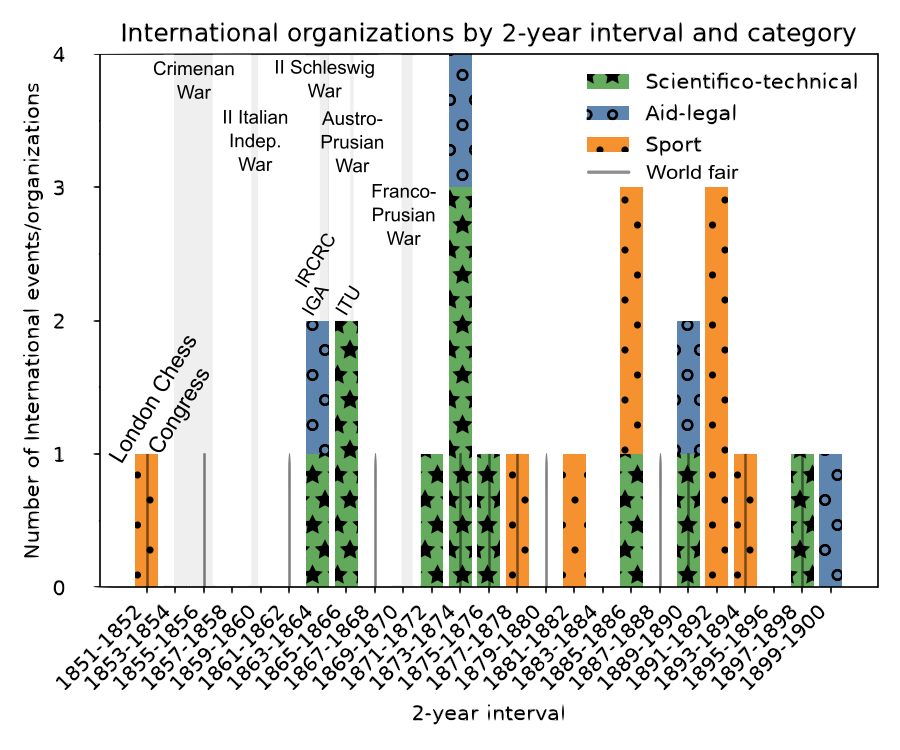
Below I show the number of international organisations created since the London Fair of 1851, together with periods where international conflict happened within Europe, and the major World Fair years, as identified by the Bureau International des Expositions (yes, there is a bureau for that, founded in 1928). Of these early international organisations we find four broad categories: scientifico-technical, political-law, humanitarian-aid-health, and sports (see table below). If we jump to the XXc. we also find several organisations with economical goals, like the Bank for International Settlements (1930), or environmental ones, like the International Whaling Commission (1946).
Number of events or international organisations created per 2-year periods for each category: scientifico-technical, aid-legal, sport overlays with war years in Europe and World Fairs.
There is no general trend between wars and the creation of international organisations, except maybe for the periods after war years, for example after the Italian Wars of Independence (1859-68) and the Franco-Prussian War (1870), which was started after the creative editing of an infamous telegram. There are, though, hundreds of other international and regional fairs that exploded since the mid of the XIXc. Again, this represents the revolution in transport, communication, the unprecedented ease of gathering people in a place, and the willingness to see the advances in scientific, technological, artistic and exploration revolutions happening mostly within the western hemisphere and its colonies. Within this context, people with some means could more easily gather for other contexts, meet, agree to certain conventions, and lobby relevant decision-makers to push particular agendas, many with a standardisation mindset or the need for international cooperation for some greater goal, like treating wounded people better.
In all, the emergence of these international institutions had many forms and flavours. As we have seen with sports, scientifico-technical and humanitarian organisations, some institutions emerged organically and took a while to establish bureaucratic governing bodies, while others were thought out from the beginning as top-down codifications of rules and laws, sometimes governed by institutions, sometimes by regular meetings. The creation, establishment and emergence of new international organisms followed stochastic dynamics, mostly governed by the onset, and ending, of international conflicts.
In this environment, however, we can identify general trends where international institutions emerge and mostly consolidate on the back of a better interconnected planet in terms of human and information flow. From the mid XIXc. there are more and more of these institutions globally, but as we have seen, most follow structures, rules, worldviews, organisational conventions and other procedures rooted in European traditions and innovations. Moreover, these organisms, institutions and proto-bureaus do not seem to deal with random topics, but do have a bias towards dealing with specific topics and interests, namely technical standards, sports rules and competitions, aid and law, economics and debt, and environmental protection. Beyond these, the emergence of global frameworks, institutions, organisations, organisms, frameworks, codifications, standards, administration, corporations and other such structures is rather limited.
For the purpose of our essays, we then will focus on these 5-8 aspects of international coordination, and the bases of these, from organic emergence to nation-state backing.
Finally, I cannot avoid briefly commenting on a couple more legal-political institutions that just appeared at the end of the XIXc. First, the International Parliamentary Union was created in 1889 for the arbitration of international conflicts. It is not for me to assess how effective it has been, but this bureau was one of the initiators of the more famous Permanent Court of Arbitration (PCA) in The Hague in 1899. The PCA was established after a conference at the initiative of Nicolas II of Russia. Nicolas, by the way, managed to immerse himself in most of the conflicts between 1899 and his final demise after the Russian revolutions, famously being ended by massive loads of lead in his body, together with all his family, instead of being handled by the Permanent Court of Arbitration. This kind of political-legal organisation, or the lack of it, or its effectiveness, will be relevant for answering the main question of our text.
Name
Year
Scope
Cathegory
Central Commission for Navigation on the Rhine
1815
Regional
Economical
London Chess Congress
1851
International
Sport
International Committee of the Red Cross (ICRC)
1863
International
Aid-legal
International Geodetic Association
1864
International
Scientifico-technical
International Telegraph Union (now ITU)
1865
International
Scientifico-technical
International Union of Prehistoric and Protohistoric Sciences1866
1866
International
Scientifico-technical
International Congress of Geography
1871
International
Scientifico-technical
International Meteorological Organization (IMO now WMO)
1873
International
Scientifico-technical
International Law Association
1873
International
Aid-legal
International Congress of Orientalists
1873
International
Scientifico-technical
Universal Postal Union (UPU)
1874
International
Technical
International Bureau of Weights and Measures (BIPM)
The humble metric system, as we have seen, was not established immediately. The legacy of the metric that I want to focus on is how it came to be, and what bureau was created to establish, motitor, standarize and update the metric.
The metric gathered support little by little from 1795, until, by 1875, the infamous Metre Convention, with the US being one of its founders! made it the International standard we all know and love, well at least one of these two is true.
The convention did not just stop at pushing for an international, standarised, metric system, no, they created one of the first bureaus. That we will be evaluating for now.
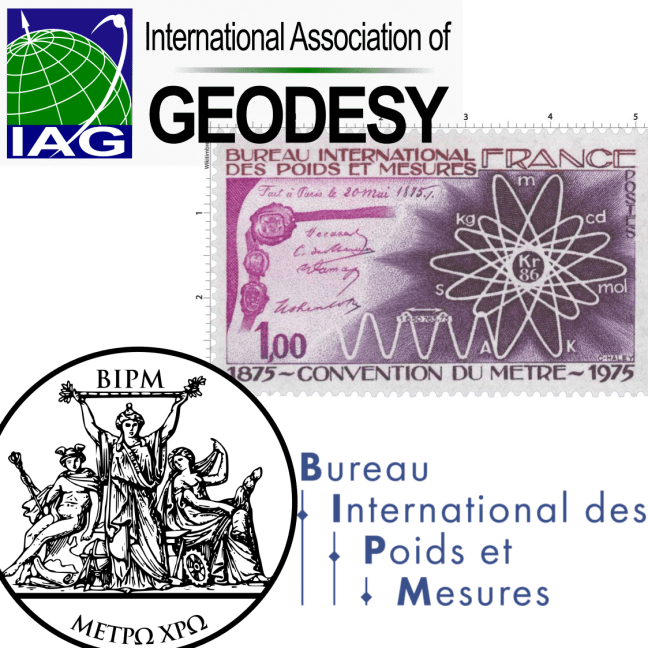
The 1875 one is the Weights and Measures: the International Bureau of Weights and Measures, or in its original french Bureau . They also established a conference (General Conference on Weights and Measures) and a committee (International Committee for Weights and Measures). Again, more on bureaus later, and committees, and conferences, and…
But why, by 1875, was it needed for a French mostassafto be in charge of an international bureau at all? This is the interesting question. What is relevant for the metric system is not the use of units for measurement set by a national administration, but the fact that it implanted the idea that we all must use it and be raised in it.
The french Weights and Measures mostassaf did not came out of nowhere. Going back to the scientific homogenisation, we need to add the germans to the mix.
By 1841, 28 measurements of the magnetic field of the Earth where taken over a six year period. These measurements, all over the planet, where centralised by the “Magnetic Society”, or Magnetische Verein in the original german. This was a society not a bureau, yet. As a society, the compromise was just to gather, standarise and share the measurements, so they could be useful across the planet. There was an extra benefit for endeabour, navigation. Like with the making of accurate clocks to measure longitude, an accurate description of the magnetic field allowed better seafaring transits, as the north and south magnetic poles of the Earth do not coincide with the geographical poles of the planet. Actually, the magnetic ones have a tendency to wander, quite fast indeed (hundreds of kilometres per decade), and even flip! (north becoming south). This was know for decades, or centuries, but was Gauss who in the 1830s started measuring its strength, and latter instigated the creation of the society, with international aims and ambitions.
Later on, the also german based Mitteleuropäische Gradmessung (Central European Arc Measuremen), linked with the need to measure the meridian to estimate the circunference of the Earth, and hence, the metre, was created on 1862. Interestingly, the Mitteleuropäische Gradmessung still exists in the form of the International Association of Geodesy, again, an association and not a bureau. By 1859 it was known that several meridians had not the same length, and that as measurement techniques would advance, the nominal definition of the metre would constantly change, even if so slightly.
A Catalan office —well aware of the Barcelona lie— Calos Ibañez e Ibañez de Ebro, was in charge of the International Association of Geodesy when in 1875 the Meter Convention was stablished. At the time of Carlos running these two pioneering international organisms, these were planned as contributing to increase precision in navigation, cartography and geography, as well as the emerging railways and telegraphs. Railways and telegraphs will come hunting us, but that’s for later.
So, despite the logic of unification being a concept from the particular French Revolution — which linked the metric with revolutionary ideas to make their political movement of decapitating kings (and many others) universal — the universalisation cached up four generations later, and, for the first time the particular Catalan mostassaf was not to be for a town, or state, but for all the planet!
From this story what I want to emphasise is that the importance is the base of knowledge of the standard, more than the standard itself, whatever it is.
How a continuously fighting world of nations came to decide that they could trust a base of knowledge? Moreover, how for the first time —unlike with mathematical, temporal, musical, and punctuational spontaneous standardisation — these nations decided to bureaucratise the process of standardisation with scientific geeks at the front of the first modern international institutions. This how process boils down to write laws that would be shared across borders and mutually understood, plus trust that the mostassaf would be available and willing to keep, share and not abuse its privative and privileged knowledge. Again, remember that the term mostassaf comes from an Arab religious figure of moral and measurement accountability.
So what makes the metric stand? Truly, a handful of things: i) It was the first one designed from the get-go to be universal; ii) it was based on natural units accessible, in principle, to anyone who had the time to finance the measure; iii) it was easy to learn, aligning with mathematical notation, already quite universal and on base 10; iv) it was set to work with technical and scientific communities; v) the scientific communities were expanding, encompassing industrial and geodesical needs for better instruments, better measurements, faster and easier comparisons and sharing of technical information and better land and sea surveys for better administrative oversight (more on administrations later); vi) its creators also kinda pushed for it to be adopted universally, following the spirit of revolution; vii) there were not many alternatives at the time, to be honest.
Let us look at the last option (vii), alternatives? The only real contender for standard measurement used for scientific and technical applications by the end of the XIXc was the British Imperial system (still slightly kept by the US and Liberia). The imperial traces its roots to the standardisation of English measures, as designed by the 13th-century Magna Carta, but standardised by 1496, rectified in 1588 and made the British Imperial system by 1826.
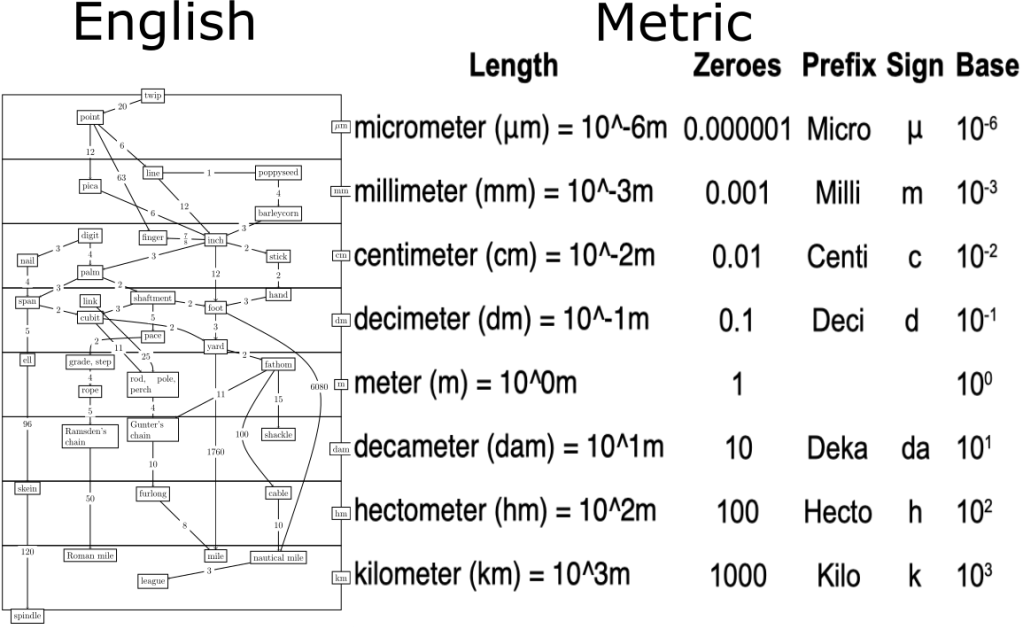
We have the imperial length units. Let us look at these!. The basis is the foot, abbreviated as ft. The multiples are a yard as 3 ft, chain 3×22 ft, furlong 3×220 ft, mile 3×1760 ft, league 3x3x1760 ft. Well, it seems they were trying a base 3, but kinda gave up on it, soon. For the sub-units: twip 1/3^3×640 ft, thou 1/3×4000, barleycorn 1/3^2×4, inch 1/3×4, hand 1/3. OK, OK, kinda keeping with the basis 3 there, sometimes 4 as well, maybe inspired by the 60 for time — 3x4x5 — but also not quite. Now let us look at the distance units at sea: we have the fathom 6.0761 ft, cable 607.61 and nautical mile 6076.1… Now there is a base ten! But not much sense otherwise.
But a visual is better than thousands of words, and words of measures. Here is a side-by-side comparison of units of length in the traditional English system vs the metric one.
Comparison of English customary english and their interrelation with metric
For mass, the basic unit is the pound. Fair enough. But the shorthand for pound is lb. Yeah, we have seen that pound and livre are, in theory, referring to the same old Roman unit, but still, lb looks quite different than p or pn. Anyway, let us see its divisions: grain is 1/7000 lb, drachm is 1/256 lb, stone is 14 lb, quarter 28 lb, hundredweight 112 lb and ton 2240 lb. Little sense, but in base 12 or 60, like time, still makes no sense. For multiples it has base 14 (1, 2, 4, 800). Yet for divisions it has a basis, ehem, no consistent basis. A grain is 1/(14×500) — why 500? Well, a drachm is 1/2^8…
Sorry, I tried.
I will not even try the volume units. A beer pint is just a large half-litre drink. Cheers to that!
The other option could have been the Burmese system. Myanmar still has traditional Burmese units of measurement. The Burmese system maybe has been maintained, in part, because for mass and volume it follows a neat base-two system, in which each unit is a factor 2 bigger than the previous — the metric being a factor 10 between units. Unfortunately, this is not the case for length and area; no, for length the Burmese system is a mess. For example, as of 2010, the state used miles to describe the length of roads, square feet for the size of houses, square kilometres for land area in cities, acres for agricultural areas, kilometres for the dimensions of the country. Still, when I was travelling there in 2015 I did check if they were the US of Asia for the metric, but for reasonable driving they did use km for distances to places and km/h as road speed limit indicators.
So, form the above list, let us focus on points (iv) to (vi): the need, willingness and expansion of technical and scientific domains beyond national borders (more on nations later).
The expansion of the metric is interlinked with these technical and national advancements and ended with some of the first bureaus on the planet.
The republican French, to celebrate the 10th anniversary of the Revolution, did a technical and industrial fair in 1798. This was not much international, as they were in the middle of intense wars, still not called Napoleonic. At the exposition they showed devices demonstrating the new metric system of metres, grams and litres, and, following European fair traditions, they had prizes for outstanding products, mostly fabrics and textiles, but now including innovative technical and industrial devices. One of them was the precursor of the modern pencil, and pencil colours.
They held three more expositions until 1806, and then new ones shall happen every 3 years; this allowed for enough new inventions, geographical explorations, arts, sciences and devices to be developed between events. But by 1809 France was indeed in the middle of the Napoleonic wars.
By 1819 the now French kingdom restarted the expositions, which happened roughly every 4 years.
Then the Kingdom of France decided to revolutionise a bit again and become the kingdom “of the French”. Notice the difference; it will be important later on. Then they decided to make an exposition every 5 years, starting in 1834.
The 1844 one was quite a success internationally, spawning similar fairs in other nations — Bern (1845), Madrid (1845), Saint Petersburg (1848), Lisbon (1849). Then in 1849 there would be the last national exhibition, as in 1851 the British did their Great Crystal Palace Exhibition, which for the first time had the dimension of a world, and not national, fair. From there on, world exhibitions would happen regularly, a bit like the Olympic Games now, and cities would compete with each other to host the event.
These World Fairs, or “the Expos” for us old enough to remember them being a thing, initially were great opportunities for showcasing the most advanced scientific and technological discoveries of the time. This was especially important in an era when more efficient and powerful steam engines, steel, locomotives, rails, and later electricity and telegraph were taking over the European nations and their colonies. In these events, industrialists and scientists from around the world could meet and agree on stuff.
That stuff, my friends, was the metric system, which by the end of the Napoleonic Empire, like decimal time, had gone down the drain. Napoleon reintroduced the customary units, but retained the metre and kilogram for these units to be compared against. The metric systen was also taught at schools and academia. It was simple to teach, as we have seen.
Meanwhile, the metre lived on in other states that were under the influence of the French Empire and retained the metric system, like the Netherlands, Switzerland, and Piedmont, later the Italian kingdom.
And the US, of all places, had a central role for the metre. The Coastal Survey Office, since its inception in 1807, but really by 1836, standardised all the coastal measurements with the metre as its basis.
And even nations that escaped Napoleon, like Portugal, by 1814 adopted the metre, though retaining the traditional names when needed.
Spain, as we have seen with the Catalan measures, had a diverse set of systems. But by 1849 decided to standardise measurements with the metre and kilogram, and by 1851 decided to conduct a survey of the state. The Spanish bureau of measures also adopted and developed new measurement tools to compensate for thermal expansion of the standard metre rods. That made the use of the metre more precise and more manageable. Then it provided standard metres to the Egyptians, and the standard was used throughout France and the German Confederation.
On the first French Universal Exposition in 1855, the Swiss had finished, and presented, their official map with the metre adopted as unit of length, and this was awarded a medal.
Moreover, the Congress of Statistics was held in Paris at the same time as the exposition. There, statisticians, probably tired of wasting time making conversions of units, and probably not happy with the metre being kept by a France-based mostassaf, decided to settle on a uniform decimal system of measures, weights and currencies.
Again, the US pushed for the metric system by 1866. One of the bases of precision balances was in grams and kilograms. In 1866 (made in Bangor, Maine, where I’m writing this now) the legislative organ passed the Metric Act, which defined the metric system in terms of customary units rather than with reference to the international prototype. Interestingly, this anchored the customary measurement units to that of the metre, even if it legislated the other way around.
Then, at the 1867 Exposition Universelle, again in Paris, the statistician geeks formalised the universalisation desire with the creation of a Committee for Weights and Measures and Monies. Now it would not be the French revolutionaries calling for universalisation, but a bunch of geeks with the ears of wealthy industrialists interested in easier technical standards.
That committee finally, after the Franco-Prussian War, created the Bureau, the International Bureau of Weights and Measures, with two governing organs and the headquarters. The newly created German and Italian states already adopted the metric system as their standard. These nations now were part of the bureau, which was tasked to facilitate the standardisation of weights and measures around the world. The bureau had three parts: a conference as a forum for representatives of member states; a committee of metrologists as an advisory board of high standing; the headquarters as the meeting place and laboratory facilities that inform the decision and advisory bodies for decision-making. Corporations, interestingly, often work similarly to that: the conference would be the shareholders’ meeting, and the committee the board of directors.
The Catalan Carlos Ibáñez e Ibáñez de Ibero — the head of the Spanish survey and national measures institute, and maybe familiar with the mostassaf concept — was one of the main pushers of an international standard based on the metre. By the bureau’s creation, he was made the initial president of the committee, the Permanent Committee of the International Metre Commission (confusingly, also named International Committee for Weights and Measures and General Conference on Weights and Measures; do not ask). Being Catalan of origin, Ibáñez, since 1853, also impulsed the remeasurement of the “Barcelona lie”, that is, the Paris meridian, extending the measurement from the Shetland to the Sahara. That effort, and other European meridian measurements, awarded him the first presidency of the International Geodetic Association by 1867.
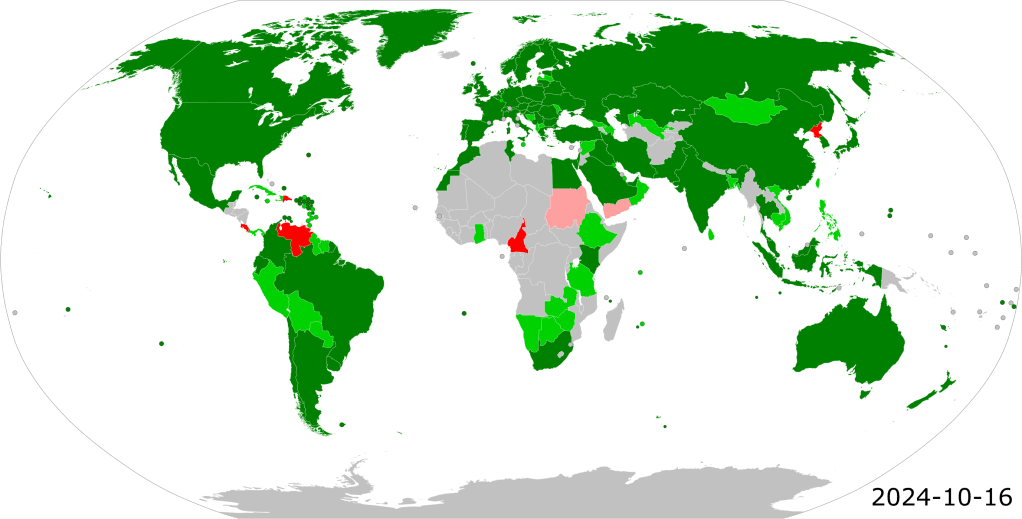
The 1875 Metre Convention put the decision-making of the standard measurement of the planet in a bunch of nation states’ hands. The original signatories being Argentina, Austria-Hungary, Belgium, Brazil, Denmark, France, Germany, Italy, Peru, Portugal, Russia, Spain, Sweden, Switzerland, Ottoman Empire, United States of America (yeah, you have seen it well, US is here!), and Venezuela (which no longer ratifies the Metre Convention).
Metre Convention on the planet. Dark green, member states; light green, associate states; red, former member states; light red, former associate states.
Interestingly enough, the metre is also not completely dominant in the UK, where the standards for the metric system, and the metal piece that defined the kilogram for 160 years, were made.
In the US there is also the fun fact that, unlike the UK, industry is not forced to use the metric system for all their products, despite being one of the original seventeen signatory nations to the Metre Convention.
Therefore, when NASA asked its suppliers to work with the metric system, but one of its suppliers, who procured thrusters for a probe to Mars, worked with customary units of pound-force-seconds, the result of such an integration of two different systems was that the poor Mars Climate Orbiter probe simply went on its sweet way to Mars just to descend to about 57 kilometres above Mars’ surface, instead of its planned orbit at about 150 kilometres. At that height, and without enough angular velocity, and with the drag of the tenuous Martian atmosphere, the orbiter simply produced a nice flame in the atmosphere.
That is the price of not having a unified unit system.
So being the first, and not having many alternatives, plus being relatively memorable and accessible (had to knock at the Parisian mostassaf from time to time, but was a cool person), made the whole system go global, or pay the price if not.
The metric system simply illustrates how national administrations and gatherings of world representatives agree to standards. In the metric case this quasi-standard emerged through technological need, the ease of communication that allowed repeated forums where actors interested in standardisation and sharing could gather and lobby in a uniform way, the relative ease of the new system and its spirit of universalisation, and a specific individual with the right connections and maybe aware of the connection between moral and measurement accountability through an old mostassaf legacy in our lands.
If we compare the metric to the other standards that we have seen — mathematical and musical notation, francas, timekeeping and punctuation — all of these share similarities. Technical advancements for clocks creation and the need of better measurements for navigation and trains in the case of timekeeping; more communication, new instruments and bigger orchestras for music; economic interest for francas; facilitation and economic dissemination for punctuation. With the exception of the calendar, none of these standards had behind them the will of the states or nations. And even the legislation for calendars happened at a customary and slow attrition, state by state, without an international gathering, convention or bureau leading it.
Like the weights and shekel 3000 years ago, we can look at more modern cases of this seemingly spontaneous standardisation originating by the end of the 19th and beginning of the 20th. For example, if you ever used headphones, the connector, or “jack”, to the sound device might have always been the same diameter 1⁄4 in and shape, or have only two–three standards (1/8). Another piece quite familiar to most of us nowadays is the keyboard I am typing this on, which is an almost international standard, called QWERTY, named after the order of the letters on the first keys’ row. Looking elsewhere, the bicycle chain is 0.5 in between pins and 5⁄16 in for roller diameter. The size of cargo containers, 8 ft wide by 8 ft 6 in high and 20 or 40 ft long. Yeah, metric did not make it for jack, bikes and cargo, damn.
More on the emergence of these (and other) standards later.
What we can infer, however, is that standardisation follows a mixed route of informal conformity by useful means of exchange, plus a forcing pace by institutional action. Then, in an interconnected, and colonially dominated, world, the metric system in particular shows the first, or one of the first instances, of how slow attrition to shared standards could be hastened by gatherings and lobbying committees. And how that commitment results in autonomous bureaus that horn in their task. In the experience of THE Metric, the legislative power of national institutions could be weaponised to steer reluctant populations that were happy with their local traditions and units, however clumsy, to adopt new and bureaucratised standards countries away, instead of their local mostassaf. Or shield them, as in the US, however clumsy. A new state-sponsored universal education could get away with old traditions by educating children in new, maybe more memorable, systems.
With the dreaded metric we can see how all the pieces are falling into place to have the ruleset to ask our question: what does humanity want? But before that we need to go through the emerging bureaus and other international organisms that, for now, rule, the World.
To keep postponing the Metric, let us explore another metric — the music metric. Since my music ignorance is as immense as music is —and I do deeply apologise to all he music lovers out there— I take metric to mean notation.
As we all know, sound is difficult to record compared to visual signals. We have pictorial art going all the way back to 60.000, to 80.000 years, but no record of sounds before the invention of gramophones and ceramic disks. Though we do have evidence of music being played at least 40.000 years ago, with evidence ofclose to 200 fragments ivory or bone flutes, whistles, and pipes and a conch shell horn. Percussive instruments can be traced to the same period, with mammoth bones as drums, and reindeer-antler as drum sticks and possible rattles (Morley, 2013). However, from the beginning of music to the first sound records, the only way to play music created previously was either to have an unbroken sequence of people remembering how to play it, or to encode it in a system that could be reproduced later — either by other humans or by moving machines.
As always, the Greeks and Babylonians (Sumerians, to be exact) had already dealt with the encoding of music, but music is an immensely complicated language, and these scripts were only able to store the strings, the intervals, and tuning parts of the music.
The bit that is often told about the Greeks is the mythical Pythagoras. Beyond his triangles — which mostly were a well-established Egyptian knowledge — the Pythagoreans linked music and ‘harmony’ with mathematics, which they copied from the Babylonians this time. (Interestingly, the Chinese Shí-èr-lǜ scale follows the same logic.) Beyond copying and being attributed things he did not create, Pythagoras did make the musical and mathematical ‘divinity’ a religious sect by the 6th century BCE — if you want to perpetuate nerdy, complex, boring knowledge, you’d better make a religion out of it. In instruments, pitches, notes that were a half or 3/2 apart ‘sounded’ good. With strings, this is related to length, but also tension or tuning. Pythagoras and his followers could not resist giving this a ‘mystical’ meaning, trying to fit existence into his ‘divine’ vision — but reality, as it turned out, had other ideas.
What Pythagoras actually discovered — before wrapping it in mysticism — was that the harmonics of strings resonate with each other, a simple fact of physics that our ears have evolved to enjoy. From what we understand now, it is mostly a coupling of harmonics in strings and “overtones” in general. In other words, when an instrument produces a ‘pitch’, it gives off not just one pure wave but many smaller ones that resonate with it — and these combine to sound harmonious because they complement each other. Then, if you add another tone that also resonates with the primary frequency, or some of the overtones, that is also harmonious.
Our auditory system also resonates with nearby frequencies, which is why we find it oddly unsettling when two notes are almost — but not quite — the same. And there is a cultural layer on top. If you hear something that is slightly dissonant often enough, it will “sound good enough” not to care. It’s only when we hear music from another culture — one that divides its scales differently, using another temperament — that we start to notice those dissonances. Once your ear adjusts to the new metric, returning to the old one feels oddly off for a while.
And again, we go to Western Europe to observe the origins of most modern music notation. In this case, it started with the singing of prayers. As you can notice, voice is a continuum; there is no predefined ‘do’ or ‘re’. So voice, and music, had to be discretised into common units that everybody could ‘aspire’ to. This standardisation, inspired by the mathematical spirit of universality, was thought to be divine — which made following Pythagoras rather straightforward. Until it wasn’t (but more on that later).
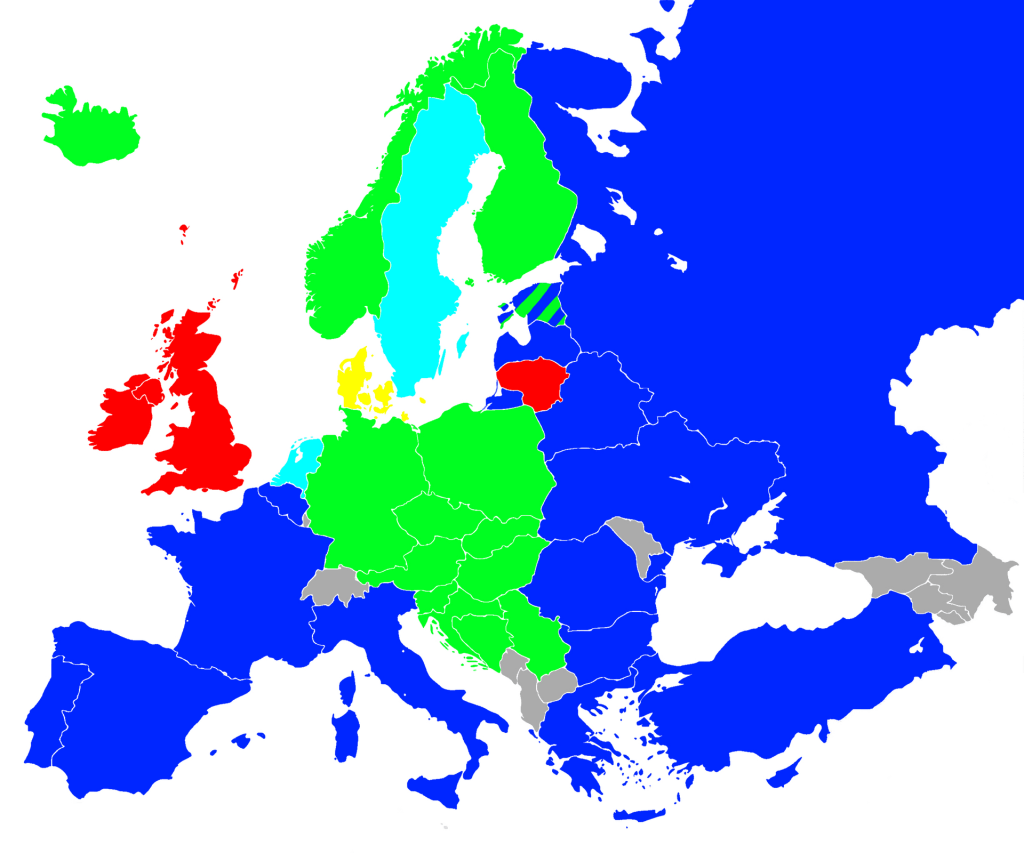
Before the well-known pitch system, what ecclesiastical choruses did by the 10th century was to annotate when the melody went ‘up’ or ‘down’ on top of the lyrics. Then a reference line was added to show the relative high and low of the melody. From there, by the 11th century, more lines were added above and below to structure the pitches in a standardised way. In parallel, it was necessary to know what the actual ‘pitch’ was, and that’s where the same guy who started adding the extra lines developed solmisation, with the familiar Do–Re–Mi–Fa–Sol–La–Ti (or Si) sequence appearing (though Ut instead of Do). This provided seven basic notes, which mirrored pre-existing scales like the Byzantine Pa–Vu–Ga–Di–Ke–Zo–Ni and the Indian svaras Sa–Re–Ga–Ma–Pa–Dha–Ni. This naming (blue in map below), however, was never fully standardised: the British preferred C–D–E–F–G–A–B (red in the map), as in guitar chords (E–A–D–G–B), while Germans and neighbouring regions (green, yellow, and sky blue in the map) used C–D–E–F–G–A–H.
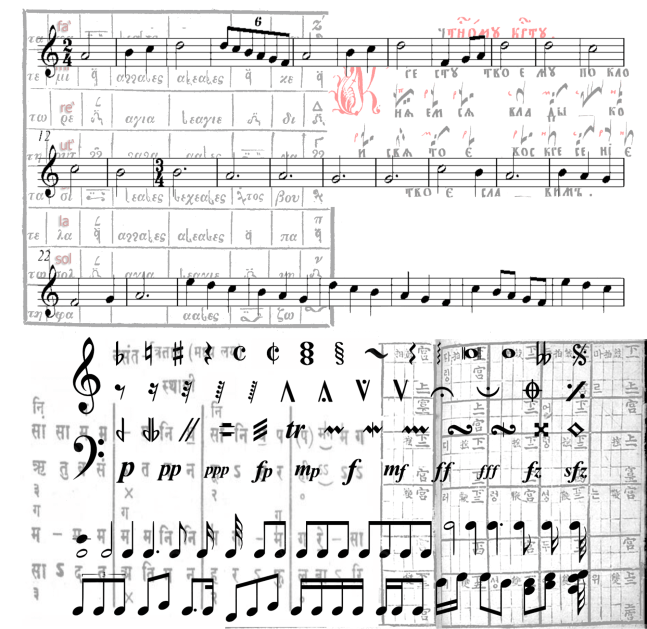
If one doubles around the central note, this provides the conventional twelve notes to be placed on top of the five-line staff developed by the 13th century. If you place a symbol on top of the five lines, plus four in between them, and two more on top and bottom, you have eleven spots; adding one more small line (a ledger line) at the bottom when needed is easy and gives the Babylonian twelve. At this point, we have something that looks a lot like the modern musical staff, or pentagram, and symbols that look a bit like the familiar ‘white’ [], ‘black’, and ‘round’ musical notes. These symbols, known as ‘neumes’, took longer to standardise; there was still variety until around 1700, but by then most European notation had settled into the familiar form — even recognisable to a musically challenged person like me. Five thin lines, a ‘clef’ symbol at the beginning, and the pleasant ant-like procession of pitch along them. But like mathematics, musical notation is immense!
For the temperament, or tuning itself, Pythagorean (Babylonian and Chinese) fixing of the twelve notes to perfect ratios of 1/2, 3/2, 2/3 and their powers (C 1⁄1, D 9⁄8, E 81⁄64, F 4⁄3, G 3⁄2, A 27⁄16, B 243⁄128, C 2⁄1) failed because, contrary to belief, some of these pitches do not sound harmonious when played together — particularly something called the Wolf interval. It also made it difficult to shift the scale up or down beyond the twelve notes, since the spacing between them was uneven. To solve this, particularly for string instruments with many keys, like the piano, equal temperament became the standard by the 18th century, in which the distance between notes is, as the name suggests, equal. Developed independently in Europe and China in the XVI c., in mathematical terms each frequency interval is 1/12 of the octave (the distance between the highest pitch and the lowest), and the ratio between consecutive intervals is 12√2 — all equal in a logarithmic scale.
There is much more to it than that, and music notation and temperament have been evolving ever since, not unlike mathematics, with hundreds of signs emerging. Moreover, other familiar notations like the C–D–E–F–G–A–B guitar chords are ever-present. And music notation beyond the Western one is rich and diverse. But acknowledging my immense ignorance of music — and the fact that the basics have been quite established and spread around the world — I will limit myself to this standard that, like mathematical notation beyond numerals, has taken over the world.
From then — plus a few more inventions in tuning, non–string-pipe instruments, and electronic music among others — we have the fascinating fact that music written in one period can be played by future or distant musicians who have never heard it, as long as they possess the relevant knowledge and skill.
That transfer of sound into visual form (and back) is a truly fascinating invention — a collective effort across generations showing how sensory experience can be encoded, standardised, shared, and reinterpreted again and again. And, for better or worse, this very standardisation enables immense creativity while also stifling non-standard forms — a kind of ‘Western’ myopia, or more aptly, tone-deafness.
Thus, to recount: by the year 1800, and to this day, we have the following global or quasi-global standards — timekeeping, the calendar, mathematical notation, the Copernican principle, music notation, and temperament. These are not that many, but we will see that the other topics introduced — commerce and francas — will play a dominant role in the following two centuries.
Plus the infamous metric system! Nobody expects the metric system.


 ], ‘black’, and ‘round’ musical notes. These symbols, known as ‘neumes’, took longer to standardise; there was still variety until around 1700, but by then most European notation had settled into the familiar form — even recognisable to a musically challenged person like me. Five thin lines, a ‘clef’ symbol at the beginning, and the pleasant ant-like procession of pitch along them. But like mathematics,
