Roads: rules and signs

Let’s leave bureaus, sports, aid and law for a bit, and focus on one more scientifico-technical standard that emerged on the back of technological development at the beginning of the XXc.

The world had not finished with mathematics, music and signs as technical or symbolic languages. A much more passionate topic rolls on: road signage!

As with clocks (timekeeping), religion and administration (the calendar), accounting (mathematical signs), the printing press (punctuation), musical instruments (music sheets), geodesics and administration (the metric), statistics (significance and error conventions), the telegraph (the Morse code), the World Fairs (places for technonerds to meet), the railways (time zones), bicycles (standardised parts) and typewriting (QWERTY keyboards), the motorised vehicles that were taking over the planet at the beginning of the XXc were poised to push some convention upon us.

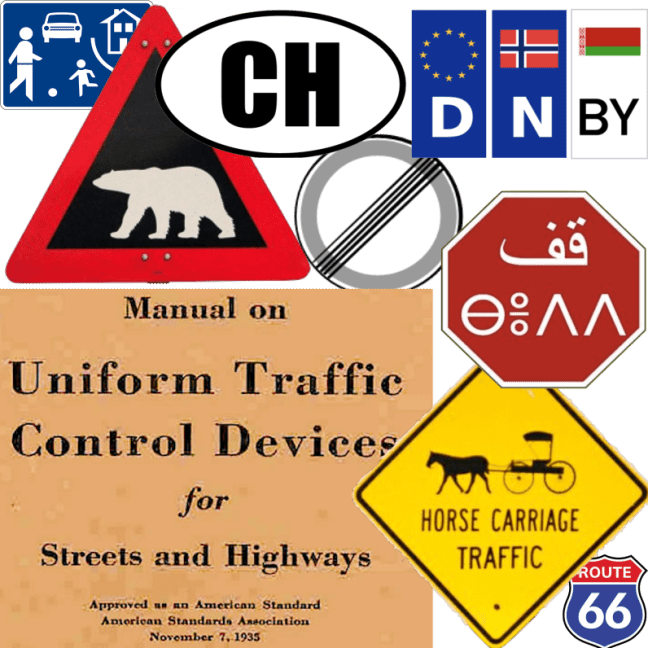
We might be familiar with the signs that emerge on the side of roads. They might be circular, squares, triangles, octagons, or sideways squares (diamonds), shields and house-like shapes (pentagons). Their colours would be red, white, blue, yellow, green, with the occasional brown, pink, or orange. There are also luminescent ones, with colours that change, usually from green to orange and to red. These signs have a combination of standardised pictures, messages and numbers to convey an almost global meaning. These signs are expected to be understood by the people who go about on the roads with their motor vehicles.

The signs and traffic lights did not exist before the clogging of the pre-existing roads with these fast vehicles, though bicycle clubs were the first ones to experiment with road signage, especially indicating slopes. The new road conditions called for easily identifiable signs to be read quickly by any driver, no matter their origin. So, with the fast, and numerous, vehicles the signs went up. Soon enough people in Europe were aware that the signs had to be shared across national borders, otherwise vehicles crossing from one country to another could be confused by different meanings. Speed of reaction was, and still is, crucial.

Following the international conventions that we have seen emerging from the end of the XIXc. on the back of technical inventions and imperial powers, they organised what probably is one of the most boring conferences in history. In 1909 the European vehicle associations met in Paris to decide on a small set of common traffic signs. They did a similar thing in 1931 and 1949 in Geneva to unify a larger set of signs on a European scale. By 1968 security triumphed over boredom, they met in Vienna and created the “Vienna Convention on Road Signs and Signals”, aiming to make traffic signalling universal for the whole planet.

They failed.
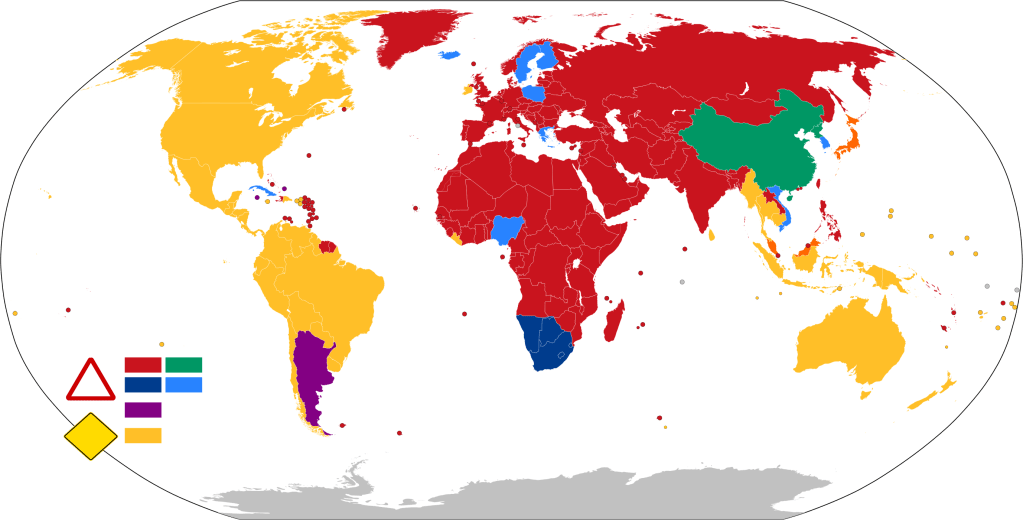
Map of "danger" sing shapes on by country. Red, blues, green denote triangles use  ad warning or danger. Yellow and orange indicate diamonds use. Purple has both.
Map of “danger” sing shapes on by country. Red, blues, green denote triangles use ad warning or danger. Yellow and orange indicate diamonds use. Purple has both.

Currently, there are two main road sign standards on the planet, plus a lot of other stuff in between. One of them is the European one, which gave the world the “Vienna Convention”, adopted by 68 countries (roughly red on the map), and the North American one, boringly called the “Manual on Uniform Traffic Control Devices for Streets and Highways” (MUTCDSH), and used, with many variants, in the yellow countries on the map. But not all is well and standard in the US for the MUTCDSH, as some states engaged in Typefacewars, maybe the most bland wars in history. In southern Africa, ten countries use the also engaging name of the Southern African Development Community – Road Traffic Signs Manual (SADC-RTSM).

Road traffic sign from South Africa, as encoded in the Southern African Development Community – Road Traffic Signs Manual

But even in MUTCDSH- and SADC-RTSM-derived countries, The Convention forms the basis of much of the traffic signage, or is similar enough. If a non-Irish European drives through the US, most of the signs would be immediately familiar. The biggest differences between The Convention and Non-Convention countries are that speed limits and obligatory signs are rectangular, and yellow diamonds with black signs are used as warnings. Instead, The Convention uses round signs for speed limits and obligatory signs and an upward-pointing red and white triangle for warnings — also shared by SADC-RTSM, but one might find different animals. Even that difference between Convention and Non-Convention danger signs is not much, as an upward-pointing triangle is just the upper half of a diamond, therefore it is not much of a stretch of the imagination to understand the other.

The story of road signage does not stop in the 20th century! In 2025, the Global Forum for Road Traffic Safety (another global boring organism that rules your life but you probably never heard about) passed a resolution to replace the entire text of the Convention! The exciting road-signage path rolls ahead!

We then took this little traffic diversion to show three ingredients that we will see from now on shaping many of the global questions of the planet. First, an agglomeration of big and middle-sized countries that are in close proximity to each other and need to share a convention for the benefit of them all find terms to agree with each other. Second, when new technology standards — especially related to communication — emerge and extend, the consolidation into commonly agreed rules tends to take shape relatively fast. Third, colonial powers force the conventions into colonised territories without the input of the societies under dominion.

Roads, moreover, are the paramount example of infrastructure. It is needed, inherited, maintained over generations and represents connectivity like nothing else. For much of the modern world, the combination of technology and infrastructure drives the need for a — virtually — universal language. Coordination forces create the political motivation for neighbouring, independent administrations to sit down at a table and try to agree on a common set of conventions. Once a standard achieves enough maturity through this process of regional standardisation, technological development and colonial imposition, the parts of the planet that are still not part of this dynamic are more likely simply to adopt that standard. New players, then, either adopt it or at least have it in consideration.

With these three characteristics, it is easy to see how Europe is the place in the World that has the most influence in shaping much of the standards and internationalisation, as we have seen in the Western Dominions entry.

Similarly, exceptions to these three general trends are easy to see, with densely populated islands that have not been colonised recently, like the Japanese archipelago and Great Britain, and big countries like China and the US. The US and the UK in part explain the survival of two Western standard flavours, as they were big enough, isolated enough and innovative enough to consolidate and protect their own conventions, but still share much with the rest of international protocols.

This kind of mindset and framework would be important for our question of what humanity wants.

Previous

Next

Foreword

In this work, you will not find the answer to this question. However, you should come to appreciate the beauty and uniqueness of the time in which we can ask it at all.

This work is not unlike the age-old philosophical questions: “Where do we come from?”, “Where are we going?”, and “Why are we here?” These questions have been asked countless times over generations, and you will not find their answers here. Instead, I aim to frame these timeless questions in the context of “humanity” as a new, emergent concept—one that, on the light I will be describing it, has never existed before in the history of our species at a Global scale.

I approach this inquiry from my particular background. I was raised in a Mediterranean, European cultural context, deeply influenced by Greco-Roman philosophy and state-building traditions, as well as by the values and narratives of the Abrahamic religions.

On top of that, my education has shaped my worldview and the sources of information I draw upon. I hold a bachelor’s degree in Physics and a PhD in Cosmology. My academic and professional pursuits have included projects in neuroscience, astrophysics, dynamical systems, perturbations, information theory, causality, human evolution, and the cultural dynamics of loss and survival. These areas of study form the framework on which the ideas in this text are based.

Moreover, within this “Western” perspective, I come from València, born into a Catalan-speaking family. Both of my grandfathers hailed from the same town in which I was born, Sagunt, and were Catalan-speaking. My grandmothers, however, emigrated to Sagunt in the 1940s, during the post-Civil War period, from the interior of València. They came from a region that had historically spoken Aragonese but had since transitioned to Castilian. Like many mixed families, my linguistic landscape is varied. My maternal grandmother did not adopt Catalan in the family environment, while my paternal grandmother did.

Economically, my grandparents’ livelihoods were tied to the land: farming, orange orchards and related industries, baking, and later neighborhood retail shops. Their social standing ranged from lower to upper-middle class.

Although I grew up in a predominantly Catholic society, my parents raised me as a free thinker. They were agnostic, and my natural inclination toward skepticism, empiricism, and atheism was both allowed and encouraged in my family and educational circles. Even my paternal grandmother, the most religious and spiritual person in my family, supported my questioning nature. Despite being a Christian believer, she was skeptical of the Catholic Church as an institution, often remarking, “Do what the Church says, not what the Church does.” My interactions with the Catholic Church were minimal, limited mostly to festivities and a brief period of religious education when I was six or seven years old to prepare for my first communion. Even then, my early atheism led me to openly express my doubts—sometimes at the cost of being made to face the wall for extended periods.

Politically, my parents aligned with left-leaning Catalan/Valencian nationalism, which advocates for self-determination within the historical boundaries of the former Kingdom of València. They moved away from the land and family businesses, pursued higher education, and worked in government positions—one in city hall taxation and the other as a school counselor and head teacher.

València itself is a land of historical significance, renowned for its fertile, irrigated grounds that date back centuries. It has supported industrial-level agricultural production, particularly of fruits like grapes and oranges.

Culturally, Valencian and Catalan traditions are distinct within the Iberian Peninsula. The peninsula is home to three states (Andorra, Spain, Portugal) and part of the United Kingdom (Gibraltar). Spain itself is a multilingual nation with four main languages—Euskara (Basque), Catalan/Valencian, Castilian (Spanish), and Galician/Portuguese—as well as several smaller, rapidly disappearing Romance languages like Aragonese and Asturian.

The history of València is one of successive cultural layers: Iberians, Celts, Phoenicians, Carthaginians, Greeks, Romans, Germanic tribes, Arabs, and Berbers. Catalans were the last colonisers, arriving in the 13th century to a land that had been predominantly Arab in culture. For centuries, the region was home to the three main Abrahamic religions: Judaism, Christianity, and Islam. However, under the Spanish monarchy, the Jewish and Muslim populations were expelled—the Jews in 1492 and the Muslims in 1609. In my hometown, Sagunt, it is estimated that Jews once constituted 20% of the population and Muslims 20-30%. Within three or four generations, nearly half of the town’s inhabitants were forced to leave their ancestral lands.

Those who remained faced strict scrutiny, forced conversion to Catholicism, and severe punishment for any violations of its practices. This era gave rise to the infamous Spanish Inquisition. My homeland, therefore, is one depleted of its historical religious and cultural diversity, with a language brought by colonisers and later persecuted. Despite centuries of suppression, our language endures, albeit in decline.

València is also known for its vibrant cultural traditions, such as the Falles de València, Fogueres d’Alacant, and Moros i Cristians d’Alcoi, correfocs, among many others. These festivities highlight the resilience and creativity of our people.

This framing is intended to underscore that, in a different sociocultural context, with different formative experiences and interests, the themes of this text could be entirely different. Humans are the only animals (as far as we know) capable of sitting under the stars and pondering the universe’s future—imagining what it might look like in 100, 1,000, or even a trillion years—and questioning whether “humans” will exist at all in such distant times. Remarkably, these thoughts inspire actions in the present.

Beyond these star-gazing, future-oriented humans, we have created something entirely new: the concept of “humanity.”

This text encourages the question of “humanity” to be explored by as many diverse perspectives as possible. Willingly or not, we are living in the age of “humanity”, the Anthropocene. We are no longer merely individuals or groups; we are now “humanity,” understood as a collective that seeks to include every individual of our species on equal terms under universal rules. These rules, of course, arise largely from the cultural context in which I was raised. Still, we must critically examine the limits and implications of this universal view.

This work is not about humans but about “humanity”: how it came to be, how it can “think,” and whether it, too, can look to the stars, recognise the beauty of this question, and act now in light of it.

Disclaimer <- Previous Next -> Preface