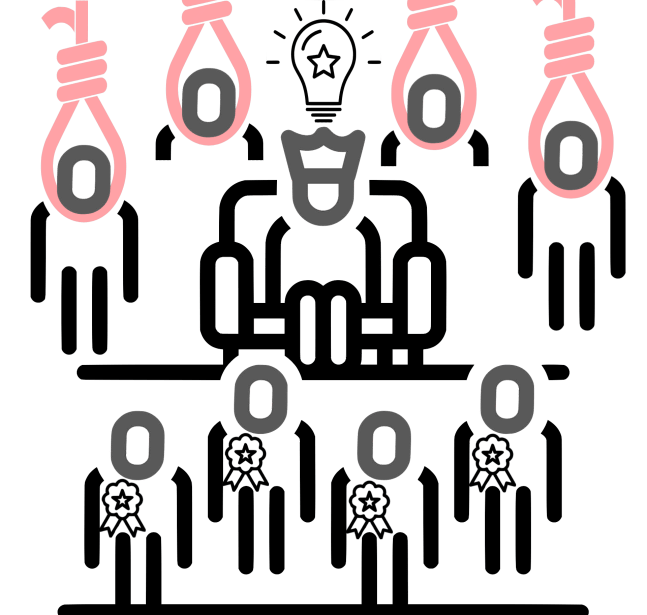
The cultural ideal, privileges and industrial-scale evils

Through my studies of cultural loss, I came across a powerful concept from political sciences, the political ends. This is proposed by Morton Gorden within a process of conflict resolution as the “process by which a government sets limits on what enters the political process”(Gorden 1972:vii).

In an evolutionary perspective, governments come after politics, politics comes after public, and public comes after culture. Since my objective is to focus on humans and humanity, for now, I want to abstract that basic schema beyond governments, to a dynamic that captures most of human behaviour.

For that, I reinterpret the first step of the process “goals”, or “political goals” as pursuing a specific “cultural ideal”. In other words, political goals are culturally generated representations of desired final states.

In that framing, I claim that we can see the political process as the path towards the fulfilment of representations of cultural ideals. Even without a government or collective decision-making, as long as there is an individual who wants to freely express its cultural ideal in a social environment, that can be seen as “politics”.

Simply put, every action to pursue a specific cultural end defines politics.

Goals in a political system reflect patterns in culture. The setting of specific goals represent a choice of objectives from a larger range of possibilities residing within the accessible cultural landscape.

Evolutionarely, my argument is that a cultural ideal, while abstractly shared by a “public”, resides in each of the individuals of that public. While growing up in a public a.k.a. a society, we slowly form a diffuse, ever-changing idea of a cultural ideal.

This sequence: cultural ideal formation – action – politics – ends , is not exclusive to humans, or humanity for that matter.

Let us trace possible evolutionary roots for the pursuit of a “cultural ideal”.

Remember Lekker, the vervet monkey who took over as alpha male, and could eat the popcorn of his preferred colour?

If we accept that the choice in colour of popcorn can be called “cultural”, then Lekker imported his “cultural ideal” when he went to a new group that had a different cultural preference of popcorn colour.

With the alpha-male power and influence Lekker kept eating the colour of popcorn that he was used to eating. By that time (six months later) both colours were equally sweet, so there was no real fitness difference other than the colour. In the case of Lekker, he was able to keep his rather simple “cultural ideal”.

We humans do this conscious and unconscious process all the time while sticking to a cultural ideal. For whatever reason, a “cultural ideal” of how things ought to be is created, and then individuals take constant actions to approach that ideal. In the case of Lekker, he achieved his “ideal” through power. Paraphrasing my earlier definition, these actions were Lekker’s politics.

Again, I call all the actions that one takes towards achieving a cultural ideal, “politics”.

As I’ve written before, Joan Fuster, one famous Valencian intellectual, has the aphorism that “politics is done by you or is done onto you”.

In other words, we are constantly doing politics by expressing or protecting our preferences, and even when not doing so, others will press their preferences and ideals to you. This might be because some humans have a tendency to press their preferences and ideals to others, unlike the vervet monkeys–there is no evidence that Lekker forced his preference of popcorn colour on others.

That’s where conflict arises, our constant cultural dynamics are smelted and we can apply Gorden’s framework.

Another interesting intellectual to summon here is Christofer Boehm. He was a primatologist and anthropologist who developed much of his career characterising egalitarianism and equality in human and non-human primate societies.

One of Boehm’s theses is that primates, us included, show two opposing tendencies, one is to oppress and the other is to fight oppression.

To oppress is what Lekker did when he took over the alpha position. That position allowed him to keep his ways in the new group who ate a different colour of popcorn.

What the difference is between other primates and humans, according to Boehm’s observations, is that in human small scale societies these groups are significantly more egalitarian than other primate groups and large scale societies–despite being a spectrum of social inequality and oppression in these small scale human societies.

This egalitarianism is not because humans have a significantly reduced tendency to oppress others, when compared to other primates, but because the small-scale societies have developed and sustained a set of strategies that effectively manage the emergence of oppressive tendencies and weeds it out before oppressive regimes, like Lekker’s taking over the group.

Interestingly, in many human small scale societies there is no such thing as a permanent “leader” like a Lekker. There is a prestige hierarchy, but leadership roles tend to be emergent and evanescent–situational, task-specific, non-centralised, and often temporary leadership rather than institutionalised or hereditary. In many cases, these roles are shared by a council, the decisions are made in a communal fashion or different leaderships emerge to deal with a specific problem or situation. When the problem is solved, or the situation changes, their particular leadership role can disappear with it like in the case of the axe-makers of the Wahgi.

Going back to cultural ideals, a cultural ideal can pop up, like popcorn, as well as being susceptible to constant change.

The rest of the macaques who, unlike Lekker, adapted to the local popcorn colour had to pay the small price of giving up the privilege of eating their preferred coloured popcorn from six months prior.

In that case, a change in “cultural ideal” had little repercussion other than maybe a reticence to try something they remembered as bitter.

The fact that we have a sense of stability and continuity is even more surprising. Take my grandfather, who had just turned 100 at the time of writing. His World has undergone immense revolutions in worldviews, technological advances, scientific breakthroughs, information and human connectivity, exploration, material wealth, services, ways of living, the concept of family, social bonds, entertainment options… Yet, his life, despite his experience of a civil war and an acrimonious post-war period, has been relatively stable, with a level of continuity and relative comfort unheard of for most of human history on this planet. One hundred rounds around the Sun provide so much and so little at the same time, encompassing the extremes of human existence in one lifetime.

My grandfather, in particular, had no problem adopting the “cultural ideal” of going to school, being removed from it because of warfare, working as a labourer to provide for his family when his father passed away after the war, living in a fascist autarkic economy and then a Catholic capitalist dictatorship, finding a wife – late by the standards of his time – owning a vehicle, benefiting from an incipient welfare state in terms of social security, healthcare and public education for his children, supporting his wife in opening a business, integrating into the European market and benefiting from an influx of wealth because of the valorisation of oranges, experiencing a transition to democracy, public nudity in the media and on the beaches, gifting a home to his children, taking early retirement, receiving a pension, travelling, and even accepting something as strange as homosexuals constituting a legal family and having the right to adopt children.

Throughout these continuous transitions, my grandfather’s “cultural ideal” reconstituted itself one way or another. Other aspects of that ideal have held strong, such as how an orange field should properly be tended, how my haircut should look, or how youngsters should care for elders.

Continuously, change was pushing against his “cultural ideals”, and those of his fellow elders, through technology, conflicts, discoveries, interconnection, integration, exposure and innovation. In the process, their individual “cultural ideals” changed without much push or pull, as if Lekke had adopted the local popcorn colour instead of his preferred one.

Most likely, most, if not all, “cultural ideals” hold little to no intrinsic value as long as holding them does not take one too far from the demands of reality. Reality, then, is just a selective pressure that constantly reshapes individual “cultural ideals”, while the Sunrise Paradox allows societies to be reshaped in the intervening periods.

In a sense, variation in “cultural ideals” is neutral as long as there is no selective pressure, as in the case of the preferred popcorn colour when both colours were equally sweet. The main difference is that cultural ideals might be reshaped constantly and, potentially, at striking speed throughout a human lifetime, though limits might exist on these changes.

The existence of the concept of “humanity” itself, and how it has expanded across human populations around the planet, represents a change in “cultural ideals” for hundreds or thousands of societies.

For most societies, what constitutes a person, or a human, is deeply intertwined with membership of that society, as we have seen in the case of ethnic categories.

Many small-scale societies call themselves “people”, “persons” or “humans” and, by implication, consider others to be “non-humans”. Moreover, across the continents, many groups call those who speak different languages “mutes” or “deaf”. It always makes me smile that Slavic languages use a word meaning “mute” to refer to Germans. For example, in Czech, Germans are Němci, which translates as something like “mute” or “silent”. Surely, German must sound to them, and many others, as if one wishes its speakers did not know how to speak German – apologies to German speakers here.

For most of human history, who speaks the language, or wears the same kind of tattoos and body markers, is WHO a person is. Others are just that: others. Interestingly, others can be a mixture of mythological creatures, animals and other beings that interact with real people but are not themselves considered people. Of course, there are ample exceptions to that in-group/out-group division, and cases of individuals from other ethnicities being adopted into groups that see themselves as the only people do exist. We even practise that kind of adoption with animals or inanimate objects like rivers, which acquire personhood through a system of beliefs, or even legal systems.

The fact that “humanity” exists as a global, all-encompassing term that includes every individual of the Homo sapiens species is something that has had to be built on top of the systematic destruction of “cultural ideals” that had clear definitions of what a “person” is.

What a “human” is fascinates us constantly, across all areas of existence, even when we look to the past. Through my research, I have had the opportunity to work with Neanderthal experts. Despite being considered a different hominin species, we now know that Homo sapiens repeatedly reproduced with Neanderthals, and that all humans outside sub-Saharan Africa are descended from Neanderthals.

The biological definition of “species” becomes blurred here, as Homo sapiens and Neanderthals could reproduce. My colleagues would have no problem referring to Neanderthals as “humans”. To this day, there is a profound debate about how “human” Neanderthals were. To engage in that debate, academics usually base their hypotheses on perceptions of their cognitive capacities and the cultural artefacts that can be found in archaeological contexts. In a way, this means outsourcing what it means to be human to what a given population, tens of thousands of years ago, could leave in the sediments of its settlements.

Again, our artificial classifications based on physical characteristics and cultural or ethnic ones get mixed and blurred, and we extend our newly minted concepts to tens of thousands of years ago. In the case of Neanderthals, this is mostly an academic or philosophical exercise. But who, or what, constitutes humanity has had, and will continue to have, repercussions for generations to come.


The deep fall, from privilege to mass evil

Changing the cultural ideal, like in the case of my grandparent 100 years, or what it means to be human, or the popcorn colour, sometimes seems to be quite neutral, and easy to transition from one state to the other.

However, other changes seem to be torturing for the ones experiencing them and happen at a high cost in terms of well-being for all the ones being involved.

For primates, losing other privileges, like the spot as the alpha male can be much more emotionally gruelling. No more choosing of the best food, being cuddled and deparasitised more than the others, abundant sex… Losing all of that when one is used to it sucks. So it makes sense that evolutionarily we have inherited this strong emotional attachment to privilege.

When I was at a top research institute, the head of the department took a liking to me, so we started organising weekly meetings. I really appreciated that privilege because the guy was hyper-busy and difficult to reach. I also was invited to be a “permanent visitor” to the department, meaning that my access to the institution would be prolonged for as long as the director wanted. I really liked the atmosphere there, beyond the director himself. My colleagues were gorgeous, I made many meaningful friends, the intellectual landscape and seminars were enriching and engaging, and a lot of scientific effervescence and advances were happening there in real time. Also I had access to a climbing wall and free sauna. I love both of these.

I left the institute and went travelling. I had an online meeting with the director and I forgot to cancel it because my mind was somewhere else. He did not take it kindly. I kept joining to the weekly online group meetings, but the interaction felt colder than before. A few months after I wanted to come back for a few weeks visit, and I was told through the administrators that I no longer had not that privilege. I did visit for one day, but I was told by the administrators that I was not being welcomed. I kept appearing at the online meetings still. But after a couple of appearances I was notified that I was begin cut off from access to the digital infrastructure. There were other details, but the important thing is that it felt bad, really bad, terrible, awful. The emotional upheaval, even though it was a slow-motion train crash, felt like one of the worst emotions of my life. I felt guilty over my own actions, but also a sense of powerlessness and injustice.

Luckily, I have this coping mechanism of doing cold dips. Losing the heat of your body quickly reminds you that there are other things in life.

After the final notification of being removed from the online groups, I went for a cold dip on the Baltic Sea in February, and it hit me. The emotional disturbance that I was feeling was the aggregation of losing privileges.

I could understand how that emotion, over thousands of generations of evolution, could potentially build this impressive force of needing to have power to oppress others, to keep the privileges in place. This is my speculation, of course, but the emotional upheaval hints at deep origins.

At that time I probably would have sold my soul if I had the option to gain the kind of power to reverse the perceived injustice and bring back my privileges.

Thankfully, I did not have that option to sell my soul. Plus a cold head, and body, helps to relativize things. Also, the understanding I gained through that upheaval is another coping mechanism for me. Gaining that insight at the price of that privilege felt like a comfort price. And life continues.

My personal experience of losing paradise, losing privilege, combined with the concept of “cultural ideals” politics and oppression allows me to connect with the concept of evil.

I will frame “evil” as understood by the interview with Ben Ferencz, one of the prosecutors of the Nuremberg trials (who was 98 at the time of the interview). In his view, the evil he has studied all his life after the Nuremberg trials was when humans rationally, and cold-mindedly, pursue the oppression and extermination of others at a massive scale.

As he put it:

people in very high places, people of good education and high rank are quite competent at becoming mass murderers against any group that they think threatens either their nationality or their religion or their economic circumstances. I have seen that. These are not crimes committed by devils with horns. These are committed by educated, well intentioned, patriotic people.

Ben was the chief prosecutor, he was 27 years old at the time of the trials. He only had space to prosecute 22 people out of more than 3000. Here is how he selected the ones to persecute:

I had at least 3000 people on detention. All of whom were complicit in mass murder. I selected who to prosecuted based on several factors. First of all, we have them in captivity. [...] I picked those of the highest rank and then checked out their background, from the Nazi party records which we captured in Berlin. Those who had Doctor degrees, and had... Or generals, they got priorities. I picked out 21 or 28, it was we only had 22 seats in the dock. Is that absurd? Of course it is absurd. There were only 22 seats in the dock for the Hermann Goering trial, so we have a selection.

From then on he studied all the cases of genocide, mass murder, war crimes, organised slavery and heinous crimes done at a massive scale across cultures across the planet. He wanted to understand of how people who were so well trained, spoke many languages, had multiple degrees and PhDs were able to do what they did in the final solution and setting up the extermination camps.

His conclusion on what motivated humans to engage in such dark, evil, cold-minded initiatives is that humans do such massive “evils” to others under three motivations: religion, ideology or keeping of privileges.

The third one resonated with me. It was the first time I heard that privilege could be a fundamental part of human nature.

Moreover, the other two motivations–religion and ideology, or patriotism–could be easily seen as cultural mechanisms to regulate privilege through the exercising of power, or its removal (like in revolutions). If Ben’s observations hold true, this might suggest a possible evolutionary mechanism linking the evils of mass murder and privilege.

As with the opening of this texts, understanding the dark side of humanity from a non-judgmental way would be part of our effort.

Understanding that many of our dark dynamics might come from a strong, evolutionarily build, and shaping an emotional package. Often, parts of ideology and religions build on that emotional package to redirect the emotional dynamism of losing privilege, or the fear of losing it. These dynamics are important in shaping what humanity wants.

If we do not develop the cultural infrastructure to regulate the dynamics of privilege we, in societies where oppression can reach industrial scale, and the lack of effective mechanisms to fight it–as the small-scale societies that the likes of Christopher Bohem and James Woodburn described– we are poised to repeat these monstrous acts.

Then, it will be important to understand how, when and in which ways cultural ideals are created, sustained and shaped, because in cultural ideals many privileges are often stored.

Interestingly, with Lekker I have been writing about his individual “cultural ideal” and his actions can be called politics as “the actions taken towards a political ideal”. Both of these are concepts, “cultural ideal” and “politics” here are seen from an individual perspective.

However, what we want to focus on are shared cultural ideals. These, after all, are the ones that truly drive the kind of oppression that genocides and slavery imply. Yes, we humans have that in us, do we want that?

Previous

Foreword

In this work, you will not find the answer to this question. However, you should come to appreciate the beauty and uniqueness of the time in which we can ask it at all.

This work is not unlike the age-old philosophical questions: “Where do we come from?”, “Where are we going?”, and “Why are we here?” These questions have been asked countless times over generations, and you will not find their answers here. Instead, I aim to frame these timeless questions in the context of “humanity” as a new, emergent concept—one that, on the light I will be describing it, has never existed before in the history of our species at a Global scale.

I approach this inquiry from my particular background. I was raised in a Mediterranean, European cultural context, deeply influenced by Greco-Roman philosophy and state-building traditions, as well as by the values and narratives of the Abrahamic religions.

On top of that, my education has shaped my worldview and the sources of information I draw upon. I hold a bachelor’s degree in Physics and a PhD in Cosmology. My academic and professional pursuits have included projects in neuroscience, astrophysics, dynamical systems, perturbations, information theory, causality, human evolution, and the cultural dynamics of loss and survival. These areas of study form the framework on which the ideas in this text are based.

Moreover, within this “Western” perspective, I come from València, born into a Catalan-speaking family. Both of my grandfathers hailed from the same town in which I was born, Sagunt, and were Catalan-speaking. My grandmothers, however, emigrated to Sagunt in the 1940s, during the post-Civil War period, from the interior of València. They came from a region that had historically spoken Aragonese but had since transitioned to Castilian. Like many mixed families, my linguistic landscape is varied. My maternal grandmother did not adopt Catalan in the family environment, while my paternal grandmother did.

Economically, my grandparents’ livelihoods were tied to the land: farming, orange orchards and related industries, baking, and later neighborhood retail shops. Their social standing ranged from lower to upper-middle class.

Although I grew up in a predominantly Catholic society, my parents raised me as a free thinker. They were agnostic, and my natural inclination toward skepticism, empiricism, and atheism was both allowed and encouraged in my family and educational circles. Even my paternal grandmother, the most religious and spiritual person in my family, supported my questioning nature. Despite being a Christian believer, she was skeptical of the Catholic Church as an institution, often remarking, “Do what the Church says, not what the Church does.” My interactions with the Catholic Church were minimal, limited mostly to festivities and a brief period of religious education when I was six or seven years old to prepare for my first communion. Even then, my early atheism led me to openly express my doubts—sometimes at the cost of being made to face the wall for extended periods.

Politically, my parents aligned with left-leaning Catalan/Valencian nationalism, which advocates for self-determination within the historical boundaries of the former Kingdom of València. They moved away from the land and family businesses, pursued higher education, and worked in government positions—one in city hall taxation and the other as a school counselor and head teacher.

València itself is a land of historical significance, renowned for its fertile, irrigated grounds that date back centuries. It has supported industrial-level agricultural production, particularly of fruits like grapes and oranges.

Culturally, Valencian and Catalan traditions are distinct within the Iberian Peninsula. The peninsula is home to three states (Andorra, Spain, Portugal) and part of the United Kingdom (Gibraltar). Spain itself is a multilingual nation with four main languages—Euskara (Basque), Catalan/Valencian, Castilian (Spanish), and Galician/Portuguese—as well as several smaller, rapidly disappearing Romance languages like Aragonese and Asturian.

The history of València is one of successive cultural layers: Iberians, Celts, Phoenicians, Carthaginians, Greeks, Romans, Germanic tribes, Arabs, and Berbers. Catalans were the last colonisers, arriving in the 13th century to a land that had been predominantly Arab in culture. For centuries, the region was home to the three main Abrahamic religions: Judaism, Christianity, and Islam. However, under the Spanish monarchy, the Jewish and Muslim populations were expelled—the Jews in 1492 and the Muslims in 1609. In my hometown, Sagunt, it is estimated that Jews once constituted 20% of the population and Muslims 20-30%. Within three or four generations, nearly half of the town’s inhabitants were forced to leave their ancestral lands.

Those who remained faced strict scrutiny, forced conversion to Catholicism, and severe punishment for any violations of its practices. This era gave rise to the infamous Spanish Inquisition. My homeland, therefore, is one depleted of its historical religious and cultural diversity, with a language brought by colonisers and later persecuted. Despite centuries of suppression, our language endures, albeit in decline.

València is also known for its vibrant cultural traditions, such as the Falles de València, Fogueres d’Alacant, and Moros i Cristians d’Alcoi, correfocs, among many others. These festivities highlight the resilience and creativity of our people.

This framing is intended to underscore that, in a different sociocultural context, with different formative experiences and interests, the themes of this text could be entirely different. Humans are the only animals (as far as we know) capable of sitting under the stars and pondering the universe’s future—imagining what it might look like in 100, 1,000, or even a trillion years—and questioning whether “humans” will exist at all in such distant times. Remarkably, these thoughts inspire actions in the present.

Beyond these star-gazing, future-oriented humans, we have created something entirely new: the concept of “humanity.”

This text encourages the question of “humanity” to be explored by as many diverse perspectives as possible. Willingly or not, we are living in the age of “humanity”, the Anthropocene. We are no longer merely individuals or groups; we are now “humanity,” understood as a collective that seeks to include every individual of our species on equal terms under universal rules. These rules, of course, arise largely from the cultural context in which I was raised. Still, we must critically examine the limits and implications of this universal view.

This work is not about humans but about “humanity”: how it came to be, how it can “think,” and whether it, too, can look to the stars, recognise the beauty of this question, and act now in light of it.

Disclaimer <- Previous Next -> Preface

Disclaimer

In these texts, I attempt to answer the question: “What does humanity want?” I approach this from the perspective that, for the first time in human history, we have the means to ask ourselves this question and set aside a fraction of our resources to act upon an answer. However, I wish to emphasise that the ability to ask this question is neither inherently good nor bad—it simply is—and to be able to ask it represents a new phenomenon on our Planet.

I want to stress that asking it is not a sign of grandeur or having achieved something superior. It is not as though this represents a greater good we should aspire to, nor is it the only possible outcome for humanity, as if dictated by some kind of divine providence. There are countless other paths in which humans might never have arrived at this point. It is not a “manifest destiny”; it is simply the reality we find ourselves in at the moment.

For now I want to preemptively suspend moral judgement in order to assess the question itself and the possibilities it presents. From that moral suspension, we may be able to ask ourselves what we want to do, and with that awareness and consciousness, we can build upon this knowledge—both critically and appreciatively—of the state of the world in which we find ourselves.

That said, it is important to highlight that there are moral considerations attached to the decisions we make regarding what to do with the awareness of the question.

A significant part of the book is dedicated to analysing and investigating the routes that brought us to the point where we can ask this question. Some of these routes involve the destruction of many cultures; the extinction of global eco-cultural diversity; the growth of administrations and institutions that impose restrictive measures on their populations and others around the Globe; wars of conquest; the deaths, killings, and murders of millions of people, genocides; all the spectrum of suffering experienced by human beings, individually and collectively; the imposition of world-views in the ongoing ethnocide, the destruction of ways of life and world-views, languages, and traditions; the overwhelming dominance of a cultural might; abuse of power; the use of technology to subjugate other peoples, among others.

I want to make it unequivocally clear that I am not at all justifying or condoning these events, nor am I grateful for their occurrence because they allow us to ask the question posed in here. On the contrary, I strongly condemn the list above, and I would much prefer they had never happened. I would be happier if humanity did not possess these qualities and did not take these actions in the past. Nevertheless, we must acknowledge that these past acts are part of our path to the present, part of our ancestry and legacy, of our shadows. As the saying goes, those who fail to learn from history are condemned to repeat it. If the question behind these writings serves any purpose, it is to make us aware of that dark side and to help us decide whether it is acceptable in the present and in a possible future. I have stated my moral position here, but I recognise that it may not be shared by all.

On the other hand, if we indulge in “what if” scenarios of alternative histories, our World might look very different, and this question might not even arise. However, that is not the point. What matters is recognising that the items on the list of shadows are, by most accounts, considered terrible events, and yet they are also part of who we are and how we came to be. The lesson here is to learn how to act with this knowledge and awareness, much like young children learning to redirect and control their anger. We cannot deny our childhood and the ways it has shaped us, but we can learn to behave in a manner we consider appropriate for the times in which we live—with the extra resources, responsibilities, and nuances of adulthood.

Our current era presents a unique opportunity to explore the ways we can take action to avoid repeating the dark past—or, at the very least, to determine whether such an endeavour is possible or merely a pipe dream.

Overview <- Previous Next -> Foreword

Overview

What does humanity want?

In this work you will not find the answer to this question, but you should find realise of the beauty and unique time when we can ask it at all.

This work is no different than the old philosophical questions of “where we come form?” where are we going?” “And why are we here?”. These have been asked countless times over generations and you would not find the answer to them here. But I would just put these questions in the context of “humanity” as a new emergent concept that has never existed before in the history of our species.

I also do this questioning from my particular background. I have been raised in a Mediterranean, European cultural context, deeply immersed in Greco-roman philosophy and state building plus the influence of the Book or Aramaic religions.

On top of that my studies shape my information sources and world view. I studied a Bachelor in Physics, a PhD in cosmology, did projects in neuroscience, astrophysics, dynamical systems, perturbations, information theory, causality, human evolution and cultural loss and cultural survival. These lines of research are the framework in which I am basing the texts presented here.

Moreover, in that particular “western” view, I come from València, from a catalan speaking family where both of my grandfathers are from the same town I was born (Sagunt), both being Catalan speaking. Both of my grandmothers emigrated to my town in the 40s (in the psot civil-war period) with their families, coming from the interior of València, from a region that was previously Aragonese speaking and switched to Castilian. As with many other mixed families, my linguistic landscape is mixed. My maternal grandmother did not switch to Catalan in the family environment, while my paternal grandmother did. The main economical sources of my grandparents where linked to the land, as farmers, orange orchards and orange industry, bakery and later on neighbourhood retail shops. In general terms they where from lower to upper middle class range in their society at the time.

Although inside of a mainly Catholic society, I have been raised a free thinker, with agnostic parents. Since childhood I always have felt a natural inclination to skepticism, empiricist and atheism. All these inclinations where allowed or encouraged in my educational and family circles, even by my paternal grandmother, who is the most religious and spiritual person in my connections. Although a christian believer, she is not a devout practitioner and is quite skeptical of the institution of the Catholic Church. One of her sayings being “do what the church says, not what the church does”. I have had little interaction with the Catholic church structure, other than the festivities, and enforced learning program at 6-7 years old that was required to do a first “communion”. Even in these classes I have been able to express my early atheism, at the little price of being put to face the wall for extended periods of time.

My parents move within the left-leaning Catalan/Valencian nationalism, which pursues auto-determination by our people in particular, within the historical boundaries of the pervious Kingdom of València, and by historical cultural groups in general My parents shifted away from the land and businesses, got university education and worked mostly at government jobs (city hall taxes and school- high school counselor and head teacher). The land itself in Valencia is of high significance, is one of the most fertile irrigated grounds in the planet, with extensive irrigation channels dating back centuries and developing a industrial level production of fruits, mostly grapes and then oranges.

To expand a bit on my unique cultural background, Valencian and Catalan cultures are quite special inside the Iberian and Spanish context. There are 3 states in the peninsula (Andorra, Spain, Portugal), plus a small part of the United Kingdom (Gibraltar). As Spaniard passport holder, I have unrestricted access to the colonial lands outside the peninsula: the Canary Islands and Ceuta and Melilla.

There are still 4 main languages in the peninsula (Euskara/Bask, Catalan/Valencian, Castilian/Spanish, Galician/Portuguese) and at least 3 other latin languages that are rapidly disappearing or are quite in the minority (Aragonese, Bable/Asturanu, Occitan/Aranés).

Historically, we have layers of culture that most of us can trace to Iberians, Celtics, Phoenicians, Carthaginians, Greeks, Romans, Germans, Arabs and Berbers/Amazigh. And in particular catalans are the last colonisers of the Valencian land, which was predominately dominated by Arab culture by the time of the Catalan colonisation in the XIIIc.

For few centuries my land was the home of the three main Abrahamaic religions, Judaism, Christianism, and Islam. But, within the Spanish monarchy in the Iberian context, they outlawed the other two religions and expelled every family that was associated with the practices or ancestry of the Jewish or Islamic religions. The Jewish heritage peoples where expelled in 1492 and the muslim heritage peoples in 1609.

In particular, in the town I was born, it is estimated that jewish population peaked at about 20% of the town population before being expelled, and muslims where about 20-30% before being expelled. So within 3-4 generations almost half of the population of my town was kicked away from their ancestral lands. This could be seen archeologically in empty houses in the old Jewish quarters that where scarcely inhabited until the XX century.

The peoples remaining from these other religious and/or ethnic groups were under strict scrutiny. They were forced to adopt Christian Catholicism and they were heavily punished if they were found to violate the practices. That is where the infamous “Spanish Inquisition” comes from.

Therefore, I am from a land depleted form its historical religious and cultural diversity, from a cultural group who’s main language comes from colonisers to the north, and our language itself has been prosecuted in a more or less stringent way for the last few centuries. Yet, we still widely use it, even if it is in decline.

Valencia is also the home to a staggering number of highly visual and impactful cultural traditions and festivities along the territory, or at specific towns that are involved in a grandeur public display. Among others these are: Falles de Valencia; Fogueres d’Alacant; Tomantina de Bunyol; Moros i Cristians d’Alcoi; Correfocs (shared with Catalunya and Balearic islands); la Cordà de Paterna; Muxarangues d’Algemesí; Bous al carrer i Bous Embolats; Bous a la Mar de Dènia; el Misteri d’Elx; la Foguera de Canals; Gegants (Giants and big heads, also shared in many other places of the Iberian peninsula and Europe, especially France and Belgium); Carnivals, shared with most of the Catholic world; and the Holy Week parades (shared with most of Spain and Latin America), which in the case of Sagunt’s Holy Week, it seems to be among the oldest ones, with its origins placed in 1492 and associated with the converted Jews and textile workers.

This framing is intended to raise conscientiousness that in a different socio-cultural background, with different interests, worldviews, formative years, the topic of this text could take a completely different perspective. Humans are the only animal (that we know of) that can sit at night looking at the stars and start wondering how would be the universe in 100 years, 1000 years, 10.000 years, 100.000 years, 1.000.000 years, 1 billion years, 1 trillion years, and where we will be in that time, even there will be such a thing as “humans” then. Moreover, these thoughts would make these humans act NOW in certain ways. To illustrate this point, there is an exercise that is passed to philology students to communicate to people living tens of thousands years in the future to not enter radioactive waste dumpsters. Under this simple exercise there is the deep thought about caring about the future so far removed from us cultural that current communication would be mostly gone.

But beyond these thinking, star-dreaming, “nuclear waste” worried humans, we created something new, the concept of “humanity”.

Therefore, I encourage the question itself to be shared and explored by many other different people, because, willingly or not, we are “forced” to live in the age of “humanity”.

We are no longer simply humans, that time has passed, we are now “humanity”. “Humanity” understood as a willingness to include every single individual on this planet that we can catalogue as a biological “hominid species” in a kind of tabla rasa where we are all equal and there are universal rules applied to all. These rules emerge, in big part, from the cultural background where I have been raised and nourished. Nevertheless, we will see the limits of this universal view, where they are and why.

This writing is about “humanity”, not humans. How “humanity” came to be, how “humanity” can “think”, and if “humanity” can also look at the stars, realise the beauty of the question, and the unique time “humanity” is living, and see what these thoughts, if they exist at all, would make “humanity” act NOW.

Next-> Disclaimer