The Language of Foreign Affairs

Through aviation and other technical advances, English became the first language to achieve universal and almost exclusive reach throughout the planet in specific niche areas, especially technical ones. English was the first natural language to be dominant in so many technical areas—with the small caveat that chemistry and taxonomy have many technical terms based on Latin. Other than that, no language got that uncontested global dominance.

As we all know, now English dominance does not stop there; the fact that I am writing this text in English despite my mother tongue being Catalan already shows it. If one thinks today of a global language, of an international language, of a World language, the first one that comes to mind is English, and one would have to think hard to come up with others.

Other candidates for World languages could be those which have enough speakers or have had past prestige or dominance. Again, we can think of classical Latin and Greek as playing that role in the Mediterranean and Northern Europe for a while. Similarly, within their respective zones of influence, Phoenician, Aramaic, Persian, Arabic, Sanskrit, written Chinese, Mandarin, Khmer, Malay, Quechua and Maya were, and still are, in similar positions as Latin and Greek. Natural languages that also acted as lingua franca.

Other natural languages have also played a role in the technical landscapes, where vocabulary from the language extended far beyond the natural geographical area by giving names to specific technical features. Before WWII, if one wanted to follow the advancement of science as it progressed, it was necessary to be a versed reader in, at least, French, German and English. This is because during the early phases of the industrialisation of Europe these three centres had comparable influence in the creation and propagation of scientific and technological advances. At the time, no one language dominated over the others, even in the small niche world of science and technology. As we have seen, this shared dominance changed with the appearance of new technologies —like aviation and software—that took off especially during the war years and soon afterwards. Maybe there was the little exception of Russian being used for advanced mathematics, theoretical physics, nuclear physics, rocketry and other highly technical and specialised fields, as a heavy amount of research was done in these areas during Soviet times. During the Cold War years it would help to know Russian if one wanted to keep up with the times. Yet, that time for Russian also ended after the collapse of the Soviet Union.

By the mid-XX c. and especially in the XXI c. English has become the default natural language of the World, with no competitor even close to it in terms of reach, number of second-language speakers and its use in many different fields of international reach—from international law to the language of memes. English has influence in culture, the arts, travel, sports, economics, food, science, technology, romance, infrastructure… Probably there is no area in the world that it has not touched in one way or the other, with maybe the exception of really local traditions that have escaped the reach of anthropologists, missionaries or travellers. Each of these does codify the World in the international language by default, English, or they translate to English whatever was captured in another language.

English is the default natural language to approach virtually any aspect of life when one thinks in international or global reach. It is so much so that when I was travelling in Vietnam, I remember the locals talked to me in “foreign language” because they needed to practise with me their “foreign language” skills. For them English was not just a language, but the language that dominated “foreign” relations and affairs, that is, whatever was of international matters. I, as a traveller from afar, was not expected to have as my working language my own Catalan, but just the default language from “foreign lands”. It was not even called English. It had nothing to do with the origin of a kingdom on a small island off the coast of north-western Europe. It was just The Language of Foreign Affairs. That was not just in Vietnam, but I also heard that expression in many other Asian countries. In these nations, any foreigner was expected to be fluent in that “foreign language”. That expectation would not have been so just 100 years ago. At that time Western Europeans and Russia dominated the planet, but there was a bunch of languages that would have been expected to be known by a traveller. Moreover, if the traveller had scientific training, that person would be expected to be familiar with German, French, English and also Russian. And depending on which part of the world you were, most travellers would know Arabic, Persian, Mandarin and Malay, Spanish and Portuguese.

That dozen of “foreign” dominant languages has slimmed down to just one on the podium. English. The first natural language to hold that position alone, and so far, keep it.

Curiously enough, the English language is a kind of “lingua franca” by itself, with some linguists considering it a “mixed language”, creole or pidgin as 29% of its vocabulary is of French origin, 29% Latin, 26% Germanic, and verbs are inflected for tense and number but not for person. Others say otherwise and argue that it is in fact a Koiné language (the simplification of different dialectal forms in contact). But this is mostly a debate of definitions, on how to divide a continuum. This kind of division of a continuum, and the Sorites Paradox, is something we will explore in the future related to what does humanity want.

However English is defined, for whoever has to learn English for the first time, they soon discover that English is quite simple grammatically. It has no gender, only a handful of irregular verbs and most of the vocabulary is quite simple, with many words composed of pairs of others like “water-fall” to designate something that in many other languages has a proper word, like “cascada” used in many Latin languages. And the fact that cascade also exists in English shows another sign of “lingua franca”, that is, of vocabulary emerging from many different origins and backgrounds.

In fact, this mixture comes as no surprise when one knows a bit of the history of the English kingdom.

It was a Roman province thinly controlled by a military elite which was depleted over the dwindling of the Western Roman Empire. The Celtic population there only partially adopted Latin as their vehicular language, and with the power void left by the absence of the Roman legions, other peoples took the opportunity to fill the power vacuum.

Then came the Anglo-Saxons, from present-day northern Germany and southern Denmark. The Angles have left the name to the country and the Saxons many elements of a Germanic language, built upon strata of Celtic and Latin.

After them came the Norse, another Germanic language from northern Denmark and Norway, which contributed to much of the vocabulary like they, them, their. Also, the interaction between two similar but distinct varieties of Germanic languages contributed to the koinezitation of the Germanic variants. It produced a simplification towards a common grammar, which departed from Old English by greatly reducing the inflectional system which was not shared between them. This simplification, for the happiness of many students of English, increased the amount of regular verbs present, and got away with the almost nightmarish inflection systems that haunt the students of German.

Then, soon afterwards came the Normans, who brought with them French. The aristocracy took over what is now England and they brought with them most of the vocabulary that comes from Latin and can be found in modern English, like the word cascade. The Norman aristocracy left much of the vocabulary on the topics related to the elites, including cuisine, where most of the vocabulary comes from French and Latin, like the word cuisine itself. That makes it easy for us Latin speakers to learn the language—once we learn how crazily the English speakers pronounce our words…

Unfortunately, all is not that easy. At some point by the XV c., someone decided to standardise the written form of English. They adopted the way they spoke at the time, what is called “Middle English”. Middle English and Modern English are quite similar in most aspects, but, unfortunately for us, especially if you are dyslexic like me, the main difference is that the whole southern population decided to change the way they pronounced words. That change is known with the grand name of the “Great Vowel Shift”, which affected mainly vowels and diphthongs’ pronunciation, but also how some consonants became silent. This has left us with the horrible challenge of having to remember by heart how words like bite are spelled, because the correspondence with the actual pronunciation bait is low or nonexistent in many cases.

Moreover, the printing press did a small mess. As we have seen with the standardisation of punctuation, early on, spelling standardisation of printed English happened mostly outside England. Books in English were printed mostly in the nearby Netherlands and Germany, as they had a more developed industry. The typesetters, not being profoundly familiar with English, would adapt German or Dutch spellings to write English words, like adding an h to “ghost”, from the Dutch gheest.

To complicate things further, English nerd writers who thought themselves to have command of classical Greek and Latin tried to reinforce supposed Greco-Latin origins of English words. They happily started adding silent letters to reinforce the real—or imagined—links. For example, dout became doubt (to link it to Latin dubitare), and funnily, iland became island because they convinced themselves that the word came from Latin insula and not from ieg-land, from Old English meaning “water land”.
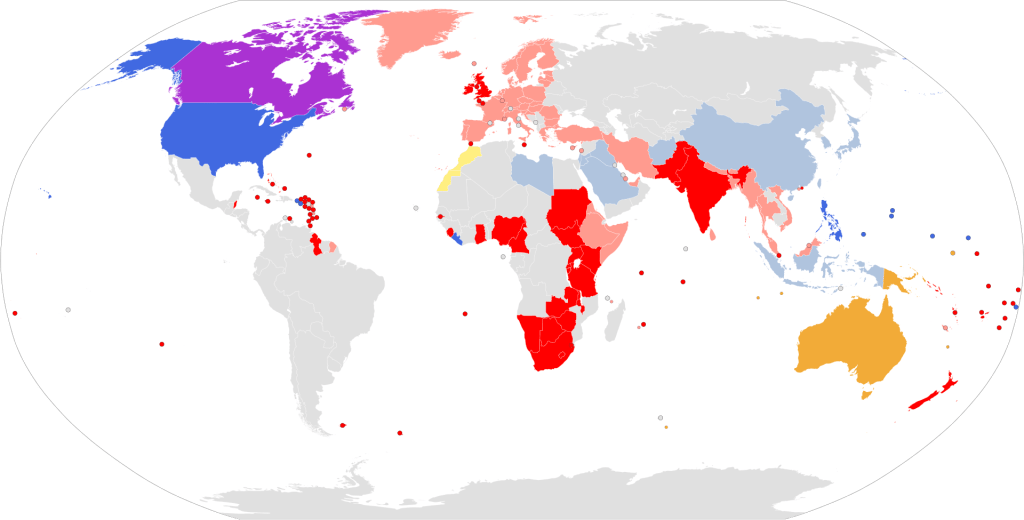
British (red) and US (blue) spelling of the English language.

The current spelling differences between US and British variants come from dictionary initiatives. English is, famously, a language without an institution in charge of standardising and leading change, unlike neighbouring ones like Spanish and French. In the US, a few decades after its independence, the Webster dictionary (1828) got established as the leading reference for spellings and introduced the simplification of words that used to be written with OU and were shortened to O, like color and neighbor. Z replaced S in many endings of words, like analyze and customize, because of Greek roots and is more phonetic. LL was reduced to L in words like metallic and modelling. Meanwhile, British English kept following Johnson’s A Dictionary of the English Language (1755).

Finally, an intriguing attempt at spelling rationalisation came in the saga of the “simplified spelling” movement for US English. The notion here was to scrub English of silent letters and irregular vowel pronunciations, so that have would become hav in a simplified written language. Leading the charge was Melville Dewey, creator of the Dewey Decimal System (oh, you do not know about it? You can guess why, another triumph of standardisation). Melville hilariously demonstrated his commitment to the cause of “simplified spelling” by legally changing his name to Melvil Dui. Dui got his funding from a wealthy donor by 1905, and simplified spelling won support at one point from President Teddy Roosevelt, who tried to instaurate it as the governmental spelling through an executive order. It did not work. The wealthy donor pulled his funding by 1915 with a poignantly spelled note: “I hav been patient long enuf.”

Nevertheless, however easy English is—because of its emergence from a combination of mainly three different linguistic backgrounds—, and however difficult it is—because of the standardisation of it in written form before the Great Vowel Shift and two slightly different standards—, English has become the first natural language to be the dominant and almost universal language of the World. The default cannon, the standard way of communication, the accepted-upon general channel of exchange, the platform upon which to create the connections between different places and peoples of the planet.

English, now, is a truly global codex that, for the first time, has reached and is reaching all aspects of life all around the planet in a way that no other language has ever done on such a scale, depth and speed. A natural language that, like any other language, has adapted, evolved, shifted, transformed, grown, reached new frontiers because of the necessities demanded by its new global role and new global users.

Notwithstanding, the global reach of English and the Anglo-Saxon culture behind it, its dominance happened simply because it has been an opportunistic being that has piggybacked on the extreme connectivity that the planet has taken, starting with the shipping revolution.

Like with Austronesian, the maritime revolution brought a handful of languages to dominate specific locations. But unlike previous connectivity expansion, the new aeronautical and computational revolutions have placed English as the unique global channel of communication.

History could have provided a different outcome, where, like the scientific world before WWII, global communication was shared by a handful of languages. If, like naval powers, different cultures and states reached a similar technological point at a similar rate, other languages might be sitting together for global communication. For example, in aviation the French had an early start with plane-making, and by WWII Germans and Italians had quite advanced military development on planes. Similarly, Polish and German scientists and technicians had early advances in computation, and the USSR and Japan could have invested more in electronics, software development and computation, but never got around to that. It is conceivable that another order could have happened in which a part of the planet rejected the English standard. In fact, that can be partially seen in countries like North Korea, where they firmly reject anything that has hints of Western culture. But nevertheless, even North Korea follows the aviation and software defaults. For better or worse, English stands as a giant alone in the human world.

For this text the fact is that, for now, there is a global acceptance for English to be the default language of communication. That fact, however it is, gives us a tool to address our question, with its usefulness and limits.

In a way, the question of “what humanity wants” can be asked because we, for the first time, can talk in the same language, and it has done so in a somehow passive way, like other standards such as timekeeping. There is not a chunk of the world that is disconnected from that acceptance of the default, there is no major iron curtain that keeps two or more disconnected systems. Since “humanity” has accepted this language, that has allowed English to permeate all the spheres needed for global communication.

Previous

Next
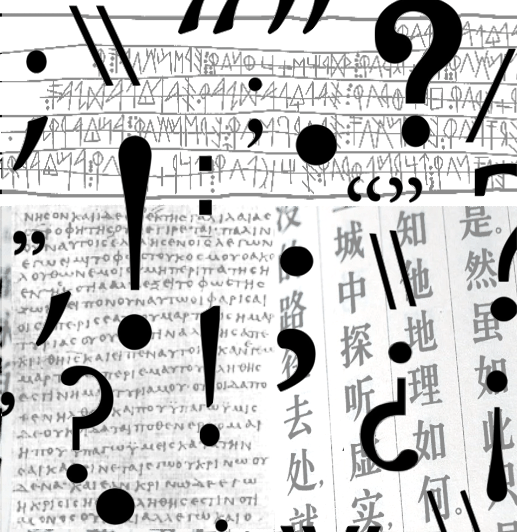
Oh!, punctuation

Oh, one more, just one more before we go to the infamous Metric System!

What are we reading now? Yeah, text. But how is it written? It is English using the Latin alphabet (more on that later), but the point I am making is this .

That space between the . and the ‘this’ is not by chance, it is punctuation, which has grown to be another quasi-universal standard, a bit earlier than mathematical and music notation.

Punctuation, from Latin punctum (dot) — the dashes, squiggles, dots and spaces you are reading now — is so normalised that I barely noticed it until I started this project. Yet it is one of the “global standards” in writing beyond a specific alphabet, quite like algebraic signs are virtually universal among numerical systems beyond the Arabic numbers.

For most of human literary history, texts in many alphabets looked more like this: scripturacontinuawheretherewerenospacebreaksorparagraphs — a long, breathless string of letters rolling inexorably forward. And they still look like this if you are reading Javanese: ꦱꦧꦼꦤ꧀ꦮꦺꦴꦁ ꦏꦭꦲꦶꦂꦫꦏꦺꦏꦟ꧀ꦛꦶꦩꦂꦢꦶꦏꦭꦤ꧀ꦢꦂꦧꦺꦩꦂꦠꦧꦠ꧀ꦭꦤ꧀ꦲꦏ꧀ꦲꦏ꧀ꦏꦁ ꦥꦝ꧉. Here, the way the words themselves are written together, the ups and downs, does indicate a cadence in the reading.

Japanese kanji and Chinese ideograms are still traditionally written without spaces, as each sign, or pair of signs, represents a concept, but modern writing in these systems does tend to use spaces and punctuation, like , (comma) and 。(period).

In fact, the division of words into discrete units of text is kind of artificial, because spoken language does not work like that. It is hard to notice, but when we talk we kind of talk in a scriptio continua, or more aptly, talkacontinua.

Notice next time you talk: we do not add little pauses between words. In written terms: we. Do. Not. Speak. Like. This. And, honestly, that would be a bit of a waste of time.

Our brains have evolved to process around 10 phonemes per second, irrespective of how many words are in there. So we hear them all at once. The record of most phonemes pronounced and understood in one second stands at 23 (depending how one counts phonemes).

That is equivalent to this sentence.

Talked and understood.

In one second.

In Latin, writing without punctuation and spaces was known as scriptio continua. It was common in most ancient scripts, including hieroglyphs, cuneiform, Chinese ideograms, Tibetan, Sanskrit, and even the Maya glyphs — maybe with the exception of Old Uigur/Mongol scripts, which connect the phonemes of each word by a vertical twig-like line, thus separating words if the lines were not connected.

Thus, from the scriptio continua, writing in the pre-printing press world was not simply to store knowledge and pass it on as text. No, the purpose of writing was to assist the performance of the text — kind of like the prompter notes that theatre players use to help deliver the lines. Early texts were supports for the oral tradition, not replacements for it.

Text just travelled as a kind of parasite of the much more popular and extensive oral tradition. Literary text was mostly a device helping with memorisation, which was the core of the whole cultural transmission. And the oral performance was a skill to be kept, practised, valued, specialised and perfected.

The text on papyrus and tablets, in most of the cases, is the equivalent of prompters from the ancient world. Thus punctuation was neither necessary nor standard. Why mark pauses when the pauses already existed in the bodies and memories of the performers?

Reading was not a silent, private act; for most of human history, storytelling has been a performance, usually given by trained bards and poets.

Even today, many cultures which were until recently purely oral in nature, or still are, value immensely the individuals in their group who do keep these oral traditions alive. The more songs and stories you remember, the more appreciated you are and the higher status you have.

Moreover, there are many cases of individuals who, due to old age or life events, have lost sight. Some of these might specialise in oral storytelling and poetry, making them really valued members of their society, despite the difficulties that not having sight might otherwise entail.

The divisions in sentences, the pacing, the pauses — all of that lived in the voice, not on the page. The written text was a mnemonic scaffold, a reminder of what you had already memorised, or at least heard performed professionally. If you were not trained in the piece, staring at lines of continuous text was like, after an all-nighter, being put at a blackboard in front of a class to do complex arithmetic — the kind professor would kindly put you to sit and make you listen instead.

Night-bed reading, as much as many of us love it, is a rather rare and recent tradition.

Again, the classical Greek texts had some visual guidance that can be interpreted as early punctuation.

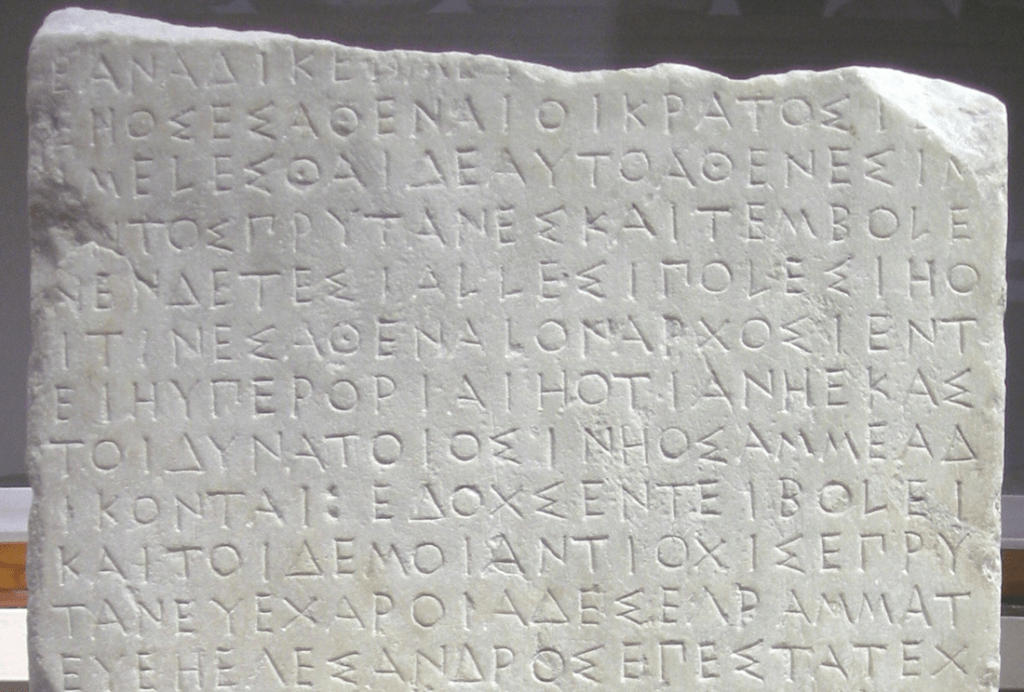
By the 3rd century BCE, reportedly, Aristophanes of Byzantium introduced a system of dots at different heights — low, middle, high — to represent different lengths of pause. It was not quite “.” “;” “:” yet. The Greeks also experimented with marginal marks, paragraph dividers, and diacritical hints.

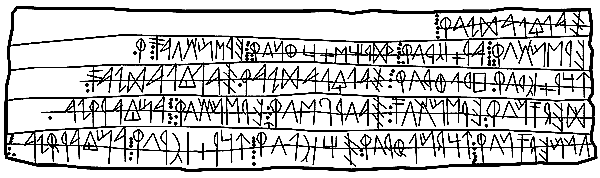
Iberian, a different ancient script from the region I am from, Valencia, also has in most instances several dots as separation between words.

example of Iberian script with punctuation and supporting writing lines

In my childhood, I observed these wiggly scripts, which many times seemed more out of the hand of a child than a neatly curated Latin text that we see all around us in print, or even in the old Latin scripts that will be nearby in a museum or exhibition.

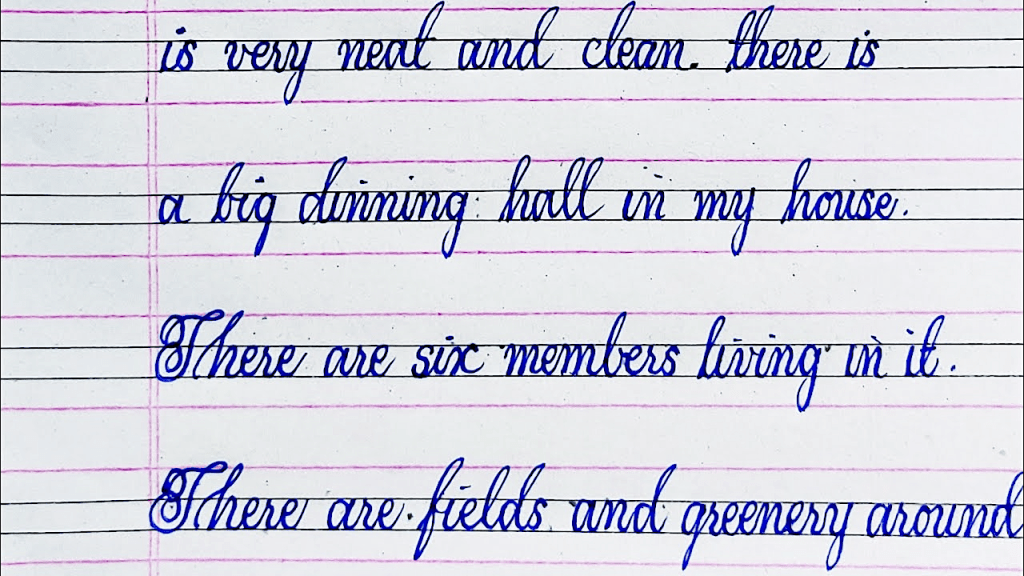
In my child-mind, I considered the need for dots in these Iberian scripts to arise naturally due to the seemingly chaotic nature of the writing itself, in contrast to the well-arranged ones, that needed only a clear space. The letters in the above example (read right to left) are uneven. Many of the texts often needed horizontal lines to arrange them, the same way that we children were taught to write between straight lines at different levels. Thus, neat writing handled by experts and people familiar with recitation did not need the ‘wasteful’ separation of spaces, while writing by people (or children) where writing was practised more sparsely used punctuation more often, albeit not overly standardised. In the case of Iberian script itself, only a few thousand rather short texts survive, despite this cultural group extending over hundreds of well-studied settlements, and the script itself being in use for 400 to 600 years.

Example of a cursive continuous writing typical of children in a patterned notebook

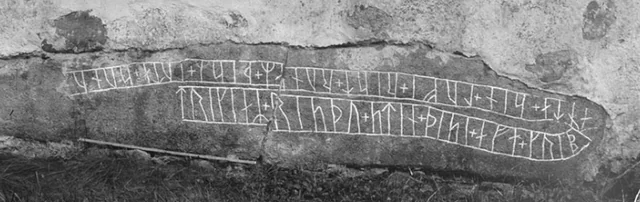
The later Runic scripts — which incidentally look similar to Iberian — are also short texts, often wiggly and fitted inside guidance lines. Also, only a few thousand runic texts still remain. These, like Iberian texts, commonly have ways of separating words and sentences, like dots, lines, crosses, or sections of a serpent!

Example of runic text, with word divisions by + and lines encasing the letters

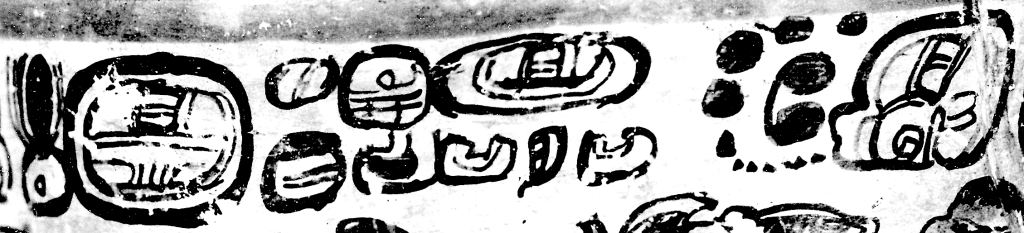
Moreover, in Maya texts decorating ceramic vessels, we find one or two thick lines or two or more vertically arranged dots or circles, sometimes with small fiddling fillers added, indicating the end of sentences. These ceramic texts often were, we can say, more amateurish, less elegant and “space-conscious” than the palace walls or surviving codices — a bit like the wiggly Runic and Iberian scripts.

maya script showing a cluster of black dots denoting an end of a stucture/sentence

Another clear example of how text was just auxiliary to recitation is the vast genre of didactic poetry.

Humans are quite good at remembering songs and poetry, especially when held under a predictable metric and rhyme. Since in the past text was not ubiquitous as now, people had to memorise most of the important content they needed for technical and theoretical knowledge as rhythmic songs that they would recite. Potions, medications, how to plough a field, how to seduce someone, history, geography, the origin of the universe, atomism, to name a few — all these things were carefully adapted to poetic form once widely used so people could access the memories stored as songs and recitations at the tip of their tongue, when smartphones and Wikipedia were not an option. Or imagine how a pub quiz would be if people started reciting the names of rivers in rhymes to crack an extra few points remembering the fifth longest river of the state. Or the pharmacist recited some poetry to make sure that the medications you are taking are not incompatible with each other.

Interestingly, one of the most influential texts in history, the Qurʾān, contains much of this didactic format. It has a kind of scriptio continua, called rasm. Until 1924 CE, when the Azhar Qurʾān, or Cairo edition (1343 AH), was printed, most, if not all, texts of the Qurʾān were written in a kind of skeletal text containing mainly the consonant pronunciation of the words in the Arabic alphabet, and without the standardised punctuation nor things like ! ? and diacritics.

The Cairo edition now is the most widespread Qurʾānic version. By 1343 AH there were 14 different standardised ‘recitations’ of the Qurʾān, that is, how to read the scriptures orally. The differences are subtle, but a pause can be different, and we know that in punctuation a point or a comma might be critical, so more importantly, the differences are contextually equivalent. The rasm itself was quite homogeneous, though different versions also existed, and the Cairo one chose al-rasm al-ʿuṯmānī as the orthography of the Qurʾān, that version being the shortest one.

As we have seen for the case of musical notation, originally, much of the written text was used as a mnemonic device to help with public recitation, not to read by the bed.

The Qurʾān was mostly intended for that use, as a recitation. In fact the word Qurʾān means ‘he read’ or ‘recited’, clearly spelling the intention of the text to be recited and read aloud. The act of reading the Qurʾān in the original Arabic has been made into an art. Many of the verses and surahs, or sections, have quite a poetic reading to them, and when travelling in Muslim countries it is quite melodic to hear imams reciting parts of the Qurʾān, or the muezzin doing the call for prayer, adhan, in the original Arabic. These rich, art-like forms of oral recitation might explain the long time until it was accepted that the Qurʾān could be printed, because many Muslim clerics initially refused the verses to be ‘soiled’ by a typographic technique.

What the Qurʾān exemplifies beautifully is this long-lived tradition of textual to recited mapping, where text and oral tradition cohabit the same space for centuries, and even such an important text as the Qurʾān was only printed in an accessible reading way accepted by a Muslim authority by 1924 CE, or 1343 years after Hijri.

Beyond the Afro-Eurasia context, Mayas, again in ceramic paintings, also compressed text in such a way that was just the skeletal support of well-known recitatory formulas. These were so standardised and well known that not all elements had to be written. So, like in the “old world” textual traditions, knowledgeable readers simply knew missing parts by heart. In fact, in Maya scripts, the quotative chehen “so they say” basically is saying that the text was conventionally recited, not unlike the Qurʾān.

On the non-Arab, post-Latin European geographies, the discontinuation of many of the philosophical and academic schools existing in the western side of the Roman Empire quickly fell out of fashion due to a multimodal impact of shocks: wars, economic collapse, fragmentation of networks, migration, substitution of the political powers by the “barbarian” populations which generally valued less such cultural traditions, the famine after the volcanic winter of 536, the consequent Justinian pandemic from 541 to 548, and recursive waves. That continuous conflict, famine, and pestilence ruralised much of the urban centres in that side of the world.

Moreover, a kind of “cultural inquisition” by the hands of a more militant branch of Catholic bishops that dismantled institutions linked to ‘pagan’ knowledge, or not emerging from Christian faith, erased much of the previous recitatory practices and transmission of many of the non-Christian texts. This combination of effects made the common parallel co-transmission of scriptio continua and recitation much rarer, especially in the western, or Latin, part of the previous Roman Empire lands.

The inheriting kingdoms and lands, thus, had a much smaller and scattered pool of experts to pass on how to actually read texts. In this environment, people scarcely or never listened to recited texts beyond clerical ones. Thus, when accessing a bloctextofscripturacontinua could be a challenging task for non-initiates without the oral form.

With fewer professional reciters, fewer schools, and fewer trained scholars circulating texts, the ability to “just know” where the pauses and cadences in the scriptio continua were was becoming rarer and rarer. A bit like the Iberian texts, which were quite rare too. This is when Isidore of Seville (560–636 CE), born in Iberia around half a millennium after the Iberian script lost its use, strongly pushed for punctuation standardisation, which many adopted.

By the 7th century, scribes in Ireland were adding more systematic spacing, word division, and symbols to ease public reading. The so-called punctus elevatus, punctus interrogativus, and other medieval marks begin to appear.

The rise of punctuation might be more a story of necessity born from the fading of oral memory, not unlike the rise of emoticons is a necessity born from the need to communicate casual information textually while face-to-face, and even telephonic interaction is fading.

Among the medieval innovations was something resembling our modern question mark. Originally a kind of elevated squiggle or stylised semicolon, it served to mark an interrogative tone in Scripture, telling the reader: here, please raise your voice before the congregation in a questioning way.

Medieval scribal marks were not invented for grammar as we understand it today — they were needed to assist performance in a performance-scarce world. They guided breath, rhythm, emphasis, and tone to the uninitiated. It was a more sophisticated prompting which might need less rehearsal, or initially avoid the need to hear it being recited before performing it. In this way the text can more easily travel by itself, without the need to be accompanied by a person who knew how to properly recite it, not unlike the musical notation that we have seen.

Printing press, killer of recitation

Here is where we introduce the printing press. Not so much revolutionary because it allowed cheaper copies of text to travel further and reach more people, but because it did for punctuation what the metric system later did for measurement: standardisation. Once texts could be mass-produced at a speed far exceeding the capacity to mass-produce and spread reciters, writing needed to be self-sufficient. The recitative transmission could not keep up with the changes, and punctuation was needed to ease rapid access for naïve audiences of new texts.

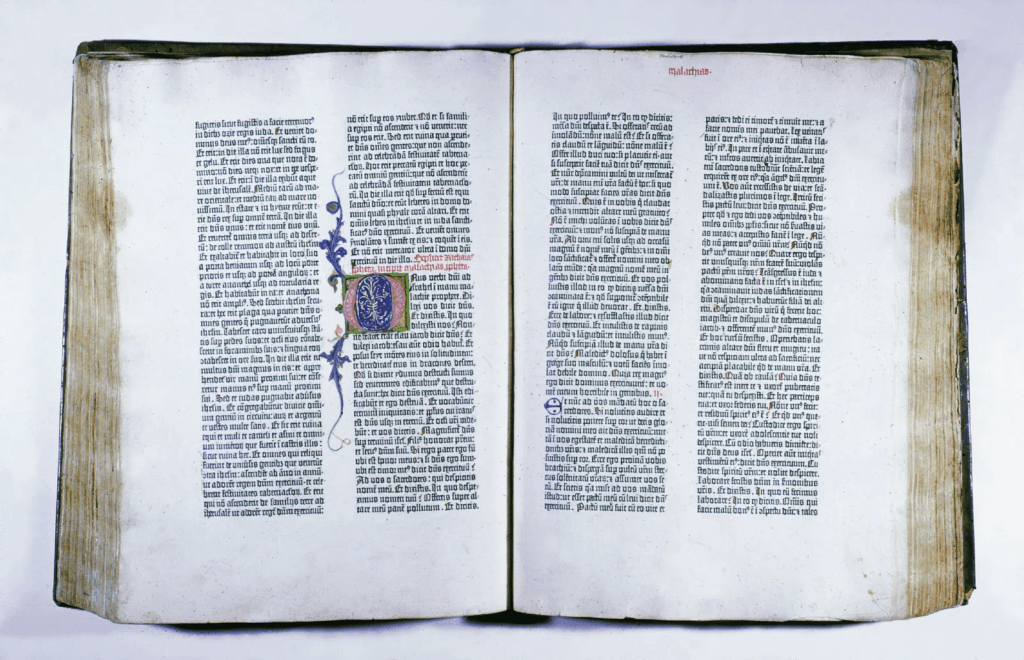
Punctuation became a technology for comprehension. The Guenberg Bible, looks kinda the scripturacontinua, but does have different punctuation signs and rules. Punctuation will be standardised later. Early presses, like the Venetian Aldine, popularised many of the marks — the comma, semicolon, full stop — in recognisable modern forms. The Aldine press also popularised modern formats of books, in portable “paperback-like” sizes.

Silent reading expanded, literacy without reciters first became affordable, accessible, and then widespread. In the process punctuation became a more standardised system across Europe.

Meanwhile, Arabic used spacing, diacritics, and occasional marks, but not the panoply of Western punctuation.

Outside Europe, South Asian scripts like Devanagari developed marks like the danda (।), but did not have Western equivalents until modernity.

With global printing, colonial administration, missionary presses, and later digital technology, many systems adopted Western punctuation by the 19th–20th centuries: the full stop, comma, question mark, and brackets appear regularly in Mandarin, Korean, Japanese, and Hindi texts today, even alongside entirely different scripts.

So Western punctuation is now nearly universal, though local variations and older indigenous traditions still coexist.

Interestingly, such standardisation emerged and consolidated at the same time as the mathematical and musical one, from XV to XIXc, also the same period of Western domination that we have covered.

Beyond the imperial apparatus, what these standardisations and universalisation show is the need and desire for ways to capture as accurately as possible form and meaning by increasing affordability of the form. These forms (music, accounting/science, recitation) where more accessible and circulated faster by reducing the need to have face to face interaction and transmission of knowledge and information.

While person to person interaction might produce, at first, more nuanced transmission, once the distances to travel, and the ease to copy, made other formats much more abundant than training and shipping living beings, then these dominated, and where even adopted in most of cultures of the world in one way or another.

Once you have trained people on the same codes at different parts of the planet, you do not need to send more trainees, just mroe coding to be processed. Sending a computer code is easier and cheaper than sending the whole computer over, even if you are more warranted that the code will work more accurately in the original computer, or a close reproduction of it. Paper is cheaper than people, if you have people on the other end to read the same signs, send the printed thing, not the person.

The Emoji Epiloge

And just as mass literacy once strained writing’s ability to convey tone, modern digital short-form writing strains it again. Text messages, tweets, and emails lack intonation, facial expression, and gesture — the very things punctuation once tried to restore.

So, almost inevitably, a new form of punctuation emerged: emoticons and emoji.

They compress emotion, tone, irony, and doubt into tiny digital glyphs — modern versions of breath marks, pauses, or rhetorical flourishes. In a way, they represent a second separation of textual and oral traditions: the written is now so independent of the spoken that we need new symbols to compensate for the loss of nuance.

Interestingly, emojis come out of combinations of signs that were not intended as emotional significance, but as grammatical expressions, such as the :), being just a left parenthesis and two dots.

Piggybacking in the interconnected world, many of these emojis emerged across the world, notably Japan, but are standardised as modern glyphs in the US.

Nevertheless, in a short time, emojis have emerged as a new global standard that permeates all the world.

🤔

Previous

Next